Best OneTrust Alternatives (2026): 10 Options Reviewed by Buyer Fit

Osman Husain
OneTrust raised its minimum annual contract to $10,000, but pricing is only one reason teams are migrating. Other frustrations include multi-month implementation, a complex user interface, and hard-to-reach customer support.
What's more, most mid-market teams don't need a full OneTrust GRC suite. They need cookie consent management, Google Consent Mode v2, and, in some cases, DSAR workflows. Our OneTrust review covers the platform's capability in depth.
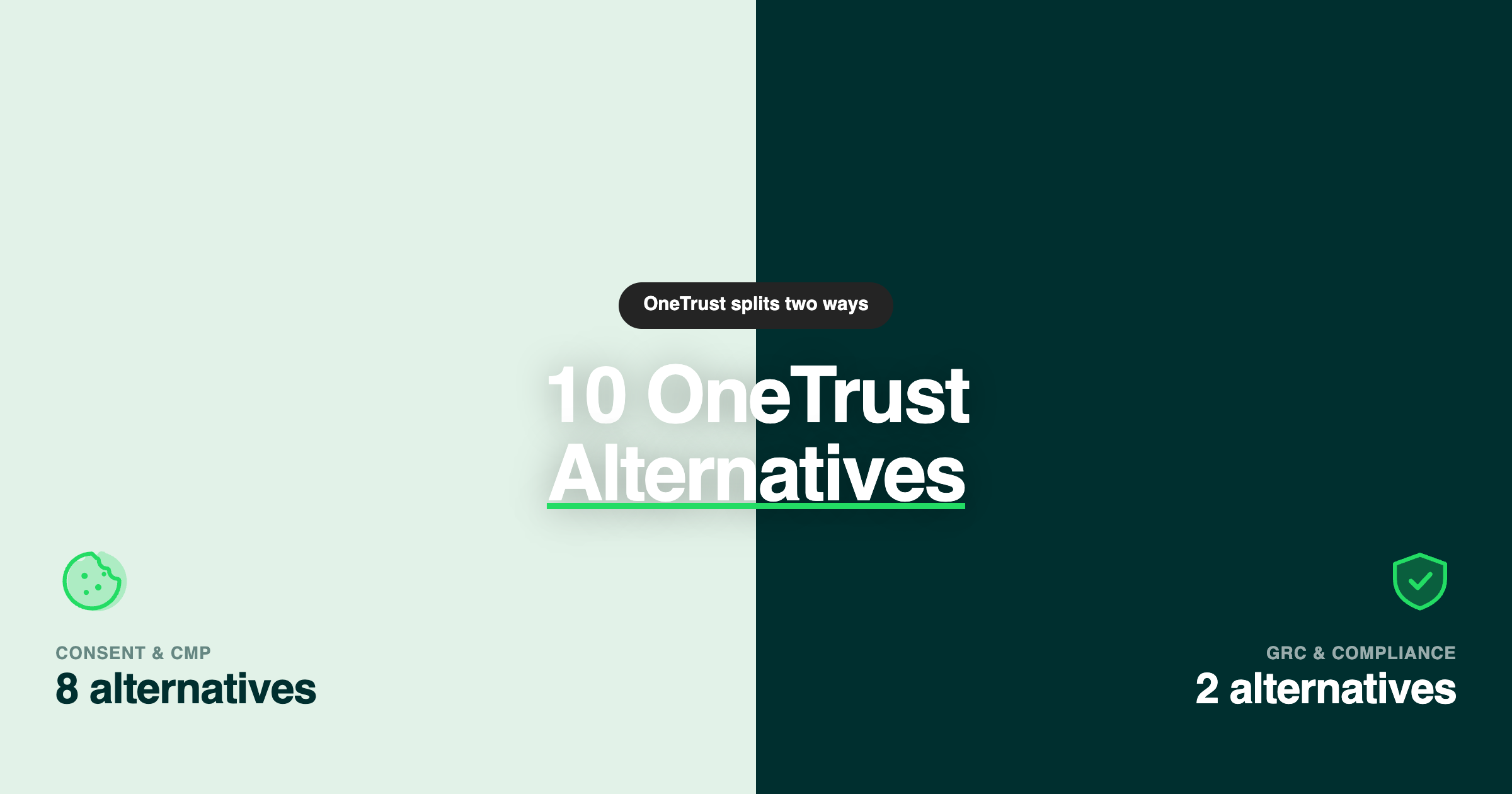
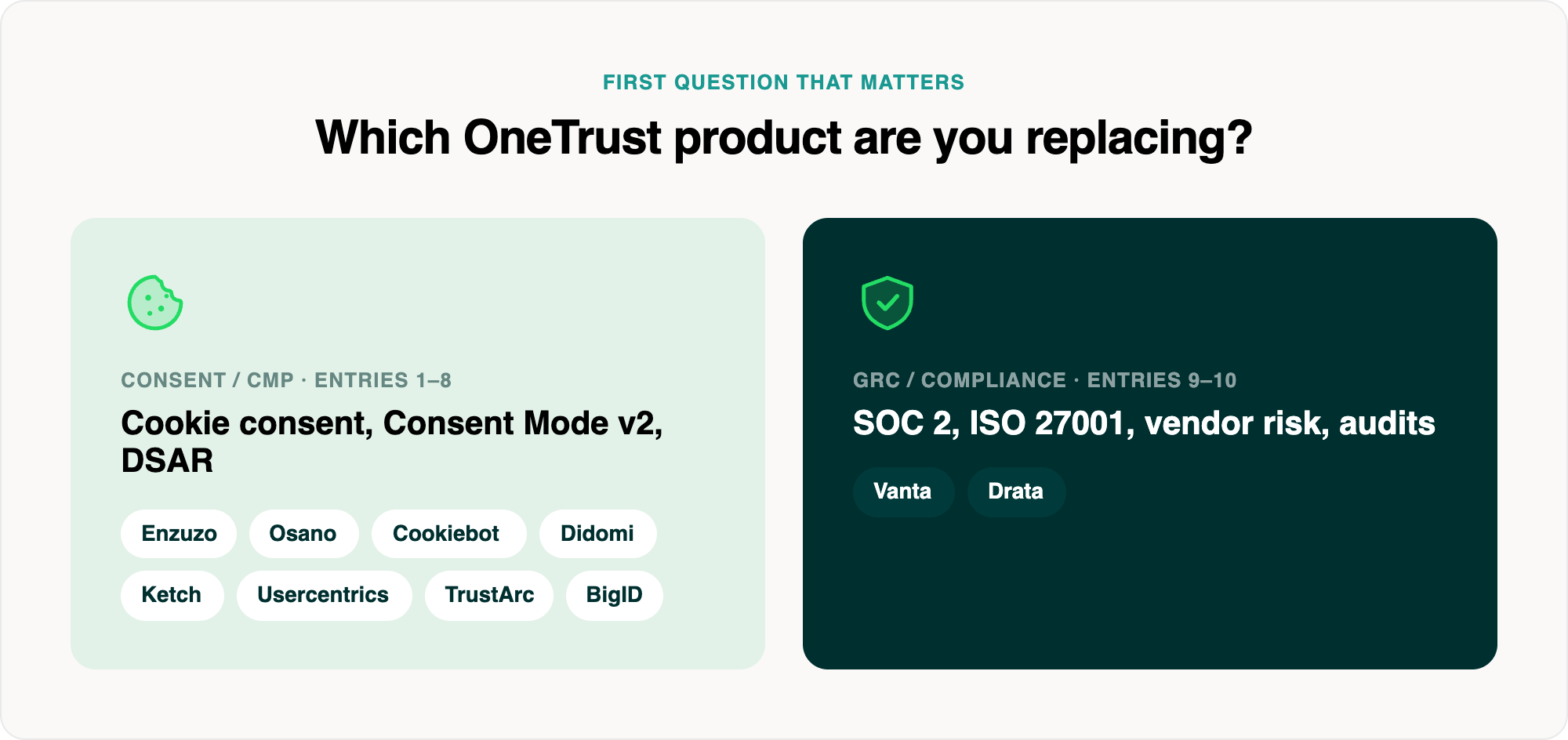
This article covers the ten strongest alternatives across two buyer types: teams evaluating cookie consent management and Google Consent Mode v2 compliance, and teams replacing a broader enterprise privacy program covering GRC and more.
OneTrust alternatives at a glance
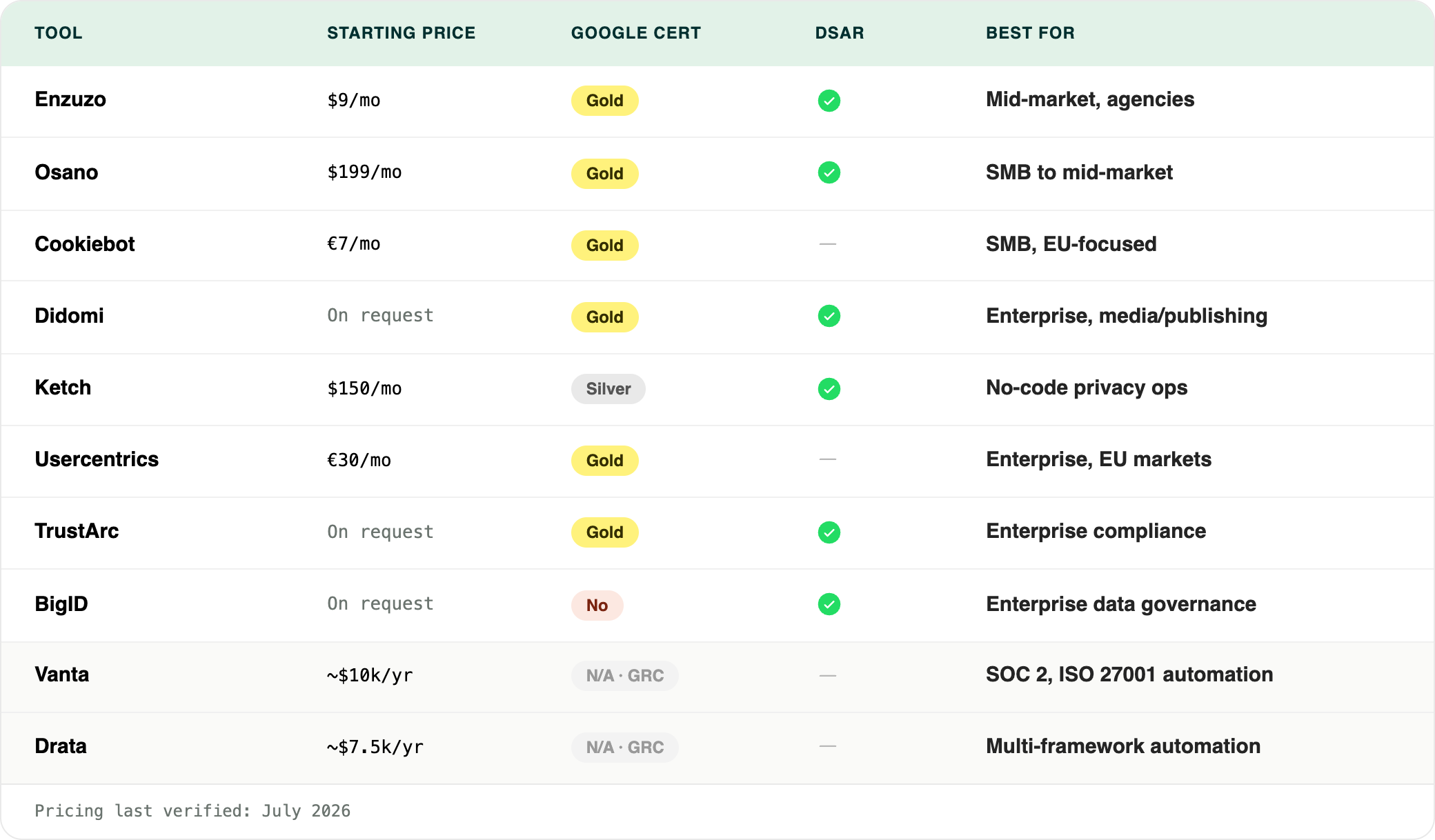
For mid-market consent management, the best OneTrust alternatives are Enzuzo (flat pricing across 10 domains, from $9/month), Osano (compliance guarantee), and Cookiebot (EU-focused, from €7/month). For enterprise programs, Didomi, TrustArc, and BigID are your top picks. For GRC and compliance automation, Vanta and Drata replace OneTrust's Tech Risk side.
| Tool | Starting price | Best for | Key limitation |
| Enzuzo | $9/mo self-serve; $300/mo mid-market | Mid-market teams, agencies | No data mapping, DPIA, or RoPA |
| Osano | $199/mo (30,000 visitors) | SMB to mid-market | Advanced plan pricing requires a sales call |
| Cookiebot | €7/mo entry; €15–30/domain typical | SMB, EU-focused compliance | Costs compound per domain and subpage count |
| Didomi | Pricing on request | Enterprise, media/publishing | Enterprise scope; oversized for smaller teams |
| Ketch | $150/mo Starter; $499/mo Plus | Mid-market, no-code privacy ops | Integration library gated to the $499 Plus tier |
| Usercentrics | €30/mo (15,000 sessions) | Enterprise, European markets | Session-based costs climb with traffic |
| TrustArc | Pricing on request | Enterprise compliance | Pricing in OneTrust's range; not a cost play |
| BigID | Pricing on request | Enterprise data governance + consent | Enterprise-only; no Google CMP certification |
| Vanta | $10,000/year | Compliance automation (SOC 2, ISO 27001) | No consent management at all |
| Drata | $7,500–15,000/year | Compliance automation, multi-framework | No consent management at all |
OneTrust consent management and privacy ops alternatives
These are our top alternatives to consider:
1. Enzuzo: best for mid-market teams
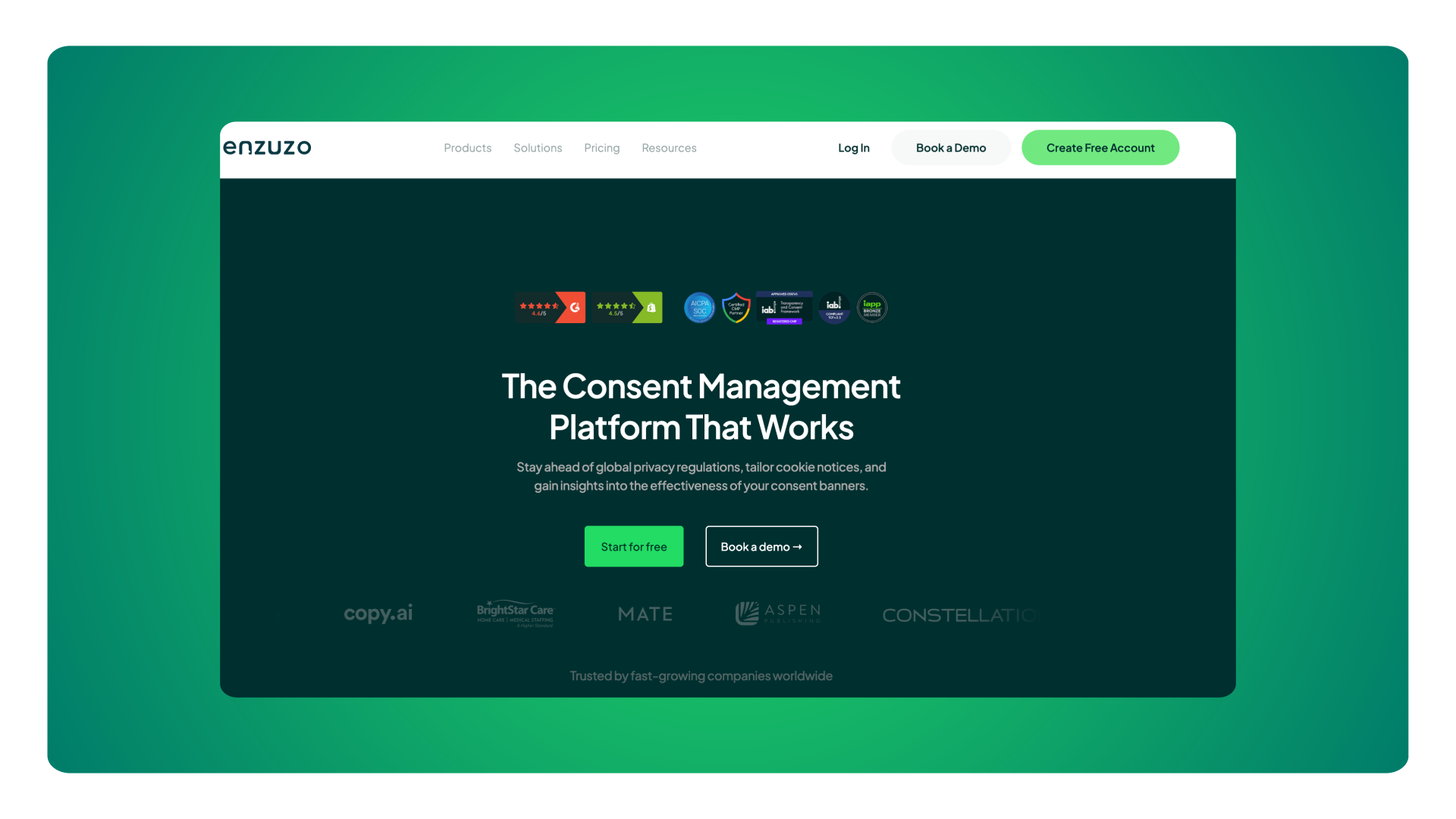
Enzuzo's consent management platform is Google CMP Gold-certified and built for marketing and IT teams at companies that OneTrust's 2026 minimum ACV of $10,000 has priced out of the market.
Most teams switching from OneTrust are paying for data mapping, vendor risk management, ESG reporting, and AI governance modules they never use. Enzuzo covers the three capabilities teams actually need: cookie consent, Google Consent Mode v2, and DSAR management. Setup is measured in hours, not months.
Reasons teams choose Enzuzo over OneTrust:
- Flat-rate, predictable pricing. The Pro plan covers 10 domains for $79/month (or $59/month billed annually). Mid-market teams needing higher traffic capacity start at $300/month for up to 250,000 monthly visitors across 10 domains. Every competitor on this list charges per domain or per session, which compounds quickly at scale. See Enzuzo's full pricing.
- DSAR management included. Enzuzo includes a built-in DSAR intake form and automated response workflow on paid plans. It is designed for teams managing requests through standard web forms.
- Google Gold CMP certification with a half-day migration. Same certification tier as OneTrust. Teams switching from OneTrust report that migration takes an afternoon when OneTrust was deployed via GTM as the new script replaces the existing one in the same container. No professional services, no multi-month implementation, no onboarding videos required.
- Human support with a dedicated onboarding channel. Enzuzo's enterprise plans include a dedicated Slack channel with a sub-24-hour response SLA. Assisted migration from OneTrust is also included, if requested by teams. The shared Slack channel handles onboarding, deployment questions, and ongoing compliance queries.

Where Enzuzo falls short:
- No data mapping, DPIA, or RoPA. Enzuzo does not include records of processing activities, data impact assessments, or data discovery modules. If your compliance program requires those capabilities alongside cookie consent, you will need a separate tool.
Enzuzo's banner configuration and admin panel is built for ease of use; for teams to manage without developer involvement. Geofencing, localization, banner design, and consent rules by jurisdiction are all configurable through the UI. The dashboard is designed for the person responsible for compliance, .
Best for: Marketing and IT teams at 50–500 person companies switching from OneTrust, with multi-domain setups or Google Consent Mode requirements.
Book a strategy call to explore your options; we'll audit your stack and give you a balanced view of your current program, even if it means looking elsewhere
2. Osano: best for teams expanding their compliance programs
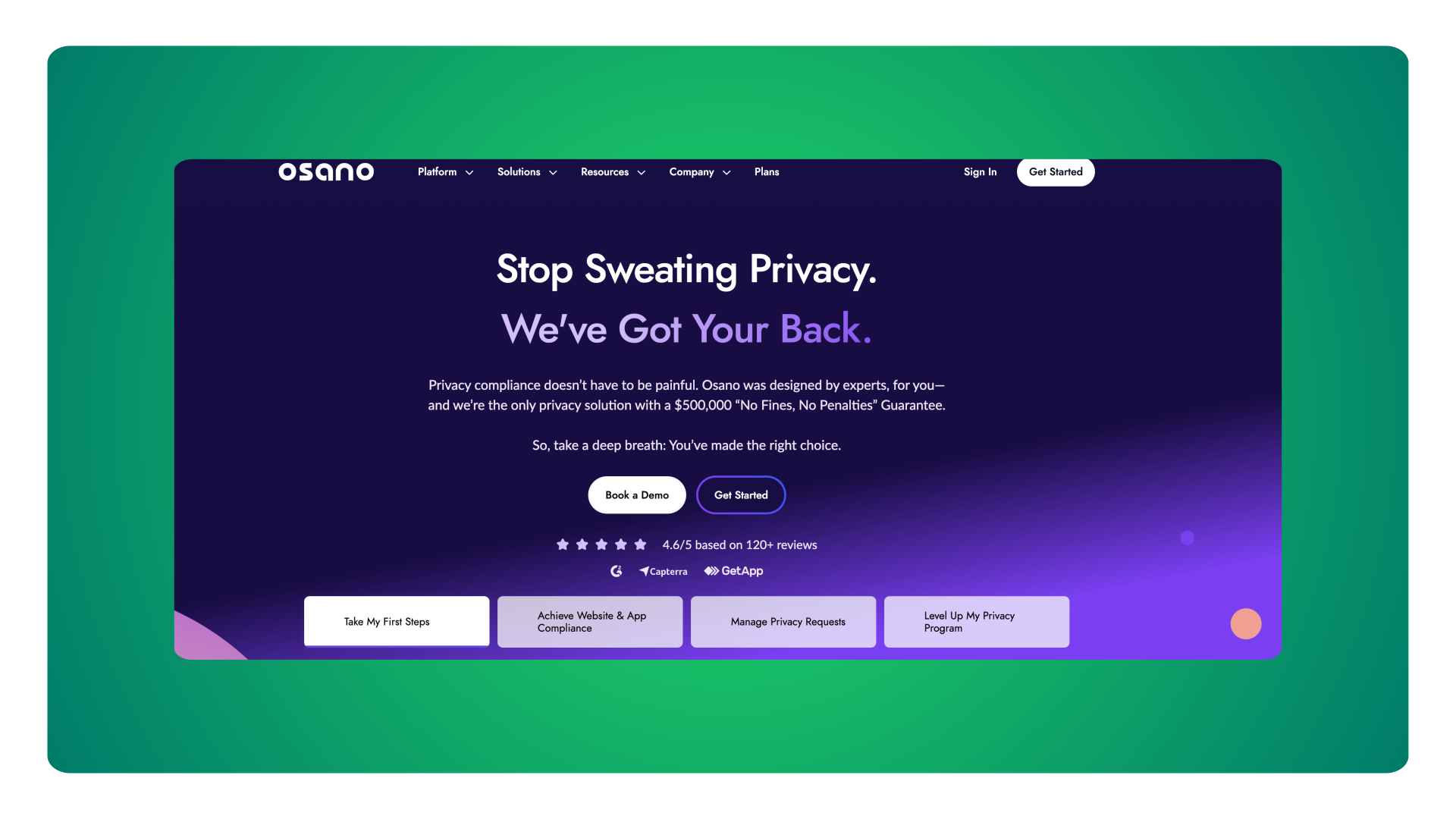
Osano is a data privacy platform built for SMB to mid-market teams that want straightforward privacy compliance with a contractual safety net. Its standout feature is a "No Fines, No Penalties" guarantee that covers regulatory fines incurred while using the platform.
Three reasons legal and compliance teams choose Osano over OneTrust:
- Contractual liability protection. The "No Fines, No Penalties" guarantee shifts regulatory risk from the buyer to the vendor.
- All-in-one compliance without GRC complexity. Osano combines cookie consent management, DSAR processing, vendor risk management, and data mapping in a single platform. It covers the privacy program needs of most SMB and mid-market teams without requiring a dedicated privacy engineer.
- Consent audit trails ready for inspection. The platform maintains detailed consent logs that legal teams can present during regulatory inspections without having to compile them manually.
Osano's interface is designed for non-technical buyers. Banner configuration, geofencing, DSAR intake, and vendor risk scoring are all accessible without developer involvement, which makes it easy for a plug-and-play solution.
Pricing: Cookie consent starts at $199 for a limited plan capped at 30,000 monthly visitors. Pricing for advanced plans requires a sales conversation with the Osano team.
Where Osano falls short: pricing beyond the $199 entry plan is not published, so budgeting for the full privacy program requires a sales cycle. On the product side, G2 reviewers note that cookie classification sometimes needs support intervention to fix, and report that useful reporting often means exporting CSVs rather than reading dashboards.
Best for: Legal and compliance-led buying teams at SMB to mid-market companies where contractual liability protection matters as much as feature depth.
Overview: Osano is the right choice when the compliance team, rather than IT, is driving the purchase, and the company is transitioning to a wider data governance and third-party risk management program.
3. Didomi: best for enterprise media and omnichannel consent
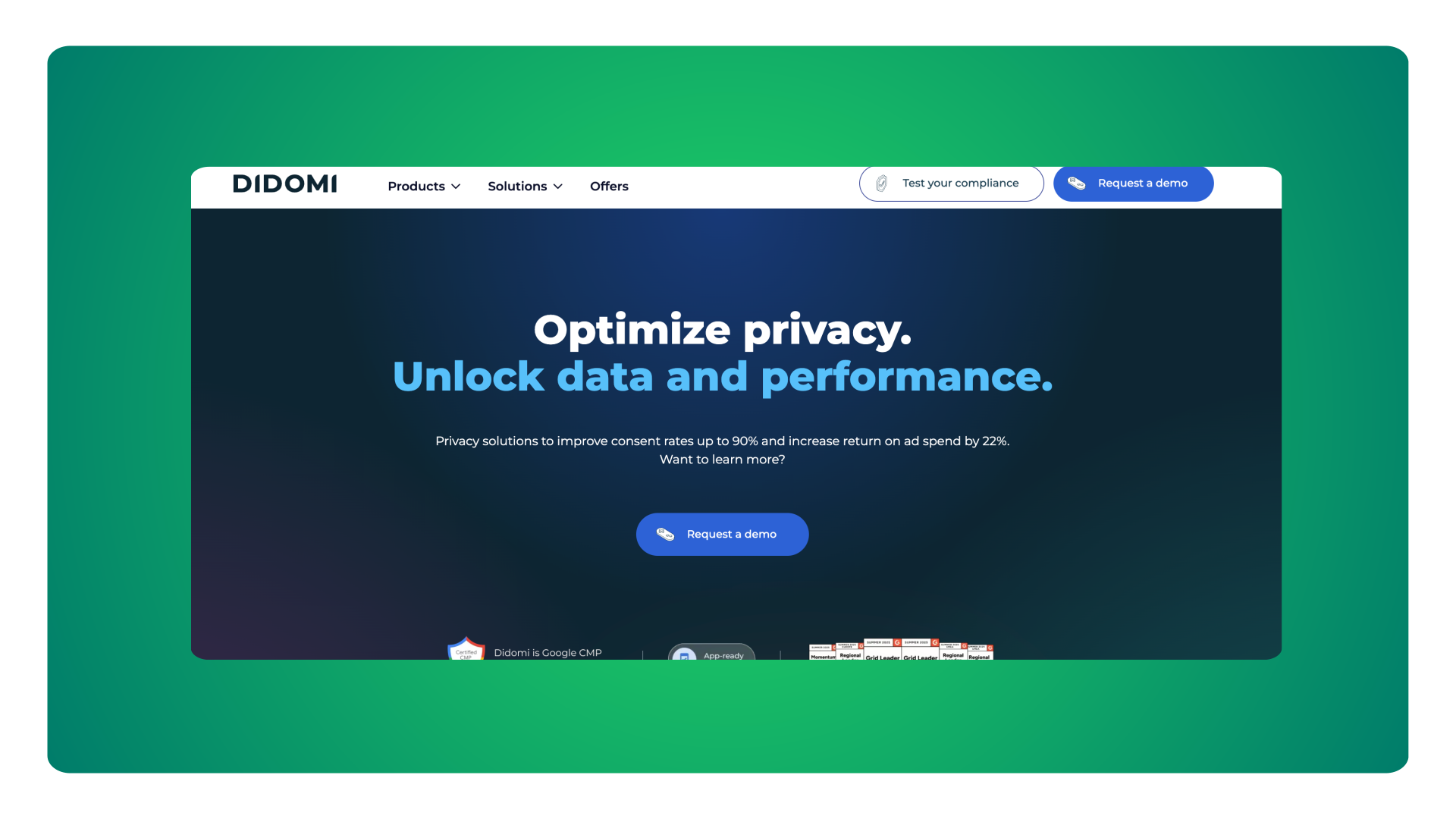
Didomi is a French enterprise CMP that expanded its U.S. presence after acquiring Sourcepoint in July 2025. The combined entity now operates across roughly 1,700 enterprise customers globally, making it a force to reckon with.
Didomi covers web, mobile app, in-app, and connected TV (OTT/CTV) consent from a single platform, which matters for media companies and publishers running consent across multiple surfaces simultaneously. Its preference management capabilities capture granular user choices across web, mobile, and other platforms, supporting first-party data strategies alongside regulatory compliance.
Three reasons enterprise teams evaluate Didomi over OneTrust:
- Omnichannel consent in one platform. Web, mobile, in-app, and CTV consent managed centrally. Few CMPs cover connected TV natively; for broadcasters and streaming platforms, this eliminates the need for separate consent infrastructure across surfaces.
- Post-Sourcepoint enterprise footprint. The Sourcepoint acquisition brought deep publisher and adtech compliance expertise into Didomi's platform, particularly vendor assessment and consent monetization for ad-supported properties.
- Google CMP Gold Partner with app-ready certification. Didomi holds Gold tier certification and is also certified as a Google app-ready CMP partner, covering mobile consent requirements alongside web.
Pricing: Not publicly listed. Enterprise-focused; requires a sales conversation. Didomi's own positioning acknowledges its scope "may exceed the needs of smaller companies looking for a basic solution."
Where Didomi falls short: the platform is genuinely enterprise-scoped; Didomi's own positioning acknowledges its scope "may exceed the needs of smaller companies looking for a basic solution." According to G2 reviewers, advanced configurations get complicated when managing many vendors and consent scenarios, and the platform's scripts can slow page response times, a real cost for the media sites it targets.
Best for: Enterprise media companies, publishers, broadcasters, and regulated industry teams in Europe and the U.S. that need a unified view across web, mobile, and connected TV.
4. Ketch: best for no-code integrations
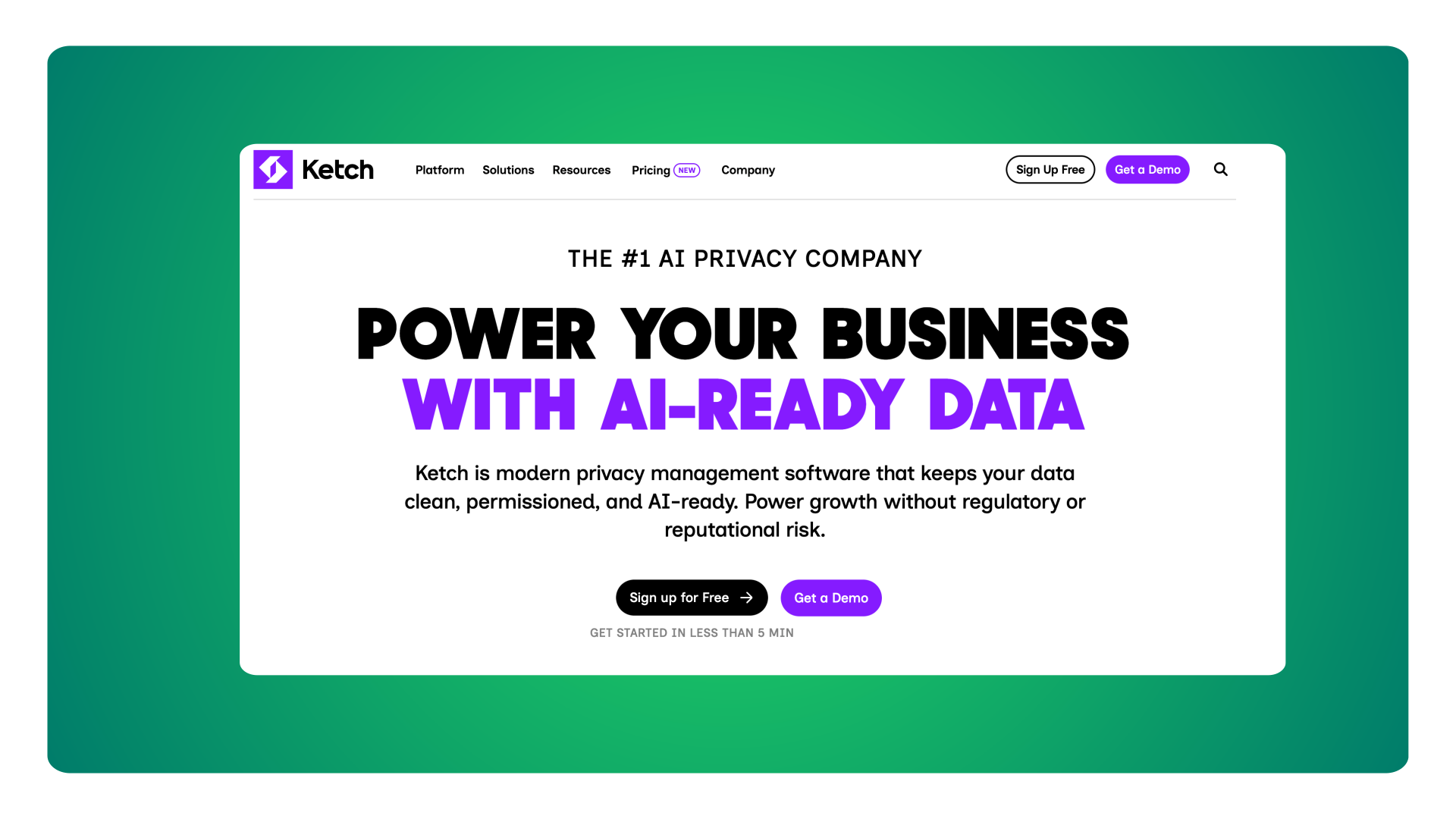
Ketch takes a "Privacy Infrastructure as Code" approach to consent management, using no-code workflows and over 1,000 pre-built integrations to automate consent collection, DSAR processing, and data mapping across an organization's full technology stack.
Its consent orchestration layer unifies user preferences and consent signals across websites, mobile apps, and SaaS platforms in a single interface, enforcing Global Privacy Control (GPC) preferences downstream in real time.
This makes Ketch a strong fit for teams with complex marketing stacks who need privacy compliance to work across multiple channels simultaneously.
Ketch is a Google Silver CMP partner and includes DSAR automation, identity resolution, policy management, preference centers, and visual data mapping tools that do not require technical expertise to configure.
Pricing (verified July 2026): a free plan covers up to 5,000 users/month. The Starter plan is $150/month for up to 30,000 users/month with consent management, two integrations, and email support. The Plus plan, the tier most OneTrust switchers land on, starts at $499/month billed annually for up to 100,000 users/month and unlocks the 1,000+ integration library. Enterprise pricing is based on data volume, integrations, and support level.
Where Ketch falls short: the integration library that is its main selling point sits behind the $499/month tier, and Consent Mode certification is Silver, rather than Gold. G2 reviewers also describe a real learning curve, with banner styling and UI fine-tuning often requiring more involvement than advertised.
Best for: Mid-market teams with a complex MarTech stack (CRMs, CDPs, ad platforms) that need consent and DSAR to work across all of them without custom development.
Go deeper in our comparison of OneTrust vs Ketch.
5. Cookiebot: best for EU-focused compliance
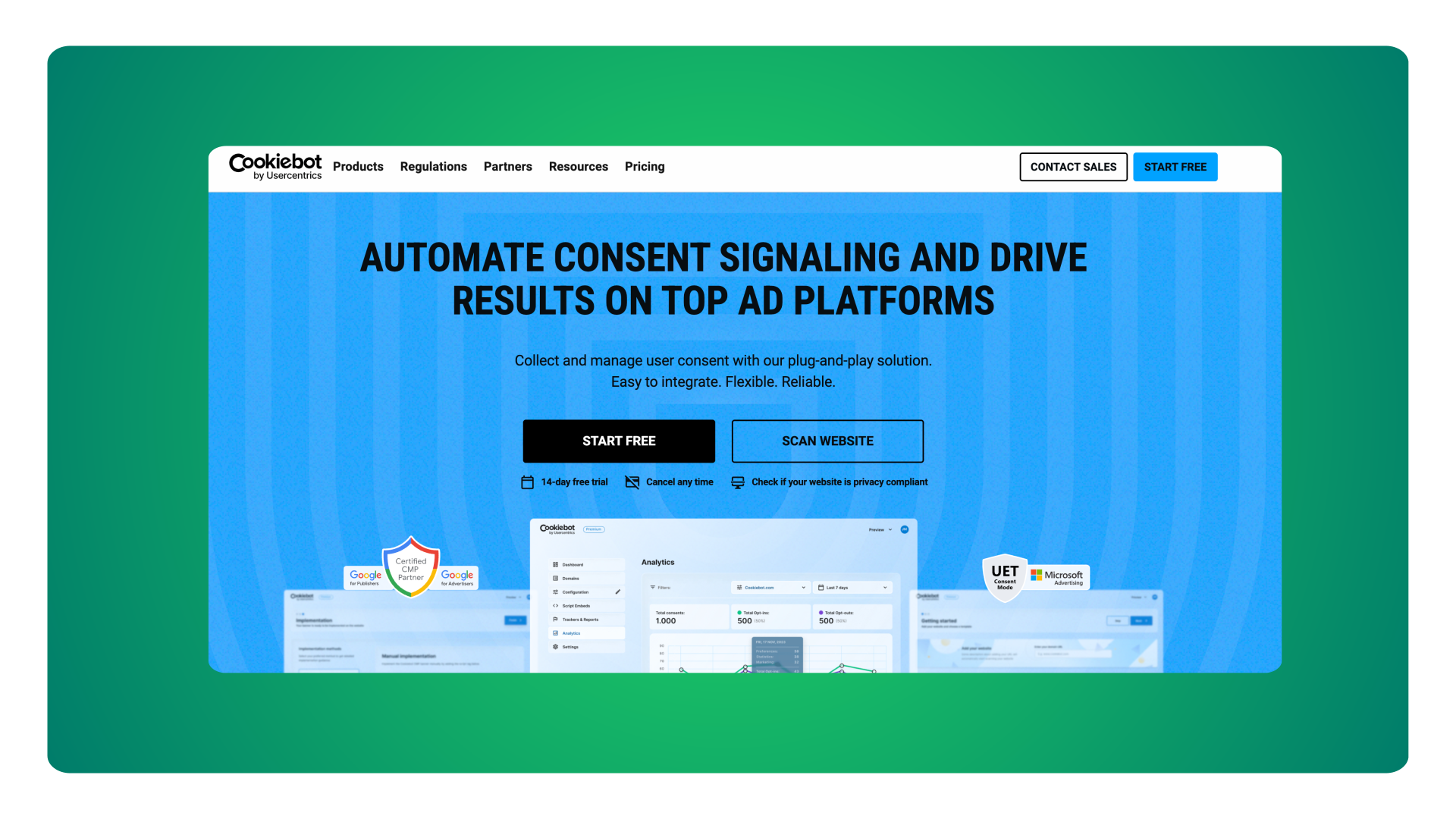
Cookiebot, owned by Usercentrics, is a solid option, with its primary strengths being deep EU regulatory coverage and a mature market presence.
It is a Google Gold-certified CMP and supports IAB TCF v2.2. However, in August 2025, Cookiebot doubled its pricing, a move that triggered significant customer backlash and drove buyers to start evaluating alternatives. Per-domain pricing also means costs compound quickly for multi-site operations, which can be hard to absorb for companies scaling to new geographies.
Pricing: Starts at approximately €9/month per domain for a single small website. The August 2025 price increase roughly doubled previous rates. Multi-domain costs scale per domain with no flat-rate option.
Pricing (verified July 2026): a free tier covers 1 domain up to 50 subpages. Paid plans start at €7/month (annual). Realistic deployments for small-business deployments land on Premium Small or Medium at €15 to €30 per domain per month and tiers run up to €90/month per domain for the largest sites. There is no flat-rate multi-domain option.
Where Cookiebot falls short: no DSAR handling at any tier, and the per-domain, per-subpage pricing model means costs compound quickly for multi-site operations. According to G2 and Capterra reviewers, automatic cookie rescans run only once a month, exceeding a subpage limit auto-upgrades the account to a higher tier without warning, and support is email only with no live chat or dedicated account manager.
Best for: Single-site SMBs and EU-focused organizations focused on consent management. Didomi does not offer data subject access request features, making it a poor fit for GDPR compliance.
Read our detailed OneTrust vs Cookiebot comparison.
6. Usercentrics: best for EU-focused privacy compliance
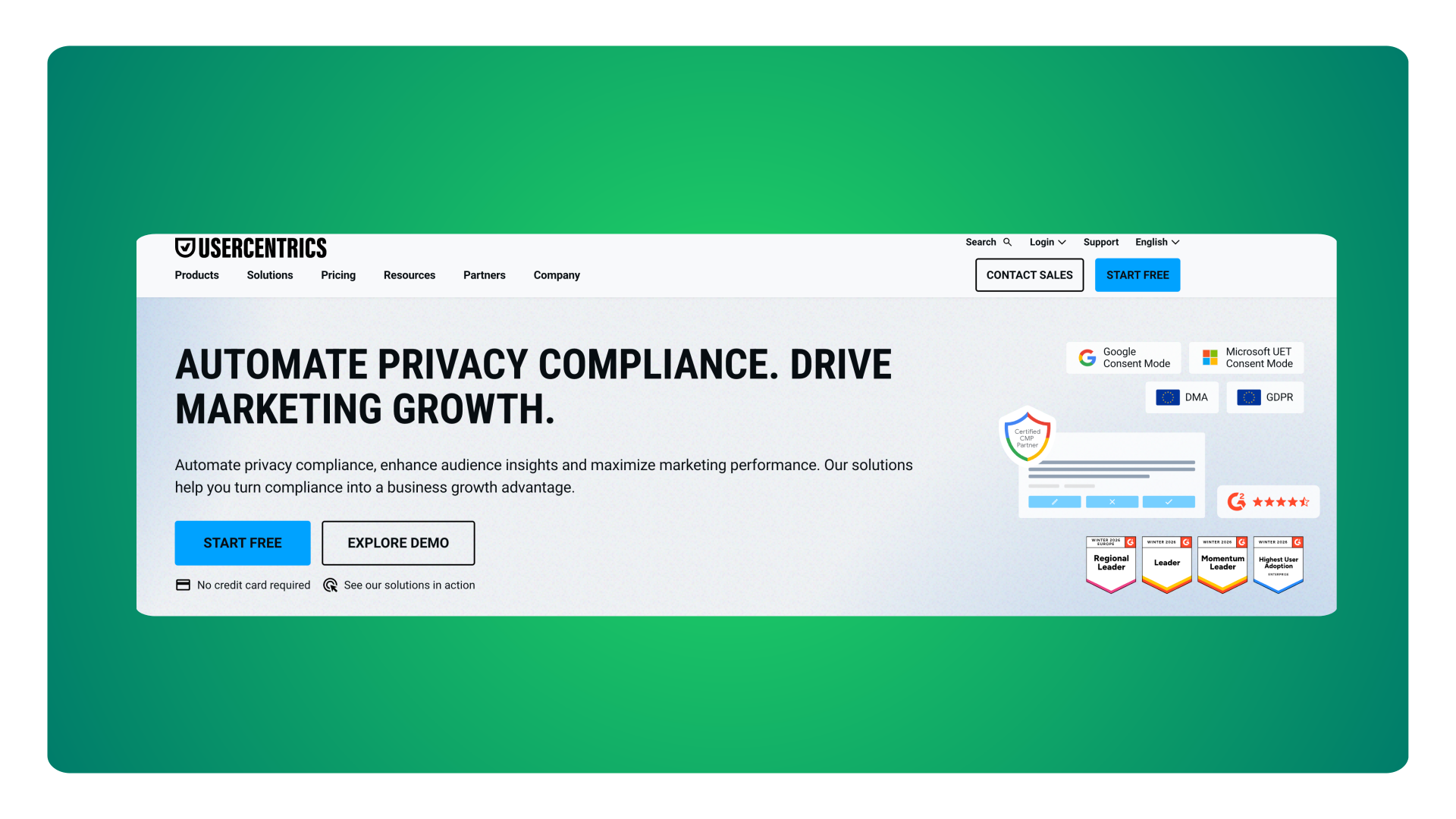
Usercentrics is built for enterprise teams in European markets that treat consent as both a compliance requirement and a revenue driver.
Its distinguishing capability is consent rate optimization: built-in A/B testing lets teams test banner configurations and placement to improve opt-in rates, which directly affects how much consented traffic shows up in analytics and how much ad revenue is recoverable under GDPR. It is a Google Gold CMP partner and covers GDPR, ePrivacy Directive, and IAB TCF v2.2 with strong multi-language support across EU member states.
Pricing is session-based rather than domain-based, which changes the cost structure significantly for high-traffic, few-domain deployments. This is common in European publishing and media where a single property serves millions of monthly sessions.
Pricing: Starts at €30/mo for up to 15,000 sessions. Higher limits require a sales conversation.
Where Usercentrics falls short: there is no DSAR handling, and session-based pricing that starts cheap climbs quickly with traffic; hitting a pageview or subpage limit auto-upgrades the account. G2 reviewers report setup difficulty and point to the platform's learning curve as a drawback. U.S. state law coverage is weak, too, compared to its EU depth.
Best for: Enterprise teams in European markets, particularly financial services, media, and publishing, where improving consent rates alongside maintaining regulatory compliance is a shared goal.
7. TrustArc: best for enterprises that need OneTrust depth
TrustArc is a solid enterprise-equivalent alternative to OneTrust. It is a legacy privacy compliance platform that has been operating since 1997 and covers data governance, records of processing activities (RoPA), privacy impact assessments (PIAs and DPIAs), third-party vendor risk management, and consent management in a single enterprise suite. Its compliance coverage extends to SOC 2, ISO 27001, GDPR, CCPA, and DORA, making it particularly relevant for financial services and regulated industry teams with multi-framework obligations.
TrustArc automates evidence collection and maintains audit trails for regulatory inspections, with continuous compliance monitoring that flags when controls drift from required standards. For organizations that used OneTrust's ESG and sustainability reporting module, TrustArc is the closest replacement on this list.
For organizations that genuinely need the full compliance program depth that OneTrust provides but want an alternative vendor relationship, TrustArc is the most credible option.
The honest caveat: TrustArc's pricing is in a similar range to OneTrust at enterprise scale. It is not a cost-saving alternative. It is a feature-equivalent alternative for organizations seeking competitive leverage in their OneTrust renewal negotiations or who prefer a different vendor.
A second caveat worth noting: TrustArc was acquired by Main Capital Partners in October 2025. Enterprise buyers should factor in product roadmap continuity and ownership stability alongside feature comparisons.
Pricing: Not publicly listed. Enterprise tier pricing; requires a sales conversation.
Best for: Large enterprises with complex multi-jurisdiction compliance programs that need a like-for-like OneTrust alternative for procurement or negotiation purposes.
For a more detailed comparison, read OneTrust vs TrustArc.
8. BigID: best for data governance
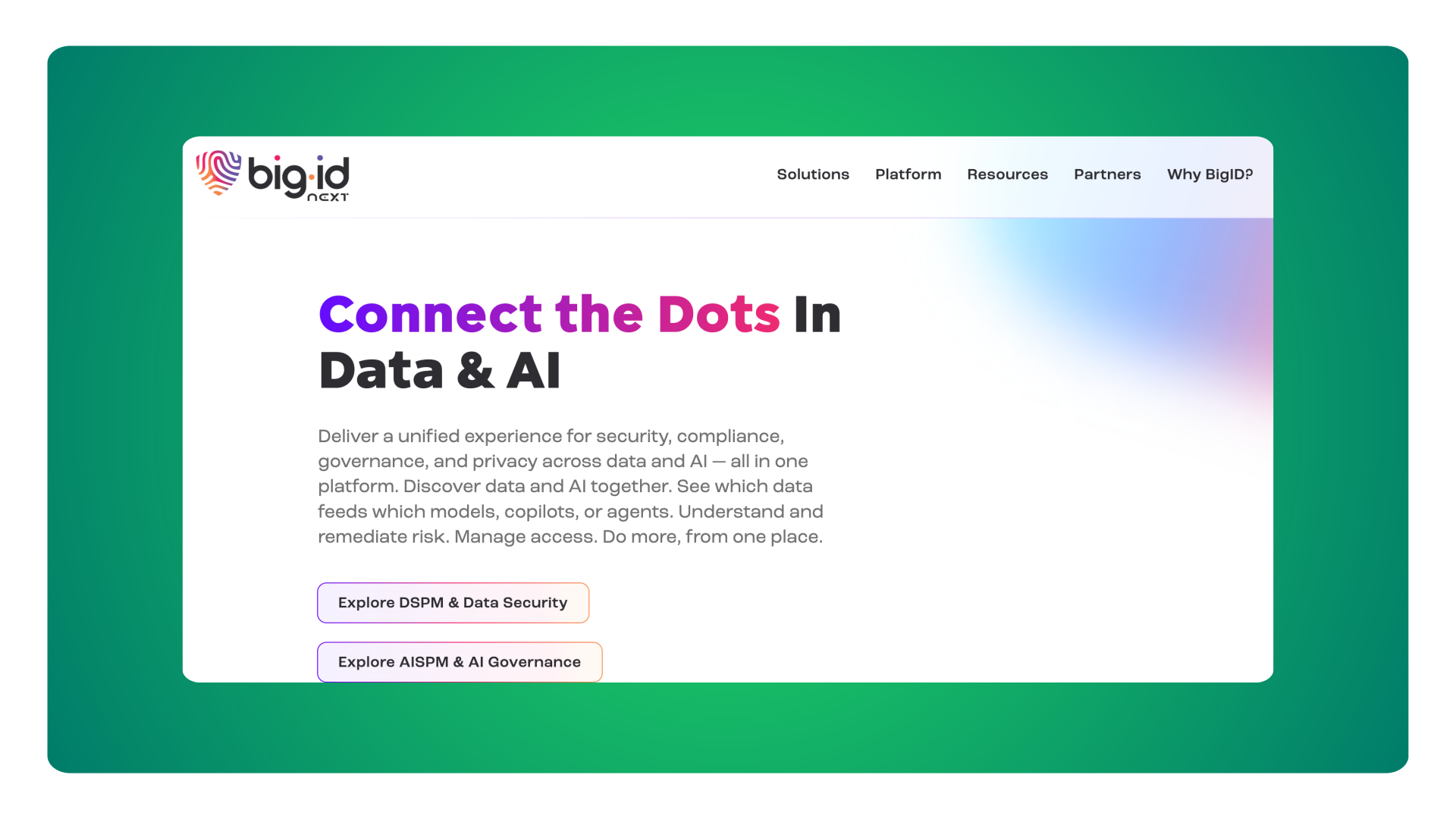
BigID is a data intelligence platform that launched BigID CMP Express in November 2025, a standalone consent management product that sits alongside its broader data discovery and privacy governance suite. It is the only tool on this list where cookie consent preferences connect directly to enterprise data discovery, meaning user choices are enforced at the data layer across systems, not just at the browser layer on the front end.
The CMP Express product supports IAB TCF v2.2 and Global Privacy Control. It includes AI-powered cookie classification that automatically categorizes all first and third-party cookies, scripts, beacons, and pixels across websites. Geolocation-aware banners adapt by country and US state without developer involvement, and multi-site management is built for organizations running 50 or more web properties.
Three reasons enterprise privacy teams consider BigID over OneTrust:
- Consent connected to data governance. BigID is the only CMP that operationalizes user consent across the data layer, connecting banner-level choices to actual data processing activity across cloud, on-premises, and SaaS environments. OneTrust offers similar data mapping functionality, but BigID's AI-driven sensitive data discovery and data security posture management (DSPM) capabilities are more automated and extend into unstructured data environments.
- AI-powered cookie classification. Automatic classification of 100% of cookies and trackers using machine learning, reducing the manual audit work that typically precedes a CMP deployment at enterprise scale.
- Forrester Wave Leader in Privacy Management. BigID holds analyst recognition in the same category as OneTrust, giving procurement teams a credible like-for-like comparison for RFP purposes. The platform includes trust center automation and AI governance capabilities aligned with the EU AI Act, making it relevant for enterprises building AI-ready privacy programs.
Pricing: Not publicly listed. Requires a demo. BigID CMP Express positions itself on "transparent pricing without vendor lock-in" relative to OneTrust's module-based contract structure.
Where BigID falls short: the CMP is new (launched November 2025) with a short track record, it carries no Google CMP Partner Program certification, and the platform is enterprise-only with no self-serve tier. G2 reviewers of the broader platform describe the interface as slow and clunky, report false positives in data classification that create manual cleanup work, and note that bugs in newer products can take time to get fixed.
Best for: Large enterprises where cookie consent needs to connect to a broader data governance and AI governance program, particularly organizations already using BigID for sensitive data discovery, DSPM, or DSAR automation who want to consolidate consent into the same platform.
For a detailed comparison with OneTrust on DSAR automation and data governance, see OneTrust vs BigID.
OneTrust GRC and compliance alternatives
If you are replacing OneTrust's Tech Risk & Compliance side (SOC 2, ISO 27001, vendor risk, audit automation) rather than its CMP, the options below will serve you best.
9. Vanta: best for compliance automation (SOC 2, ISO 27001)
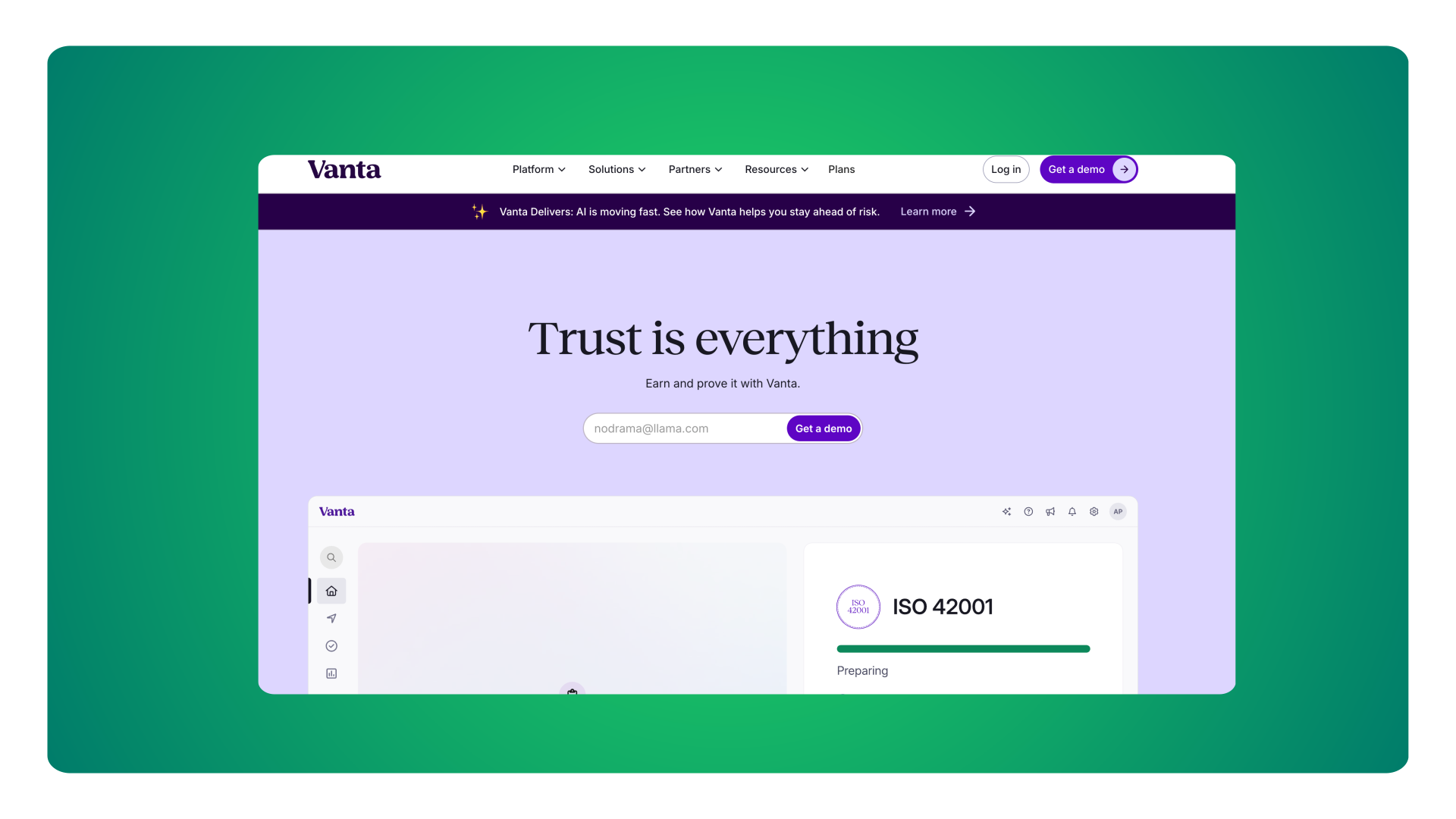
Vanta is the market-leading trust management platform for automating security compliance. It continuously monitors your stack against SOC 2, ISO 27001, HIPAA, GDPR, and 35+ other frameworks, automates evidence collection, and includes vendor risk management and trust center capabilities that compete directly with OneTrust's products.
Vanta replaces OneTrust GRC workflows with far less implementation overhead: integrations connect in hours and most teams reach audit readiness in weeks rather than the months a OneTrust GRC deployment typically takes.
Pricing: According to Vendr data, Vanta starts around $10,000/year for a single framework at a small company, with a median contract of $20,000/year; growing companies typically pay $25,000 to $55,000. Not cheap, but comparable to OneTrust's GRC entry point with materially faster deployment.
Where Vanta falls short: no consent management product. There is no cookie banner, no Google Consent Mode support, and no DSAR intake, so teams replacing both sides of OneTrust need Vanta plus a CMP. Renewal price creep is a recurring complaint on G2 and Reddit (reviewers report 30 to 50 percent year-two increases), and engineering teams often push back on installing the monitoring agent.
Best for: Companies replacing OneTrust's GRC, vendor risk, or trust center modules, especially SaaS businesses pursuing SOC 2 or ISO 27001.
10. Drata: best for multi-framework compliance automation
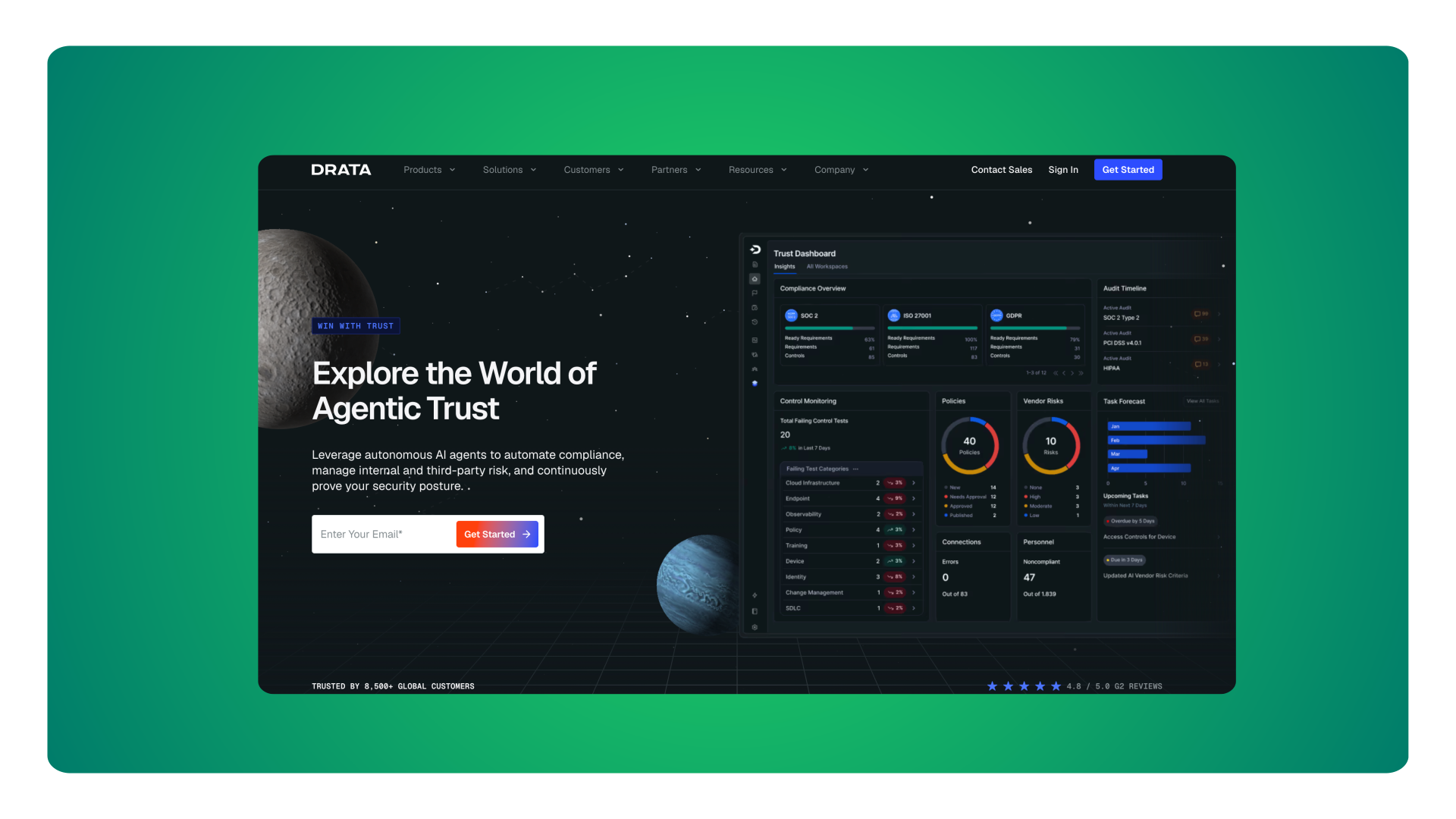
Drata is Vanta's closest competitor and the other name that consistently appears when teams replace OneTrust's compliance side. It automates evidence collection and continuous control monitoring across 20+ frameworks, with strong multi-framework crosswalking (map a control once, satisfy several frameworks) and a dedicated CSM model that reviewers consistently praise.
Pricing: According to Vendr data, Drata's Foundation tier runs approximately $7,500 to $15,000/year for one framework, with a median contract around $25,000/year and enterprise deployments reaching $100,000+. Framework add-on pricing is more transparent than most competitors in the category.
Where Drata falls short: like Vanta, it has no consent management side; cookie banners, Google Consent Mode, and DSAR intake all require a separate CMP. According to G2 reviewers, it is not always clear which controls are mandatory versus optional, and when an integration is missing or breaks, evidence collection falls back to manual workflows.
Best for: Companies consolidating multiple compliance frameworks (SOC 2 + ISO 27001 + HIPAA) that want automation-first GRC with hands-on support, as a replacement for OneTrust's Tech Risk & Compliance module.
Best OneTrust alternative by use case
| Use case | Top pick | Runner-up | Why |
| Trust center automation | BigID | Vanta | BigID pairs trust center automation with data-layer governance; Vanta's trust center ships with its compliance automation |
| DSAR automation | Enzuzo | Osano | Enzuzo covers intake and response workflows on standard web forms at the lowest cost; Osano adds broader privacy-program DSAR handling |
| Cookie consent and banners | Enzuzo | Cookiebot | Enzuzo for flat multi-domain pricing and Gold certification; Cookiebot for EU-focused single sites |
| Preference centers | Didomi | Usercentrics | Didomi's preference management spans web, app, and CTV; Usercentrics adds consent-rate A/B testing |
| IAB TCF v2.2 and GPP compliance | Didomi | Cookiebot | Both are publisher-grade TCF implementations; Didomi leads for ad-supported enterprise properties |
| Multi-domain consent management | Enzuzo | BigID | Enzuzo includes 10 domains flat from $79/month; BigID CMP Express is built for 50+ property enterprises |
| GRC and vendor risk | Vanta | Drata | Both replace OneTrust Tech Risk & Compliance with faster deployment; Vanta leads on market adoption, Drata on multi-framework crosswalking |
| Data governance and discovery | BigID | TrustArc | BigID leads on AI-driven data discovery and DSPM; TrustArc covers RoPA, PIA/DPIA, and governance in one suite |
| DORA compliance | TrustArc | BigID | TrustArc covers DORA explicitly for financial services; BigID connects DORA obligations to data inventory |
| Developers and API-first teams | Ketch | Enzuzo | Ketch's orchestration layer and 1,000+ integrations lead; Enzuzo offers a REST API with same-day setup |
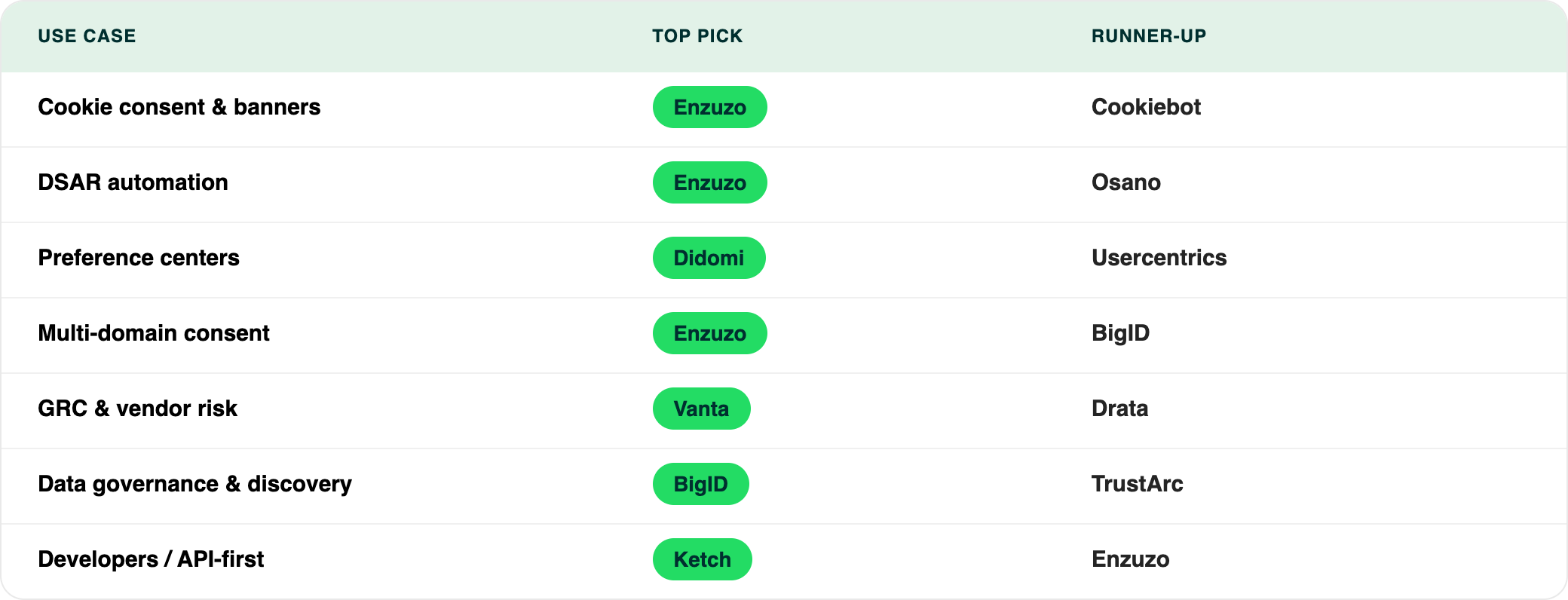
If you know which OneTrust capability you are replacing, the table above will give you the fastest shortlist. Picks are based on feature fit and verified pricing.
How to choose the right OneTrust alternative
The right alternative depends on three variables: how many domains you manage, what features you need, and how much implementation complexity you can absorb.
If you need cookie consent and Google Consent Mode v2 under $500/month: Enzuzo and Cookiebot are the strongest options. Enzuzo is the best choice for multi-domain teams (flat-rate pricing across 10 domains) while Cookiebot is best for EU-focused single-site deployments.
If you need consent across web, mobile, and connected TV: Didomi is the strongest option, particularly post its Sourcepoint acquisition. Ketch and Usercentrics are also solid contenders.
If you need privacy automation across a complex marketing stack: Ketch is the strongest no-code option, with 1,000+ integrations and consent orchestration across web and mobile.
If you are a large enterprise looking for a OneTrust equivalent: TrustArc is the closest feature match to OneTrust. BigID can also provide most of the same functionality, particularly for AI governance workflows.
If you need enterprise data governance: BigID is the only CMP on this list that operationalizes consent at the data layer. It is the strongest option for organizations already running BigID for data discovery or DSAR automation who want to bring consent into the same platform.
If you are replacing OneTrust's GRC or vendor risk modules: Vanta and Drata are the compliance-automation leaders; SecurityScorecard and BitSight cover continuous vendor security ratings.
For a broader look at the category beyond just OneTrust, see our guide to the best consent management platforms.
What OneTrust switchers say on Reddit
In a widely-read thread on r/cipp, the recurring asks are the same three things: easier day-to-day UX, predictable cost, and solid GDPR/CCPA coverage. Other subreddits like r/gdpr, talk about frustrations around renewal quotes several times the original contract and implementation complexity.
Open-source OneTrust alternatives
Open-source consent tools exist and can work for developer-led teams. Klaro! is the most established open-source consent manager, and Osano maintains an open-source cookie-consent JavaScript library that powers basic banners on millions of sites.
What they cover: banner display, consent capture, and script blocking. What they do not cover: DSAR workflows, geolocation-based rule logic, consent records for audit, and Google Consent Mode v2 certification.
How we chose and ranked these tools
Every tool on this list was evaluated on five criteria: verified pricing (checked against each vendor's published pricing page in July 2026), Google CMP Partner Program certification tier, DSAR coverage, aggregate review ratings on G2, and fit for a specific buyer type. Rankings reflect fit for the most common OneTrust switcher (a mid-market team replacing consent management), not overall company size.
Disclosure: Enzuzo publishes this guide and appears first in the consent category. We compete with the consent tools on this list and do not compete with the GRC tools (Vanta, Drata).
Try Enzuzo free; set up in minutes, no credit card required. Or book a call to speak with a consent management expert
Frequently asked questions
Why are companies switching from OneTrust?
The three most common reasons for companies looking to switch are price increases, platform complexity, and technical failures with Google Consent Mode. Many mid-market companies report OneTrust renewal quotes 5 to 10 times higher than their original contract price, with no corresponding increase in the features they actually use. Others find the full platform oversized for their needs, such as paying for GRC and data mapping modules while only using cookie consent.
How much does OneTrust cost?
OneTrust does not publish pricing publicly. Based on Enzuzo's conversations with companies evaluating OneTrust, costs vary widely depending on traffic volume, domain count, and modules. Companies with 400,000 monthly visitors and 6 domains have reported quotes around $80,000 per year.
Companies at 1 million sessions per month have been quoted between $36,000 and $60,000 annually. Smaller deployments often started under $2,000 per year on legacy pricing, which OneTrust has been phasing out, with a minimum ACV of $10,000 introduced in 2026.
Is OneTrust worth it for mid-market companies?
For most mid-market teams, OneTrust is not worth the complexity and cost. The platform is built for enterprise legal and compliance departments that need GRC, data mapping, and vendor risk management bundled together. Mid-market buyers typically use two features: consent management and DSAR workflows, which makes the full OneTrust suite impractical and a poor fit overall.
Does OneTrust work with Google Consent Mode?
It supports Consent Mode in principle, but implementation quality varies significantly. Some companies running OneTrust report a 40 to 50 percent gap in site traffic visibility in GA4, attributable to consent signals not being passed correctly to Google's tags. The data cited is via individual conversations with teams migrating away from the platform.
This is one of the more consequential technical failures because it directly affects marketing attribution data, not just legal compliance.
How long does it take to migrate from OneTrust?
This depends on how OneTrust was deployed. If it was implemented through Google Tag Manager, then migration to a replacement CMP can typically be completed in a few hours. The new consent banner is added to GTM, the OneTrust script is removed, and scripts are recategorized under the new platform.
If OneTrust was hardcoded directly into the site or integrated at the SDK level for mobile, the timeline would extend to days or weeks and would require developer involvement.
Can you switch from OneTrust before your contract ends?
Most buyers we speak with wait until renewal rather than break mid-contract. The practical implication is that if your renewal is within 90 days, starting a vendor evaluation now gives you enough time to complete a demo, run a technical audit, and migrate before the renewal date hits. Because migration via GTM can be completed quickly, you do not need months of lead time. The bigger risk is delaying the evaluation until the week before renewal and being forced to auto-renew by default.
What does OneTrust offer beyond cookie consent?
OneTrust is not a single product; it is a suite of modules sold under one brand. The core modules most buyers encounter are cookie consent management, DSAR intake and response, and privacy policy management. Beyond those, OneTrust also sells GRC tools, third-party vendor risk management, data discovery and classification, ESG reporting, and trust center automation. These modules are separately licensed and priced, which is OneTrust customers can have different contracts and different reasons for evaluating alternatives.
What are the pros and cons of OneTrust?
OneTrust's genuine strengths are feature breadth and brand recognition. The platform can handle consent management, DSAR workflows, data mapping, and vendor risk in a single admin environment, which appeals to large legal and compliance teams that want a consolidated system. It holds multiple compliance certifications, has a large implementation partner network, and is widely recognized in enterprise procurement processes.
The recurring criticisms in practice are cost, complexity, and integration quality. OneTrust does not publish pricing, but companies regularly report quotes that scale from a few thousand dollars annually to $80,000 or more at higher traffic volumes, with a minimum ACV of $10,000 introduced in 2026. Implementation typically requires dedicated IT or legal ops resources, adding to cost and timelines.
What are the best OneTrust alternatives for DSAR automation?
The tools most commonly evaluated alongside OneTrust for DSAR automation are Osano and Enzuzo.
Osano includes DSAR handling as part of its broader CMP offering. Enzuzo covers DSAR intake and response automation but does not currently include deep integrations with third-party platforms like Hubspot.
The right choice depends primarily on your request volume and integation requirements. Companies receiving fewer than 50 DSARs per month and managing a small number of tools will be well served by a CMP with built-in DSAR. Companies with high volumes or complex data environments should evaluate dedicated DSAR automation tools.
What do OneTrust reviews say?
OneTrust is consistently rated as a capable yet complex platform on review sites such as G2 and Capterra. Positive reviews tend to come from enterprise compliance teams that value its breadth, with reviewers citing strong regulatory coverage, regular product updates as privacy laws evolve, and the convenience of managing multiple compliance functions in one platform.
Negative reviews cluster around three themes: the time and expertise required to configure and maintain it, pricing that is opaque and increases sharply at renewal, and a learning curve that makes it difficult for smaller teams without dedicated privacy staff.
For an in-depth analysis of each OneTrust module with reviewer evidence, see our OneTrust review.
What are the best OneTrust alternatives for GRC and privacy program management?
For teams replacing OneTrust's governance, risk, and compliance modules, Vanta and Drata are the compliance automation leaders, automating SOC 2, ISO 27001, and HIPAA readiness through continuous monitoring.
TrustArc is the closest like-for-like enterprise replacement for the full privacy program suite. BigID leads on AI-driven sensitive data discovery and data security posture management (DSPM), connecting consent to data governance at the infrastructure layer.
Ketch handles privacy automation and DSAR orchestration across complex tech stacks through no-code workflows. Securiti.ai is also worth evaluating for organizations that need privacy, security posture management, and AI governance in a unified platform.
Which OneTrust alternative is most user-friendly for marketing teams?
For marketing teams managing consent alongside ad performance, Enzuzo and Osano are the most accessible options. Both are built for non-technical buyers, with consent dashboards and Google Consent Mode v2 signals that marketing teams benefit from. Didomi is purpose-built for enterprise media and publishing teams where consent optimization affects ad revenue, with its preference management suite.
How do Termly and OneTrust compare?
They sit at opposite ends of the market. Termly is a low-cost, single-site compliance tool for small businesses: cookie banner, policy generator, and a basic DSAR intake form, typically under $20/month. OneTrust is an enterprise platform with a $10,000/year minimum, built for multi-module compliance programs. Companies outgrowing Termly but priced out of OneTrust usually land on mid-market CMPs like Enzuzo or Osano, which cover multi-domain consent and DSAR workflows without enterprise contracts.
How does TrustArc compare to OneTrust?
TrustArc is the closest like-for-like OneTrust alternative: a full enterprise privacy suite covering consent, RoPA, PIA/DPIA, vendor risk, and multi-framework compliance including DORA. It is feature-equivalent rather than cheaper, with enterprise pricing in a similar range to OneTrust. Our full OneTrust vs TrustArc comparison covers the differences in depth.
What are the best OneTrust alternatives for ESG and sustainability reporting?
OneTrust's ESG and sustainability module competes with dedicated ESG platforms rather than consent tools. Workiva, Watershed, and Persefoni lead that category for reporting, carbon accounting, and disclosure compliance, respectively. Among the tools in this guide, TrustArc is the closest replacement for teams that used OneTrust's ESG module alongside privacy.
Which OneTrust alternatives work for developers or API-first teams?
Ketch is the strongest API-first option, with a consent orchestration layer and 1,000+ pre-built integrations designed for programmatic control. Enzuzo offers a REST API alongside same-day setup for teams that want API access without infrastructure work.
Osman Husain
Osman is the content lead at Enzuzo. He has a background in data privacy management via a two-year role at ExpressVPN and extensive freelance work with cybersecurity and blockchain companies. Osman also holds an MBA from the Toronto Metropolitan University.
LinkedIn →More related blogs
Your next read