Osman Husain
The best Osano alternatives cover cookie consent, data subject requests (DSARs), analytics, and more. Each entry on this list offers something Osano doesn't, whether that's a better price, features, third-party certifications, or enterprise depth. Here's our quick reference list:
Enzuzo: best overall for multi-domain consent and DSARs at a flat price
OneTrust: best for enterprise-wide privacy governance
Ketch: best for engineering teams that enforce consent through APIs
Usercentrics: best for consent across web, mobile apps, and connected TV
Transcend: best for automating DSARs across many internal systems
Didomi: best for EU publishers that need consent plus preference management
TrustArc: best for enterprise programs that want certifications and regulatory research
Cookiebot: best for a single EU-focused site that wants automatic cookie scanning
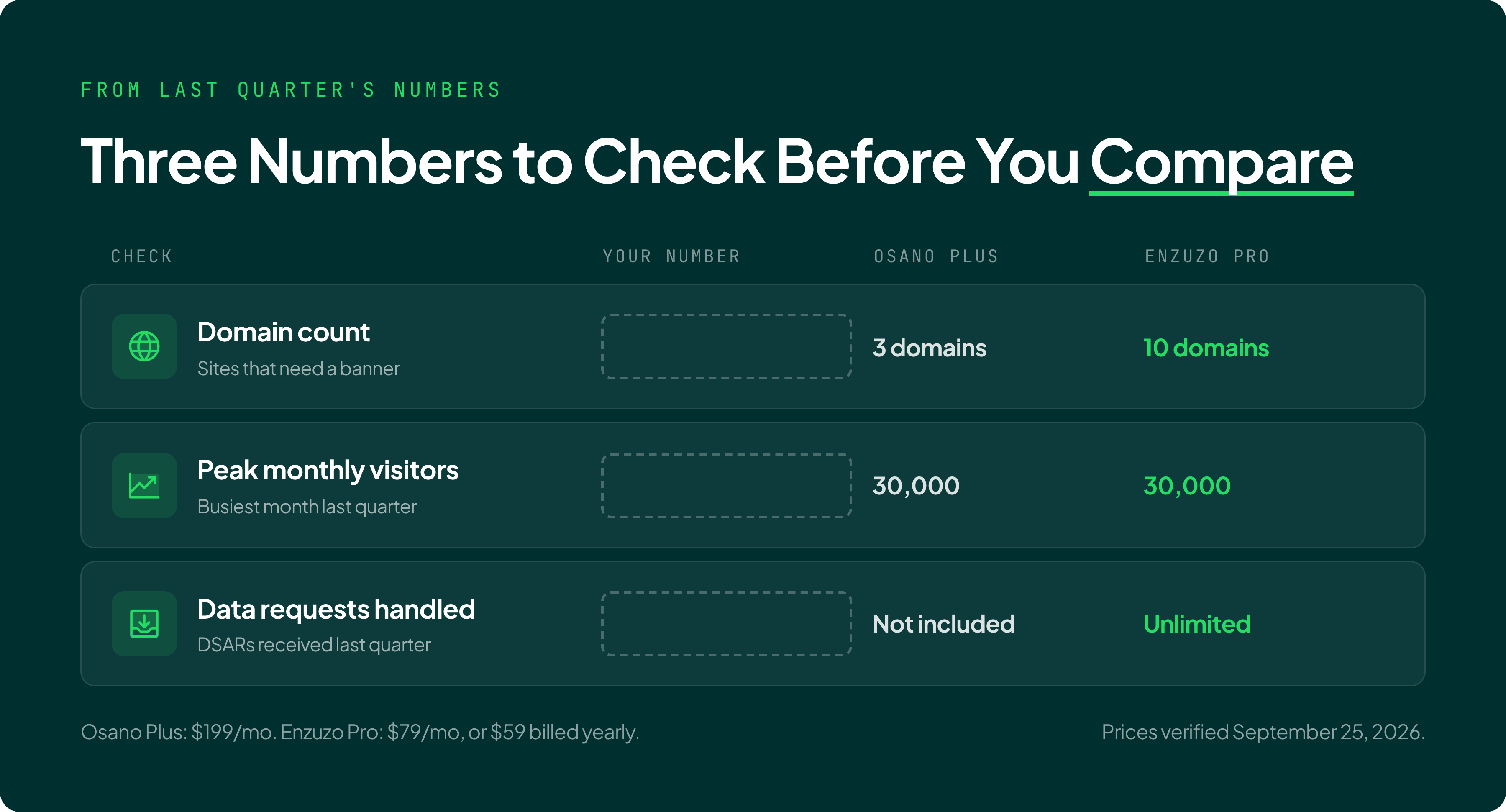
Osano's Plus plan costs $199 a month and covers two users, three domains, and 30,000 monthly visitors. Adding a fourth domain, or temporarily increasing traffic limits moves the account to Basic Privacy, the custom-priced tier that requires a sales call.
That step is the point where Osano's pricing starts to bite. It's built for the middle of the privacy software market: more than a cookie banner, less than an enterprise governance suite.
Osano does many things well, and it's worth highlighting those, too. It ships prebuilt banner rules for 95-plus regulations in 50-plus countries. Consent, DSARs, data mapping, vendor risk, and assessments all run inside its platform. Customers can consult Osano's team of attorneys and privacy professionals.
Reviewers on G2 single out ease of use as a positive. Osano's custom tiers also carry a No Fines, No Penalties pledge, reimbursing fines up to $500,000 for customers who opt for the Enterprise package.
Teams start to look for alternatives when the plans don't fit their needs or they find that it offers more than what they're looking for. Companies evaluating Osano competitors purely for consent management require a different alternative from those looking for enterprise depth.
How do Osano alternatives compare on price, DSARs, and Google tier?
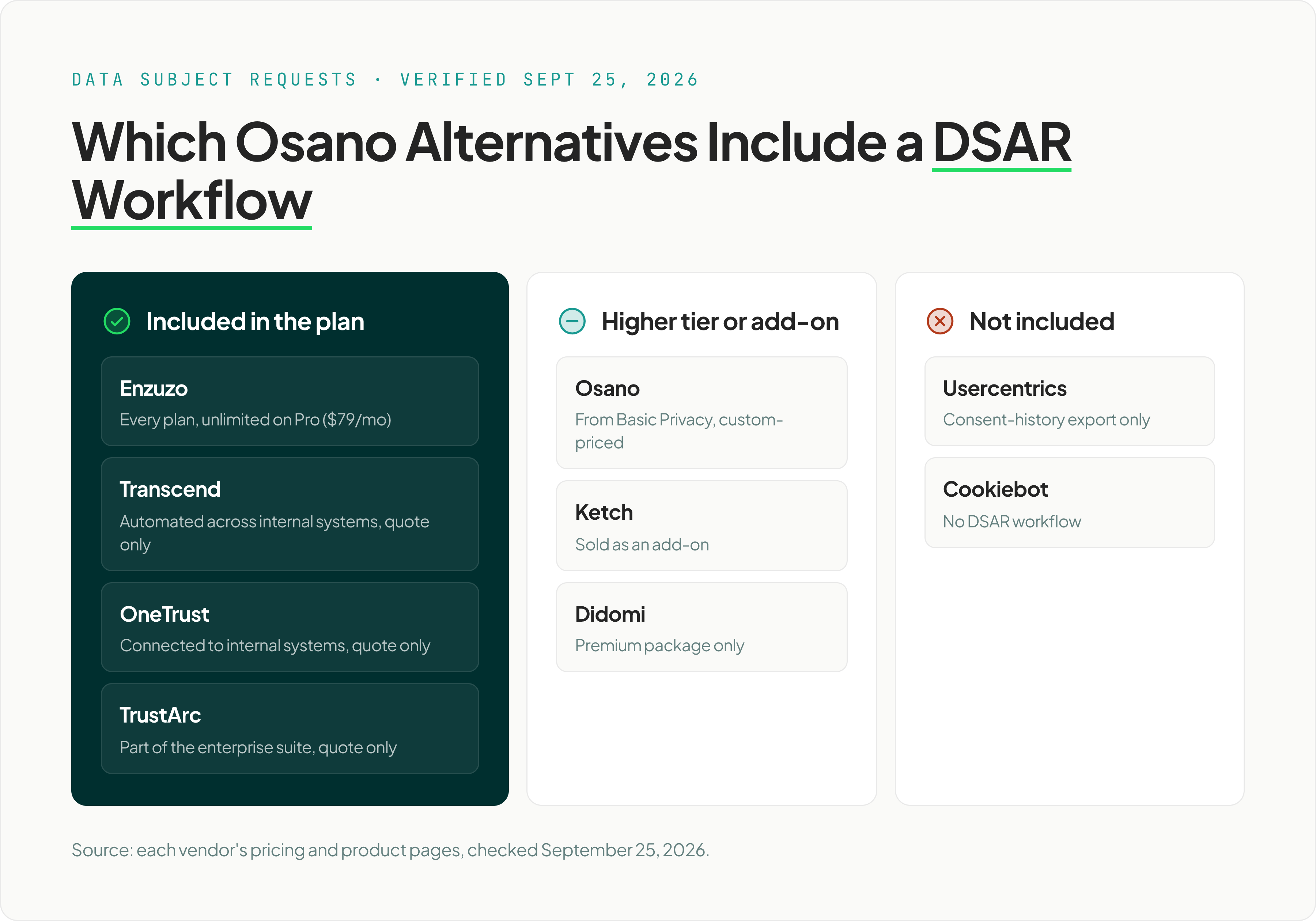
Four of the eight Osano alternatives publish their prices and four are quote-only, four include a DSAR workflow in the plan, and six hold Google's Gold tier against Osano's Silver.
| Tool | Best for | Published entry price | Cost across several sites | DSAR workflow | Google CMP tier | Key limitation |
|---|---|---|---|---|---|---|
| Osano (baseline) | Mid-market privacy programs | $199/mo (Plus) | Custom above 3 domains | From Basic Privacy (custom) | Silver | No public price past Plus |
| Enzuzo | Multi-domain consent + DSAR | $9/mo (1 domain) | $79/mo for 10 domains (Pro) | Yes, on every plan | Gold | No data mapping or vendor-risk module |
| OneTrust | Enterprise governance | Quote only | Quoted | Yes | Gold | Cost and implementation effort |
| Ketch | Engineering-led teams | $150/mo (Starter) | Priced by visitors | Add-on | Silver | Learning curve on advanced features |
| Usercentrics | Web, app, and CTV consent | €7/mo (Essential) | €50/mo for 10 domains (Business) | Consent-history export only | Gold | Setup complexity |
| Transcend | DSARs across internal systems | Quote only | Quoted | Yes | Certified, no tier | Needs developer resources |
| Didomi | EU publishers, preference management | Quote only | Unlimited domains, quoted | Premium package only | Gold | No free tier or public pricing |
| TrustArc | Enterprise programs with certifications | Quote only | Quoted | Yes | Gold | Services-heavy rollout |
| Cookiebot | One EU-focused site | €7/mo (Lite, 1 domain) | Per domain, by subpage count | No | Gold | Costs stack per domain |
Prices are in each vendor's own currency, and a cell marked add-on means the feature is sold separately from the plan.
For the quote-only vendors, Vendr's buyer data puts the median contract at $12,000 a year for OneTrust, $15,120 for TrustArc, and $85,000 for Transcend. Vendr lists no benchmark for Didomi. Those are contract values buyers reported, since none of the four publishes a list price, and they describe enterprise-sized deals. A team leaving Osano over cost is choosing among the four vendors that publish their tiers.
The 8 best Osano alternatives, reviewed
Each of these eight tools replaces Osano for a different kind of team. This isn't a ranked list, each vendor has its unique features and capabilities which we've highlighted transparently.
1. Enzuzo: best overall for multi-domain consent and DSARs
Best for: mid-market teams, agencies, and ecommerce brands that leave Osano over cost and need consent plus DSARs across several sites.
Enzuzo's consent management platform handles cookie consent and data subject requests on every plan, at one flat monthly price.
The Enzuzo Pro plan covers 10 domains and 30,000 monthly visitors for $79 a month, or $59 billed yearly. Osano's Plus covers three domains and the same 30,000 visitors for $199.
All of Enzuzo's paid plans include Google Consent Mode v2 and Microsoft UET Consent Mode. Geo-specific rules, API access, and consent analytics are also added. Sites on Shopify and Webflow can install it as a native app.
Enterprise plans and up offer custom onboarding, Slack-based support, advanced API access, and unlimited traffic. Spinning up consent for multiple domains is easy inside the Enzuzo dashboard, and it's a scalable option for agencies managing client portfolios.
If consent management is your primary consideration, Enzuzo offers a rock-solid product.
Key features:
- Cookie scanning, region-aware banners, and audit-ready consent records
- Per-region cookie blocking on Growth and above, and per-region Consent Mode (Basic, Advanced, or off)
- DSAR management on every plan, unlimited on Pro
- Privacy policy, terms, and other legal documents generated in the same account
- Native Shopify app, plus WordPress, Webflow, and Google Tag Manager setups
- Global Privacy Control detection on Pro and Enterprise plans, once it's switched on
- API access on every plan, with a headless mode on Enterprise
Where Enzuzo falls short: Enzuzo isn't an enterprise governance suite. It has no data discovery, records of processing (the GDPR inventory of how personal data is used), or vendor-risk module. A program that relies on Osano's data mapping and vendor risk needs another tool for that work.
The UK or GDPR representative is a second gap. Enzuzo doesn't bundle one, and Article 27 requires a local contact point for some companies based outside the EU. Osano's Plus plan includes one, so a team using it would need a separate provider after switching.
Pricing: A free plan covers one domain and 5,000 monthly visitors. Growth is $29 for four domains and 10,000 visitors, and Pro is $79 for ten domains and 30,000 visitors. Enterprise is custom, with unlimited domains and visitors, and every tier is listed on the Enzuzo pricing page.
The right pick when: a team runs several domains or a Shopify store, needs consent and DSARs without a governance suite, and wants a price it can read off the page.
Considering a switch? Book a strategy call with a consent expert to see how Enzuzo can power your stack.
2. OneTrust: best for enterprise privacy governance

Best for: large enterprises with a dedicated privacy team that need consent as one part of a full governance program.
OneTrust is the alternative for teams that have outgrown Osano's depth, not its price. Its consent and preference product runs on web, iOS, Android, and connected TV. It's one piece of a platform that adds data discovery, DSAR automation, third-party risk, assessments, and AI governance.
OneTrust builds for privacy programs that span business units and countries. It's an enterprise giant, with pricing starting at $10,000/year. Some features like consent for connected TV and AI tooling are areas which Osano cannot match.
Key features:
- Consent and preference management across web, mobile apps, and connected TV
- Data discovery, data mapping, and records of processing
- DSAR automation connected to internal systems
- Third-party risk, privacy assessments, and AI governance modules
Where OneTrust falls short: OneTrust's consent product received3.5 out of 5 on G2, with complaints about a complex setup and slow support. Implementation fees are steep, too. The platform's complexity means 20 to 40 percent of the annual subscription should be budgeted on top, solely for consultants and rollout.
Pricing: OneTrust publishes packages on its pricing page but no dollar figures; each package needs a sales evaluation. Contracts start around $10,00/year and can go up to six figures based on rollout and complexity.
The right pick when: an organization treats consent as one piece of a wider governance effort and has the budget and staff to run a platform of that size.
Read OneTrust vs Osano for a side-by-side comparison.
3. Ketch: best for engineering teams that enforce consent through APIs

Best for: technical teams that want consent enforced in code across apps, data systems, and AI models.
Ketch's product set is a close match to Osano's, albeit skewed towards engineers. Ketch calls its model data permissioning: a visitor's choices are enforced through APIs across the systems that use their data, with the browser only one of them.
That browser layer covers Google Consent Mode v2, IAB TCF, GPC, and the Global Privacy Platform (GPP), the IAB's multi-jurisdiction consent format. It's also a Silver-certified partner, the same tier as Osano.
On G2, Ketch rates 4.6 out of 5 across more than 170 reviews, with support and feature depth getting praise.
The OneTrust vs Ketch vs Osano breakdown compares all three by use case.
Key features:
- APIs that enforce consent choices in code across connected systems
- Consent signals passed to data systems and AI models
- DSAR automation (Ketch calls it DSR automation), data mapping, and risk assessments (sold as add-ons)
- Mobile SDKs and jurisdiction rules that reach individual US states
Where Ketch falls short: Ketch's advanced features carry a learning curve, the most-cited product con in its G2 reviews, and reviewers also say the interface gets harder to navigate as a setup grows. DSAR automation, data mapping, and risk assessments are sold separately from consent, so matching Osano's bundle means buying add-ons on top of an annual plan.
Pricing: Ketch prices on unique monthly visitors. A free plan covers 5,000, Starter is $150 a month for 30,000, Plus starts at $499 a month billed annually for 100,000, and Pro is custom.
The right pick when: a team has engineers who want consent wired into its own systems, with multi-step AI workflows.
4. Usercentrics: best for consent across web, mobile apps, and connected TV
Best for: consumer brands, publishers, and app developers that need consent on every screen they run, with ad-platform signals managed in one place.
Usercentrics sells its own enterprise CMP built for consent beyond the website. It ships native SDKs, the software kits developers build into apps, for iOS, Android, Flutter, React Native, and Unity, plus a dedicated CMP for connected TV. Osano's Silver certification covers web, iOS, and Android, while Usercentrics holds Gold on all four platforms, connected TV included.
Ad measurement is the other reason teams pick Usercentrics. One account sends consent signals to Google through Consent Mode v2, to Microsoft through UET and Clarity, and to Amazon through its Consent Signal. Usercentrics supports IAB TCF on the web, with GPP live in its app CMP and announced for the web.
Key features:
- Native consent SDKs for mobile apps, games, and connected TV
- Google, Microsoft, and Amazon consent signals from one dashboard
- Banners in 60 languages on Pro and above, with automated scans monthly on paid tiers and weekly on Corporate
- Managed server-side tagging, sold as a separate product
Where Usercentrics falls short: Setup complexity is the top con in Usercentrics' G2 reviews. Usercentrics can export a person's consent history, but it has no workflow to take in and fulfill data subject requests. Replacing Osano's subject rights module (its DSAR tooling) takes a second tool.
That's not the only added cost. Usercentrics plans upgrade automatically when a site passes its session limit, so a busy month can raise the bill without anyone choosing a new tier.
The OneTrust vs Usercentrics comparison goes deeper on its pricing and product family.
Pricing: Usercentrics publishes session-based tiers in euros. A free plan covers under 1,000 monthly sessions, and Essential is €7 a month for 1,500 sessions. Pro is €30 for 15,000 sessions and three domains, and Business is €50 for 50,000 sessions and ten domains. Corporate pricing is custom.
The right pick when: consent has to work inside mobile apps or on TV screens, and ad-platform consent signals matter more than DSAR handling.
5. Transcend: best for automating DSARs across many internal systems

Best for: engineering-led companies that handle high DSAR volumes and need requests fulfilled across many internal databases and SaaS tools.
Transcend connects to the systems that hold customer data and fulfills data subject requests inside them, end to end. The same platform adds data discovery and classification, consent and preference management, assessments, and a privacy center. For a company where most DSAR effort goes into finding and deleting data across internal systems, that connection automates the part that costs the most hours.
Reviewers on G2 credit that automation and the platform's ease of use. Google lists Transcend as a certified CMP for web and apps on its publisher list, though it isn't part of the tiered Partner Program.
Key features:
- DSAR automation that runs requests through connected internal systems
- Data discovery, classification, and a live data inventory
- Consent and preference management for websites and apps
- A policy engine and AI governance tools for data use
Where Transcend falls short: Transcend assumes an engineering team. Reviewers on G2 say implementation needs developer resources and that a privacy or legal team can't run it alone, and some report support and bug-fix delays that stalled template work.
Pricing: Transcend has no pricing page; its pricing URL redirects to a contact form. Vendr's buyer data puts the median Transcend contract at $85,000 a year across 31 purchases. That's a paid median on enterprise contracts, and it puts Transcend in a different budget tier from any plan Osano publishes.
The right pick when: DSAR volume is high, customer data is spread across many internal systems, and an engineering team will own the rollout.
6. Didomi: best for EU publishers that need consent plus preference management

Best for: European publishers, media groups, and consumer brands that manage consent and communication preferences across web, apps, and TV.
Didomi is a Paris-based CMP whose core market is European enterprises that run IAB TCF consent and sell ads, a slightly different buyer from Osano's core userbase.
For that buyer, Didomi pairs consent with preference management, so a visitor's communication choices and data-use choices are managed in one center, on web, iOS, Android, and connected TV. Didomi's Gold-tier rating in Google Consent Mode covers all four platforms.
Key features:
- Consent and preference management in one platform
- Consent SDKs for websites, mobile apps, and TV apps
- Analytics and A/B testing for banners
- Server-side data collection
Where Didomi falls short: Didomi has no free tier and no public pricing, so evaluating it means booking a sales call first. Its DSAR tool is only available on the higher tiers, too. Reviewers on G2 report technical complexity for setup and A/B testing cookie banners.
Pricing (verified September 25, 2026): Didomi sells three quote-only packages, Essential, Advanced, and Premium, with unlimited domains and consent priced on monthly unique visitors.
The right pick when: a European publisher or consumer brand needs consent and preference management across web, apps, and TV, and budgets for an enterprise contract.
7. TrustArc: best for enterprise programs that want certifications and regulatory research

Best for: enterprise privacy teams that want consent, program management, third-party certification, and legal research from one vendor.
TrustArc sells an enterprise bundle of consent, program management, certification, and legal research. It's the oldest vendor of the eight, founded in 1997 as TRUSTe. Its Cookie Consent Manager is one product in a suite that adds PrivacyCentral, data mapping, assessments, and Nymity regulatory research.
TRUSTe privacy certifications and dispute resolution are a line of business Osano doesn't offer. Google's Gold tier for TrustArc covers web, iOS, and Android, and reviewers on G2 rate it 4.2 out of 5, with training and support the most-praised points.
Key features:
- Cookie Consent Manager with geo-specific banners and Google Consent Mode
- PrivacyCentral program management and assessment tools
- Nymity research with legal summaries and templates
- TRUSTe certifications, verifications, and consulting services
Where TrustArc falls short: Some TrustArc modules are complex and need extra configuration. Product rollout can be slow, too.
Pricing (verified September 25, 2026): TrustArc doesn't publish prices, and flagship products point to a demo request. Vendr's buyer data puts the median TrustArc contract at $15,120 a year across 53 purchases.
The right pick when: an enterprise wants certification, regulatory research, and consulting alongside consent, and is sized for an enterprise suite.
8. Cookiebot: best for a single EU-focused site that wants automatic cookie scanning

Best for: a single website with mostly European traffic that needs a certified banner at a low entry price.
Cookiebot, owned by Usercentrics, is the narrowest of the eight Osano alternatives: a scanner-led consent banner for websites. Google lists it in the Gold CMP category for web platforms. One of its strengths is strong cookie scanning support.
That scan is what reviewers on G2 credit: easy implementation and little upkeep once it runs. Osano's banner and Cookiebot's are set side by side in the Osano vs Cookiebot comparison.
Key features:
- Monthly site scans with automatic cookie categorization
- Consent-based blocking of cookies and trackers
- Support for Google Consent Mode v2 and the IAB TCF
- WordPress, Shopify, and Google Tag Manager setups
Where Cookiebot falls short: Cookiebot bills per domain and prices each domain by its subpage count, so costs stack as a team adds sites, and reviewers report surprise tier upgrades as sites grow. Cookiebot has no DSAR workflow, so it leaves the subject rights work to another tool.
Pricing: A free plan covers one domain up to 50 subpages, and Premium Lite, the first paid tier, is €7 a month ($8 in the US) for one domain of up to 50 subpages.
Small is €15 per domain for up to 350 subpages, and Medium is €30 for up to 3,500. Large is €50 for up to 7,000, and XLarge is €90 for more than that.
Cookiebot assigns the tier from a scan of each domain's subpages and moves plans up automatically as a site grows. Accounts with one to three domains skip the Small tier, so a domain in the 50-to-350 subpage band on those accounts pays the Medium rate.
The right pick when: a team runs one European site, wants a scanner that keeps the banner current, and doesn't need DSARs from the same tool.
How much does Osano cost in 2026?
Osano's published pricing stops at $199/month. The free and Plus cookie consent plans are self-serve, as the Osano plans page shows. Basic Privacy adds Compliance Check scanning, basic subject rights tools, and the No Fines, No Penalties pledge, and it runs through sales along with the rest of the platform.
| Osano plan | Price | Users | Domains | Monthly visitors |
|---|---|---|---|---|
| Solo & Freelancers (free) | $0 | 1 | 1 | 5,000 |
| Plus | $199/mo | 2 | 3 | 30,000 |
| Basic Privacy and above | Custom quote | Unlimited | Unlimited | Not published |
How were these Osano alternatives compared?
Each Osano alternative was compared on six main factors: pricing tiers & scalability, consent depth, DSAR workflows, native apps, setup effort, and public reviews.
Consent depth covered four main factors:
- Google Consent Mode v2, which passes a visitor's choice to Google's ad and analytics tags
- Google's CMP Partner tier, Gold, Silver, or Bronze
- The IAB Transparency and Consent Framework (TCF), the ad industry's consent format
- Global Privacy Control (GPC), a browser signal that opts a visitor out of data sales
Pricing comes from each vendor's own pricing page, checked on September 25, 2026. Where none exists, we used public estimates and industry knowledge.
Google's tiers come from the CMP Partner Program directory, and review themes come from G2 and Capterra.
Enzuzo publishes this comparison and ranks its own product first, so its limitations get the same treatment as every other tool's. A consent management platform supports a company's compliance work. It doesn't make a company compliant on its own.
Which Osano alternative fits?
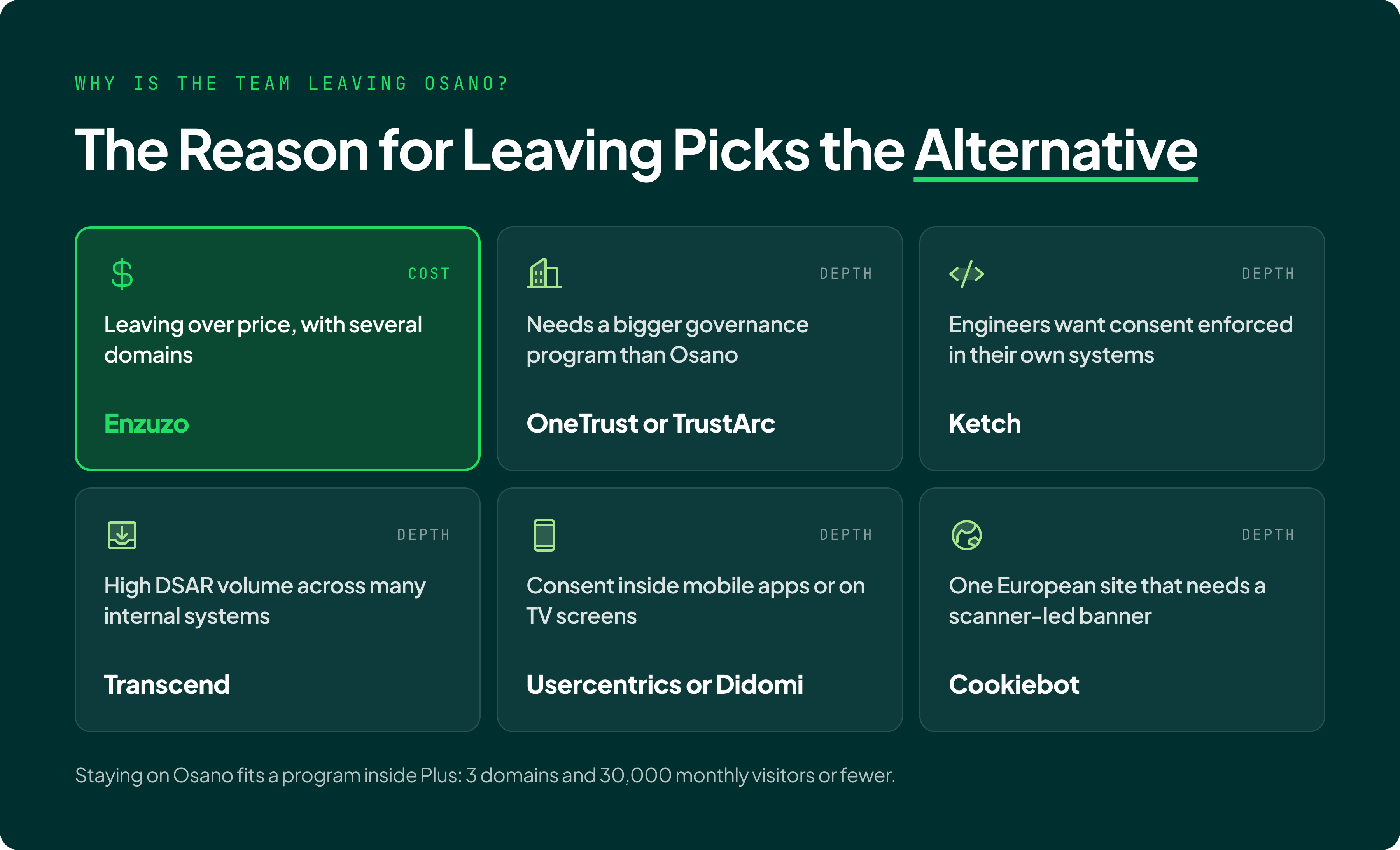
The right Osano alternative matches the same reason business look to switch away. Osano's costs spiralling? Try Enzuzo. Need more enterprise depth? OneTrust. Want a developer-friendly platform? That's Ketch.
- Leaving over price, with several domains: Enzuzo keeps consent and DSARs on one flat plan for up to 10 domains.
- Needs a bigger governance program than Osano: OneTrust for the broadest suite, or TrustArc when certifications and regulatory research matter.
- Engineers want consent enforced in their own systems: Ketch, with published visitor-based pricing.
- High DSAR volume across many internal systems: Transcend, with an engineering team to own it.
- Consent inside mobile apps or on TV screens: Usercentrics for the widest set of ad-platform signals, or Didomi for European publishers that also need preference management.
Staying on Osano is the right call for a program that fits inside Plus, with three domains and 30,000 monthly visitors or fewer. It's also right for a legal team that treats the No Fines, No Penalties pledge as a requirement and wants that promise in the contract.
Best practices of migrating from Osano
Teams switch from Osano cleanly by exporting consent logs first, then rebuilding the banner on the new platform. The order is:
- Export consent records before cancelling. Osano's Customer REST API and CSV export give access to consent logs. The export doubles as audit evidence, too, so future requests can be handled appropriately.
- Replace the extras Plus bundled. Osano's Plus includes legal templates and a UK and GDPR representative service, so each needs a new home. Teams that triggered the No Fines pledge should ask for similar guarantees from other vendors.
- Re-scan every domain on the new CMP. Cookie categories get rebuilt from a fresh scan, since trackers change between scans and a copy of Osano's list would already be stale.
- Rewire Google Consent Mode and tags in a staging site. Consent defaults and updates need to reach Google tags before the new banner goes live.
- Finish open DSARs before the switch. Requests carry legal deadlines, 45 days under the CCPA and one month under the GDPR, so close any open requests before switching.
- Swap the scripts and test by region. Osano's script comes out, the new one goes in, and the banner gets checked from EU and US locations.
- Time the switch to the renewal date. The Osano contract's notice period sets the timeline, so the new platform is live before the old one lapses.
Frequently asked questions
What are the best Osano alternatives in 2026?
The best Osano alternatives in 2026 are Enzuzo for multi-domain consent and DSARs at a flat price, OneTrust and TrustArc for enterprise governance, and Ketch and Transcend for engineering-led privacy automation. Usercentrics and Didomi lead on app and TV consent, and Cookiebot suits a single EU-focused site. The right one depends on whether a team leaves Osano over cost or over depth.
Who are Osano's main competitors?
Osano's main competitors are OneTrust and TrustArc at the enterprise end. Ketch and Transcend compete with it on privacy automation. Enzuzo, Usercentrics, Cookiebot, and Didomi compete on consent management and DSARs.
What is the cheapest Osano alternative that still handles consent and DSARs?
Enzuzo is the cheapest Osano alternative that includes consent management and a DSAR workflow on self-serve plans. Pro covers 10 domains and unlimited DSARs for $79 a month, or $59 billed yearly. Osano's Plus costs $199 a month, and does not include DSARs.
How much does Osano cost?
Osano costs $199 a month on its Plus plan and offers a limited free plan to get started. Neither the Plus nor the free include subject rights tools, Compliance Check scanning, or the No Fines pledge. Those come with Basic Privacy, which Osano quotes by sales call. The published price covers cookie consent for up to three domains and 30,000 monthly visitors.
Is Osano a Google-certified CMP?
Osano is a Google-certified CMP at the Silver tier of Google's CMP Partner Program, covering web, iOS, and Android. Enzuzo, OneTrust, Usercentrics, Cookiebot, Didomi, and TrustArc hold the Gold tier.
Which Osano alternative is best for DSAR automation?
Transcend is the strongest Osano alternative for DSAR automation when customer data is spread across many internal systems, because it fulfills requests through connected databases and SaaS tools. DataGrail, which advertises 2,500-plus system integrations, is the other DSAR specialist buyers compare with Transcend and Osano. For teams that handle a moderate number of requests alongside consent, Enzuzo includes DSAR management on its self-serve plans.
Which Osano alternatives cover AI governance?
OneTrust and Transcend are the Osano alternatives with dedicated AI governance tools: OneTrust sells AI governance modules inside its suite, and Transcend pairs a policy engine with AI governance for data use. Ketch applies consent choices to AI models, and Usercentrics sells MCP Manager, a gateway for what AI agents can reach. Osano's own AI feature answers privacy questions and helps classify cookies.
Is OneTrust better than Osano?
OneTrust is better than Osano for large enterprises that need data discovery, third-party risk, and AI governance alongside consent. Osano is better for mid-market teams that want a lighter platform, published entry pricing, and a fine-reimbursement pledge on its higher tiers.
What is the best Osano alternative for an ecommerce store?
Enzuzo is the best Osano alternative for most ecommerce stores, because it ships a native Shopify app and covers GDPR and CCPA consent across several storefronts on one flat plan. Cookiebot offers a Shopify app too, for a single store with mostly EU traffic. Enzuzo's plans include DSAR management as well, so a store handles consent and customer data requests in one tool.
Can Osano consent records be moved to another CMP?
Osano consent records can be exported through the Customer REST API or a CSV export. The safe order is export first, cancel second, so the log survives as audit evidence. Whether the new platform can load that history is a question for its support team before the switch.
Osman Husain
Osman is the content lead at Enzuzo. He has a background in data privacy management via a two-year role at ExpressVPN and extensive freelance work with cybersecurity and blockchain companies. Osman also holds an MBA from the Toronto Metropolitan University.
LinkedIn →More related blogs
Your next read