OneTrust Review 2026: Cost, Ratings & Verdict

Stephen Cooper
OneTrust Review (Updated July 2026)
OneTrust is one of the top privacy and GRC platforms, but starts at a $10,000/year minimum, making it impractical for most mid-market teams. It earns 4.3 to 4.6/5 on G2 and Capterra for feature depth, but holds a 1.5/5 on Trustpilot driven by renewal and pricing complaints. While it's best suited for enterprises with complex, multi-module compliance needs, the purpose of this review is to dive deeper into its features, complexity, support, and analyze what it truly brings to the table.
What is OneTrust?
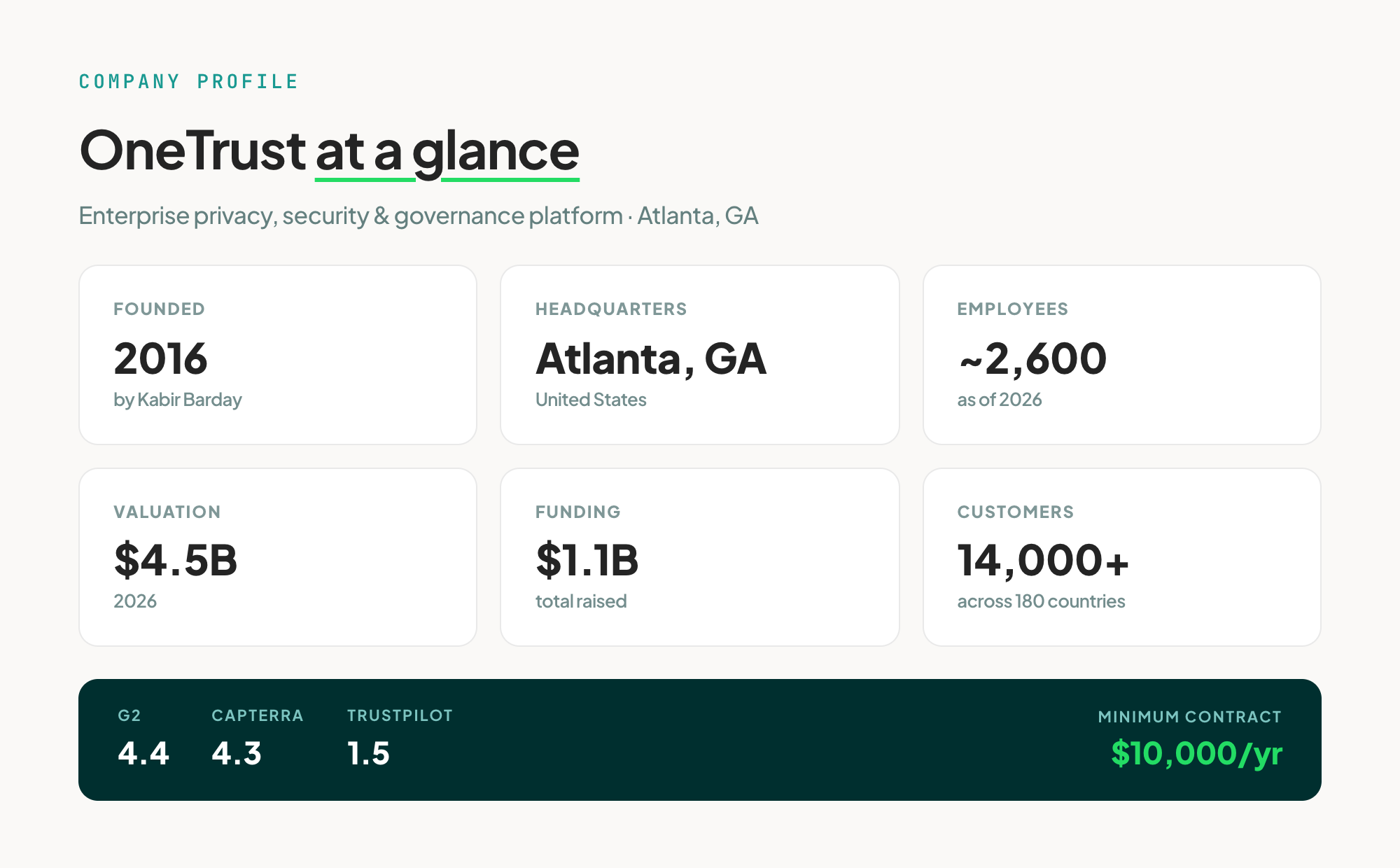
OneTrust is an enterprise privacy, security, and governance platform headquartered in Atlanta, Georgia. Founded in 2016, it now serves 14,000+ customers across 180 countries and is the market leader in enterprise consent management.
Its platform is built around seven core modules:
-
Cookie consent and preference management (CMP)
-
Data subject access request automation (DSAR)
-
Third-party risk management (TPRM)
-
Privacy impact assessments (PIA/DPIA)
-
GRC and compliance automation
-
Data discovery and classification
-
Responsible AI governance
OneTrust is Google Consent Mode v2 certified and supports GDPR, CCPA, HIPAA, LGPD, and 100+ global privacy frameworks. Its minimum annual contract starts at $10,000, making it one of the more expensive options in the GRC category.
It helps to know that OneTrust competes in two different markets at once. Its consent and privacy side competes with consent management platforms like Enzuzo, Osano, Ketch, and Cookiebot. Its tech risk & compliance side competes with tools like Vanta, Drata, Secureframe, Securiti, and BigID. Your specific business needs determine which alternatives you should be comparing it against.
How I reviewed OneTrust
This review is based on individual conversations with mid-market & enterprise buyers, analysis of sales calls, in-depth look of buyer concerns & objects, and public data aggregated across reviews on G2 (280+ reviews), Capterra (56 reviews), Trustpilot (28 reviews), and Gartner Peer Insights.
I also examined procurement pricing data from Vendr (306 recorded purchases) and Spendflo research; read through OneTrust's own product documentation; and spoke with Enzuzo's internal compliance experts; where it competes with OneTrust's Consent & Preferences module. Pricing figures were last verified in July 2026 and are re-verified quarterly. Where OneTrust does not publish a figure, I labeled it as an estimate and cited the source.
OneTrust at a glance
| Fact | Detail |
| Founded | 2016, by Kabir Barday (CEO) |
| Headquarters | Atlanta, Georgia, USA |
| Employees | 2,600 (2026, according to company profiles on Getlatka and Tracxn) |
| Revenue | $550M ARR in 2025, up from $464M in 2023 (according to Crunchbase) |
| Valuation | $4.5B, with $1.1B in total funding raised |
| Customers | 14,000+ across 180 countries |
| Flagship products | Privacy Automation, Consent & Preferences, Tech Risk & Compliance, Third-Party Management, AI Governance |
| G2 rating | 4.4/5 across 280+ reviews (product-level ratings vary; see review section) |
| Capterra rating | 4.3/5 from 56 reviews |
| Trustpilot rating | 1.5/5 from 28 reviews (verified July 2026) |
| Minimum contract | $10,000/year (effective Q2 2026) |
OneTrust SWOT analysis: strengths, weaknesses, opportunities, threats
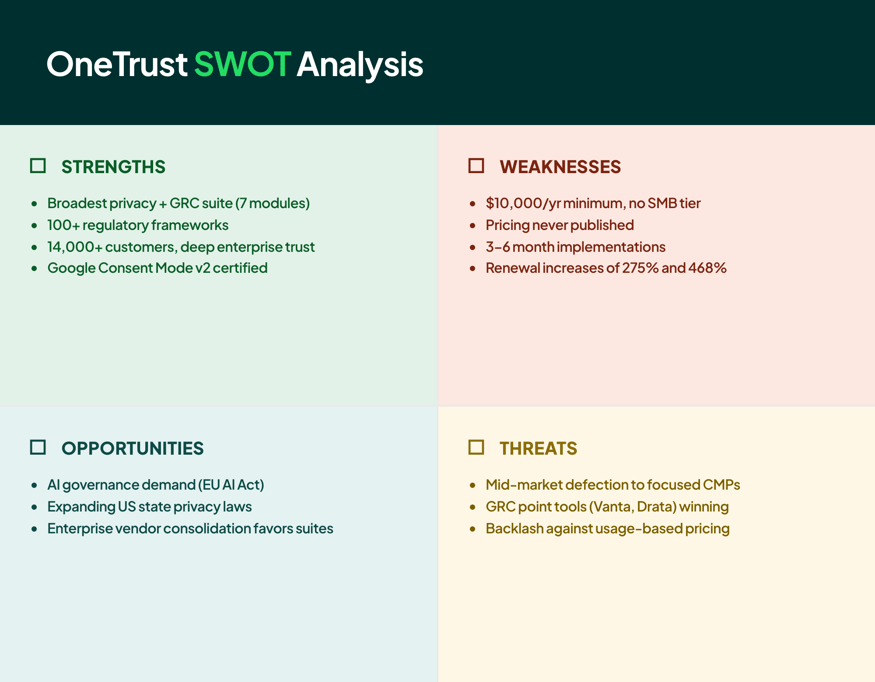
OneTrust's core strength is unmatched platform breadth across privacy, risk, and AI governance. Its core weakness is cost: a $10,000 minimum, opaque pricing, and renewal increases that have pushed mid-market customers to lighter alternatives. Its biggest opportunity is AI governance demand; its biggest threat is defection at both ends of its own market.
| Helpful | Harmful | |
| Internal | Strengths: broadest privacy + GRC suite on the market (7 modules); 100+ regulatory frameworks; Google Consent Mode v2 certified; 14,000+ customers and deep enterprise trust; strong G2/Capterra product ratings; Salesforce, ServiceNow, and Microsoft 365 integrations | Weaknesses: $10,000/year minimum with no SMB tier; pricing not published anywhere, including OneTrust's own pricing page; 3 to 6 month implementations that often require consultants; support quality tiered by spend (1.5/5 on Trustpilot, driven by renewal complaints); documented renewal increases of 275% and 468% (according to G2 reviewers) |
| External | Opportunities: AI governance demand driven by the EU AI Act and NIST AI RMF; expanding US state privacy laws increase enterprise compliance scope; enterprise vendor consolidation favors broad suites | Threats: mid-market defection to focused CMPs after the $10K minimum and the OneTrust Pro sunset; GRC point solutions (Vanta, Drata, Secureframe) winning the compliance-automation buyer; backlash against the shift to usage-based pricing |
OneTrust pros and cons
Here is a quick summary before we go module by module:
| OneTrust Pros | OneTrust Cons |
| Most comprehensive privacy + GRC suite on the market | $10,000/year minimum — no SMB or mid-market tier |
| 4.3–4.6/5 on G2 and Capterra for feature breadth | Pricing is opaque — requires a sales call to get numbers |
| Covers 7 modules: CMP, TPRM, AI governance, DSARs, and more | Implementation takes weeks to months; often requires a consultant |
| Google Consent Mode v2 certified | Support quality scales with spend — lower tiers get slow responses |
| Strong coverage: GDPR, CCPA, HIPAA, SOX, LGPD, and 100+ frameworks | Module-based pricing compounds quickly across teams |
| Large customer base with active community and integrations | Overkill for teams that only need cookie consent or a DSAR form |
OneTrust's platform is organized into product lines rather than traditional pricing tiers. Buyers pick the modules they need, which makes evaluation harder because there is no single "OneTrust experience." Below is a module-by-module review based on G2 reviews, Capterra feedback, Gartner Peer Insights, and product documentation. Each module gets its own verdict, estimated pricing, and rating where one exists.
OneTrust GRC (tech risk & compliance) review
OneTrust's GRC module automates risk and compliance workflows across SOX, SOC 2, ISO 27001, HIPAA, and PCI DSS for enterprise teams. It is rated 4.6/5 on G2 (109 reviews), the platform's strongest product rating, but the estimated $50,000+/year starting cost and heavy setup put it firmly in enterprise territory.
Estimated pricing: north of $50,000/year (estimate based on customer reports; last verified July 2026).
Rating: 4.6/5 on G2 from 109 reviews (Tech Risk & Compliance listing).
| Pros | Cons |
| Automates GRC workflows across SOX, SOC 2, ISO 27001, HIPAA, PCI DSS | Initial setup is complex and resource-intensive |
| Centralized dashboard consolidates risk and compliance in one view | Reporting and customization options are limited |
| Third-Party Risk Exchange provides instant vendor risk scores for 70,000+ businesses | Inconsistent customer support can delay problem resolution |
| Supports multi-framework compliance mapping | Dashboard UI described by multiple reviewers as needing a refresh |
SOX compliance within GRC: SOX capabilities are deeply embedded in this module rather than sold separately.
| Pros | Cons |
| Pre-mapped controls for SOX (Sarbanes-Oxley) requirements with automated evidence collection | SOX features require the full GRC module, which starts at an estimated $50,000+/year |
| Internal audit management with automated workflows for control testing and deficiency tracking | Requires significant upfront configuration to map controls to your specific IT environment |
| Audit trail generation for SOX Section 404 (internal controls over financial reporting) | The learning curve for SOX-specific workflows is steep without prior GRC platform experience |
| Integration with existing ERP and financial systems for automated control monitoring | Smaller companies subject to SOX may find the platform oversized for their control environment |
OneTrust privacy automation review
Privacy Automation is OneTrust's flagship privacy program module: GDPR, CCPA, and LGPD workflows, regulatory intelligence, and assessment automation. It is rated 4.3/5 on G2 (152 reviews). Reviewers praise the coverage and criticize the setup time and interface complexity.
Estimated pricing: the Privacy Essentials Suite (data mapping, third-party risk, incident management, PIAs) is estimated at $3,680/month (according to Spendflo research; last verified July 2026).
Rating: 4.3/5 on G2 from 152 reviews (Privacy Automation listing).
OneTrust DSAR automation review
OneTrust's DSAR (data subject access request) automation handles intake, identity verification, data retrieval workflows, deadline tracking, and audit trails. It is one of the platform's most mature capabilities, but is bundled together with privacy modules rather than as a standalone. Teams that only need DSAR handling pay for far more than they use.
DSAR automation spans intake forms, automated routing to data owners, response templates, and jurisdiction-specific deadline tracking (30 days under CCPA, one month under GDPR).
Reviewers consistently rate the workflow depth positively. The friction is commercial rather than functional: DSAR automation is part of a stack that sits behind the $10,000 platform minimum.
Companies whose DSAR volume is modest (a few requests per month) often find that a focused DSAR tool or a CMP with built-in DSAR handling covers the requirement at a fraction of the cost.
👉 Reviewing OneTrust? Book a complimentary strategy call to see if OneTrust is the best fit for your stack
OneTrust consent & preferences (cookie consent) review
OneTrust's CMP is the enterprise reference product for cookie consent: automated scanning, 250+ languages, geolocation triggers, and CTV/OTT support. Consent pricing initially cost around $827/month, but existing customers report steep renewal increases as OneTrust moves to traffic-based metering.
Estimated pricing: Consent & Preference Essentials last estimated at $827/month for a single domain. Note that OneTrust has reportedly moved away from per-domain consent pricing toward traffic-based metering; see our OneTrust pricing guide for the full breakdown.
Rating: covered within OneTrust's Privacy Automation G2 listing (4.3/5).
| Pros | Cons |
| Cookie scanner identifies and categorizes all cookies automatically | Cookie crawl has been reported to generate traffic spikes that knock sites offline |
| 250+ language support for consent forms | Account managers described as only proactive at renewal time |
| Geolocation-based consent form triggers for different regulations | Pricing has increased dramatically for existing customers |
| Templates for cookie banners, preference centers, and CTV/OTT devices | Configuration complexity is excessive for teams managing fewer than 5 domains |
OneTrust AI governance review
AI Governance is OneTrust's newest module: an inventory and risk framework for AI models mapped to the EU AI Act, NIST AI RMF, and ISO/IEC 42001. It is promising but young, with limited review data (17 reviews on Gartner Peer Insights), and it adds meaningful cost to an already expensive platform.
Estimated pricing: metered on admin users and AI inventory size (per OneTrust's packaging documentation); third-party estimates put first-year AI Governance deployments in the tens of thousands of dollars. OneTrust publishes no figures.
Rating: 17 reviews on Gartner Peer Insights (as of March 2026); too few for a stable score.
| Pros | Cons |
| Centralized inventory of AI models, datasets, and vendors across the organization | Relatively new product line with limited real-world review data |
| Risk assessments mapped to EU AI Act, NIST AI RMF, OECD Principles, and ISO/IEC 42001 | Customization described by reviewers as limited for the many variations in AI use cases |
| Auto-detection of AI models via MLOps integrations with monitoring for drift, bias, and fairness | Requires existing OneTrust ecosystem investment to get full value from cross-module data flows |
| Lifecycle governance from ideation through production to archive with audit-ready documentation | Adds significant cost on top of an already expensive platform |
OneTrust positions AI Governance as a core part of its "AI-Ready Governance Platform." The module is strongest for organizations that already use OneTrust for privacy and risk management, since it connects AI oversight to existing data maps, consent records, and third-party risk assessments. For companies without an existing OneTrust deployment, the standalone value proposition is harder to justify given the platform's overall cost and complexity.
OneTrust data discovery & classification review
Data Discovery scans structured and unstructured systems to locate and classify PII by regulation. It is genuinely useful for enterprises that do not know where their data lives, and heavy for everyone else: deployment requires real technical resources.
Estimated pricing: metered on users and privacy asset inventory (per OneTrust's packaging documentation); no published figures.
| Pros | Cons |
| Scans systems to find PII across structured and unstructured data | Requires significant technical resources to deploy scanners |
| Classifies data by regulation (GDPR, CCPA, HIPAA categories) | Performance can be slow with large data volumes |
| Integrates with cloud storage providers for automated scanning | Limited value for companies that already know where their PII lives |
OneTrust third-party risk management review
TPRM (formerly known as Vendorpedia), provides enterprises with a pre-scored database of 70,000+ vendors, automated onboarding, and continuous monitoring. It is a strong enterprise product whose value depends on committing to the broader OneTrust ecosystem.
Estimated pricing: base option estimated around $10,000/year (customer reports; last verified July 2026); metered on admin users and inventory.
| Pros | Cons |
| Pre-scored vendor database of 70,000+ companies (SIG-based) | Not every vendor a company needs will be in the database |
| Automated vendor onboarding and continuous monitoring | Questionnaire-based assessment process can feel heavy for smaller vendor relationships |
| Supply chain risk layering (vendors of vendors) | Full value requires commitment to the OneTrust ecosystem |
OneTrust preference management review
Preference Management centralizes user communication preferences (email, SMS, push) across channels. It works, but reviewers question why it is priced separately from Consent & Preferences, and smaller teams report using a fraction of the feature set.
| Pros | Cons |
| Centralized collection and management of user communication preferences across channels | Overlaps significantly with the Consent and Preferences module, making it unclear what justifies separate pricing |
| Supports preference centers that let users control email, SMS, and push notification opt-ins | Configuration complexity is excessive for teams with simple preference needs |
| Integrates preference data with marketing automation tools for personalized engagement | Smaller teams report that the feature set far exceeds what they actually use |
| Reduces opt-out rates by giving users granular control over communication types | Adds to the total platform cost without a clear standalone ROI for mid-market buyers |
OneTrust pricing in 2026
OneTrust does not publish pricing anywhere, including its own pricing page, which describes packaging and usage meters but contains no dollar figures. All plans require a sales conversation, and pricing varies based on modules, users, traffic, and jurisdictions.
Here is what publicly available data tells us about current OneTrust pricing:
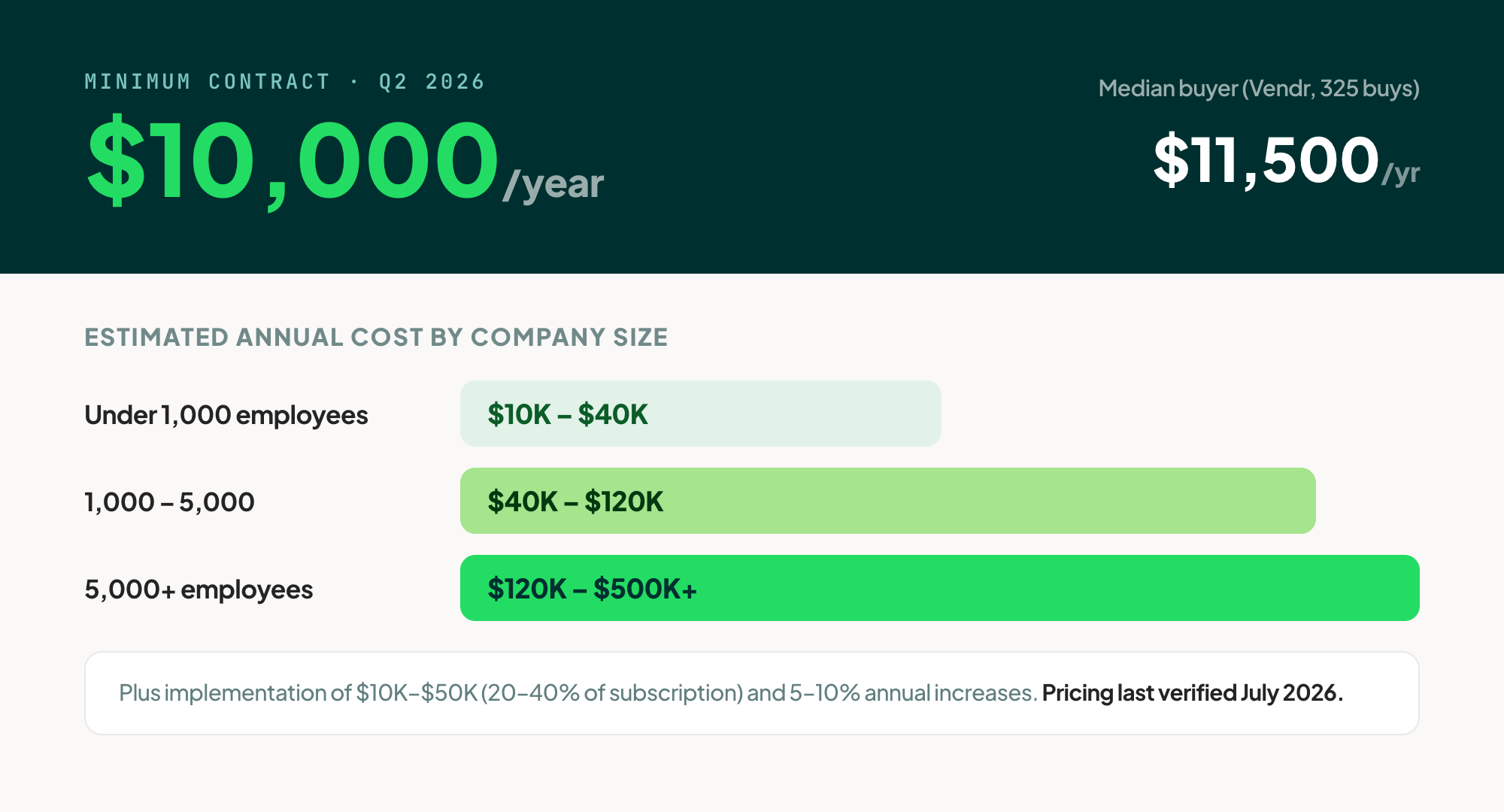
Minimum annual contract: OneTrust has raised its minimum deal size to $10,000/year, effective Q2 2026. Customers previously paying less than this threshold, including former OneTrust Pro self-serve customers, are being required to upgrade or find an alternative.
Median buyer cost: Median buyer cost: According to Vendr data based on 306 purchases, the median OneTrust buyer pays approximately $11,835/year.
By company size (based on market intelligence from multiple sources):
| Company size | Estimated annual cost |
| Small to mid-market (under 1,000 employees) | $10,000 to $40,000/year |
| Mid-market (1,000 to 5,000 employees) | $40,000 to $120,000/year |
| Enterprise (5,000+ employees) | $120,000 to $500,000+/year |
Implementation fees typically add $10,000 to $50,000 to the first year; implementation commonly runs 20 to 40% of the annual subscription. Multi-year contracts commonly include 5 to 10% annual price increases. One G2 reviewer reported receiving 275% and 468% price increases with as little as 21 days notice.
For companies that only need consent management and basic privacy compliance, these numbers represent a significant investment. More focused consent management platforms (CMPs) exist at 80 to 90% lower cost with monthly billing and same-day deployment.
How PII compliance works in OneTrust
The PII compliance workflow follows three phases. First, risk assessment: the Technology Risk module identifies security weaknesses, the Third-Party Risk module evaluates vendor security, and Data Discovery scans your systems to locate and classify PII.
Second, compliance management: the Privacy Management module provides an ongoing checklist and documentation library, logging all security measures, user training, and monitoring systems. Third, consent management: the Consent and Preferences module handles cookie consent, DSAR processing, and data subject interaction.
OneTrust does not package these modules together for specific regulations, which means buyers need to work with sales to assemble the right combination for their compliance requirements.
Is the OneTrust certification worth it?
OneTrust certifications are free online courses (with $100 in-person exam options at its TrustWeek event) that teach the OneTrust platform and general privacy concepts. They are worth taking if your team administers OneTrust. They are not a substitute for industry credentials like IAPP's CIPP/E or CIPM.
OneTrust runs its certification program through OneTrust University, with role-based tracks covering platform administration and privacy program fundamentals. The online courses are free for customers and partners, advanced tracks award Credly badges, and in-person certifications at TrustWeek cost $100 each. The program has trained over 5,000 professionals, according to OneTrust.
Two things to know before investing time. First, these are vendor certifications: they demonstrate OneTrust proficiency, which is valuable exactly as long as your organization runs OneTrust. Hiring managers treat IAPP certifications (CIPP/E, CIPM, CIPT) as the industry standard for privacy roles. Second, do not confuse certification with "OneTrust Pro": OneTrust Pro was the company's self-serve product tier, which OneTrust is sunsetting as it moves customers to the $10,000 minimum.
What do OneTrust reviewers say on G2, Capterra, and Trustpilot?
| Platform | Rating & Review Count |
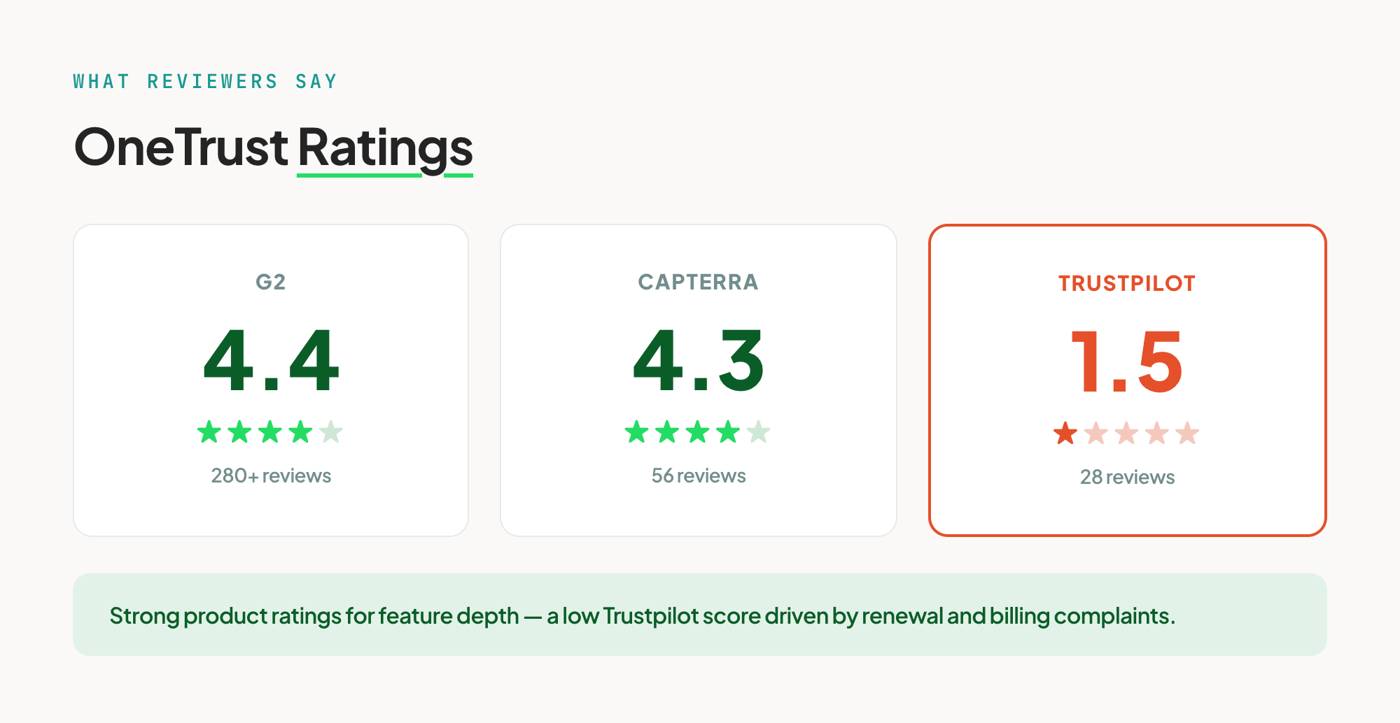
| G2 | 4.4/5 across 280+ reviews (Privacy Automation 4.3/5 from 152; Tech Risk & Compliance 4.6/5 from 109) |
| Capterra | 4.3/5 from 56 reviews |
| Trustpilot | 1.5/5 from 28 reviews (verified July 2026) |
| Gartner Peer Insights | 17 reviews for AI Governance (March 2026) |
| Overall consensus | Strong product for enterprises; expensive, complex, and increasingly resented at renewal |
What reviewers praise
According to G2 reviewers, OneTrust's strongest marks come from compliance coverage and feature depth. The most common positive themes:
- Breadth of modules: "OneTrust is the only platform that covers everything from cookie consent to AI governance in one place" (G2, Enterprise IT Manager)
- Regulatory coverage: reviewers in regulated industries (healthcare, finance, enterprise SaaS) consistently cite its multi-framework support as best-in-class
- Integrations: Salesforce, ServiceNow, and Microsoft 365 integrations are frequently highlighted as differentiators
What reviewers criticize
The most cited pain points are:
- Implementation complexity: "You basically need a consultant just to get it set up." Multiple reviewers report 3 to 6 month implementation timelines
- Pricing opacity: "We couldn't get a price without sitting through a 3-call sales process." Minimum spend of $10K is confirmed but module pricing is not published
- Support tiers: "Support quality depends entirely on how much you're paying." Reviewers on lower tiers report slow ticket resolution; enterprise accounts report dedicated CSMs
- Cost escalation: "We started with consent management and added TPRM; within 18 months we were at $80K/year" (Capterra, Head of Privacy, 500-person SaaS company)
OneTrust on Trustpilot: a different story
OneTrust holds a 1.5/5 TrustScore on Trustpilot from 28 reviews (verified July 2026). The gap between this and its G2/Capterra scores is worth understanding rather than dismissing.
Trustpilot reviews skew heavily toward billing, sales, and renewal experiences rather than product functionality. The dominant themes: renewal tactics one reviewer described as "completely shady and borderline extortion," a sales process reviewers describe as aggressive and slow to produce actual proposals, and support delays on lower-tier accounts. One reviewer reported waiting three weeks for an invoice or concrete proposal.
The fair reading: G2 and Capterra reflect what the product does, and OneTrust's product genuinely earns its ratings there. Trustpilot reflects what it is like to be a smaller OneTrust customer at renewal time, and that experience is driving the platform's worst reviews.
Who OneTrust works best for
OneTrust earns its highest satisfaction scores from:
- Enterprise companies (1,000+ employees) with dedicated privacy or legal teams
- Regulated industries: healthcare, finance, and enterprise B2B SaaS
- Teams that need multiple modules; the value proposition improves when you use 3+ products
Mid-market reviewers (50 to 500 employees) are more mixed. The most common complaint in this segment: paying for enterprise-grade complexity they don't need.
OneTrust vs. Enzuzo: a side-by-side comparison
For companies that primarily need consent management, cookie compliance, DSARs, and mid-market privacy workflows, Enzuzo is a viable alternative to OneTrust. Here is how it compares:
| Feature | OneTrust | Enzuzo |
| Starting price | $10,000/year minimum (Q2 2026) | $9/month |
| Contract terms | Annual or multi-year contracts | Monthly or annual, cancel anytime |
| Google Consent Mode v2 | Yes | Yes (Google Gold-certified CMP partner) |
| Cookie consent management | Yes, with automated scanner | Yes, with automated scanner |
| DSAR management | Yes, with automation workflows | Yes |
| Privacy policy generator | Yes | Yes |
| GDPR compliance | Yes | Yes |
| CCPA/CPRA compliance | Yes | Yes |
| IAB TCF 2.3 | Yes | Yes |
| Third-party risk management | Yes (70,000+ vendor database) | No |
| GRC and audit management | Yes | No |
| ESG reporting | Yes | No |
| AI governance | Yes | Releasing soon |
| Implementation time | Weeks to months (often requires a consultant) | Same-day setup |
| Support | Tiered; quality varies by account size | Priority onboarding for all customers |
| Ideal for | Enterprise teams with complex, multi-framework compliance | Mid-market companies needing consent management and privacy compliance |

For companies whose primary needs are consent management, cookie compliance, Google Consent Mode, and DSARs, Enzuzo's consent management platform delivers the features that matter at a fraction of the cost, with monthly contracts, same-day deployment, and no long-term commitment.
👉 Book a strategy call to see how Enzuzo can help you migrate from OneTrust and meet your consent needs
Is OneTrust worth it? My verdict
OneTrust is an excellent platform for companies that need the full GRC suite. It covers more compliance frameworks, risk categories, and governance modules than any competitor. The depth is real, and for enterprise buyers managing regulatory obligations across dozens of jurisdictions, the platform pays for itself in audit efficiency and risk reduction.
But it still struggles with the same issues reviewers have flagged: inconsistent customer support once contracts are signed, a steep learning curve that often requires paid implementation consultants, and pricing that is opaque and escalating. The minimum annual contract puts it out of reach for many mid-market companies, and the contract structures (annual or multi-year with built-in price increases) lack the flexibility that modern SaaS buyers expect.
If you are reading this review, you are likely in one of two situations. Either you are evaluating OneTrust for the first time and wondering if the investment is justified, or you are an existing OneTrust customer facing a price increase and evaluating alternatives.
For the first group: if your compliance needs extend beyond consent management into GRC, third-party risk, ESG, and AI governance, OneTrust is worth evaluating alongside Drata, Vanta, and Securiti. Get pricing from at least three vendors before committing.
For the second group: if your primary needs are consent management, cookie compliance, and DSARs, there are alternatives that deliver those capabilities at 80 to 90% lower cost with monthly contracts and same-day deployment. Our guide to the best OneTrust competitors and alternatives covers the field.
Frequently asked questions
How much does OneTrust cost per year?
OneTrust requires a minimum of $10,000/year as of Q2 2026. The median buyer pays approximately $11,835/year according to Vendr data from 306 purchases. Mid-market companies typically pay $40,000 to $120,000/year, and enterprise contracts can exceed that depending on modules and jurisdictions.
What are the main pros and cons of OneTrust?
The main pros are comprehensive regulatory coverage across 50+ frameworks, strong automation for workflows like DSARs and risk assessments, and a pre-scored vendor risk database of 70,000+ companies. The main cons are a steep learning curve, inconsistent customer support (especially for smaller accounts), opaque pricing with significant renewal increases, and implementation timelines measured in weeks or months.
Is OneTrust good for small businesses?
OneTrust is designed for mid-market and enterprise organizations. The high price, complex implementation process, and steep learning curve make it a poor fit for small businesses. More affordable alternatives like Enzuzo, Termly, and CookieYes provide consent management and basic privacy compliance at a fraction of the cost.
What is OneTrust's G2 rating?
OneTrust has separate G2 listings for each product line. Privacy Automation is rated 4.3/5 from 152 reviews. Tech Risk and Compliance is rated 4.6/5 from 109 reviews. Across all products, OneTrust holds 280+ total G2 reviews. On Capterra, OneTrust is rated 4.3/5 from 56 reviews, and on Trustpilot it holds 1.5/5 from 28 reviews.
What is OneTrust's GRC platform?
OneTrust GRC (branded as Tech Risk and Compliance) covers technology risk management, third-party risk, internal audit management, and compliance automation across SOX, SOC 2, ISO 27001, HIPAA, PCI DSS, and other frameworks. The GRC baseline is estimated to start above $50,000/year. G2 reviewers rate it 4.6/5 and praise the automation capabilities but note a cluttered interface and steep learning curve.
What are the strengths and weaknesses of OneTrust?
Strengths include unmatched breadth of compliance frameworks, a large vendor risk database, regulatory intelligence that auto-updates as laws change, and enterprise-grade audit trail capabilities. Weaknesses include opaque and escalating pricing, heavy reliance on paid implementation consultants, support quality that varies by account size, and a platform that multiple reviewers describe as slow under heavy data loads. See the SWOT analysis above for the full breakdown.
Is OneTrust cookie consent worth the price?
OneTrust's cookie consent module starts at approximately $827/month for a single domain. It includes automated cookie scanning, 250+ language support, and geolocation-based consent triggers. For companies managing 15+ domains with complex multi-jurisdiction requirements, the depth may justify the cost. For companies with fewer domains, alternatives like Enzuzo, Cookiebot, and CookieYes offer comparable cookie consent features at significantly lower price points.
How does OneTrust compare to Enzuzo for consent management?
OneTrust is a full GRC platform that includes consent management as one of many modules. Enzuzo is a focused consent management platform built for mid-market companies that need cookie banners, Google Consent Mode, DSARs, and privacy policies. OneTrust starts at $10,000/year with annual contracts. Enzuzo starts at $9/month with monthly billing. Both are Google-certified CMP Gold partners and support IAB TCF 2.3.
Is OneTrust certification worth it?
OneTrust certifications are free online courses through OneTrust University, with $100 in-person exams at TrustWeek. They are useful for teams that administer OneTrust but are not industry-standard credentials like CIPP/E or CIPM from the IAPP. See the certification section above for the full breakdown.
Is OneTrust legit?
Yes. OneTrust is an established company founded in 2016, with roughly 2,600 employees, approximately $500M in annual revenue, and 14,000+ customers including many of the world's largest enterprises. Criticism of OneTrust centers on its pricing, renewal practices, and complexity, not on the legitimacy of the company or its software.
Can OneTrust manage compliance across an entire organization with multiple websites?
Yes. OneTrust supports multi-domain and multi-entity deployments at its enterprise tiers, with consent pricing metered on traffic across properties. The practical constraint is cost: multi-property deployments are priced accordingly, and the per-usage model compounds. Mid-market teams managing several domains often compare this against CMPs with flat multi-domain pricing; Enzuzo's consent management platform, for example, includes 10 domains in a single dashboard at one flat price.
How do OneTrust, Osano, and Ketch compare for cookie consent?
All three are Google Consent Mode v2 capable consent platforms aimed at different buyers. OneTrust is the enterprise suite: deepest feature set, $10,000/year minimum, weeks-to-months implementation. Osano targets mid-market privacy programs with per-domain pricing. Ketch is API-first and suits engineering teams building consent into their own infrastructure, with longer implementation. Our [OneTrust competitors and alternatives guide](/blog/onetrust-competitors-alternatives) compares all of them side by side.
Is OneTrust a GRC tool or a privacy tool?
Both. OneTrust's Privacy and Data Governance cloud (consent management, DSARs, privacy automation) competes with privacy tools and CMPs like Enzuzo, Osano, and Cookiebot. Its GRC and Security Assurance cloud (Tech Risk & Compliance, internal audit, third-party risk) competes with compliance automation platforms like Vanta, Drata, and Secureframe. Buyers should evaluate each side against its own market rather than treating OneTrust as one product.
Stephen Cooper
Stephen Cooper started out in IT as a programmer, became an international consultant, and then took up writing. Whether writing code, presentations, or guides, Stephen relies on his degrees in Computing, Advanced Manufacturing, and Cybersecurity to generate solutions to modern challenges.
More related blogs
Your next read