OneTrust vs Ketch: Reviewed on Price, Product & Best Fit (2026)
Table of Contents
Short answer: OneTrust and Ketch overlap on cookie consent and split on almost everything around it. OneTrust is an enterprise governance suite, where consent sits alongside data mapping, vendor risk, GRC, and AI governance. Ketch is a consent-first platform priced free up to 5,000 visitors, then $150 to $499 a month, with DSAR, data mapping, and risk assessments reserved for its custom Pro tier. Pick OneTrust if you need the full governance stack in one place; pick Ketch if you want a modern, transparent CMP and can live with its privacy-ops features sitting at the top tier. Teams that need only certified consent and DSAR across a few domains tend to overpay for both, which is where a flat-priced CMP like Enzuzo fits.
OneTrust and Ketch both started as privacy tools and adopted a different product roadmap. OneTrust became a sprawling governance suite where cookie consent is one module among data mapping, vendor risk, and more. Ketch stayed consent-first, rebranded itself as an AI privacy company, and built what it calls permissioning infrastructure for the AI era.
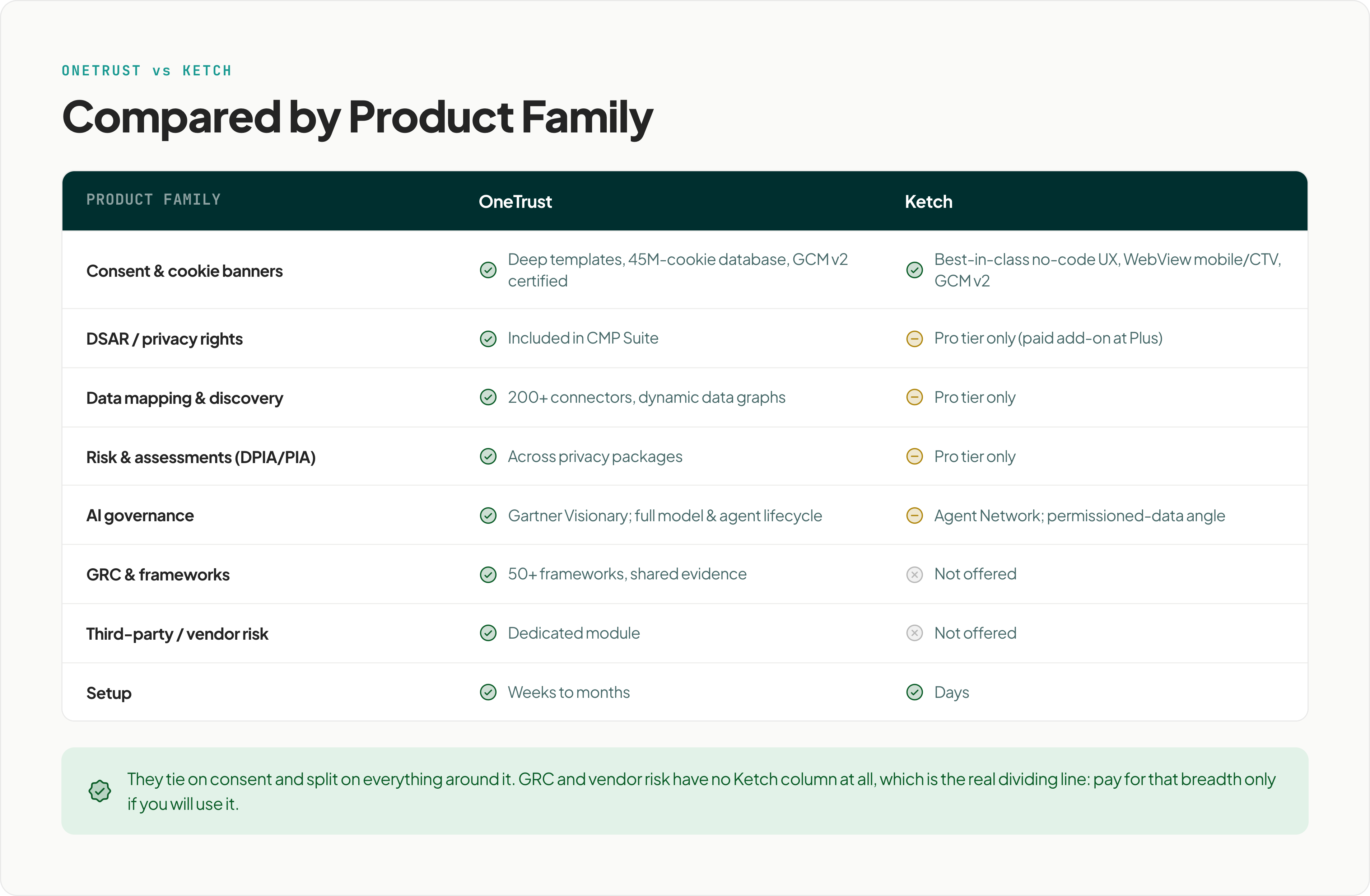
The cleanest way to compare them is family by family, because that's exactly where they diverge. They tie on consent and split hard on everything wrapped around it. Both also moved their pricing this year, so what each costs today isn't what it cost twelve months ago.
Consent management and cookie banners
This is the one family where the two are genuinely close. Both are Google Consent Mode v2 certified and IAB TCF registered, and both deploy consent across web, mobile, and CTV. If all you're weighing is core CMP capabilities, you won't go wrong with either.
Ketch wins on experience. Its banners and preference center are no-code, and reviewers consistently praise the interface for letting legal and marketing teams work without engineering. On mobile and CTV it renders through WebViews, so a banner change or an IAB framework update doesn't force an app SDK version bump.
OneTrust wins on depth. It brings a database of 45M+ categorized cookies, a broader template library, and a dedicated Universal Consent & Preference Management module for marketing-grade preference capture. For a large multi-brand estate, that breadth matters; for a single mid-market site, most of it goes unused.
Privacy rights and DSAR automation
OneTrust wins this family for most buyers, mainly on packaging. It includes DSR automation in its CMP Suite and Privacy Automation packages, so intake, ID verification, data retrieval, and secure response come in the box.
Ketch's DSAR automation is genuinely strong once you reach it: one-step Do Not Sell or Share, authenticated ID verification, and fulfillment that reaches historical data across connected systems. The catch is the tier. DSR is a paid add-on at Plus and only fully included at the custom-priced Pro plan, so Free and Starter customers don't get it at all.
Data mapping and discovery
OneTrust is the broader platform here. Its AI-driven discovery spans 200+ connectors and builds dynamic data graphs across projects, models, datasets, and vendors, which is what an enterprise privacy program needs to keep a live data inventory.
Ketch offers a capable point-and-click data map with AI-powered discovery and real-time ROPA, but the whole family is Pro-only. For a consent-first buyer that's fine, because most never turn it on; for a team that needs mapping on day one, it pushes you straight to Ketch's custom tier.
Privacy risk and assessments (DPIA and PIA)
OneTrust wins on maturity. DPIAs, assessment workflows, and mitigation are productized across its privacy and risk packages, with the audit trails an enterprise program expects.
Ketch provides customizable DPIA, PIA, and TIA templates plus automated risk detection wired into its data map, and again it lives at Pro. The assessment tooling is modern and well-integrated when you have it, but it isn't a reason to pick Ketch at the entry tiers, because it isn't there.
AI governance
Both entered AI governance in 2026, and they mean different things by it. OneTrust built a full governance platform: AI model and agent inventory, risk tiering against the EU AI Act, NIST, and ISO 42001, and runtime controls, work that earned it a Visionary spot in the inaugural Gartner Magic Quadrant for AI Governance Platforms. It also runs a separate Data Use Governance product that enforces data policies in real time at the data layer, wired into Snowflake and Databricks.
Ketch approaches AI from the data side. Its Agent Network and permissioning-infrastructure framing are about feeding clean, consented, AI-ready first-party data into models, not governing the models themselves. That puts Ketch head-to-head with OneTrust's Data Use Governance on permissioned data, even as OneTrust wins the model-governance and audit side. If your goal is program governance, OneTrust is further along; if it's keeping the data that flows into AI properly permissioned, both have a real answer and it comes down to your data stack.
GRC and third-party risk
OneTrust runs a Tech Risk & Compliance suite across 50+ frameworks with a shared-evidence model and a Third-Party Management product for vendor risk, with built-in screening and continuous monitoring. Ketch doesn't have a comparable product offering.
That's the real dividing line. If you need consent and GRC, or consent and vendor risk, in one platform, Ketch is out of the running and the choice is OneTrust or a dedicated GRC tool. If you only need consent and privacy rights, paying for that GRC breadth is money spent on capability you won't touch.
OneTrust vs Ketch recap
| Product family | OneTrust | Ketch |
|---|---|---|
| Consent and cookie banners | Deep templates, 45M-cookie database, GCM v2 certified | Best-in-class no-code UX, WebView mobile/CTV, GCM v2 certified |
| DSAR / privacy rights | Included in CMP Suite | Pro tier only (paid add-on at Plus) |
| Data mapping and discovery | 200+ connectors, dynamic data graphs | Pro tier only |
| Risk and assessments (DPIA/PIA) | Across privacy packages | Pro tier only |
| AI governance | Gartner Visionary; full model and agent lifecycle | Agent Network; permissioned-data angle |
| GRC and frameworks | 50+ frameworks, shared evidence | Not offered |
| Third-party / vendor risk | Dedicated module | Not offered |
| Setup | Weeks to months | Days |
OneTrust vs Ketch pricing comparison
Both companies changed how they price this year, and they landed on the same trap: your bill scales with your traffic, and with OneTrust you can't even see the number without a sales call.
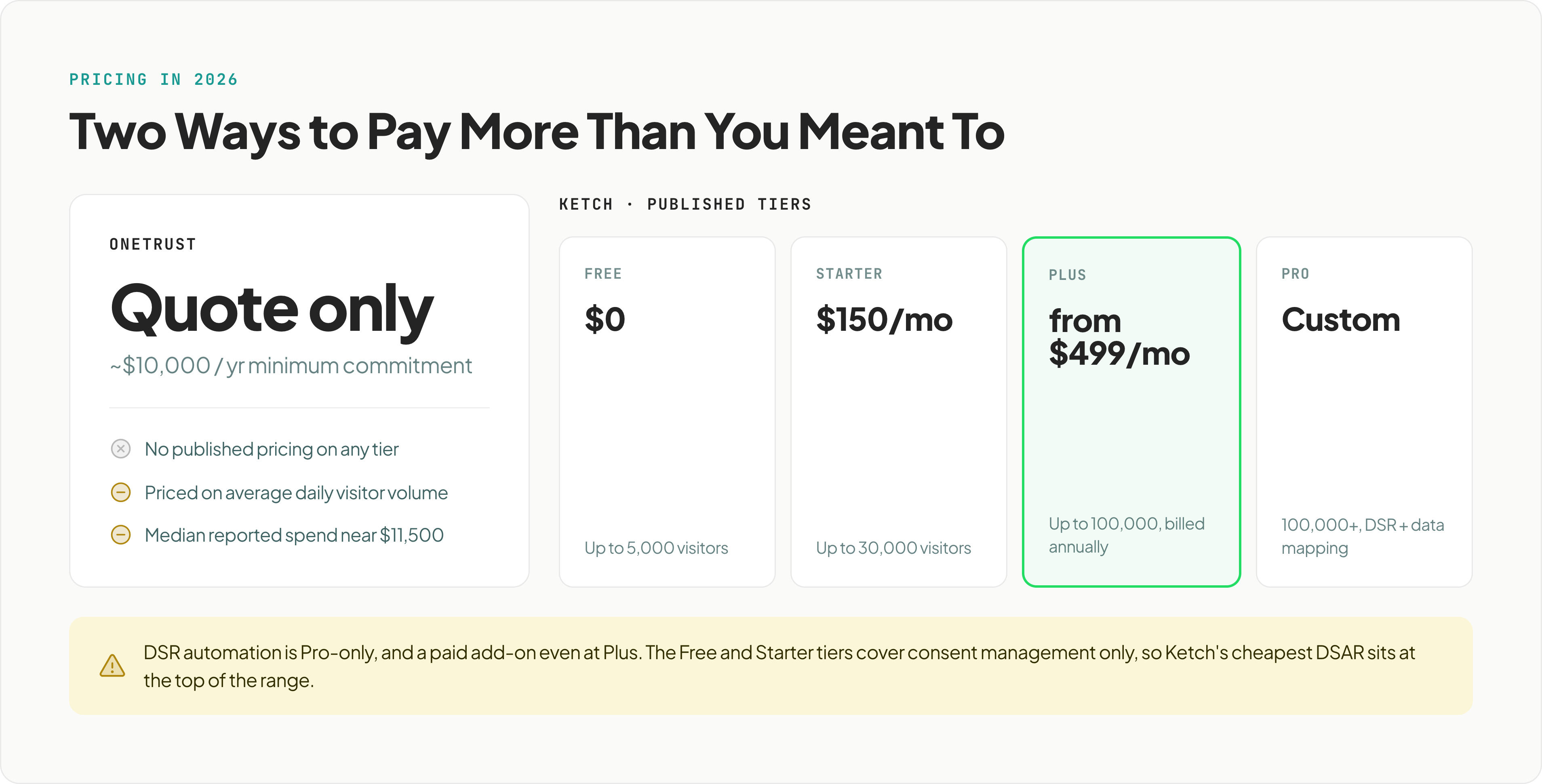
OneTrust moved from module licenses to five solution packages, none of which publish a price. The consent packages are priced on average daily visitors aggregated across all your properties; the marketing package on data-subject profiles; the governance packages on admin users plus inventory. Procurement data puts the minimum annual commitment around $10,000 a year, with median spend near $11,500. In practice, a mid-market team pays enterprise money for a CMP wrapped in a suite it may not use.
Ketch publishes its tiers and reserves the fourth for sales:
| Plan | Price | Visitors/mo | What's included |
|---|---|---|---|
| Free | $0 | up to 5,000 | Full CMP, 2 integrations, email support |
| Starter | $150/mo (billed monthly) | up to 30,000 | Full CMP, 2 integrations, email support |
| Plus | from $499/mo (billed annually) | up to 100,000 | Full CMP, 2 integrations, live onboarding; DSR and rights workflows as add-ons |
| Pro | Custom | 100,000+ | Everything: DSR automation, data mapping, risk assessments, marketing preference management, enterprise tooling |
Ketch's prices are the honest part of this comparison, but read the tiers, not the headline. Plus has climbed from around $333 a year ago, and everything in the privacy-ops families above sits at Pro.
OneTrust vs Ketch: What do reviews say?
Reviewers give Ketch the higher satisfaction scores, and independent sources back it up.
On G2, Ketch rates 4.6 out of 5 across 171 reviews. OneTrust's closest equivalent, Privacy Automation, sits at 4.3 across 154. One caveat cuts against a clean read: OneTrust's consent product itself carries just 16 G2 reviews, so CMP-to-CMP evidence is thin on its side.
On Gartner Peer Insights the gap looks similar. Ketch scores 4.7 from 32 ratings; OneTrust's Tech Risk & Compliance scores 4.1 from 109. These are different products and Ketch's sample is small, so read it as company sentiment, not a feature verdict.
Ketch's reviewers cite an intuitive interface, responsive support, and setup measured in hours or days; the recurring gripe is a learning curve on advanced features, and steeper prices. OneTrust's reviewers value the breadth and how it streamlines supplier and compliance assessments; the recurring gripe is that onboarding and customization is a real engineering bottleneck.
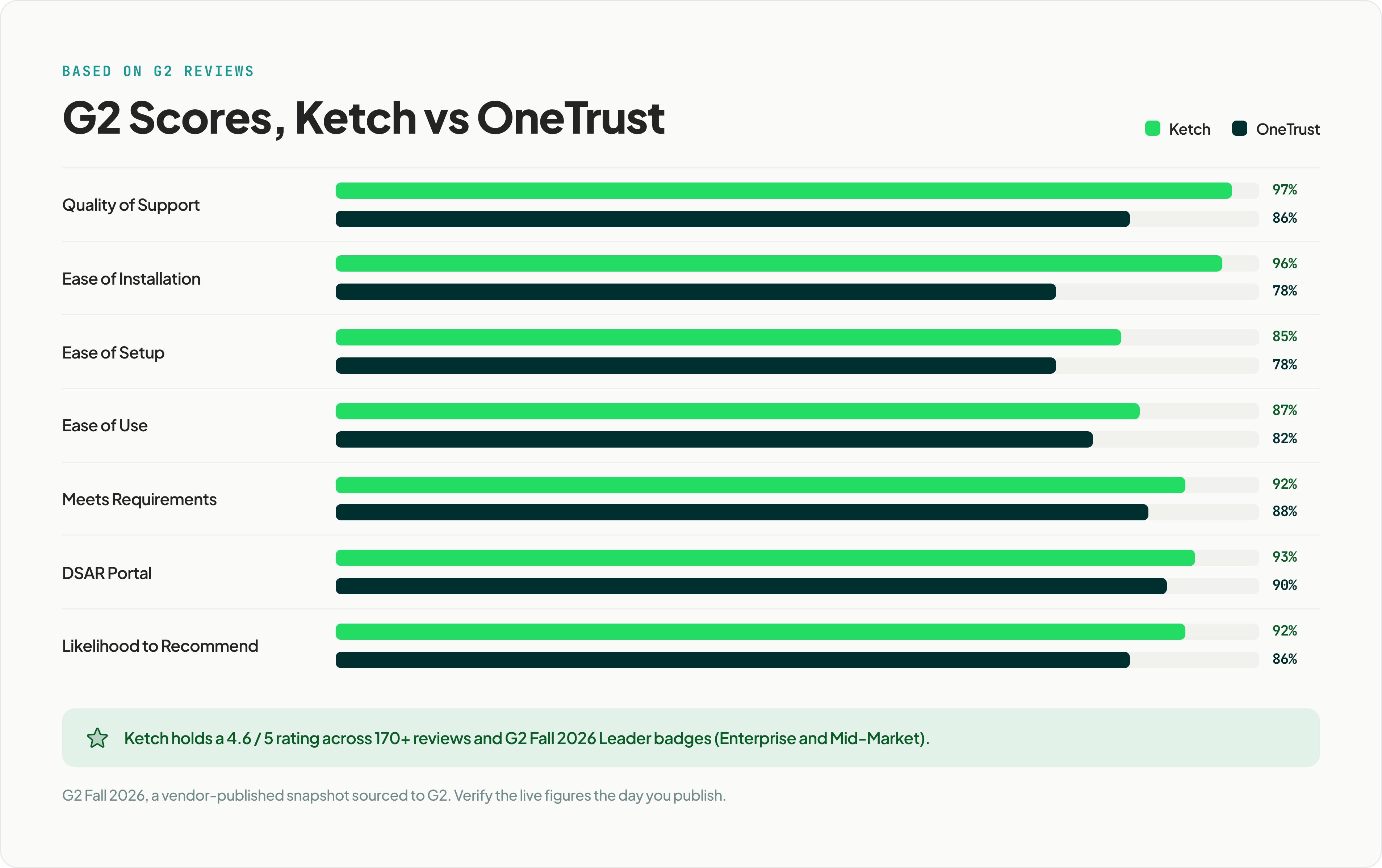
Ketch also publishes its own head-to-head G2 scorecard, and it comes out ahead in every category it lists, so take this with a grain of salt:
| Category (G2 Fall 2026) | Ketch | OneTrust |
|---|---|---|
| Quality of Support | 97% | 86% |
| Ease of Installation | 96% | 78% |
| Ease of Setup | 85% | 78% |
| Ease of Use | 87% | 82% |
| Meets Requirements | 92% | 88% |
| DSAR Portal | 93% | 90% |
| Likelihood to Recommend | 92% | 86% |
How OneTrust and Ketch compare to Securiti, BigID, TrustArc, and Osano
Buyers rarely shortlist just two tools. Four names come up most often alongside OneTrust and Ketch:
- Securiti and BigID are data security and governance platforms; they compete with OneTrust's data-mapping and AI-governance side more than with a pure CMP.
- TrustArc is a legacy privacy-compliance suite with enterprise heritage and a quote-based motion much like OneTrust's.
- Osano is a mid-market CMP with per-domain pricing, the closest like-for-like consent comparison and a common OneTrust alternative alongside Enzuzo.
If your shortlist includes these, see our guide to OneTrust alternatives and the individual matchups.
Neither fits? Consider Enzuzo, the flat-priced third option
Three real situations compel teams to look past both: leaving OneTrust over the roughly $10K minimum, finding Ketch's real cost (Pro, for DSAR and data mapping) higher than expected, or wanting certified consent without an enterprise platform wrapped around it. Enzuzo's consent management platform was built for that gap.
Enzuzo is a Gold-category certified Google CMP built GTM-first, so Consent Mode v2 works the way mid-market analytics teams deploy it. Setup runs in hours with Slack-first support, pricing is flat and published, DSAR is included rather than gated to a top tier, and multi-domain is standard.
It deliberately doesn't chase the GRC, vendor-risk, and full AI-governance families that justify OneTrust's price, because most mid-market teams never use them.
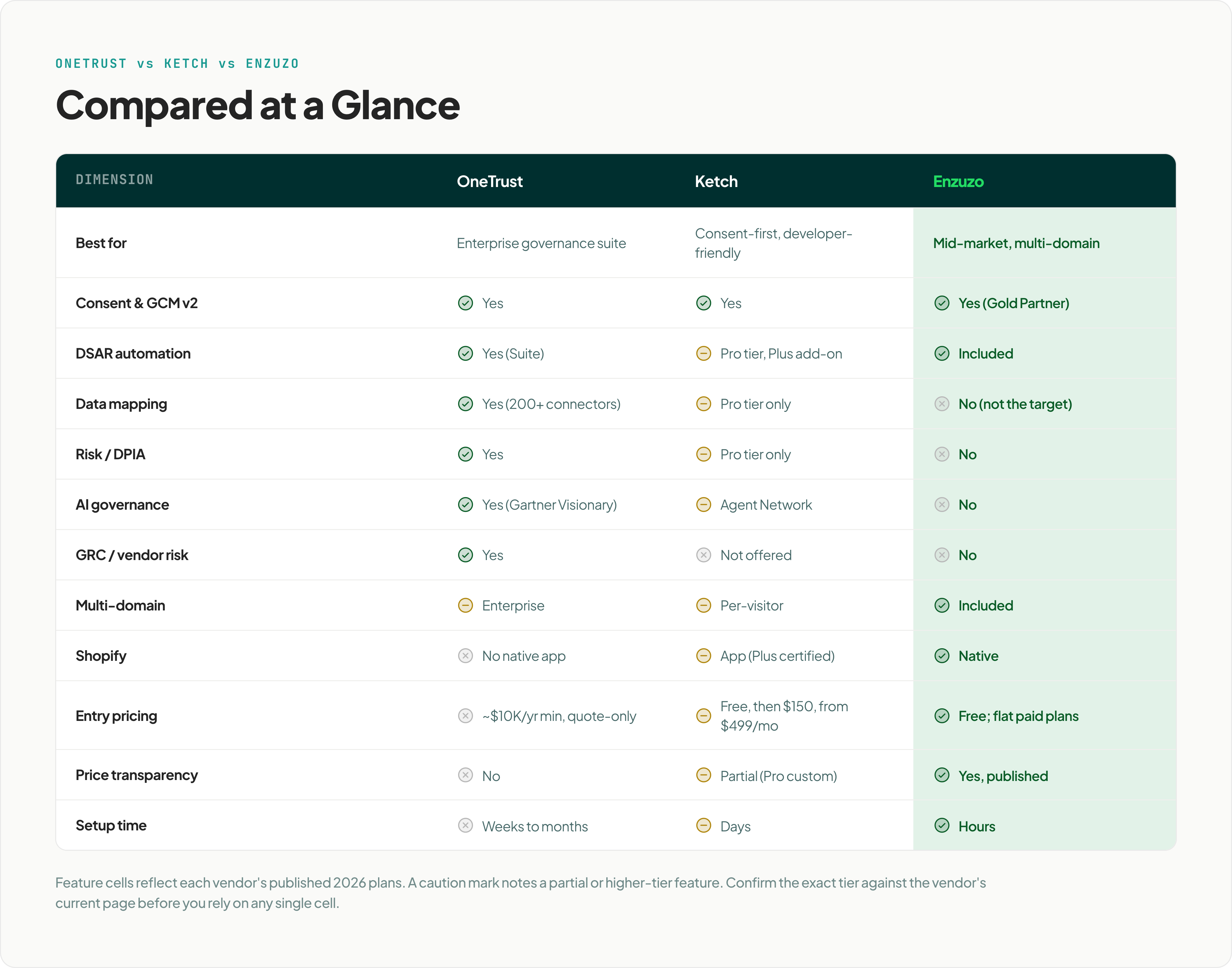
Here is how all three line up:
| OneTrust | Ketch | Enzuzo | |
|---|---|---|---|
| Best for | Enterprise governance suite | Consent-first, developer-friendly | Mid-market, multi-domain |
| Consent and GCM v2 | Yes | Yes | Yes (Gold Partner) |
| DSAR automation | Yes (Suite) | Pro tier, or Plus add-on | Included |
| Data mapping | Yes (200+ connectors) | Pro tier | No (not the target) |
| Risk / DPIA | Yes | Pro tier | No |
| AI governance | Yes (Gartner Visionary) | Agent Network | No |
| GRC / vendor risk | Yes | No | No |
| Multi-domain | Enterprise | Per-visitor | Included |
| Shopify | No native app | App (Plus certified) | Native |
| Entry pricing | ~$10K/yr min, quote-only | Free, then $150, then from $499/mo | Free; flat paid plans |
| Price transparency | No | Partial (Pro is custom) | Yes, published |
| Setup | Weeks to months | Days | Hours |
👉 Book a OneTrust or Ketch migration assessment with our team →
Frequently Asked Questions
Which is better, OneTrust or Ketch?
Neither wins outright; the deciding factor is scope. Pick OneTrust if you need a full governance suite, Ketch if you need consent-first with transparent pricing, and a flat-priced CMP like Enzuzo if you need only certified consent and DSAR.
How much does Ketch cost in 2026?
Ketch is free up to 5,000 monthly visitors, then $150 a month (Starter, up to 30,000 visitors) and from $499 a month billed annually (Plus, up to 100,000 visitors). The Pro tier, which adds DSR automation, data mapping, and risk assessments, is custom-priced. DSR automation is a paid add-on at Plus and included only at Pro.
How much does OneTrust cost in 2026?
OneTrust does not publish prices. It sells solution packages priced on average daily visitor volume for consent, with a minimum annual commitment around $10,000 as of 2026 and median reported spend near $11,500. Final pricing depends on packages, volume, and negotiation.
Does Ketch include DSAR automation?
No, not at every tier. Ketch's DSR automation is a paid add-on on the Plus plan and included on the custom-priced Pro plan. The Free and Starter tiers cover consent management only.
Is OneTrust or Ketch better for DSAR and DPIA workflows?
OneTrust is the stronger fit for most buyers, because it productizes DSR automation, DPIAs, and mitigation workflows inside its privacy packages. Ketch offers capable versions of both, but gates them to its Pro tier.
Who are OneTrust's and Ketch's main competitors?
In enterprise governance, the main names are TrustArc, Securiti, and BigID. In consent management specifically, the field includes OneTrust, Ketch, Cookiebot, Osano, Didomi, and Enzuzo. OneTrust refers mid-market customers who only need consent to lighter CMPs.
Is there a cheaper alternative to both OneTrust and Ketch?
Yes, and it is a flat-priced CMP. Flat-priced platforms cover the same certified consent core (Google Consent Mode v2, GDPR and CCPA, DSAR, multi-domain) without enterprise minimums or per-visitor tier jumps. Enzuzo offers a free plan and flat paid tiers with DSAR included, and is a certified Google CMP Gold Partner.

Osman Husain
Osman is the content lead at Enzuzo. He has a background in data privacy management via a two-year role at ExpressVPN and extensive freelance work with cybersecurity and blockchain companies. Osman also holds an MBA from the Toronto Metropolitan University.