OneTrust vs Ketch vs TrustArc: Pricing, Features & Best Fit (2026)

Osman Husain
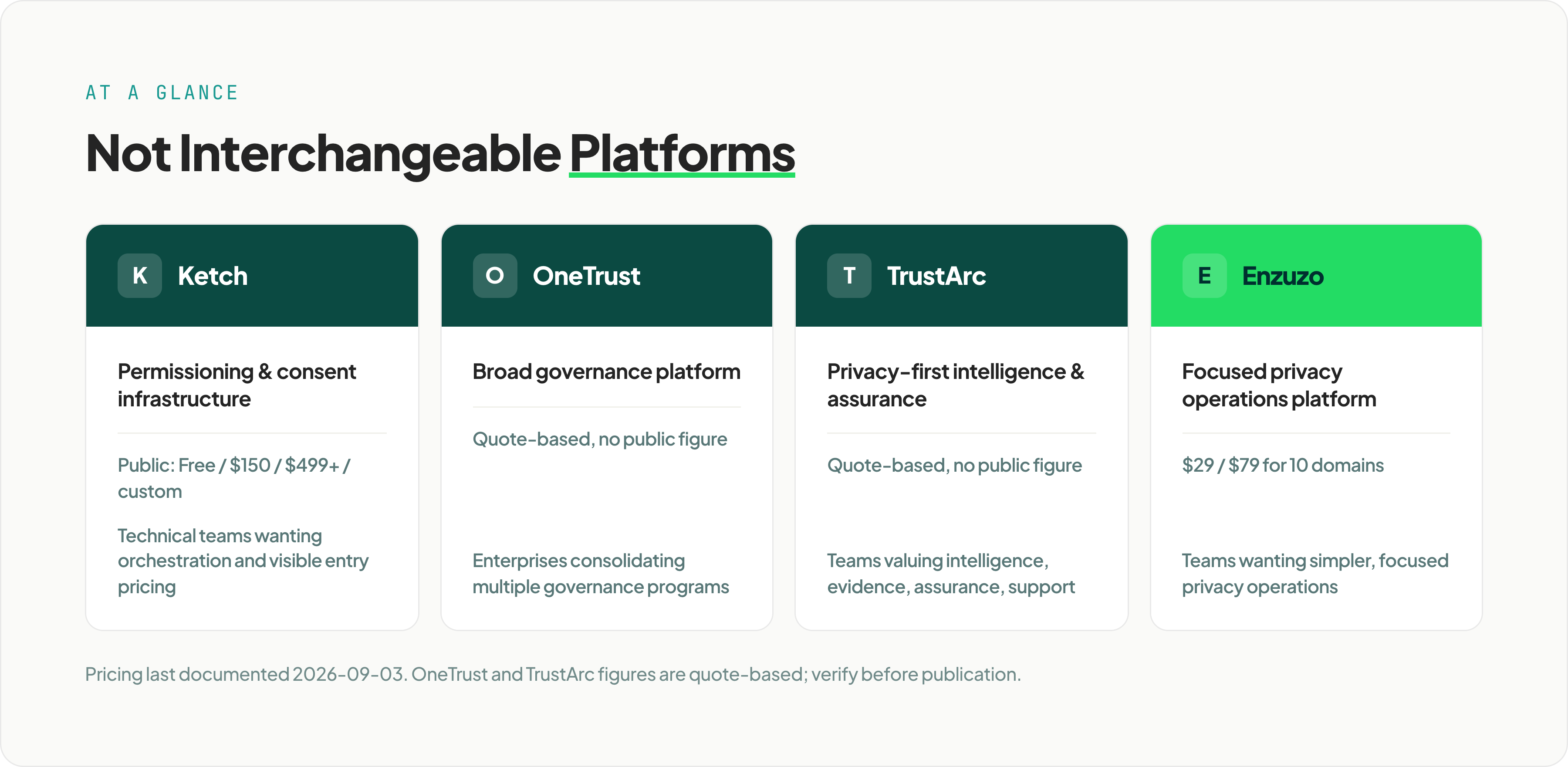
Quick answer: Ketch is a permissioning and consent infrastructure platform with public entry pricing and APIs. OneTrust is a broad governance platform that combines consent with privacy automation, technology risk, third-party management, and AI governance. TrustArc is a privacy-first intelligence and assurance suite that combines consent and consumer rights with regulatory research, assessments, data mapping, certifications, and services.
Ketch, OneTrust, and TrustArc are not interchangeable versions of the same privacy platform. Ketch fits teams that want control over data signals; OneTrust fits enterprises consolidating governance programs; TrustArc fits privacy teams that value intelligence, evidence, assurance, and support.
Ketch lists Free at $0 for up to 5,000 monthly unique visitors, Starter at $150 per month for up to 30,000, Plus from $499 per month billed annually for up to 100,000, and Pro at custom pricing. Rights Workflows is listed as a Plus add-on, while DSR automation, data mapping, risk assessments, and marketing preference management are listed under Pro.
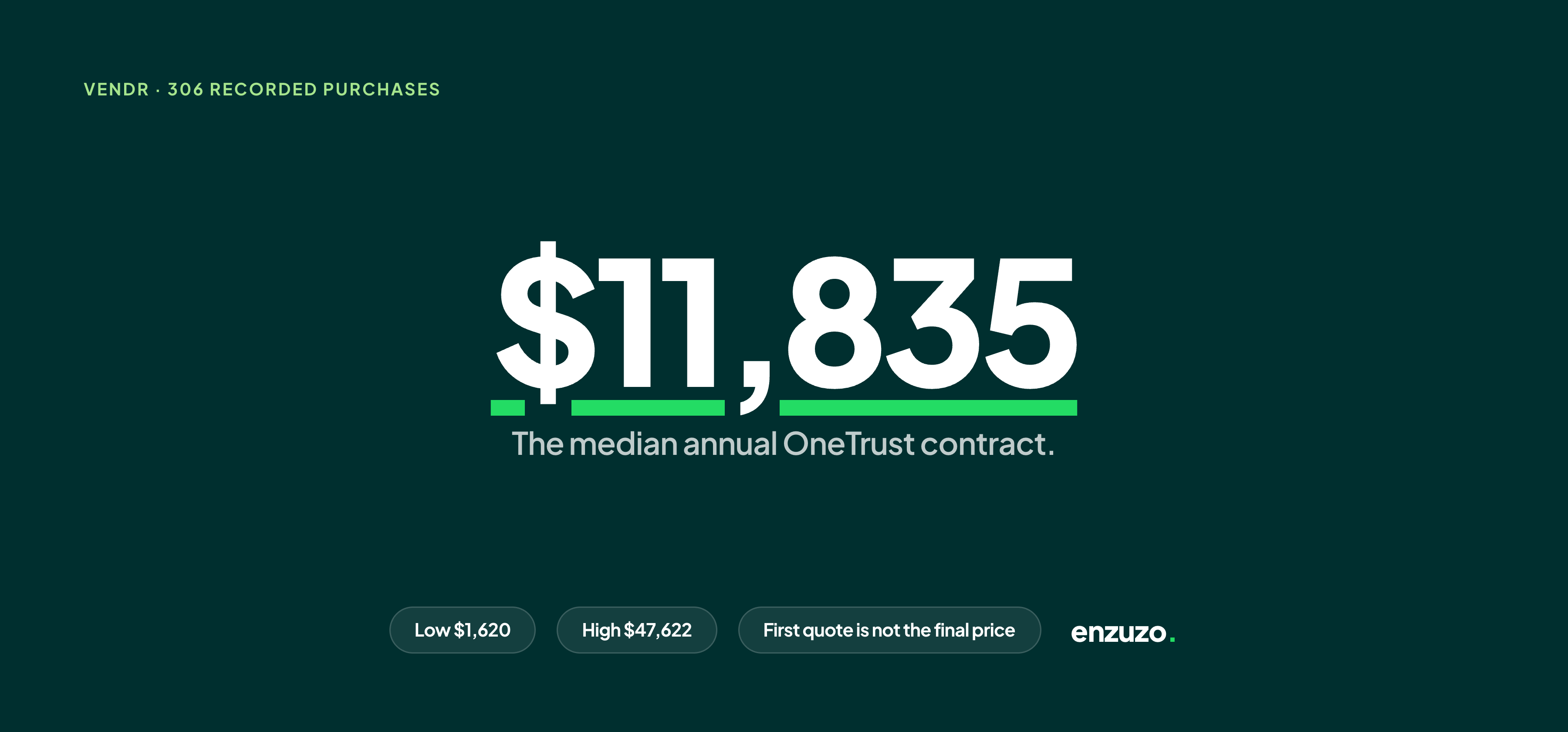
OneTrust and TrustArc route buyers to customized or quote-based pricing, with OneTrust's minimum commitment starting at $10,000 annually.
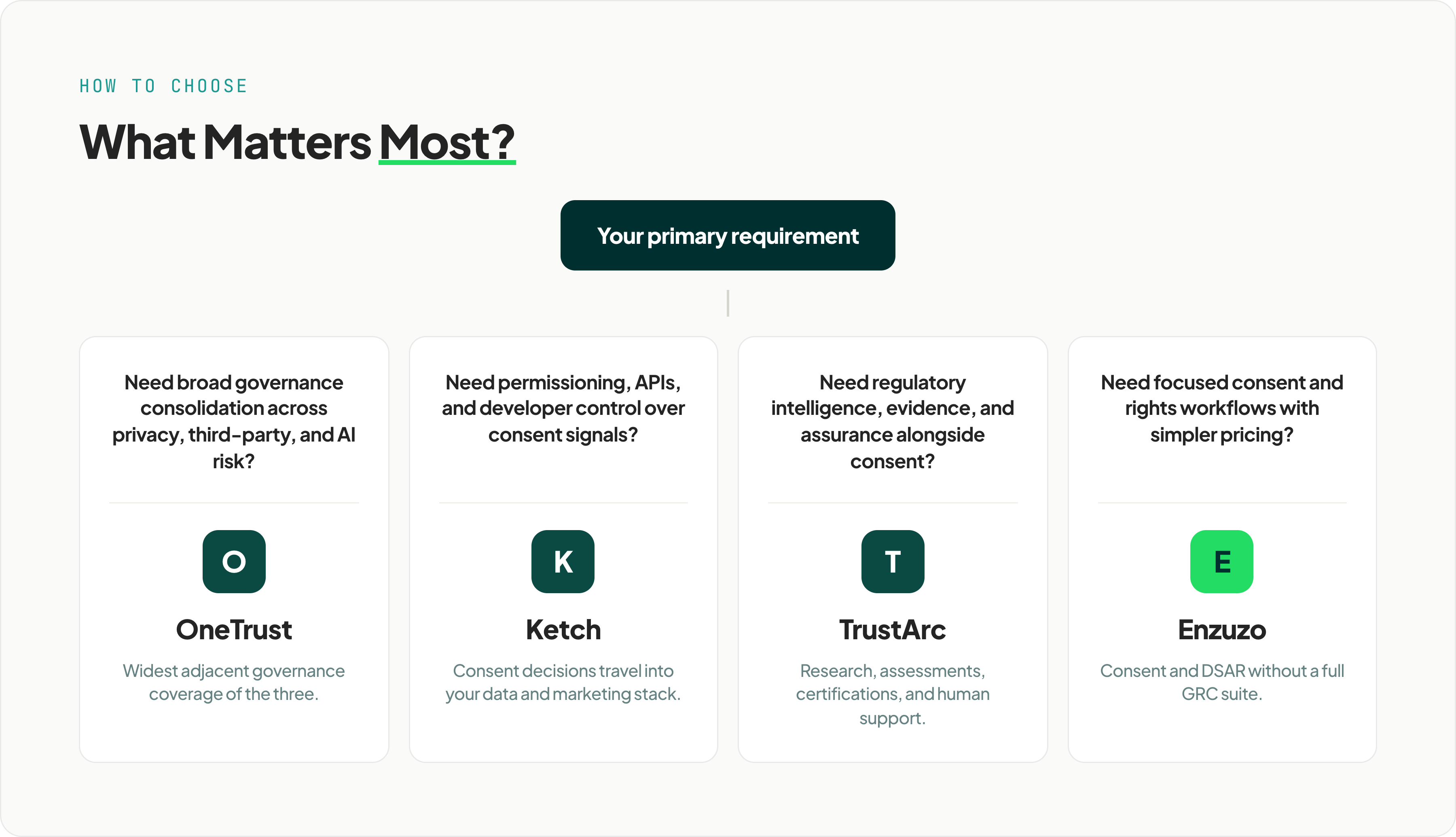
For a global enterprise, choose OneTrust when consolidating multiple governance programs matters most, TrustArc when privacy intelligence and assurance matter most, and Ketch when modern consent orchestration and developer control matter most. Enzuzo is worth a separate look when you need consent and rights workflows with simpler pricing and timely support.
Who should compare OneTrust, Ketch, and TrustArc?
Teams starting an evaluation process between the three platforms usually cover consent, preference management, subject-rights requests, data mapping, integrations, implementation ownership, and costs. For broader category research, start with consent platforms and enterprise CMPs.
In this guide, we break down each platform into its individual strengths and weaknesses followed by focused explainers on feature buckets.
OneTrust: the broad governance platform
OneTrust covers the widest surface area among these three products. Its platform includes consent and preferences with privacy automation, technology risk and compliance, third-party management, data use governance, and AI governance.
Geolocation-aware policies, multilingual templates, discovery of cookies, trackers, SDKs, and third parties, plus deployment across websites, mobile apps, and OTT or CTV environments are part of the OneTrust package.
That breadth matters when privacy is a single program within a larger governance function. A global enterprise may want the same platform to manage consent, data inventories, vendor risk, technology controls, and AI-related oversight.
OneTrust’s pricing page routes buyers to customized pricing and describes different bases for different packages, including admin users, AI inventory, visitors, or third-party inventory. It does not publish an exact consent price or universal minimum but annual contracts start around $10,000 before any negotiated discounts.
OneTrust is the natural starting point when governance teams need one enterprise platform for a rigorous compliance program. It's less suited for teams that need focused CMPs without the extra bells and whistles.
The right question is not whether OneTrust can handle consent. It can. The question is whether the other governance modules justify the price and onboarding complexity.
For a narrower two-vendor decision, use OneTrust vs Ketch and OneTrust vs TrustArc as companion comparisons.
Ketch: the permissioning and orchestration platform
Ketch leads with consent, but its product frame is broader. The platform combines consent signals with identity, orchestration, data mapping, marketing preferences, DSR workflows, and privacy risk. Its consent product includes server-side consent records, tracker scanning, native SDKs, enforcement across devices and APIs, and hundreds of integrations. That makes Ketch a credible fit for teams that want consent decisions to travel into their data and marketing systems.
Ketch is the only vendor here with public Free, Starter, and Plus figures. Its pricing page lists Free at $0 for up to 5,000 monthly unique visitors, Starter at $150 per month for up to 30,000, Plus from $499 per month billed annually for up to 100,000, and Pro with custom pricing.
The public CMP price does not describe the full Ketch product. Rights Workflows is listed as a Plus add-on. Full DSR automation, data mapping, privacy risk assessments, and marketing preference management are listed under Pro.
Ketch also promotes Ketch Switch, Quiet Mode, open APIs, and migration support for teams moving away from a legacy platform. Customers go live typically in three weeks, but each rollout will depend on individual complexity.
Ketch is the strongest fit when engineers, data teams, and marketers need a consent layer that can send permissions into other systems. It is a weaker fit when the buyer needs a mature privacy assurance program, a large regulatory research function, or broad third-party and technology risk governance within the same suite.
TrustArc: the privacy-first intelligence and assurance suite
TrustArc organizes its offering around privacy operations rather than consent alone. Its Privacy Studio includes Cookie Consent Manager, Consent and Preference Manager, Individual Rights Manager, and a Unified Trust Center. Its Governance Suite adds privacy program management, data mapping and risk, assessments, and Nymity Research. TrustArc also sells assurance services and certifications.
The consent and preference layer is substantive. TrustArc describes real-time consent activity across brands and channels, third-party cookie and tracker scanning, dynamic preference centers, and a centralized repository for consent and first-party preferences. Its consumer preference materials describe synchronization with Salesforce, Adobe, Microsoft Dynamics, and other systems through APIs and integrations.
TrustArc’s DSR workflow is similarly detailed. Its DSR automation materials describe intake, identity authentication, search across 300 or more connected systems, validation, redaction or updates, secure delivery, due-date tracking, expiration, password protection, and audit tracking. TrustArc also describes DSR coverage across 50 or more jurisdictions.
TrustArc is also explicit about Google Consent Mode. Its current GCM page states Gold status for web and mobile and describes Firebase and app-attribution integrations.
TrustArc fits a privacy team that wants legal and operational context alongside software. It is less compelling if the requirement is only a low-cost banner or an API-first permissioning layer. Its value appears when regulatory intelligence, evidence, certifications, and human support are part of the operating model.
Consent management and cookie banners
All three vendors have a credible consent product. The difference lies in where consent sits within the architecture.
Ketch treats consent as a signal that can be recorded server-side and enforced across devices, applications, and downstream systems. OneTrust treats consent as one module inside a larger governance platform and emphasizes policy templates, geolocation, discovery, multilingual experiences, and web, mobile, and OTT/CTV coverage. TrustArc combines cookie consent with consumer preferences, rights workflows, and privacy intelligence.
If your main requirement is a banner that passes a basic launch checklist, any of these will suffice. The real test comes with advanced workflows like cookie tracker discovery, regional policy resolution, SDK behavior, consent audit trails, tag enforcement, accessibility, and geofencing.
Privacy preferences and first-party data
Preference management is the dividing line between a banner tool and a broader permission system. Ketch’s marketing preference product connects privacy and marketing choices through APIs, a headless preference center, and cross-system synchronization. OneTrust’s consent and preference offering is designed for governed purposes, branded experiences, and enterprise change management. TrustArc emphasizes a centralized repository that synchronizes consumer choices through a marketing and vendor ecosystem.
DSAR automation and consumer rights
DSAR automation is where the free or entry tier stops being a reliable comparison. Ketch’s public Free, Starter, and Plus pages do not position full DSR automation as an entry-tier feature. Ketch places the capability in Pro or add-on packaging.
OneTrust packages DSR workflows through CMP Suite or Privacy Automation. TrustArc describes an Individual Rights Manager workflow with identity verification, search, secure delivery, and audit tracking, but its exact price is not revealed.
That leaves three different questions for procurement. Which workflows are included? Which systems are connected without professional services? Which tier includes the volume and types of requests you expect next year? Ask vendors to process a realistic access, deletion, and correction request during the evaluation.
Data mapping, assessments, and risk
OneTrust, Ketch, and TrustArc all describe data mapping and assessment capabilities, but they package the work differently. OneTrust emphasizes connectors, data discovery, dynamic data graphs, policy controls, and privacy automation. Ketch emphasizes agent-assisted discovery of systems and contracts, continuous classification, ROPA generation, and risk assessments connected to a live data map. TrustArc emphasizes its risk engine, data inventory, assessments, audit reporting, and integrations across more than 300 systems.
Those descriptions are not interchangeable proof of the same outcome. Ask each vendor to show how a new system enters the inventory, how a data owner is assigned, how a processing activity becomes a ROPA record, and how a DPIA or PIA changes when the underlying data flow changes.
GRC, third-party risk, and AI governance
OneTrust presents the clearest breadth when consent must sit beside technology risk, third-party management, data-use governance, and AI governance. TrustArc comes from a privacy-first angle, with Nymity regulatory research, assessment workflows, assurance, certifications, and a Trust Center. Ketch brings AI-era permissioning, orchestration, and privacy risk into the conversation, but its materials do not establish the same breadth of GRC and assurance.
The split is clear. If you need a broad GRC platform, start with OneTrust and compare TrustArc’s privacy governance depth against it. If you need permission-aware data activation, start with Ketch. If you need a focused privacy product rather than a full governance suite, the GRC software category is worth investigating further.
How to choose between Ketch, OneTrust, and TrustArc
Choose OneTrust if you need consent to sit inside a wider program covering privacy automation, third-party risk, technology risk, data-use governance, or AI governance. OneTrust’s breadth is the point. Do not buy that breadth accidentally if your project is only a consent deployment.
Choose Ketch if consent, identity, APIs, orchestration, and developer control are central to the project. Ketch has the clearest public entry pricing, but budget for Pro or custom packaging when DSR automation, data mapping, or risk assessments become requirements.
Choose TrustArc if your privacy team values regulatory intelligence, documented evidence, assessments, assurance, certifications, and implementation support alongside consent and consumer-rights workflows. Ask for the exact commercial scope because the captured TrustArc materials do not publish a universal plan price.
Choose Enzuzo if you need consent and rights workflows with simpler plan economics and do not need every GRC, assurance, regulatory-research, or third-party-risk module in the same purchase. Start with consent software, then confirm the plan against your domains, traffic, and workflows.
Where does Enzuzo fit?
Enzuzo is the focused option in this comparison: consent and DSAR workflows for mid-market teams. It skips the governance suite OneTrust sells, the assurance and research practice TrustArc sells, and the Pro-tier packaging that holds Ketch’s privacy modules.
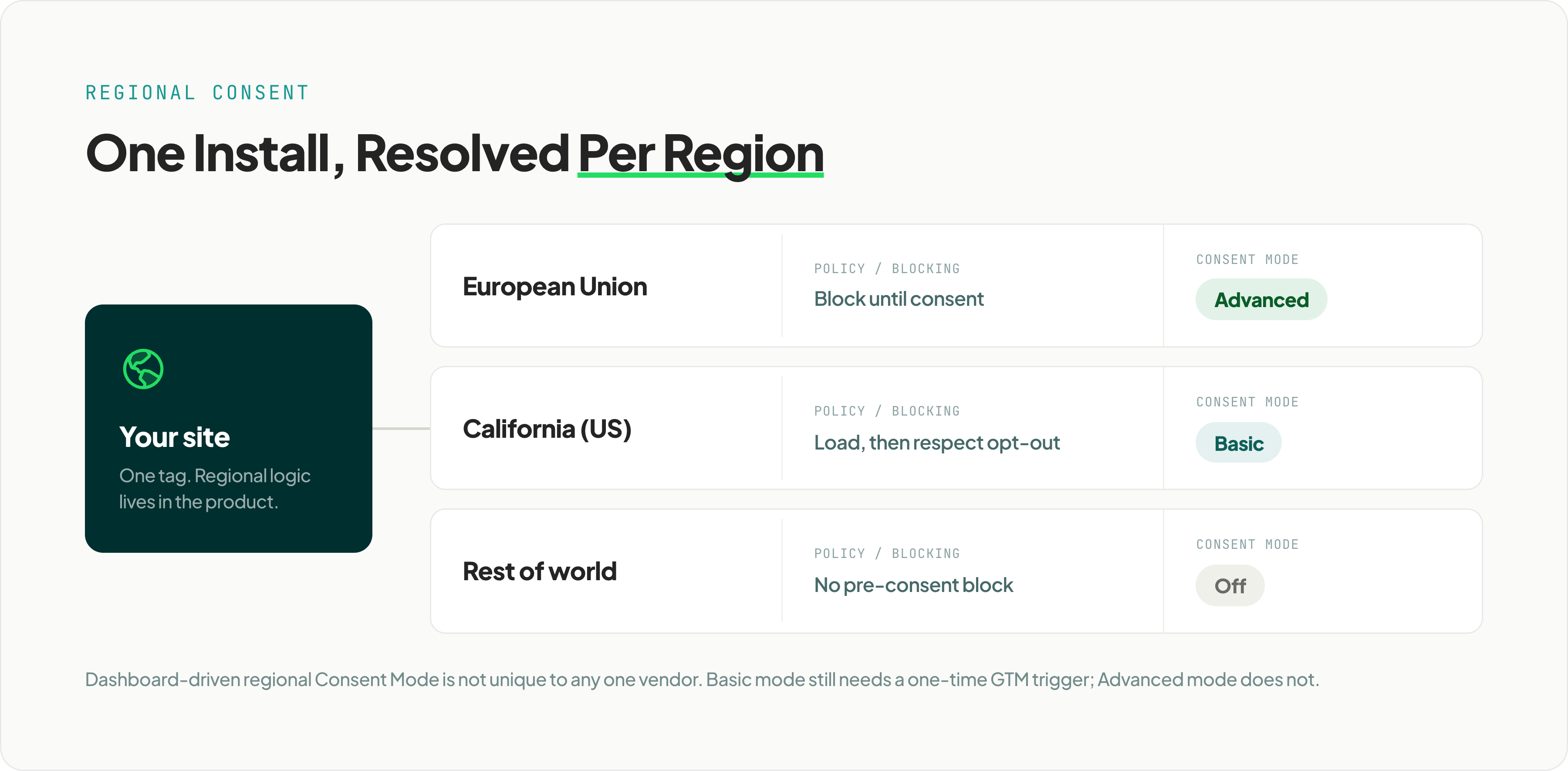
Enzuzo is a Google CMP Gold Partner running Consent Mode v2, with Microsoft Consent Mode alongside it. Regional behavior lives in the product: each region can run its own blocking mode and its own Consent Mode policy from the dashboard. Multi-domain consent and the native Shopify app come with the product rather than through an enterprise contract.
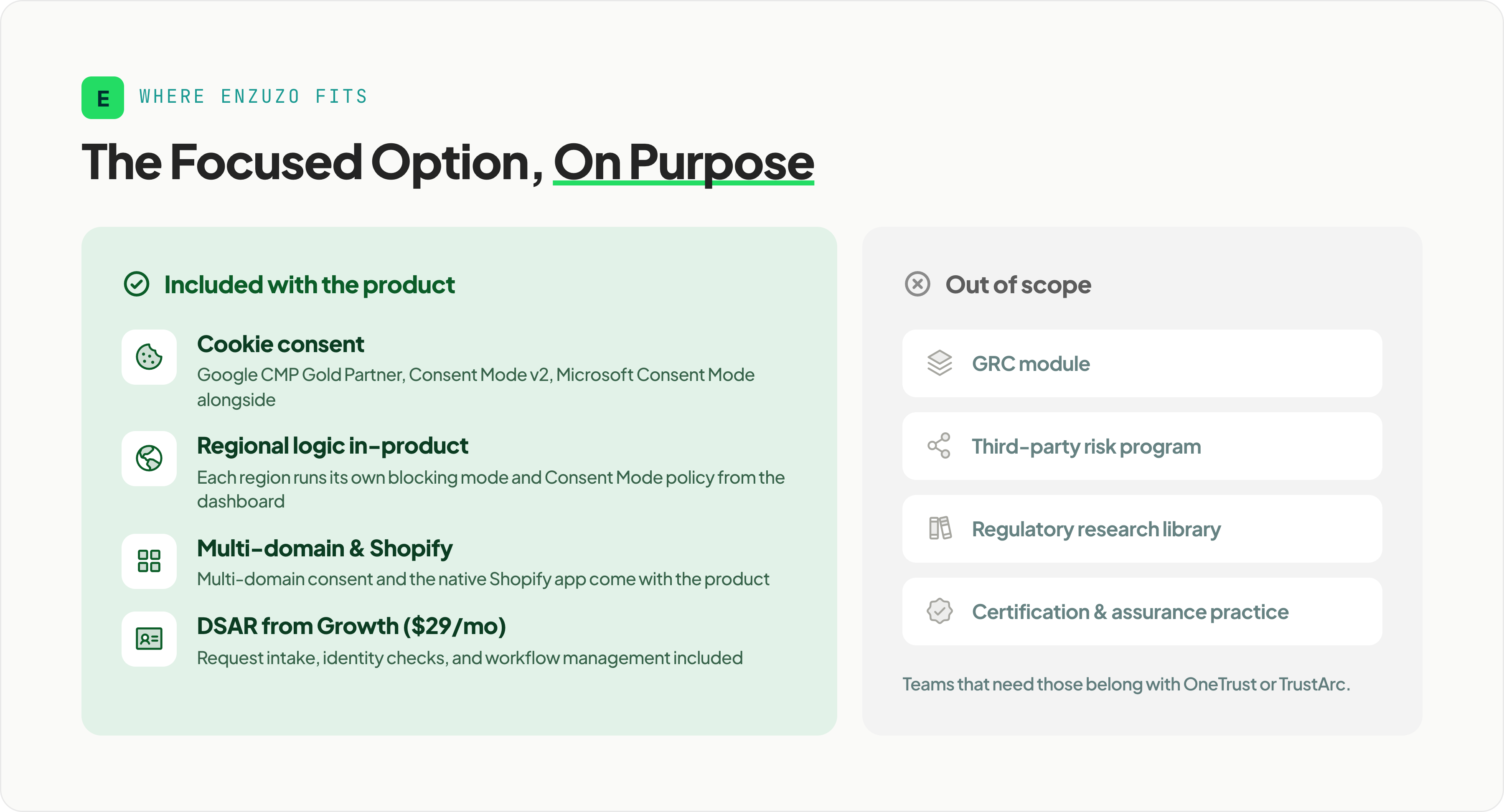
DSAR is where the packaging contrast is sharpest. Request intake, identity checks, and workflow management are included from the Growth plan at $29 per month. Across the three platforms above, the same capability sits in Ketch’s Pro or add-on packaging, OneTrust’s quote-based suites, and TrustArc’s quote-based Individual Rights Manager.
The published pricing covers every plan: Growth at $29 for four domains, and Pro at $79 for ten. Yearly billing lowers each rate.
Enzuzo's scope is deliberately narrower than the three platforms above. There is no GRC module, no third-party risk program, no regulatory research library, and no certification or assurance practice. A team that needs those belongs with OneTrust or TrustArc. A team that mainly needs consent handled correctly and rights requests answered on time will find value in Enzuzo.
Learn how Enzuzo can power your privacy operations - book a strategy call for an evaluation.
| Dimension | Ketch | OneTrust | TrustArc | Enzuzo |
|---|---|---|---|---|
| Product model | Permissioning and privacy infrastructure | Broad governance platform | Privacy-first privacy and assurance suite | Focused privacy operations platform |
| Public entry price | Free at $0; Starter $150/mo; Plus from $499/mo annual; Pro custom | Customized quote; no published exact figure | Quote-based; no published exact figure | Starter $9/mo; Growth $29/mo; Pro $79/mo for 10 domains |
| Consent and banners | Server-side records, tracker scanning, APIs, SDKs, and no-code integrations | Geolocation-aware policies, templates, discovery, web, mobile, and OTT/CTV coverage | Cookie and tracker scanning, consent repository, preference center, web/mobile GCM claims | GCM v2, multi-domain consent, and Shopify integration |
| Google Consent Mode | Support is documented; confirm Basic or Advanced by deployment | Support is documented; regional implementation varies by setup | Gold status for web and mobile is stated on TrustArc’s current product page | Gold-certified GCM v2; per-region Basic, Advanced, or Off policy control |
| Preference management | Marketing preferences, headless preference center, APIs, and cross-system sync | Universal consent and preference controls | Central repository and real-time sync across marketing and vendor systems | Consent and preference records with a focused operating model |
| DSAR automation | Pro/custom tier; Rights Workflows add-on available on Plus | CMP Suite or Privacy Automation package, quote-based | Individual Rights Manager, quote-based | Included in current paid plans |
| Data mapping and assessments | Agent-assisted discovery, maps, ROPA, and risk workflows | Connectors, data graphs, mapping, assessments, and policy governance | Data inventory, risk engine, assessments, and audit reporting | Not positioned as a like-for-like enterprise mapping suite |
| GRC, third-party risk, and AI governance | AI-era permissioning and privacy risk capabilities | Broadest adjacent governance coverage of the three | Regulatory intelligence, privacy governance, assurance, and certifications | Focused alternative, not a full replacement for every GRC workflow |
| Best fit | Technical teams that want modern orchestration and visible entry pricing | Global enterprises consolidating governance programs | Privacy teams that value intelligence, evidence, assurance, and support | Teams that want simpler focused privacy operations |
FAQs about OneTrust vs Ketch vs TrustArc
Which is better for global enterprise consent management: Ketch, OneTrust, or TrustArc?
OneTrust is the strongest starting point when global consent must connect to a wider governance program. TrustArc is a strong alternative when regulatory intelligence, privacy operations, assurance, and support carry more weight. Ketch is the better starting point when the enterprise wants consent signals, APIs, and permissioning infrastructure connected to its data stack. Final fit depends on implementation and module scope.
Is Ketch cheaper than OneTrust and TrustArc?
Ketch is easier to price at the entry level because it publishes Free, Starter, and Plus tiers. OneTrust and TrustArc do not publish an exact universal price for the relevant enterprise modules. Ketch is not automatically cheaper once Pro, DSR automation, data mapping, integrations, implementation, and support enter the discussion.
Which platform has the strongest DSAR automation?
TrustArc’s published workflow is the most detailed of the three in the documented areas, including identity verification, system search, secure delivery, and audit tracking. That documentation depth is not an independent performance benchmark. OneTrust offers DSR through broader privacy-automation packages. Ketch offers DSAR automation through Pro or custom packaging.
Do all three support data mapping and privacy assessments?
All three describe data mapping, risk, or assessment capabilities, but the workflows and tiers differ. OneTrust emphasizes connectors and governed data relationships. Ketch emphasizes agent-assisted discovery and live maps. TrustArc emphasizes inventory, risk controls, assessments, and audit reporting. Ask each vendor to demonstrate one new system, one ROPA record, and one changed assessment.
Which platform is best for GRC, third-party risk, and AI governance?
OneTrust is the clearest fit for broad GRC, third-party risk, and AI-governance consolidation. TrustArc is better aligned with privacy governance, regulatory intelligence, assurance, and certifications. Ketch’s strength is permissioning and orchestration around data use and privacy signals, not a like-for-like replacement for every enterprise GRC workflow.
Which one has the clearest public pricing?
Ketch has the clearest public pricing because it lists Free at $0, Starter at $150 per month, Plus from $499 per month billed annually, and Pro with custom pricing. OneTrust and TrustArc route the relevant enterprise packages through customized or quote-based pricing. Verify all figures live before signing.
Which platforms support Google Consent Mode and mobile consent?
TrustArc explicitly advertises Gold Google Consent Mode partner status for web and mobile and describes Firebase and app-attribution integrations. Ketch and OneTrust also need direct implementation verification for the required web, app, Basic, or Advanced configuration. Certification is one input. Test signal timing, tag behavior, regional rules, and reporting in your own environment.
Should a mid-market team choose Enzuzo instead of an enterprise suite?
A mid-market team should choose Enzuzo when it needs consent and DSAR coverage, transparent pricing, and a simpler implementation path. OneTrust or TrustArc makes more sense when the team needs broad governance, assurance, regulatory research, or third-party risk. Ketch is the closer alternative when the team prioritizes APIs, orchestration, and permissioning infrastructure.
Osman Husain
Osman is the content lead at Enzuzo. He has a background in data privacy management via a two-year role at ExpressVPN and extensive freelance work with cybersecurity and blockchain companies. Osman also holds an MBA from the Toronto Metropolitan University.
LinkedIn →More related blogs
Your next read