Multi-Domain Cookie Consent: Deploy and Stay Compliant at Scale
Table of Contents
If you run a platform or agency that hosts or builds websites for other businesses (event pages, pharmacy sites, investor landing pages, franchise locations, client microsites), you are responsible for cookie consent on every domain you control, even if you don't manage it directly.
For example, Jane App is a popular platform used by health practitioners to manage client bookings, payments, and scheduling. Individual clinics create separate platforms for their sites, but they are nested under the Jane app domain. In this situation, the responsibility for correct consent management falls under Jane App, not its clients.
Managing consent properly across hundreds or thousands of sites comes down to three decisions: correct banner deployment, managing and storing client consent records, and contractual liability if pixels fire without consent.
This guide walks through all three, plus the cross-domain rules and pricing models that decide whether multi-domain consent is affordable at your scale. It's based on real-world deployments of consent management across thousands of domains by Enzuzo, so all information is up to date and accurate.
What platform-scale cookie consent management means
Platform-scale consent is the problem of enforcing one consent policy across many domains you operate on behalf of other businesses. It is not the same as configuring a banner on a single site you own. That distinction changes how you deploy, price, and take legal responsibility for consent.
A normal CMP install assumes one company, one website, and one team clicking through a dashboard. A platform or agency breaks all of those assumptions at once.
You might host 150 white-labelled event pages, 3,000 templated local business sites, or 800 client websites that you build and market. New domains appear when a customer signs up and disappear when one churns.
You also drop analytics and advertising pixels (Google Analytics, Meta, TikTok) on your clients' behalf, often through your own Google Tag Manager container. Logging into a dashboard to configure a banner 800 times is not realistic.
Or worse yet, your clients can inject scripts/cookies into your templates that puts compliance back at risk.
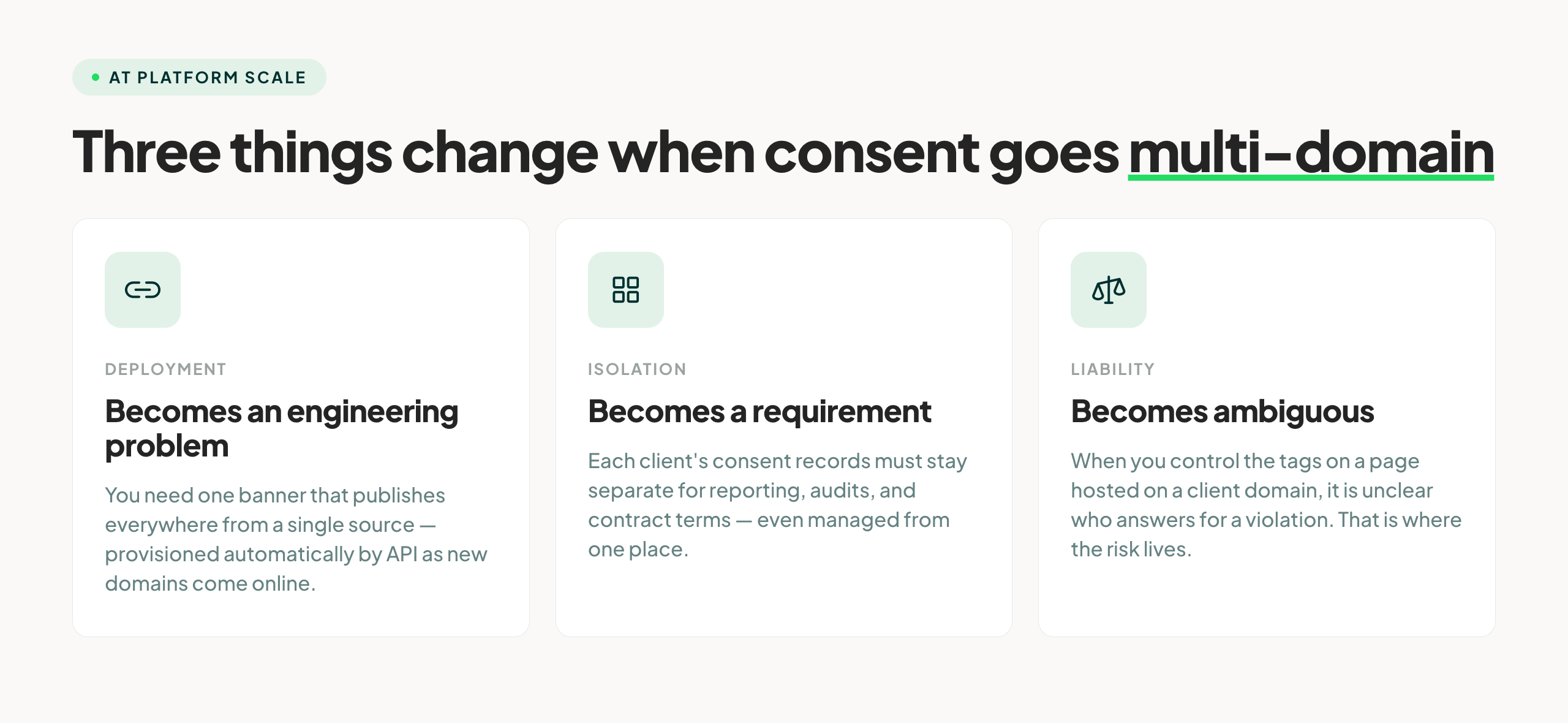
Three things change at scale, and the rest of this guide is organized around them:
- Deployment becomes an engineering problem, not a settings problem. You need one banner that publishes everywhere from a single source, ideally provisioned automatically through an API as new domains come online.
- Isolation becomes a requirement. Each client's consent records have to stay separate for reporting, audits, and sometimes contract terms, even though you manage them all in one place.
- Liability becomes ambiguous. When you control the tags on a page hosted on a client's domain, it is unclear who is responsible for a violation. That ambiguity is where most of the risk and hesitation live.
In short: at platform scale, cookie consent stops being a marketing checkbox and becomes part of your product architecture, your pricing, and your contracts.
Who's liable for cookies on a subdomain you host?
Liability for cookie consent maps to control of the tags and pixels on the site. If your platform decides what scripts load on a page, you carry real exposure even when the URL belongs to your client. The cleanest fix is to define that responsibility in your master services agreement, signed before client onboarding.
This is the hardest question platforms wrestle with, because ownership is genuinely shared. You build the page, set the template, and load the tracking. The client owns the domain, and the ad accounts that the data flows into.
Managing this incorrectly is the reason for many consent lawsuits and demand letters. When a regulator or a plaintiff's firm comes looking, you need an answer immediately.
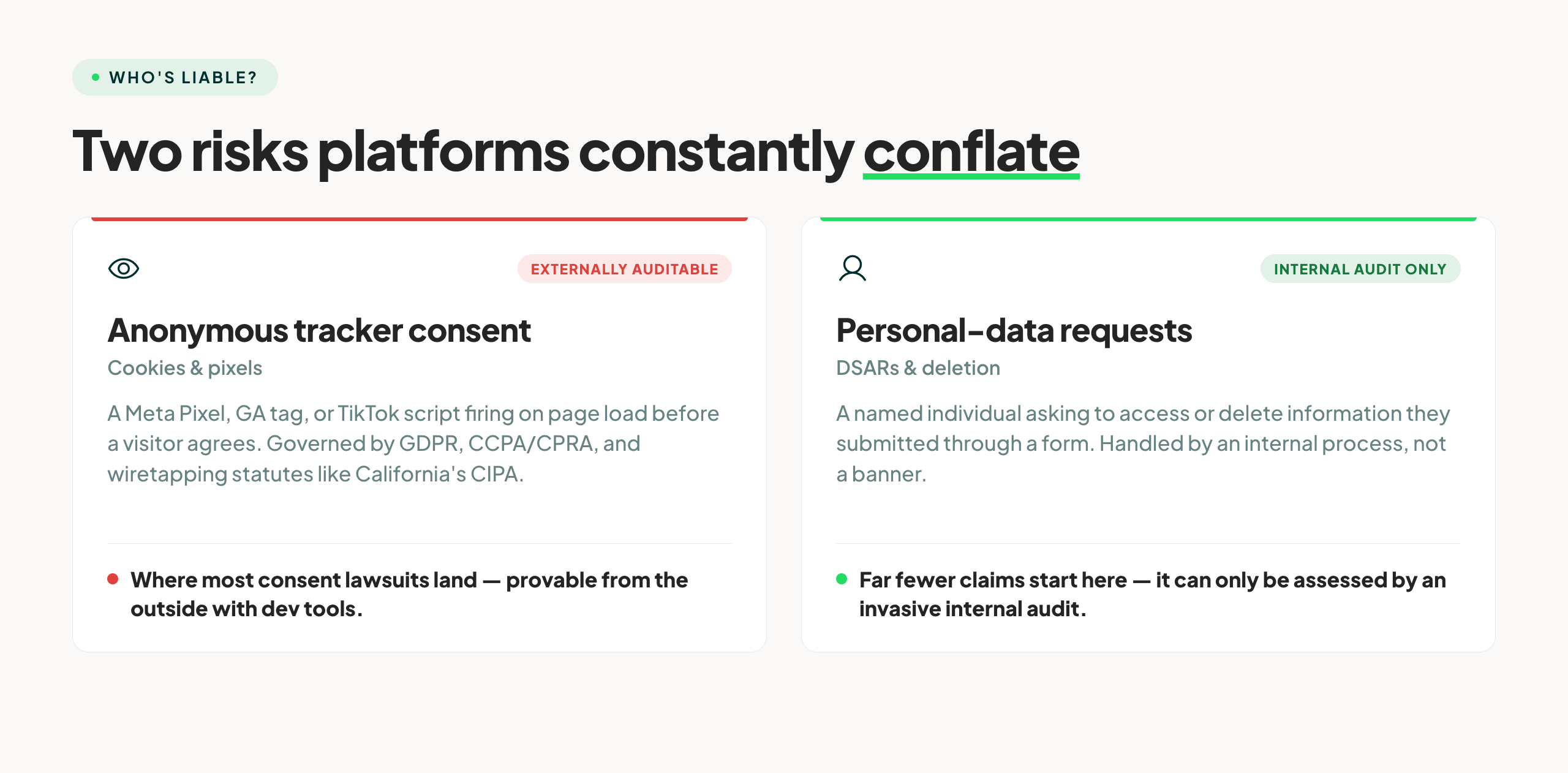
It helps to separate two very different risks, because they get conflated constantly:
- Anonymous tracker consent (cookies and pixels). The Meta Pixel, GA tag, or TikTok script firing on page load before a visitor agrees. It is governed by GDPR, CCPA/CPRA, and US wiretapping statutes such as California's CIPA.
- Personal-data requests (DSARs and deletion). A named individual asking to access or delete the information they submitted through a form. This is handled through an internal process, not a banner.
Platforms consistently underestimate the first risk. In Enzuzo's experience across mid-market deployments, the large majority of consent lawsuits target the anonymous-tracker layer, because it is auditable from the outside.
A plaintiff's firm does not need to subpoena your systems to build a case. They can load any page you host, open developer tools, and document that a pixel fired before consent, with a timestamp and the network request as evidence.
DSAR compliance, by contrast, can only be assessed through an invasive internal audit. That is why far fewer claims start there, and why the tracker layer deserves your attention first.
These firms also do not distinguish between a subdomain and a primary domain. If a non-essential pixel fired without consent on a URL, the claim stands regardless of whose name is on the domain.
What actually resolves it
- Contractual clarity. Spell out in your MSA what you take responsibility for and what the client owns. If you control the tags, say so and price for it. Under GDPR this maps to the controller versus processor distinction, and it belongs in writing, not in an assumption.
- A consent signal you control. Whoever owns the liability needs a CMP firing on those pages. It captures a consent log for every visitor (the legal artifact you will want to keep for years) and gates non-essential tags until consent allows them. We cover the how in the next section.
In short: if your platform controls the pixels, assume you share the liability. Make it explicit in the contract, and back it with a consent platform you operate. Do not let "it's their domain" be your compliance strategy.
Deploying cookie consent banners across hundreds of domains
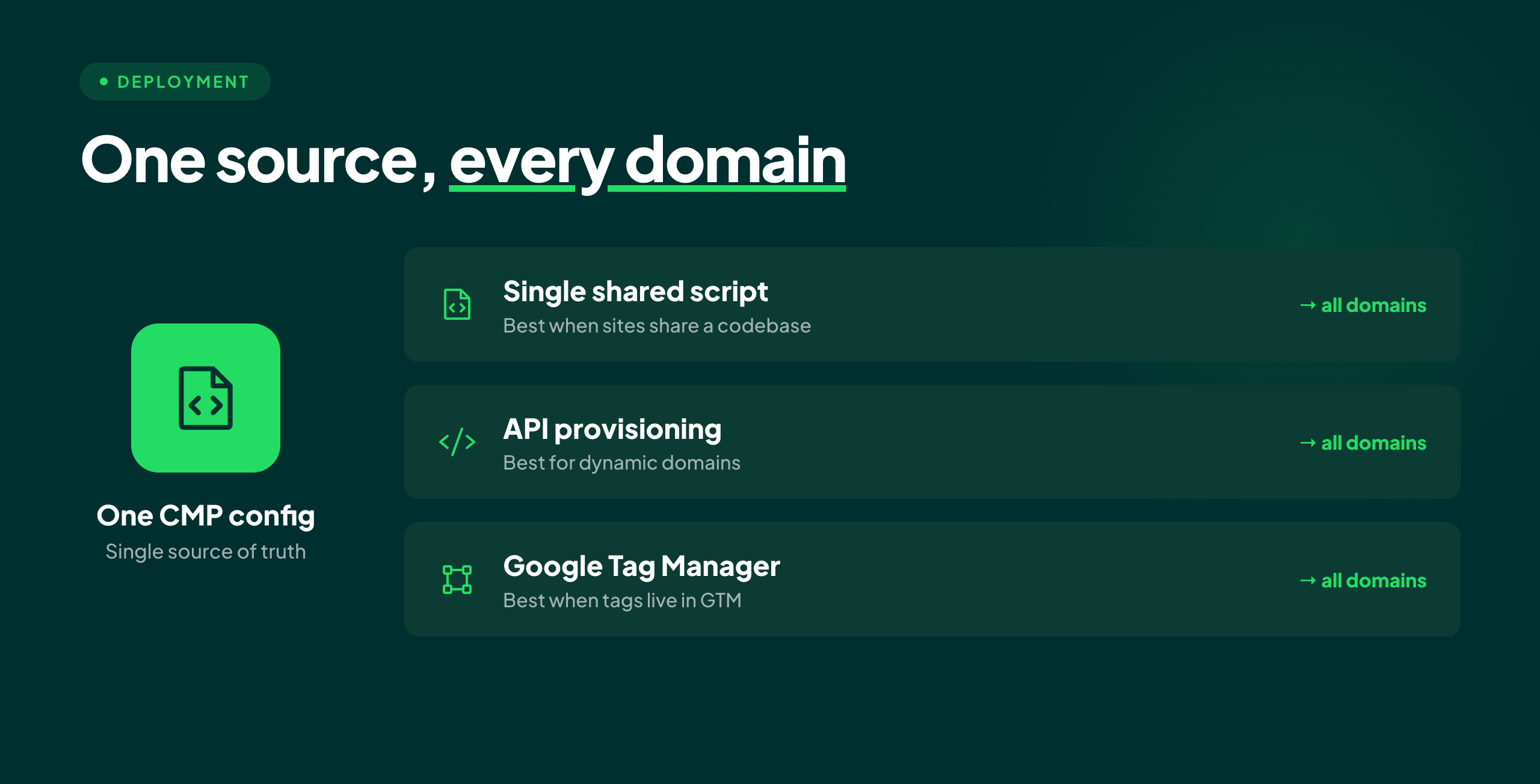
Cookie consent at scale can be done in one of three ways: a single script on a shared template, API provisioning for domains created dynamically, or injection through Google Tag Manager. Most platforms use a combination, and the right mix depends on whether your sites share a codebase and how often new domains appear.
A single script on a shared template
If all your sites render from a shared codebase or a small set of templates, the simplest path is one consent script in the shared <head>. You edit it once, and the change propagates to every site built from that template.
The catch is historical sites. If older deployments do not pull from the current template, you may need your CMS vendor to push the script to existing live sites as a one-time backfill.
API provisioning for dynamic domains
When your customers spin up their own domains, manual setup does not scale. An API lets you create, configure, and retire consent instances programmatically as domains come and go.
This is the make-or-break feature for platforms. One prospect ruled out a popular tool outright because it had no API to provision domains automatically. Enzuzo's API is built for this: a new customer site inherits compliance through a single call, with no per-site dashboard work.
Google Tag Manager injection
If you manage marketing tags through GTM, you can load the consent script through GTM and let it gate the other tags. Many platforms inject one container script across client sites. The full walkthrough lives in the GTM deployment guide.
The step most teams miss: loading the CMP script in GTM is not enough. The tags you want to gate (GA4, Meta, Ads) each need a consent check pointing back to the CMP, plus a consent initialization trigger. Skip it and the banner shows while scripts still fire, which is the exact violation you were trying to prevent.
In short: match the mechanism to your architecture (shared script, API, or GTM), and confirm your CMP can provision via API, gate tags correctly, and avoid billing you per subdomain.
Rolling out a complicated, multi-domain consent program? Speak with a compliance expert for a seamless deployment.
Keeping each client's consent records separate
Multi-tenant consent means a central template you manage plus per-client consent records that stay separate. The decision to make up front is how much isolation you need: one global template, fully isolated per-client instances, or a hybrid of central control with limited client self-service.
A single global template is easiest to manage and scales to thousands of domains, but every client gets the same configuration. Fully isolated instances allow per-client customization, but they are heavier to operate. In Enzuzo's experience, most platforms want the hybrid approach.
In practice, the common request is this: keep full portfolio control in your hands, but let a client do one or two scoped things on their own, such as adding and categorizing a new script, without touching anything else.
Isolation also matters for audits and reporting. When a client or their regulator asks for their consent logs, you need to filter cleanly to that one domain. Strong isolation runs all the way to the database layer, so one tenant can never see another's data.
In short: decide global template versus per-client instances versus hybrid before you deploy. Most platforms need central control with narrow, well-defined client self-service.
When is shared (cross-domain) consent legal?
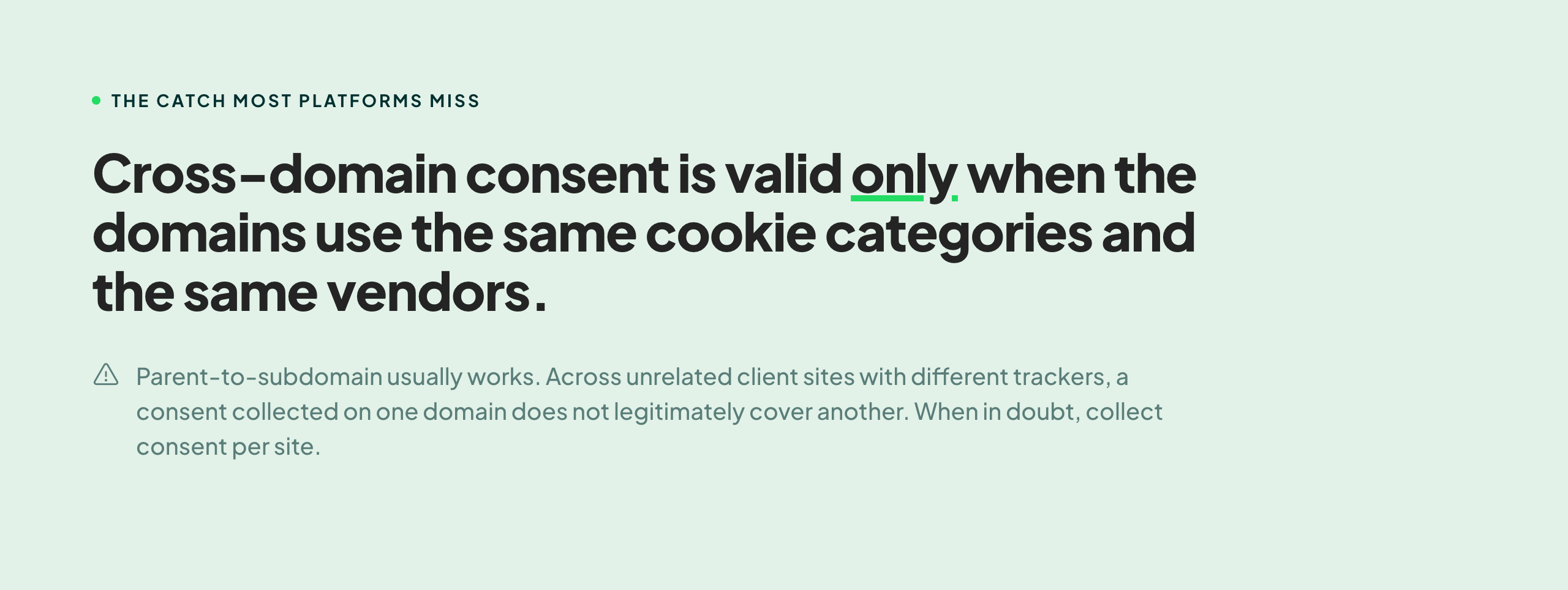
Cross-domain consent sharing is valid only when the domains use the same cookie categories and the same vendors. If the sites differ, consent collected on one domain does not legitimately cover the other, and reusing it can create the violation you were trying to avoid. This is the catch most platforms miss.
Sharing consent from a parent domain to its own subdomains usually works well, because they run the same stack. Across unrelated client sites with different trackers, do not assume one consent travels with the visitor.
There is also a withdrawal requirement. Under GDPR Article 7, it must be as easy to withdraw consent as to give it, so a shared preference center has to honor a change everywhere that consent applies.
In short: share consent only across domains with identical categories and vendors, and make withdrawal propagate everywhere. When in doubt, collect consent per site.
What does multi-domain consent cost?
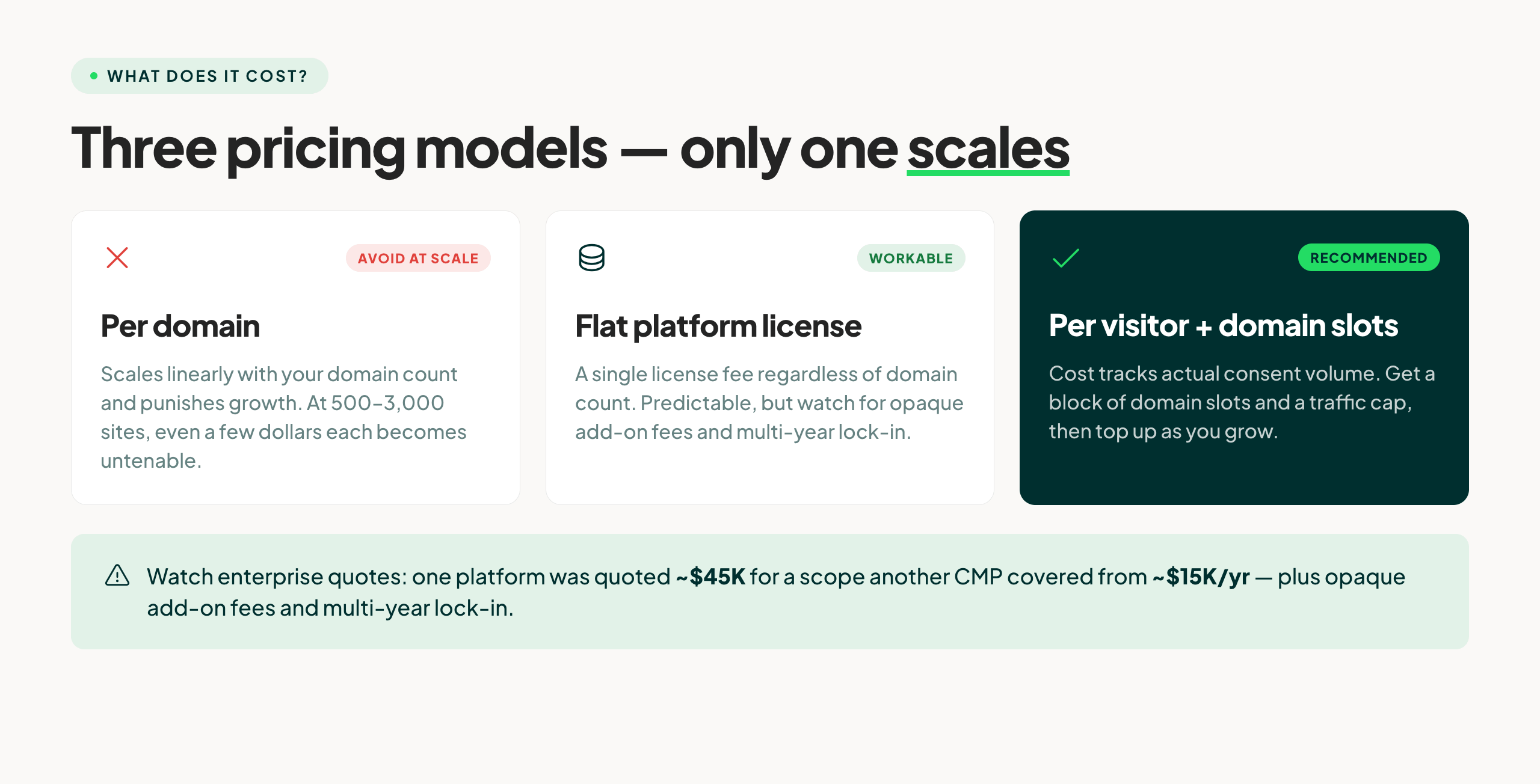
Multi-domain consent is priced one of three ways: per domain, a flat platform license, or per unique visitor with domain slots. For platforms, per-domain pricing is the model to avoid, because it scales linearly with your domain count and punishes growth.
The math breaks quickly. At 500 or more domains, even a few dollars per domain per month becomes untenable, and eats into your margins.
Per-visitor pricing with domain scales much better as it aligns cost with consent volume. You get a block of domain slots and a traffic cap, with top-ups as you scale, the same way most SaaS tools meter usage.
In short: avoid per-domain pricing at scale. Look for a traffic-plus-domain-slots model, transparent fees, and a short opt-out window rather than a long lock-in.
Consent vs. your analytics: don't kill the data
Turning on consent will reduce the data you can collect, because visitors who decline cannot be tracked. You minimize the loss two ways: precise geofencing so you only require opt-in where the law demands it, and Google Consent Mode v2 so Google can model the conversions you lose.
Geofencing sets the rule by location. Strict opt-in regions (the EU, Quebec, and increasingly California and Florida) block non-essential tags until a visitor agrees. Most other US states allow an opt-out notice where tags fire by default. This protects your data everywhere you are legally allowed to collect it.
Google Consent Mode v2 is the second lever. When consent signals pass to Google correctly, Google models the conversions from users who declined, recovering measurement you would otherwise lose. Enzuzo is a Google CMP Gold Partner certified for Consent Mode v2, so those signals pass automatically. The full setup is in the Google Consent Mode v2 guide.
For teams that want to recover more, cookieless analytics is the phase-two move: collect aggregate measurement without writing identifying cookies, while staying within the rules.
In short: geofence tightly and turn on Consent Mode v2. You keep the data you are allowed to collect and model most of what consent costs you.
A buyer's checklist: evaluating a CMP for platform scale
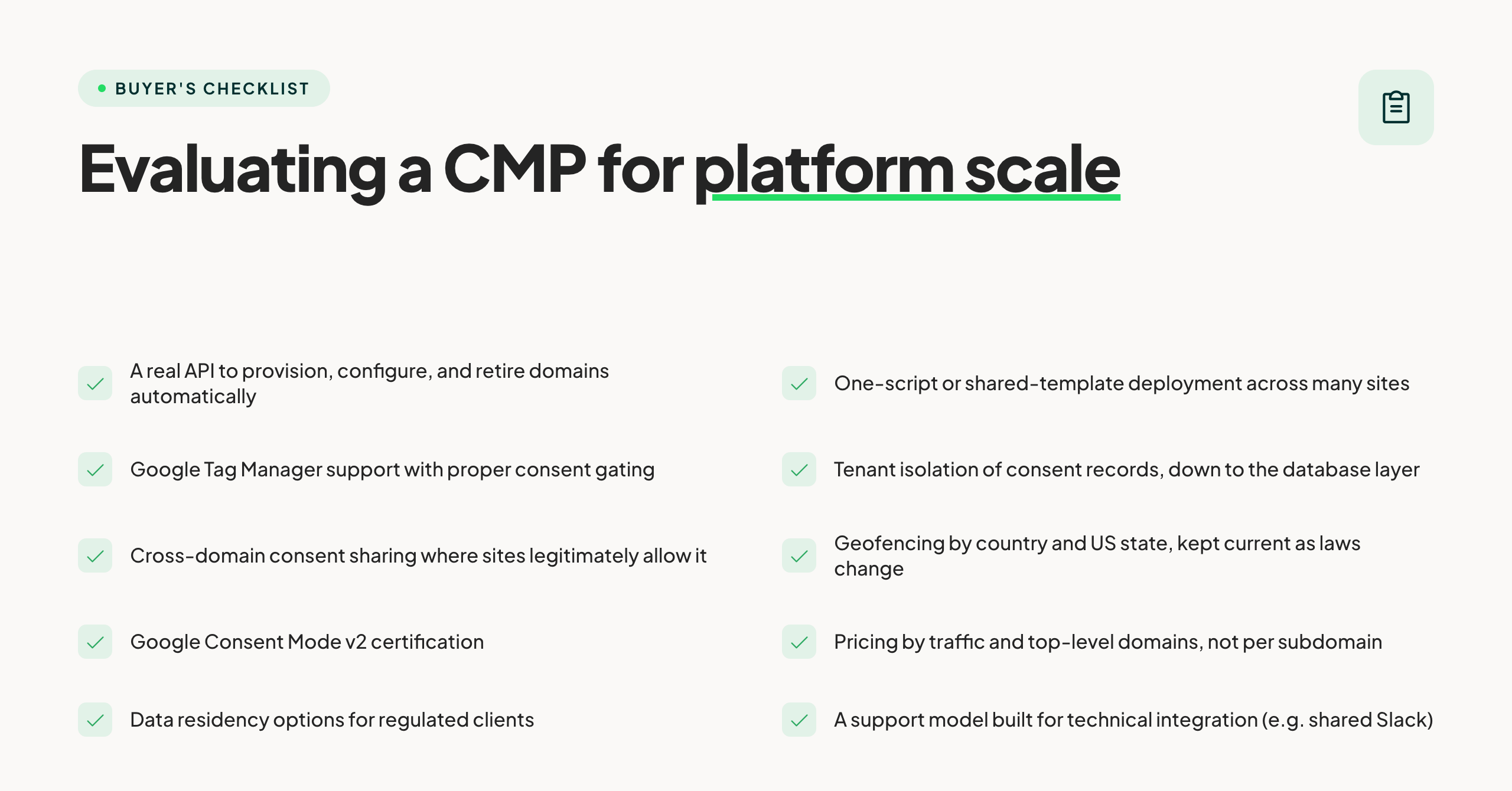
Most CMPs can put a banner on one site. Far fewer hold up across hundreds of domains. When you evaluate a platform CMP, score it against the requirements that actually bite at scale:
- A real API to provision, configure, and retire domains automatically
- One-script or shared-template deployment across many sites
- Google Tag Manager support with proper consent gating (not just script loading)
- Tenant isolation of consent records, ideally to the database layer
- Cross-domain consent sharing where your sites legitimately allow it
- Geofencing by country and US state, kept current as laws change
- Google Consent Mode v2 certification
- Pricing by traffic and top-level domains, not per subdomain
- Data residency options for regulated clients
- A support model built for a technical integration, such as a shared Slack channel
Enzuzo is API-first, certified for Google Consent Mode v2 as a Google CMP Gold Partner, and priced on traffic and domain slots rather than per subdomain, with Slack support included on platform plans.
Frequently asked questions
Who is liable for cookie consent on a subdomain a platform hosts for a client? Liability follows control of the tags, not ownership of the domain. If your platform decides what scripts load, you share the exposure even when the client owns the URL. Define the split in your master services agreement.
How do I deploy one cookie consent banner across hundreds of domains? Use one of three methods: a single script on a shared template, API provisioning for dynamically created domains, or Google Tag Manager injection. Most platforms combine them based on whether sites share a codebase.
Can I manage cookie consent for multiple websites through an API? Yes. An API-first CMP lets you create, configure, and retire consent instances programmatically, so a new site inherits compliance through a single call with no per-site dashboard work.
Does each subdomain need its own cookie consent banner? Not usually. Subdomains can share the parent's configuration and consent, provided they use the same cookie categories and vendors. You should not be charged per subdomain.
Can cookie consent be shared across domains, and is that legal? It is valid only when the domains use identical cookie categories and vendors. Sharing from a parent to its own subdomains is typically fine. Across unrelated sites, collect consent per site.
What is the best way to add a consent banner through Google Tag Manager at scale? Load the CMP script in GTM, then gate each tag (GA4, Meta, Ads) with a consent check and a consent initialization trigger. Loading the script without gating the tags is the most common mistake.
How is multi-tenant cookie consent priced, per domain or per visitor? The scalable model is per unique visitor with domain slots, not per domain. Per-domain pricing grows linearly with your portfolio and becomes untenable past a few hundred sites.
How do I keep each client's consent records separate? Use a CMP with tenant isolation to the database layer. You manage everything from one place, but each client's consent logs stay separate for reporting and audits.
Will adding consent banners hurt my clients' analytics and ad data? Some loss is unavoidable, but you can minimize it with tight geofencing and Google Consent Mode v2, which models conversions from users who decline.
What should an agency look for in a cookie consent platform? An API for bulk deployment, GTM support with proper gating, tenant isolation, geofencing kept current with the law, Consent Mode v2 certification, and pricing by traffic rather than per subdomain.

Osman Husain
Osman is the content lead at Enzuzo. He has a background in data privacy management via a two-year role at ExpressVPN and extensive freelance work with cybersecurity and blockchain companies. Osman also holds an MBA from the Toronto Metropolitan University.