Osman Husain
Enterprise teams evaluating consent management platforms in 2026 are typically replacing an incumbent CMP that has become too expensive or too complex, deploying consent across multiple domains and jurisdictions, or responding to a privacy demand letter under time pressure.
In each scenario, the evaluation comes down to the same criteria: Google Consent Mode integration quality, multi-domain architecture, geofencing granularity, consent analytics, integration depth, and audit readiness. This guide compares the six strongest enterprise CMPs against those criteria.
Enterprise CMP comparison at a glance
| Criteria | Enzuzo | OneTrust | Didomi | Usercentrics | Ketch | Osano |
| Google CMP Partner tier | Gold | Gold | Gold | N/A | Silver | Gold |
| Google Consent Mode | ✅ Native | ✅ Native | ✅ Native | ✅ Native | ✅ Documented | ✅ Supported |
| Geofencing by jurisdiction | ✅ State-level | ✅ Regional | ✅ Regional | ✅ Regional | ✅ Regional | ✅ Regional |
| Multi-domain management | ✅ Up to 6,000+ | ✅ Enterprise scale | ✅ Multi-brand | ✅ Multi-site | ✅ Multi-site | ✅ Multi-site |
| Mobile app SDK | In development | ✅ iOS, Android, CTV | ✅ iOS, Android | ✅ iOS, Android, TV | ✅ iOS, Android | ✅ iOS, Android |
| Consent analytics | ✅ Consented + unconsented | Limited | ✅ Dashboard | ✅ Dashboard | ✅ Dashboard | ✅ Activity log |
| DSAR / privacy ops | ✅ Built-in | ✅ Full suite | Separate tool needed | Separate tool needed | ✅ Built-in | ✅ Built-in |
| IAB TCF v2.2 | ✅ Supported | ✅ Supported | ✅ Supported | ✅ Supported | ✅ Supported | ✅ Supported |
| Implementation support | Hands-on onboarding | Self-serve + paid | Managed onboarding | Documentation-led | Managed onboarding | Documentation-led |
| Pricing signal | Mid-market | $10K+ minimum | Enterprise custom | Mid-market | Enterprise custom | Not published |
How to evaluate an enterprise CMP
A CMP can demo well and fail in production. For large organizations, the challenge is not collecting consent on a single site. It is managing consent signals, preferences, and audit records across dozens or thousands of properties simultaneously.
These are the criteria that matter in enterprise procurement:
Google Consent Mode integration that works in production. Every CMP claims Consent Mode support. The difference is whether signals actually sync with GA4, Google Ads, and Floodlight in a live environment. Poor integration means analytics undercount traffic and ad measurement breaks silently.
Geofencing by jurisdiction, not just by country. GDPR requires opt-in in the EU. California requires specific disclosures. Quebec's Law 25 mandates explicit opt-in for non-essential cookies. An enterprise CMP needs to apply the correct consent model by jurisdiction automatically, including at the state and provincial level.
Multi-domain and multi-tenant architecture. Enterprise deployments range from a handful of corporate domains to thousands of client sites under a single management layer. The CMP needs centralized control with per-domain customization and billing models that scale at high volume.
Consent analytics that quantify what you lose when users opt out. Most CMPs report consent rates. Fewer show the gap between actual site traffic and what GA4 reports because users declined or ignored the banner. Marketing teams need this data to understand how incomplete their analytics really are.
Audit-ready consent logs separated from personal data. Compliance and legal teams need downloadable records showing what a user agreed to, when, and what options were presented. SOC 2 documentation is increasingly a procurement gate for enterprise CMP vendors.
Implementation timeline and onboarding model. Enterprise deployments require legal, marketing, product, and engineering alignment on consent categories, tag behavior, and banner design. The quality of vendor support during that alignment often determines whether deployment takes one week or three months.
Mobile app SDK support. Organizations with native iOS or Android apps need consent collection in those environments, not just on websites. This remains a gap in some platforms.
Litigation risk mitigation. Privacy lawsuits under California's Invasion of Privacy Act (CIPA) are accelerating the CMP buying cycle. Many organizations now enter procurement after receiving a demand letter. Speed of deployment and defensible consent records have direct legal impact.
The 6 best enterprise CMPs for 2026
1. Enzuzo: best for mid-market and scaling teams
Enzuzo is an all-in-one privacy compliance platform. Its CMP sits within a broader privacy program that includes DSAR workflows, data mapping, privacy impact assessments, vendor risk management, and compliance dashboards.
Enzuzo is a Google-certified CMP Partner (Gold tier), supporting Google Consent Mode and GTM integration for ad and analytics workflows.
Strengths:
- Google Consent Mode integration validated at scale, from single domains to thousands of sites under a master code base architecture
- State-level and provincial geofencing, including differentiated models for Quebec (opt-in), California (specific disclosures), and the rest of North America (opt-out)
- Consent analytics that surface both consented and unconsented traffic, giving marketing teams visibility into the reporting gap
- Audit-ready consent logs with downloadable records separated from personal identifiers
- Hands-on implementation support with onboarding calls, Slack-based collaboration, and direct access to technical and compliance teams

Gaps:
- Mobile app SDK is in active development, but not yet in production
- Smaller vendor footprint compared to OneTrust and Didomi in enterprise RFP processes
- CTV/OTT consent collection is not currently supported
- DSAR form is standalone with no Salesforce integration currently
Best fit: Mid-market and scaling enterprise teams that want CMP functionality plus broader consent operations in a single platform, without the cost or complexity of a heavyweight governance suite.
Book a strategy call to scope your deployment or create a free account to evaluate independently.
2. OneTrust: best for global governance programs
OneTrust is one of the most recognized names in enterprise privacy management. Its platform spans consent orchestration, privacy program management, risk governance, and AI governance under a single vendor.
Strengths:
- Broadest platform coverage: consent, preference management, privacy, risk, and AI governance in one system
- Multi-channel consent collection across web, mobile, and connected TV (OTT/CTV)
- Global compliance coverage and IAB TCF v2.2 support
- Enterprise-grade audit and records infrastructure
- Large partner and systems integrator ecosystem
- Mobile SDKs for iOS, Android, and TV platforms
Gaps:
- Price floor starts at $10K+ annually, pricing out many mid-market teams
- Enterprise buyers have reported consent signal integration issues with Google Consent Mode that caused significant analytics visibility gaps in production
- Implementation complexity requires dedicated internal resources for long-term program ownership
- Legacy pricing changes have driven many mid-market organizations to evaluate alternatives
Best fit: Global enterprises with mature privacy operations, dedicated governance teams, and budget to support both the platform cost and the internal resources needed for implementation.
3. Didomi: best for multinational multi-brand publishers
Didomi is a serious enterprise CMP for multinational organizations that need consistent consent management across markets, brands, and channels. According to Didomi's enterprise documentation, the platform processes over 2 billion consents monthly across 25+ countries.
Strengths:
- Built for multinational deployments where one consent approach needs to work across brands, regions, and internal teams
- Cross-device and cross-domain consent sharing when users can be reliably identified
- Google-certified CMP Gold Partner for Consent Mode workflows
- Strong consent UX customization and analytics dashboard
- Mobile SDKs for iOS and Android
Gaps:
- Primarily a CMP, not a full privacy program platform. DSARs, data mapping, and vendor risk require separate tools.
- Enterprise pricing is custom and not publicly available
- Smaller vendor ecosystem compared to OneTrust for system integrator partnerships
- Less suited for organizations that only need consent on a handful of domains without multi-brand complexity
Best fit: Multinational companies with multiple brands and regional properties that need granular control over consent UX and consent signals at scale.
4. Usercentrics: best for marketing-led Google stack teams
Usercentrics has strong adoption in marketing-led privacy programs, particularly among teams relying on the Google measurement and advertising stack. Usercentrics acquired Cookiebot in 2022, but it is not a Google Gold CMP Partner independently (while Cookiebot is). Recently the two platforms haveflows through that integration.
Strengths:
- Deep Google Consent Mode and GTM integration with documented deployment paths
- Granular consent categories configurable to match analytics and marketing tag usage
- IAB TCF v2.2 support for ad tech workflows
- Mobile SDKs for iOS, Android, and TV
- Large documentation footprint
Gaps:
- Auto-blocking of non-essential scripts is not available when deployed through GTM . Teams should confirm enforcement approach during evaluation.
- Support responsiveness and interface usability has come under scrutiny by enterprise teams
- Primarily a CMP. DSARs, data mapping, and vendor risk require separate tools.
- Cookiebot (now under Usercentrics) does not offer DSAR functionality at any tier
Best fit: Enterprise teams that rely heavily on Google tools and need a CMP that integrates tightly with their measurement stack. Large organizations may pair Usercentrics with a separate privacy management platform.
5. Ketch: best for data permissioning and enforcement
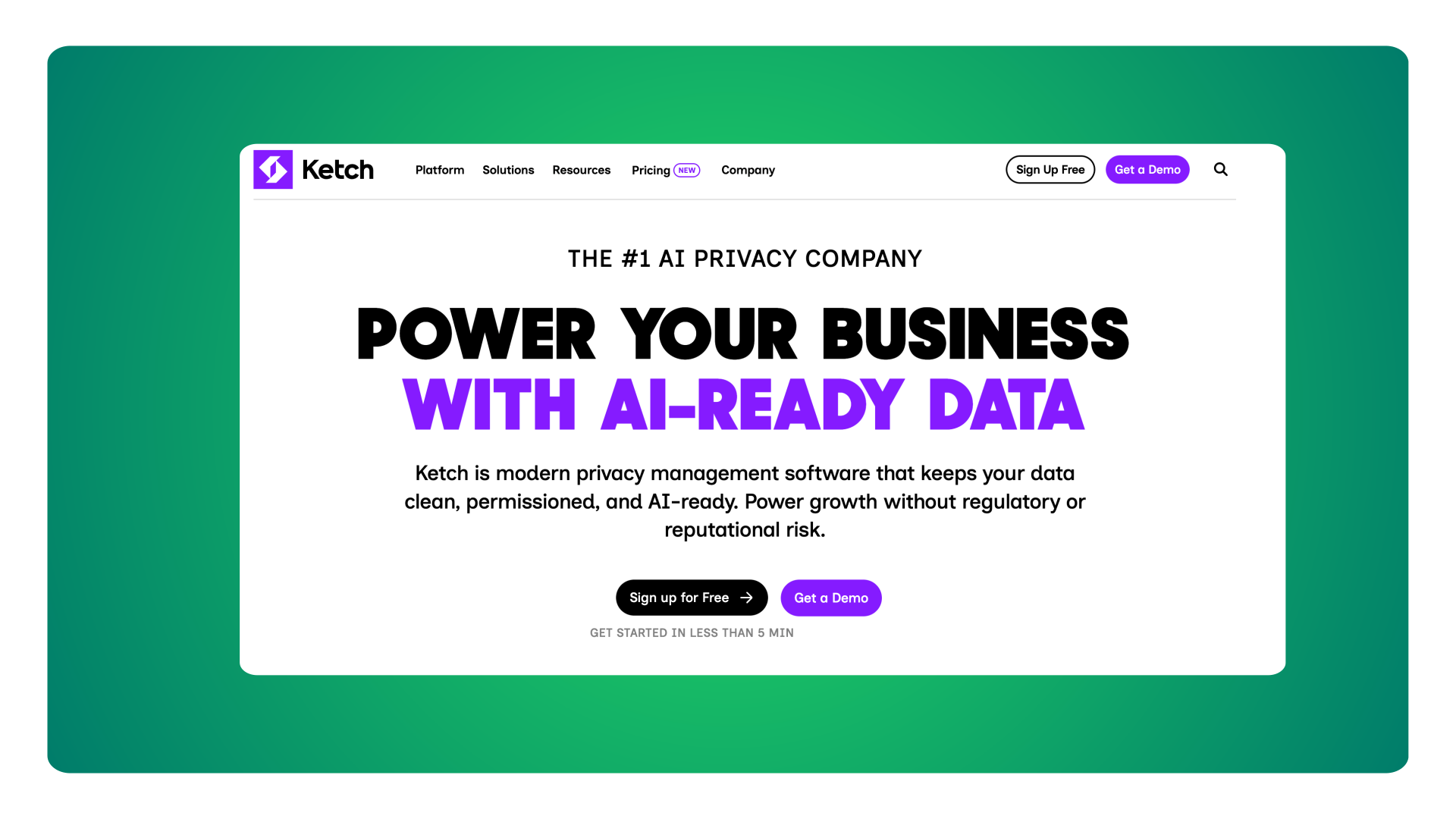
Ketch is a modern privacy platform with a data permissioning angle. It positions consent as a control layer governing how data is used across tools and workflows, not just what appears in a cookie banner.
Strengths:
- Consent signals tied to data governance, enabling privacy rules enforced beyond the website layer
- Data mapping and discovery in the same platform, connecting consent categories to real data flows
- IAB TCF v2.2 and documented Google Consent Mode and GTM integration
- Native iOS and Android SDKs for mobile app consent
- Governance focus supports audit and oversight requirements
Gaps:
- Google CMP Partner certification is Silver tier, not Gold
- Implementation effort across legacy systems should be validated during a pilot phase
- Enterprise pricing is custom and not publicly available
- Less established documentation and community footprint compared to Usercentrics or OneTrust
Best fit: Mid-market to enterprise organizations that want consent and preference management tightly linked to data permissions and internal data controls.
6. Osano: best for broad privacy suites at mid-complexity
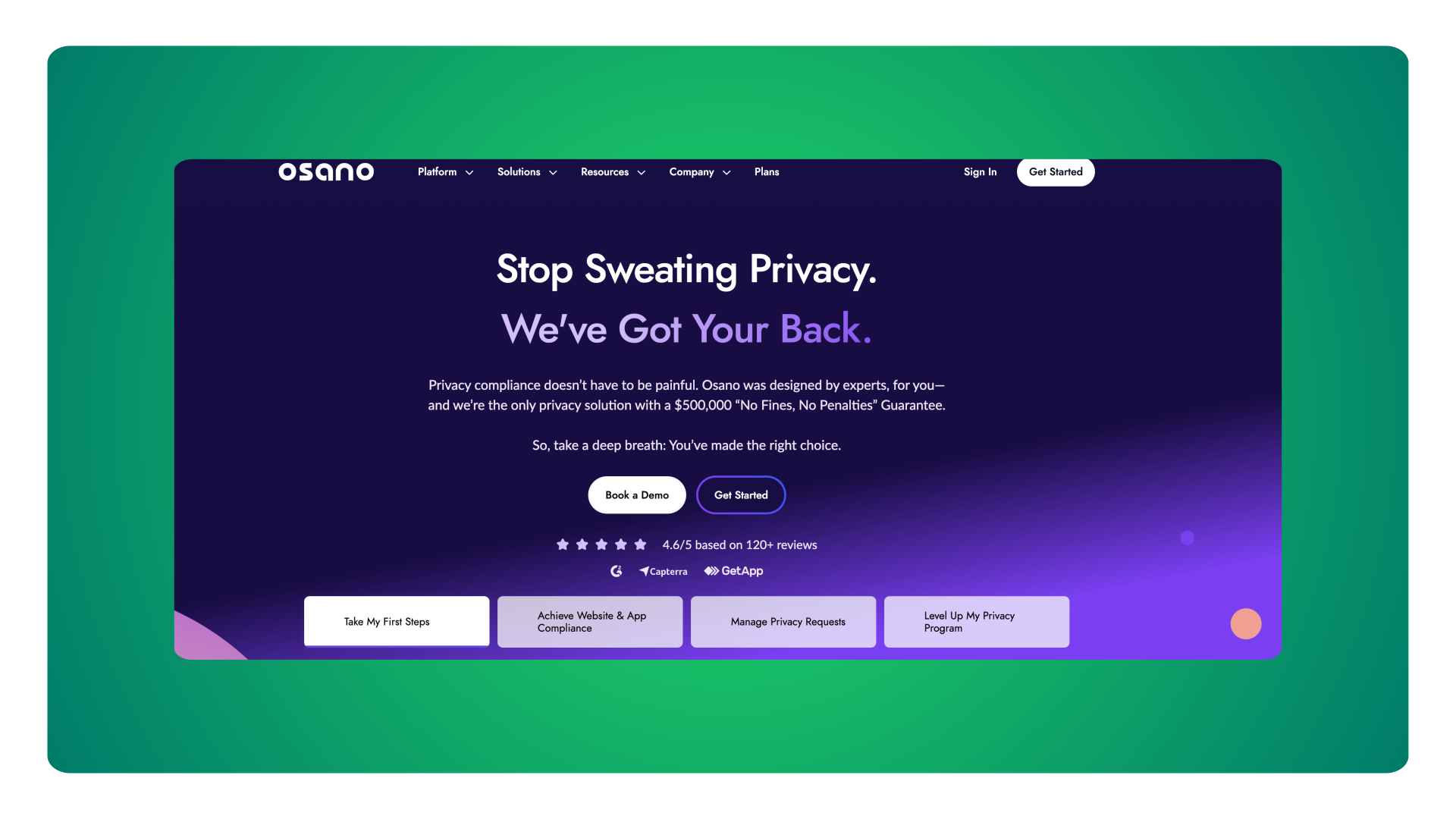
Osano positions its platform for organizations that want consent management alongside broader privacy program tools, with an emphasis on making privacy operations easier to run day-to-day.
Strengths:
- Broad privacy program coverage: consent management, DSAR handling, assessments, vendor risk, and data mapping in a single platform
- Global compliance supporting 95+ privacy laws with localized banners in 45+ languages
- Google Consent Mode v2 support and GTM integration
- Consent record-keeping with activity log for configuration changes
- Mobile app CMP coverage for iOS and Android
Gaps:
- Pricing can be vague. Enterprise buyers must request a quote directly.
- Not a Google-certified CMP Partner
- Organizations should confirm whether they need the full suite or only core CMP functionality to avoid overpaying
- Less depth in consent analytics compared to platforms with dedicated analytics dashboards
Best fit: Organizations that want a comprehensive privacy management platform with consent management as one component and room to grow into adjacent privacy workflows.
Google Consent Mode integration separates enterprise CMPs
Every vendor on this list supports Google Consent Mode on paper. In production, the difference between working integration and broken integration determines whether you get an accurate measurement or fly blind.
Google Consent Mode passes consent state signals to Google tags before those tags fire. When a user declines, tags receive a "denied" signal and adjust behavior. According to Google's Consent Mode documentation, this enables conversion modeling even when users opt out.
The failure mode is subtle. If consent signals are delayed, malformed, or missing, Google tags either fire without consent (a compliance violation) or stop collecting data entirely (a measurement gap).
One enterprise organization Enzuzo onboarded had lost visibility into roughly half of its total site traffic. The previous CMP's consent signals were not syncing with Google tags. The tags were deployed, but consent state was not being communicated, so Google treated the traffic as if no decision had been made.
Marketing teams relying on Google Ads conversion tracking, GA4, or Floodlight should evaluate vendors on how consent signals pass in a live environment, not whether the feature exists in a spec.
Enterprise CMPs must handle multi-domain consent at scale
Enterprise consent at scale is a fundamentally different problem than consent on a single website. The challenges that surface in production are rarely about features. They are about ownership, infrastructure, and cost mechanics.
Consent ownership becomes ambiguous. When a platform deploys websites on behalf of clients, who owns consent? If clients will not configure consent themselves, the platform must take full responsibility. That means a single deployment covering every site with zero per-client configuration overhead.
CMS migrations create consent gaps. Organizations moving between content management systems need consent to work across both old and new environments simultaneously. This typically requires separate CMP workspace instances for each CMS, with a migration path that swaps one for the other without downtime or compliance gaps.
GTM access is unknown at scale. When consent depends on Google Tag Manager, someone needs to control the container. Years of team turnover and inconsistent analytics setups mean organizations often do not know who owns their GTM containers, how many exist, or whether GA is loading through GTM or directly through the CMS. This has to be resolved before consent can be enforced.
Subdomain billing inflates costs silently. Some CMPs bill each subdomain as a separate domain. At 90+ subdomains across regions, this can double or triple annual spend. Ask vendors explicitly whether subdomains count as separate billable units or extensions of the parent.
Third-party vendors fire scripts without consent. Enterprise sites often load scripts from platform vendors, ad partners, or CMS providers. Those third-party scripts may not respect consent signals. If your CMP only governs what is inside your GTM container, anything loaded outside it is a compliance gap.
SOC 2 blocks procurement. Infosec teams at enterprise organizations increasingly require SOC 2 documentation before approving a CMP vendor. If the vendor cannot produce it, the deal stalls regardless of feature fit.
Enzuzo supports deployments from single domains through thousands of sites on a master architecture. OneTrust and Didomi are built for large multi-brand deployments. Usercentrics and Ketch support multi-site configurations. Osano covers multi-site as part of its broader suite.
Consent analytics: understanding the impact of opt-out
Most CMPs report a single number: how many users consented. That metric is necessary but insufficient. The question marketing teams need answered is: what percentage of our real traffic is invisible to analytics because users declined or ignored the banner?
The gap between actual visitors and what GA4 reports can range from 10% to 40% depending on jurisdiction and consent model. In EU markets where opt-in is required, it can be wider. Without analytics that surface this delta, marketing teams make decisions on incomplete data without knowing it.
Enzuzo spoke with one enterprise buyer who discovered their previous CMP was reporting consent rates but not showing unconsented traffic at all. Switching to a CMP that tracked both gave them the complete picture: actual traffic versus reported traffic, broken down by region and consent category.
One Enzuzo client built quarterly consent analytics reviews into its CMP requirements from day one. They wanted to monitor opt-in rates over time, identify banner changes that moved consent rates, and report the analytics gap to leadership.
This capability is not universal. Some CMPs surface basic consent rate dashboards. Fewer provide the consented-versus-unconsented comparison that closes the gap. Enzuzo's consent management platform tracks both, giving marketing and compliance teams a shared dataset.
When evaluating enterprise CMPs, ask specifically whether consent analytics include unconsented traffic visibility.
CIPA and privacy litigation are accelerating enterprise CMP adoption
A growing number of enterprise CMP purchases in 2026 are triggered not by planned compliance programs but by litigation.
California's Invasion of Privacy Act has become a vehicle for privacy plaintiffs to target websites that fire tracking pixels or advertising tags without proper consent. The claims are straightforward: if a site deploys scripts that collect visitor data before consent is granted, the operator may be liable under state wiretapping statutes.
The pattern is consistent. An organization receives a demand letter. Legal counsel reviews the site and confirms consent collection is absent, misconfigured, or not blocking scripts before consent. The organization enters CMP procurement under time pressure, often with an 8 to 12 week deadline.
This changes what matters in an evaluation. Speed of deployment becomes a primary criterion. Defensible consent records become directly relevant to legal defense. Geofencing that applies California-specific rules automatically reduces the surface area for future claims.
For organizations that have not yet received a demand letter, the trend is still relevant. Proactive CMP deployment with audit-ready consent logs is materially cheaper than reactive deployment under legal pressure.
Enzuzo supports rapid deployment for organizations facing litigation timelines and provides consent logs and compliance documentation for legal defense.
Which enterprise CMP is right for you?
The right CMP depends on your size, technical environment, budget, and deployment urgency.
Switching from OneTrust on a budget. If your deployment is web-only and you need consent management, Google Consent Mode, and broader privacy workflows without a $10K+ annual minimum, Enzuzo covers the requirements at mid-market pricing with hands-on support.
Global enterprise with mature privacy operations. If you have dedicated governance teams, need multi-channel consent across web, mobile, and CTV, and your budget supports a large platform, OneTrust provides the broadest suite.
Multinational company with multiple brands. If consent UX customization across markets and cross-device sharing are primary requirements, Didomi is purpose-built for this.
Marketing-led team on the Google stack. If GTM is your deployment layer and Google Ads, GA4, and Floodlight are your measurement tools, Usercentrics offers a solid product. We recommend you confirm the auto-blocking limitation and evaluate support responsiveness before deciding.
Consent tied to data permissions. If privacy rules need to be enforced across internal systems and data workflows, not just in a banner, Ketch's permissioning model is differentiated. Validate implementation effort during a pilot.
Broad privacy suite at mid-complexity. If you need consent alongside DSARs, vendor risk, and data mapping in a single platform, Osano covers the breadth. Request pricing directly since published enterprise rates are no longer available.
Responding to a CIPA demand letter. If deployment speed and defensible records are the immediate priority, Enzuzo supports fast timelines with litigation-ready consent logs and compressed onboarding.
Frequently asked questions about enterprise CMPs
What are the best CMPs for enterprise?
The best enterprise CMPs for 2026 are Enzuzo, OneTrust, Didomi, Usercentrics, Ketch, and Osano. Enzuzo is the strongest all-around option for mid-market and scaling teams that need CMP functionality plus broader privacy operations. OneTrust suits global enterprises with complex governance programs. Didomi is built for multinational multi-brand deployments. The right choice depends on your stack, regions, team structure, and budget.
Which CMPs are best for GDPR and CCPA global compliance?
All six platforms in this guide support GDPR and CCPA compliance. The differentiator is how they handle multi-regulation deployments. Enzuzo supports state-level and provincial geofencing, applying different consent models for the EU, California, Quebec, and other jurisdictions automatically. OneTrust and Didomi offer the broadest global framework coverage. Osano supports 95+ privacy laws with localized banners in 45+ languages.
The key evaluation question is whether the CMP applies jurisdiction-specific rules automatically or requires manual configuration per region.
Which CMP offers the best customization for enterprise deployments?
Customization requirements vary by deployment type. Didomi offers the deepest consent UX customization for organizations managing multiple brands across markets. Enzuzo provides configurable consent categories, banner design, and geofencing rules from a centralized dashboard. Usercentrics supports granular consent category configuration aligned to analytics and marketing tag usage.
Evaluate whether the CMP allows per-domain branding, jurisdiction-specific banner behavior, and consent category mapping that matches your tag stack without requiring engineering involvement for every change.
What is the most scalable enterprise consent management tool?
For multi-domain deployments (hundreds to thousands of sites), Enzuzo's consent management platform supports up to 6,000+ sites on a master code base architecture. For multi-channel scale (web, mobile, CTV), OneTrust and Didomi offer the broadest surface coverage. For data governance scale (consent signals enforced across internal systems), Ketch is worth a look.
Ask vendors about their largest current deployment, the architecture it required, and how subdomain billing works at your projected domain count.
Which CMPs support multi-region consent, preference management, and enterprise-grade compliance?
Consent management and preference management are related but distinct. Consent handles anonymous tracking consent for legal compliance. Preference management handles PII-based communication choices like email frequency and channel opt-outs. OneTrust, Ketch, and Osano include both. Usercentrics and Enzuzo are primarily CMPs.
For multi-region support, evaluate whether the platform applies the correct consent model per jurisdiction automatically, supports multi-language banners, and consolidates consent and preference data into a unified dashboard.
Which enterprise CMPs support IAB TCF v2.2 and GPP?
All six platforms in this guide support IAB TCF v2.2. Enzuzo, OneTrust, Didomi, and Usercentrics hold Gold-tier Google CMP Partner certification. Ketch holds Silver. Osano supports Google Consent Mode but is not listed in Google's CMP Partner Program.
GPP (Global Privacy Platform) support varies by vendor. Confirm framework support and certification tier directly during evaluation, particularly if your ad tech stack requires TCF consent strings.
What are the best alternatives to OneTrust for enterprise consent management?
Enzuzo is the most direct alternative for teams leaving OneTrust due to pricing. It covers consent management, Google Consent Mode, and DSARs. Didomi is a strong alternative for multinational multi-brand deployments. Ketch is differentiated for organizations that need consent tied to data permissioning.
Evaluate alternatives against your specific OneTrust usage. If you only used OneTrust for cookie consent, most platforms on this list will cover that. If you used the full governance suite, confirm which capabilities transfer and which require separate tools.
Which CMPs integrate across web, mobile apps, and CRM?
OneTrust, Didomi, Usercentrics, Ketch, and Osano provide native mobile SDKs for iOS and Android. OneTrust also supports CTV/OTT. Enzuzo's mobile SDK is in active development. For CRM integration, evaluate whether the CMP can pass consent signals to your CRM, marketing automation, and data warehouse, not just your tag manager.
Which CMPs are best for publishers?
Didomi is the strongest CMP for publishers, built for multinational deployments across multiple brands and editorial properties with cross-device and cross-domain consent sharing. Usercentrics has strong adoption in ad-tech-heavy publishing environments through its IAB TCF v2.2 support and Google stack integration.
Publishers should evaluate how the CMP handles consent for programmatic advertising workflows, whether it supports TCF consent strings natively, and how consent UX can be customized per publication brand.
Do enterprise CMPs support mobile app consent?
OneTrust, Didomi, Usercentrics, Ketch, and Osano provide native mobile SDKs for iOS and Android. OneTrust extends to CTV and OTT. Enzuzo's mobile app SDK is in active development.
If mobile app consent is critical to your deployment, confirm SDK platform support, implementation requirements, and whether consent state syncs between your web and mobile environments for users who interact with both.
Enzuzo's consent management platform covers enterprise consent, Google Consent Mode, DSAR workflows, and analytics in a single platform. Book a strategy call to scope your deployment.
Osman Husain
Osman is the content lead at Enzuzo. He has a background in data privacy management via a two-year role at ExpressVPN and extensive freelance work with cybersecurity and blockchain companies. Osman also holds an MBA from the Toronto Metropolitan University.
LinkedIn →More related blogs
Your next read