Mate Prgin
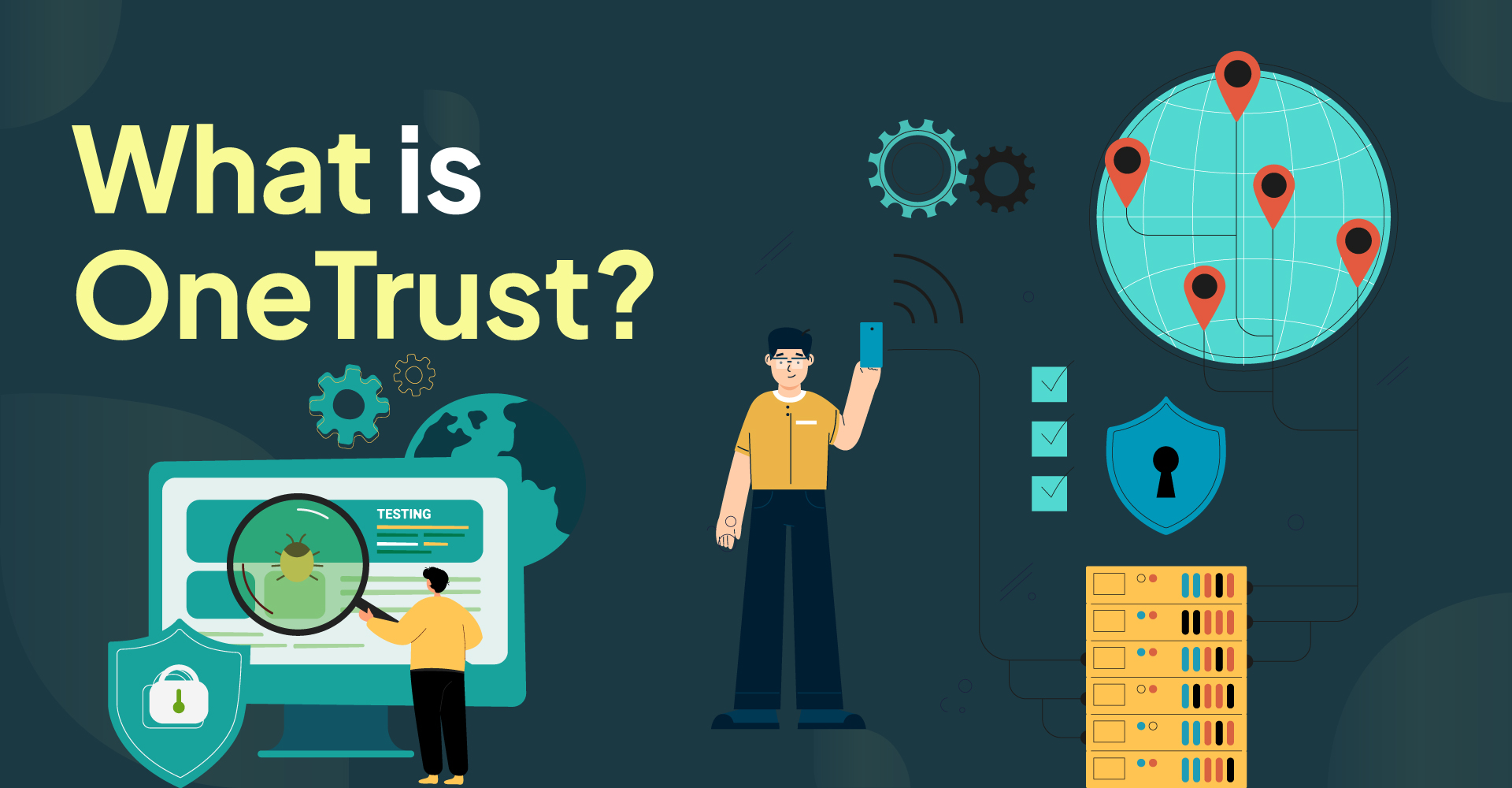
This guide explains what OneTrust does, who it’s built for, what it costs in 2026, the real pros and cons, and when a focused Consent Management Platform (CMP) makes more sense.
Is OneTrust right for your team?
OneTrust makes the most sense when privacy, consent, AI governance, data governance, vendor risk, and GRC all need to connect in one enterprise system. If the main need is cookie consent, DSAR workflows, privacy policies, Google Consent Mode, and site-level deployment, a focused CMP is usually easier to buy, launch, and manage.
In early 2026, OneTrust raised its minimum annual contract value (ACV) across tiers to roughly $10,000. As a result, many mid-market buyers are now reassessing whether they need the full governance suite or a focused consent and privacy platform such as Enzuzo.
| Choose OneTrust if… | Choose a focused CMP like Enzuzo if… |
| You need one platform across privacy, AI, data, vendor risk, and GRC. | You mainly need consent management, DSARs, privacy policies, and consent records. |
| Legal, privacy, security, procurement, data, and AI teams all need shared workflows. | Marketing, legal, and web teams need a practical consent setup without enterprise admin work. |
| You have the budget and internal owners to configure and maintain a broader governance platform. | You need transparent pricing, faster launch, and fewer unused modules. |
| AI governance, vendor risk, and compliance reporting are part of the buying case now. | AI governance and GRC aren’t current buying requirements. |
What is OneTrust?
OneTrust is enterprise-grade software for teams that need to connect governance work across privacy, legal, security, data, procurement, compliance, and AI programs. Founded in 2016 and headquartered in Atlanta, the company positions its product as an AI-ready governance platform that connects policies, risk controls, data use rules, and compliance workflows across the systems where companies collect and process data
In practice, OneTrust gives organizations a system of record for:
- Consent and preference management (web, mobile, CTV)
- Privacy automation (data subject access requests (DSARs), privacy impact assessments (PIAs), incident response)
- Data discovery, mapping, and use governance
- AI model and agent governance
- Third-party / vendor risk management
- Tech risk and compliance
OneTrust has 14,000+ organizations using its platform, including 75 of the Fortune 100. That scale is the point, but it can also create friction for smaller teams. The platform is designed for organizations running multiple governance programs at once.
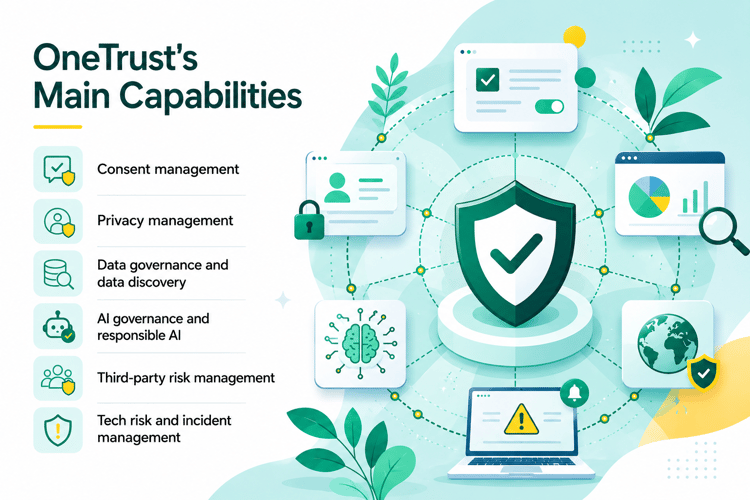
OneTrust’s main capabilities
OneTrust’s product set covers several connected governance tasks. The right mix depends on how much risk, data, vendor, and AI oversight your organization needs.
Consent management
OneTrust’s consent management tools help companies collect, store, and act on consent across customer touchpoints. That can include cookie banners, mobile app consent, connected TV consent, preference centers, tracker inventories, and consent data connected to marketing systems.
For mid-market teams, this is often the most relevant part of OneTrust. Consent affects marketing, analytics, advertising, legal, and user experience. A consent platform needs to show what users selected, which trackers were present, how consent was recorded, and how consent connects to downstream systems.
Privacy management
OneTrust’s privacy management tools support privacy operations across the data lifecycle. Its Privacy Automation packages include data and activity maps, privacy impact assessment workflows, vendor privacy risk reviews, DataGuidance regulatory intelligence, data subject request automation, and privacy incident management.
PIAs (also called data protection impact assessments) help teams review a new product, process, vendor, or data use before launch. This supports Privacy by Design, which means privacy checks are built into project planning rather than a late-stage legal review.
Data governance and data discovery
Data governance refers to the rules and processes used to manage data availability, usability, integrity, and security across enterprise systems. OneTrust’s Data Use Governance product connects policy documentation to real-time controls for AI-ready data. The platform uses classification across business, regulatory, consent, and data contexts, then links policies to data controls across modern data and AI systems.
This is where turning responsible data use into an operating model becomes a real workflow. A company can document how a dataset may be used, connect that policy to the systems where data lives, and audit how controls are applied.
AI governance and responsible AI
OneTrust’s AI governance tools track models, datasets, agents, vendors, ownership, lifecycle status, dependencies, risk tiers, approvals, audit evidence, and compliance reporting. Its AI governance product includes templates for frameworks such as the European Union Artificial Intelligence Act, National Institute of Standards and Technology (NIST), and ISO 42001.
The platform’s AI Governance Lifecycle helps teams catalog AI systems, assess risk, monitor posture, detect policy violations, and apply runtime guardrails. In production, this can include prompt and output filtering, sensitive data detection, agent observation, and policy-based controls for AI actions.
For mid-market companies, the fit depends on whether AI governance is already part of the buying case. If the main need is consent and privacy workflow management, this suite may sit outside the current scope.
Third-party risk management
OneTrust’s third-party risk management products help organizations manage vendors from onboarding through assessment, mitigation, reporting, monitoring, and offboarding. The pricing page says the base third-party risk management package includes a customized third-party inventory, vendor assessments, risk mitigation workflows, integrations, and risk intelligence on third parties.
This can help companies connect procurement, legal, security, and compliance work. It can be valuable for organizations with many vendors, regulated services, or customer security reviews.
Tech risk and incident management
OneTrust’s tech risk capabilities support governance, risk, and compliance programs. The platform includes templates and guidance across more than 50 standards, regulations, and frameworks, plus tools for asset tracking, risk scoring, mitigation, control management, and policy lifecycle workflows.
OneTrust has also added AI to incident management. In 2025, it launched a Privacy Breach Response Agent built with Microsoft Security Copilot. The tool was described as automating incident evaluation, regulatory mapping, notification requirements, breach scope review, affected jurisdiction checks, and audit logs for compliance documentation.
OneTrust pros and cons
OneTrust’s strengths are clearest when a company needs one platform to consolidate privacy, consent, AI governance, vendor risk, and GRC work. The trade-off is cost, setup time, and admin load for teams that only need focused consent and privacy workflows:
Pros
- Comprehensive: Few platforms cover privacy, consent, AI, vendor risk, and governance, risk, and compliance (GRC) under one roof. For organizations running all of these programs, consolidation has real value.
- Strong regulatory intelligence: DataGuidance regulatory intelligence is built into OneTrust Privacy Automation to support privacy research, regulatory change tracking, templates, workflows, and guidance.
- Enterprise-grade integrations: Broad integration ecosystem: OneTrust lists integrations and connectors across Salesforce, ServiceNow, Workday, SAP HANA, Snowflake, and other data sources.
- Enterprise adoption: OneTrust reports 14,000+ customers and 75% of the Fortune 100, which can help when buyers need a vendor with broad enterprise adoption.
- Mature AI governance tooling: Its AI governance tooling includes templates aligned to the EU AI Act, NIST AI Risk Management Framework (AI RMF), and ISO 42001.
Cons
- High minimum spend: OneTrust requires a higher starting budget than many focused CMPs. Larger enterprise deployments can move into six figures once modules, users, visitor volume, inventories, and implementation work are factored in.
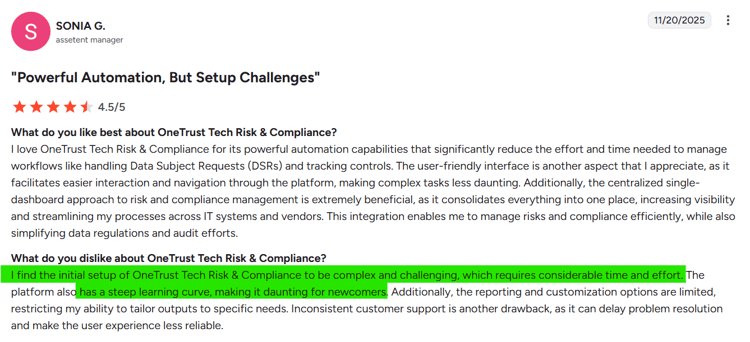
- Long implementation: G2 reviewers frequently describe OneTrust implementation as complex and time-consuming, often requiring significant configuration and training, and some recommend using professional services for deployment.
- Steep learning curve: Some reviewers note that the user interface (UI) is dense and the platform is difficult to operate without dedicated privacy ops.
- Unused-module risk: Mid-market buyers should check whether AI governance, third-party risk, or GRC modules are current requirements or future-only needs.
- Support varies by tier: Support and onboarding expectations should be clarified during procurement, especially if the team needs implementation help, training, or faster response times.
Who is OneTrust best for?
OneTrust is best suited to organizations that need a broad governance suite across multiple departments. That can include privacy, legal, security, compliance, data, procurement, risk, and AI teams.
A strong fit may include companies with:
- Global privacy requirements across many regions
- Large vendor ecosystems
- Internal AI governance programs
- Mature security and compliance teams
- Multiple business units that use sensitive data
- A need for connected workflows across privacy, data, risk, and AI
- Resources to configure, manage, and maintain a larger platform
OneTrust’s pricing page reflects that broad scope, with packages across AI Governance, Consent & Preferences, Privacy Automation, Tech Risk & Compliance, and Third-Party Management.
A mid-market company can still use OneTrust, especially if privacy, AI, vendor risk, and compliance require a single platform. The buying decision gets harder when the company mainly needs consent management, privacy requests, notices, and Google Consent Mode support. In that case, a narrower tool may be easier for the team to manage.
OneTrust is likely overbuilt for your team if:
- Your primary needs are cookie consent, a privacy policy, and DSAR handling, rather than enterprise GRC.
- You operate in only one or a few regions.
- You don't have a dedicated privacy or compliance headcount to administer the platform.
- Your annual privacy software budget is under $10,000.
- You run on Shopify, Webflow, or another modern web stack and need native integration with your site tools.
- You need to be live in days, not months.
If this list sounds familiar, the next step is a narrower comparison: OneTrust’s full suite against a focused CMP for consent, DSARs, policies, and site deployment.
How does OneTrust pricing work?
OneTrust uses a sales-led, tiered subscription model with pricing driven by users, inventory, visitors, and data volume. Public buyer reports, and pricing guides place entry-level plans around $827 to $1,100 per month for a single domain, with typical annual spend ranging from about $10,000 to upwards of $200,000 depending on scope and complexity.
OneTrust’s pricing page describes different usage meters for different products. For example:
- AI Governance pricing is based on admin users and AI inventory.
- CMP Base pricing is based on average daily visitors across channels and properties.
- CMP Suite pricing is based on average daily visitors.
- Universal Consent & Preference Management pricing is based on total data subject profiles.
- Privacy Automation pricing is based on the number of users and the privacy asset inventory.
- Tech Risk and Compliance pricing is based on the number of admin users and the asset inventory.
- Third-Party Risk Management pricing is based on admin users and third-party
- inventory.
What's important to note is that OneTrust's total cost of ownership goes beyond the licensing fee. Most OneTrust deployments also include implementation services, ongoing administration headcount, annual uplift on renewal, and multi-year commitments.
That means buyers should clarify more than the monthly or annual price. The final contract may depend on the modules selected, admin users, inventory size, visitor volume, data subject profiles, and implementation resources required.
Before speaking with the sales team, mid-market buyers should list the workflows they need now and those they may need in the future. That helps prevent a mismatch between the suite purchased and the work the team will run in the platform.
What to check before switching from OneTrust
If OneTrust’s pricing or scope no longer fits, migration planning matters before replacing the platform. A switch from OneTrust needs planning, especially if consent records, privacy notices, domains, and integrations already live in the account. A rushed migration can create gaps in records or confusion over who owns each workflow.
Start with a practical audit:
- Consent records: Confirm which records need to be retained, exported, or referenced after migration.
- Domains and properties: List each website, app, and regional experience that uses OneTrust.
- Users and roles: Identify admins, legal reviewers, marketing users, and technical owners.
- Consent banner setup: Capture banner language, geofencing rules, categories, branding, and consent mode settings.
- Tracker inventory: Export or rebuild records for cookies, SDKs, tags, and scripts.
- Preference centers: Map opt-in and opt-out preferences across marketing channels.
- Integrations: Check Google Tag Manager, analytics tools, marketing systems, customer relationship management (CRM), and data warehouses.
- Data subject request (DSAR) workflows: Review forms, routing, identity checks, response steps, and archive needs.
- Production schedule: Decide when to test, deploy, and monitor the replacement system.
The goal is to move consent and privacy workflows without losing visibility. The replacement platform should give legal, marketing, and technical teams the answers they need without adding extra waiting time or avoidable admin work.
OneTrust alternatives by use case
The right OneTrust alternative depends on which job you’re replacing. The common options break down by use case:
| Use case | Best-fit alternatives | Starting price | Differentiator |
| Cookie consent + CMP only | Enzuzo, Osano, Cookiebot | Starting around $7 to $199/month, depending on scope and billing model | Fast deployment, Google Consent Mode v2 certified |
| Consent management + DSAR + policies | Enzuzo, Osano | Starting around $22/month billed yearly for Enzuzo, while Osano’s paid tiers begin higher | Unified mid-market platform without GRC overhead |
| Native Shopify deployment | Enzuzo | From ~$79/mo | Native Shopify deployment |
| Multi-domain (10+ sites) | Enzuzo, Cookiebot | Pricing driven by domain count and traffic; Enzuzo offers a flat rate from ~$79/mo | Predictable pricing vs. OneTrust’s per-domain model |
| Full enterprise GRC | TrustArc, BigID, Securiti | Quote-based | Like-for-like OneTrust replacement at scale |
For consent and DSAR work, mid-market teams often compare Enzuzo and Osano. Teams comparing broader governance platforms may also evaluate TrustArc, BigID, or Securiti.
Enzuzo fits teams that mainly need consent management, DSAR workflows, privacy policies, and Shopify-ready deployment rather than a full governance, risk, and compliance (GRC) suite. Its platform includes Google Consent Mode v2, consent analytics, consent logs, DSAR automation, and legal policy tools, with Pro pricing listed at $79/month for 10 domains.
FAQs about OneTrust
Is OneTrust a consent management platform?
OneTrust offers a consent management platform as part of its wider AI-ready governance platform. Its CMP products cover consent banners, tracker inventories, consent across web, mobile, and CTV properties, and consent data used across customer touchpoints.
Is OneTrust an AI governance platform?
Yes. OneTrust’s current positioning centers on AI-ready governance. Its AI governance software tracks models, datasets, agents, vendors, ownership, lifecycle status, risk frameworks, approvals, audit evidence, runtime signals, policy violations, and guardrails for AI systems in production.
What is the difference between OneTrust and a focused CMP?
OneTrust offers a broader suite of governance tools spanning privacy, data, AI, security, tech risk, and third-party risk management. A focused CMP centers on consent, preferences, cookie banners, privacy notices, DSAR workflows, and related website privacy tasks.
What should companies ask before choosing OneTrust?
Ask which workflows the business needs now, which teams will manage the system, how pricing is metered, what the implementation schedule looks like, how many users need access, which integrations matter, and which modules may sit unused. The answers should connect the platform to current resources, future growth, and the team’s daily work.
Mate Prgin
Mate is the CEO & Founder of Enzuzo. He has an executive MBA from Ivey Business School and is a subject matter expert in data privacy and compliance.
More related blogs
Your next read