Best Ketch Alternatives for 2026: 7 Options Ranked & Reviewed

Osman Husain
Ketch is a capable consent and privacy platform, serving enterprise brands like Paramount, LVMH, and Kroger. If you have a dedicated privacy engineer, a mobile app that needs native consent, and an enterprise budget, Ketch is a legitimate option for your team.
But the platform's depth often results in complex onboarding, long implementation timelines, and a confusing user interface. What's more, Ketch can be expensive - the Plus plan starts at $499/month, and custom plans (where the majority of features live) are priced much higher.
Additional domains are separate line items. DSAR automation is reserved for the custom-quoted Pro tier, and standard cookie consent setup can run up to 4 weeks.
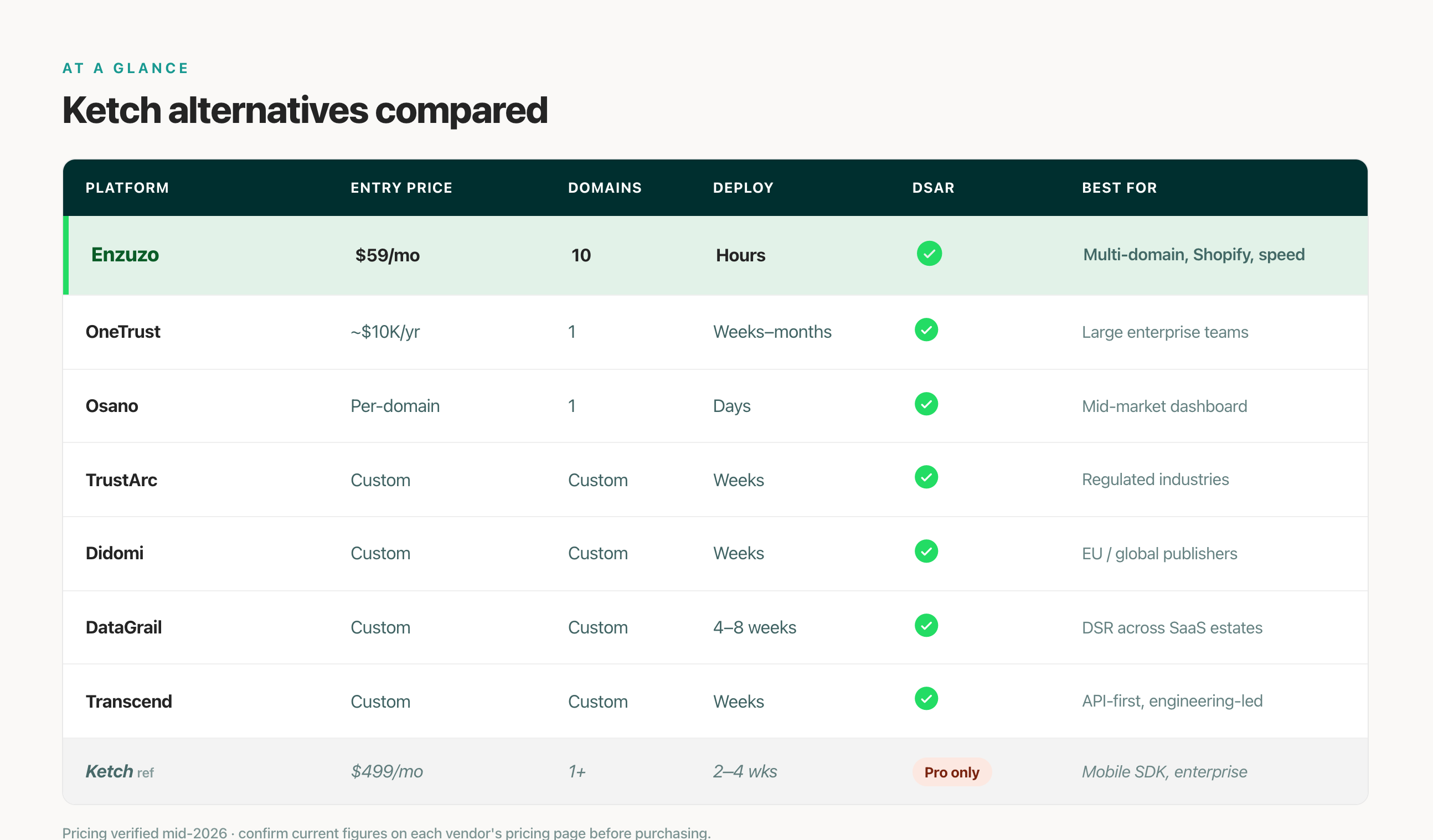
This guide compares the seven best Ketch alternatives on price, deployment time, multi-domain support, and DSAR, so you can match the right tool to your actual needs.
Why teams look for a Ketch alternative
A few patterns recur when companies evaluate Ketch against the field.
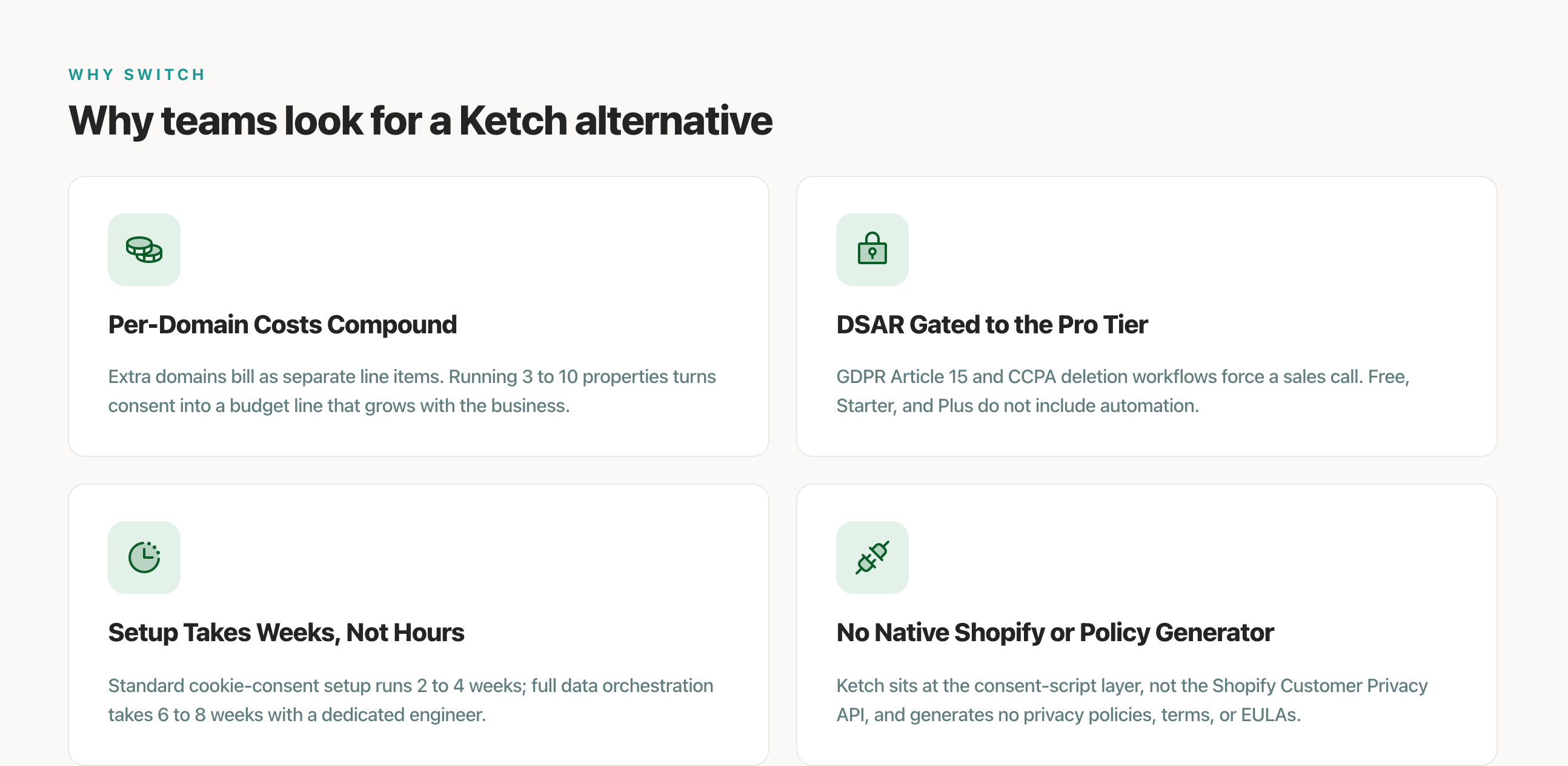
- Per-domain and per-visitor costs compound. Ketch markets visitor-based pricing as a differentiator, but additional domains are still billed as separate line items. For a business running 3 to 10 properties, the math adds up fast.
- DSAR automation is gated to the Pro tier. Any GDPR Article 15 right-to-know or CCPA right-to-delete workflow forces a sales conversation and a custom quote. Free, Starter, and Plus do not include it.
- Implementation takes weeks, not hours. Standard setup is 2 to 4 weeks; full orchestration is 6 to 8 weeks and needs a dedicated privacy or data engineer. Mid-market IT managers without that resource often run long.
- No native Shopify integration. Ketch sits at the consent-script layer, not the Shopify Customer Privacy API layer.
Where Ketch genuinely wins
Being honest about this matters, both for your decision and because a one-sided comparison helps no one:
- Mobile SDK (iOS and Android). If you collect consent inside a mobile app today, Ketch's native SDK is a real strength. Most lighter CMPs, including Enzuzo, are web-first at the consent layer.
- Banner UI customization. G2 reviewers consistently praise how easy it is to customize Ketch's banner.
- Enterprise procurement readiness. Ketch holds ISO 27001 and SOC 2 Type II certifications and has a 32-plus brand enterprise roster, which makes it a safe choice for formal procurement scorecards.
If these aren't your top requirements, one of the alternatives below will likely cost less and deploy faster.
The 7 best Ketch alternatives in 2026
1. Enzuzo: best overall Ketch alternative for multi-domain teams
 Best for: mid-market and multi-brand companies, Shopify merchants, and teams needing predictable pricing.
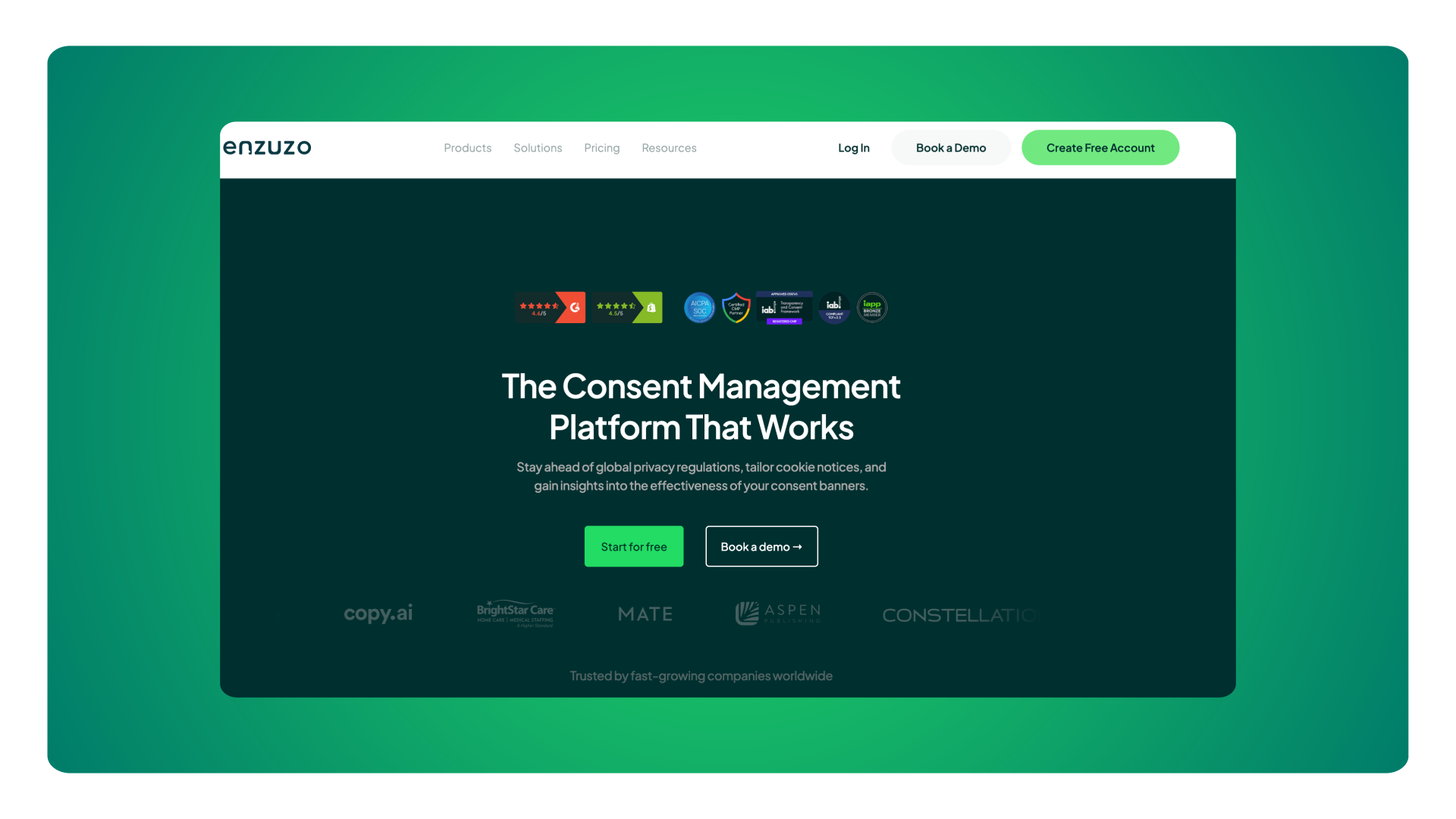
Enzuzo's consent management platform covers 10 domains for $59/month (Pro, billed annually) with no per-domain line items, DSAR automation, API access, and Google Consent Mode v2 certification. That last point is the clearest contrast with Ketch: where Ketch reserves DSAR for its custom-quote Pro tier and does not offer API access, Enzuzo bundles both into a self-serve plan.
Setup happens through Google Tag Manager and typically goes live the same day. Assisted onboarding can enable teams migrating off other platforms to be live within an hour or two, mostly during the onboarding call itself. Enzuzo is also the only option here with a full native Shopify integration at the Privacy API layer, which is why Shopify and Shopify Plus brands consistently land on it.
- Where it wins vs Ketch: price (roughly 8x cheaper at $59/mo for 10 domains vs $499/mo for one), speed (hours vs weeks), multi-domain at no extra cost, native Shopify, DSAR and policy generator included.
- Where Ketch still wins: native mobile app SDK and enterprise banner customization. Enzuzo is web-first at the consent layer.
- Pricing: Free tier available; Starter $9/mo (1 domain); Growth $29/mo (4 domains); Pro $59/mo (10 domains); mid-market plans scale on visitor volume for high-traffic sites.
If you're ready to discuss a Ketch migration pathway or want to explore your options, book a product strategy call to see where Enzuzo can help.
2. OneTrust: best for large enterprises with dedicated privacy teams
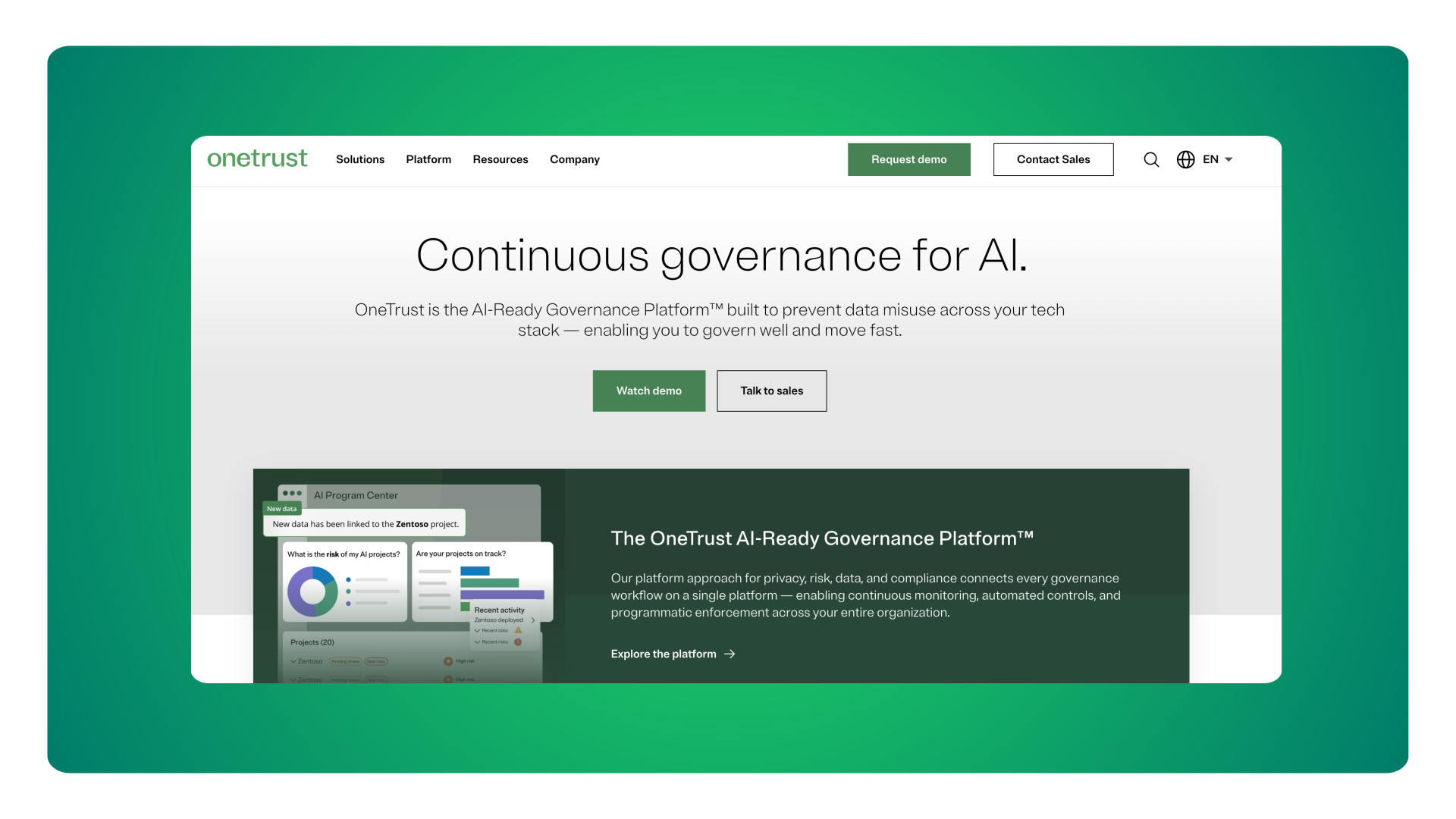
Best for: Fortune 500 and large enterprises that need a full privacy suite and have the team to run it.
OneTrust is the enterprise incumbent and the most feature-complete platform in this list; covering consent, data mapping, vendor risk, and more.
It is also the most expensive and complex: the minimum is roughly $10,000 per year, implementation runs weeks to months, and the platform is built for dedicated privacy and legal teams.
If you are evaluating Ketch specifically to avoid enterprise sprawl, OneTrust is the heavier option, not the lighter one. It earns its place here because many teams shortlist Ketch precisely as a more modern alternative to OneTrust, and it is worth knowing the incumbent you are comparing against.
- Where it wins vs Ketch: depth and breadth of the privacy suite, analyst recognition, procurement familiarity.
- Trade-off: highest cost and longest implementation in this list. See our OneTrust vs Ketch comparison for the head-to-head.
3. Osano: best for teams looking to scale into enterprise governance
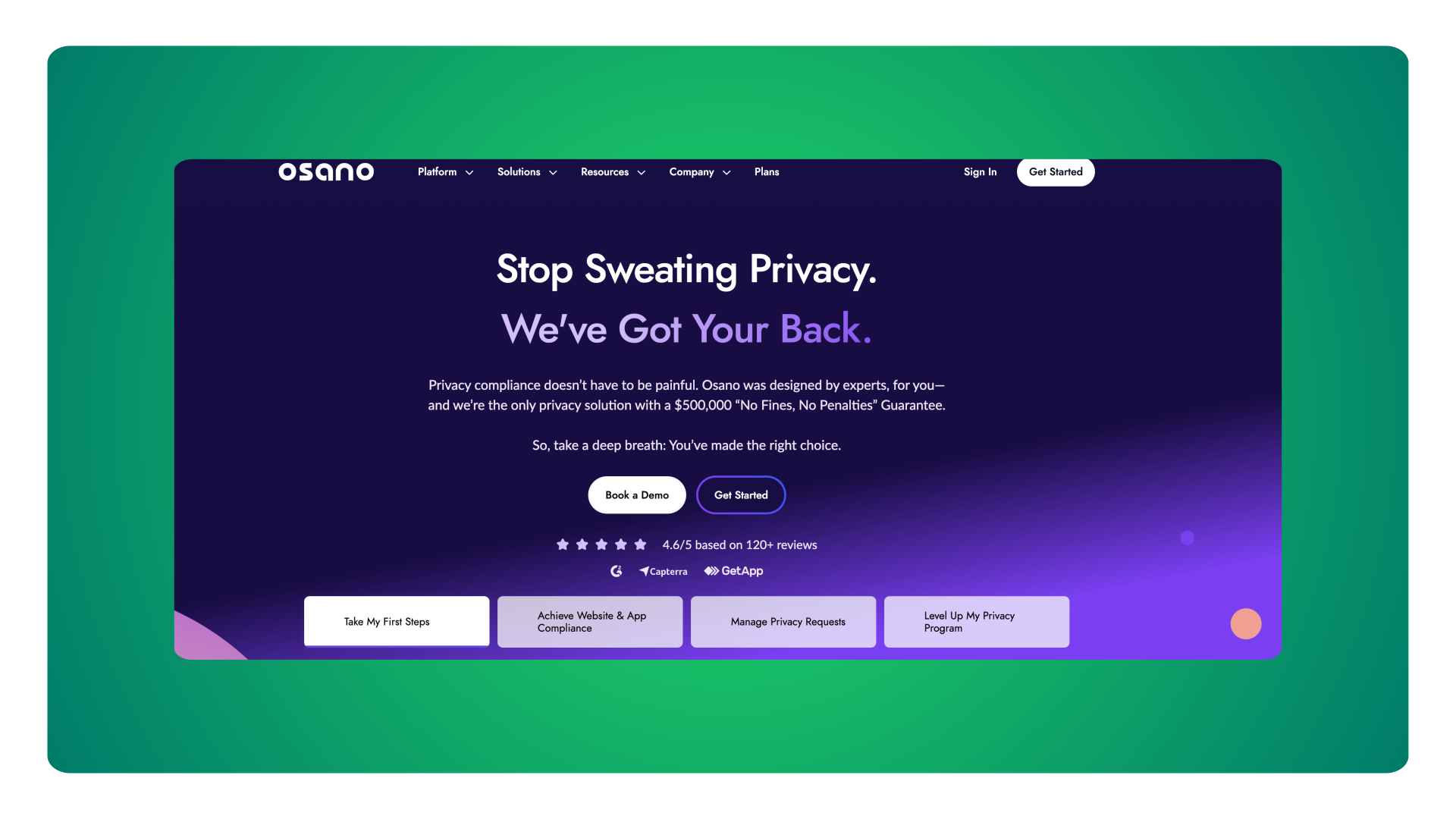
Best for: companies that want a clean, managed privacy law dashboard with enterprise-ready workflows
Osano competes directly with Ketch in the enterprise-entry market and is often shortlisted alongside it as a viable option. It offers a multi-domain dashboard, DSAR support, and ongoing privacy-law alerts. The catch is per-domain pricing: at three or more domains the cost climbs quickly.
Nonetheless, Osano is a solid option if you have a small number of domains and value the no-fines guarantee offer.
- Where it wins vs Ketch: simpler, more managed experience; privacy-law alerts.
- Trade-off: per-domain pricing compounds for multi-property businesses.
4. TrustArc: best for regulated industries 
Best for: regulated enterprises (finance, healthcare) that need privacy assessments, certifications, and consulting alongside consent.
TrustArc is a legacy privacy-compliance platform with a deep privacy assessment and certification heritage. It shows up often in Ketch vendor evaluations with a head-to-head comparison a frequent theme among buyers.
TrustArc fits organizations that need formal privacy program management and audit support, not just a consent platform. It is, however, enterprise-priced and slower to deploy than the lightweight options here.
- Where it wins vs Ketch: assessment, certification, and consulting depth for regulated industries.
- Trade-off: enterprise pricing and complexity; overkill for teams that mainly need consent plus DSAR.
5. Didomi: best for EU and global publishers and media
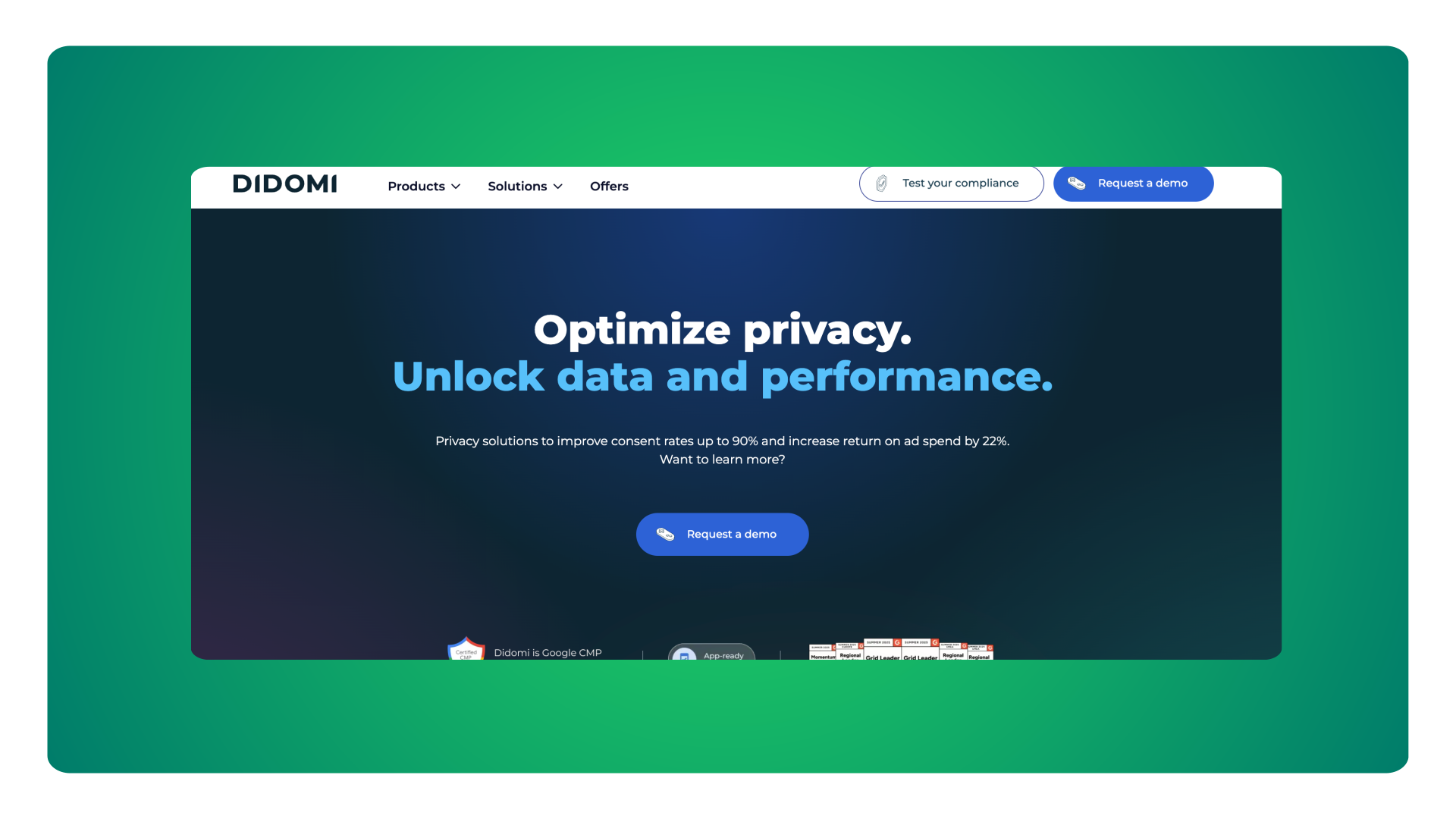
Best for: EU-based and global publishers, media companies, and enterprises with heavy IAB TCF requirements.
Didomi is an enterprise-grade consent and preference management platform, strong in the EU financial services and media sectors. It acquired Sourcepoint in July 2025, consolidating its position with publishers and adding U.S. enterprise reach. If your priority is a sophisticated IAB TCF-compatible platform for properties across the EU, Didomi is a credible Ketch alternative. Like the other enterprise options, it is custom-priced and built for larger teams.
- Where it wins vs Ketch: publisher and media depth, IAB TCF maturity, EU presence.
- Trade-off: enterprise sales motion and pricing; heavier than mid-market teams need.
6. DataGrail: best for AI-assisted governance workflowsDSAR automation across a large SaaS estate
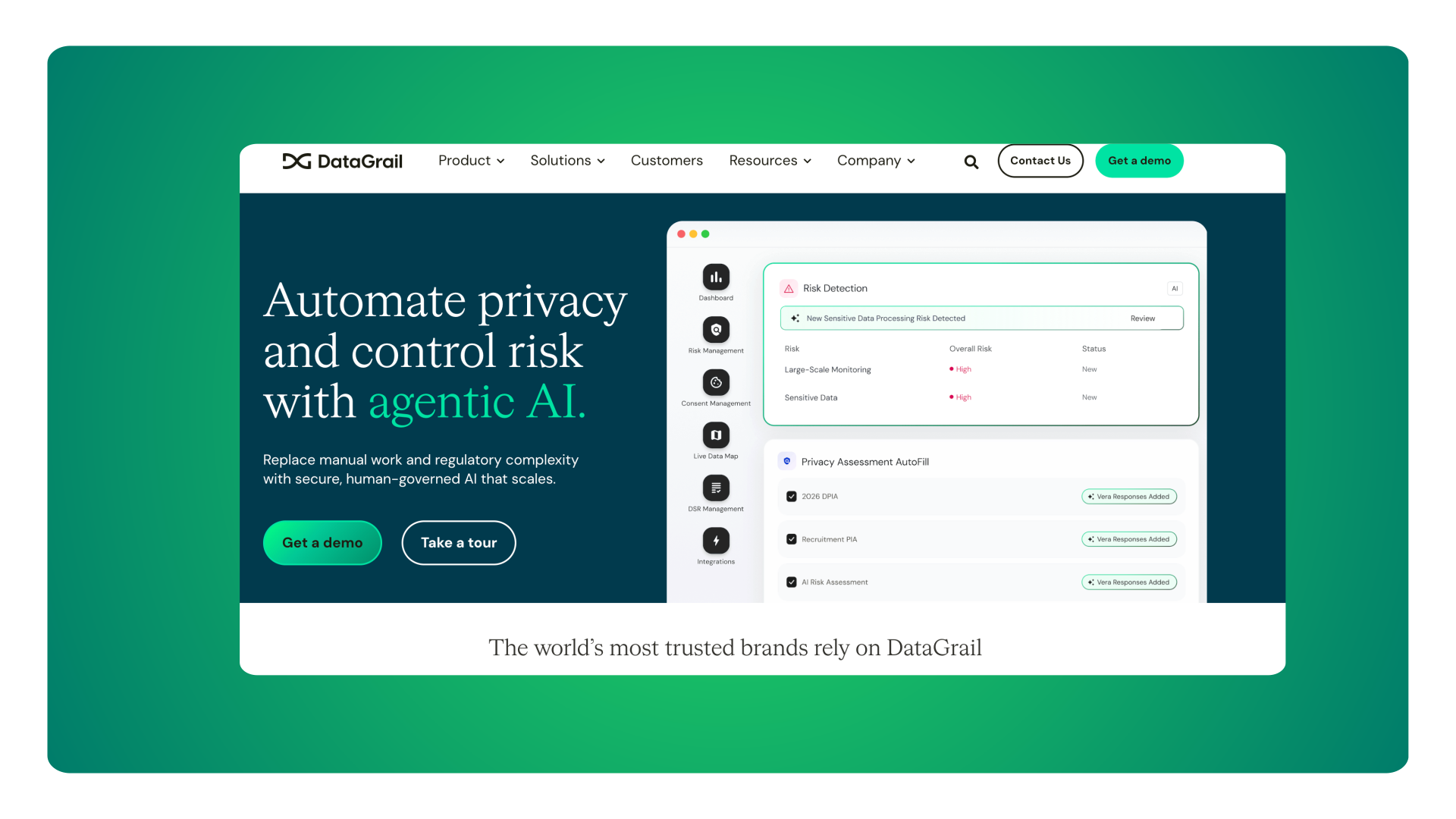
Best for: mid-market and enterprise privacy teams that need automated data subject request (DSR) fulfillment across many connected SaaS tools.
DataGrail is a popular Ketch alternative and a close match to its data-discovery solution. Its headline strength is a library of 1,500-plus pre-built SaaS integrations, an AI-driven workflow that auto-detects personal data sources, and an automated process to route access or deletion requests.
It also handles consent and data mapping, and reviewers consistently praise its support and ease of use. Implementation typically runs 4 to 8 weeks, and pricing is custom (enterprise), so expect a sales conversation rather than a self-serve checkout.
- Where it wins vs Ketch: breadth of pre-built integrations, AI-driven DSR auto-discovery, top-rated support.
- Trade-off: custom enterprise pricing and multi-week implementation; more of a data-ops platform than a fast cookie banner.
7. Transcend: best for engineering-led, API-first privacy
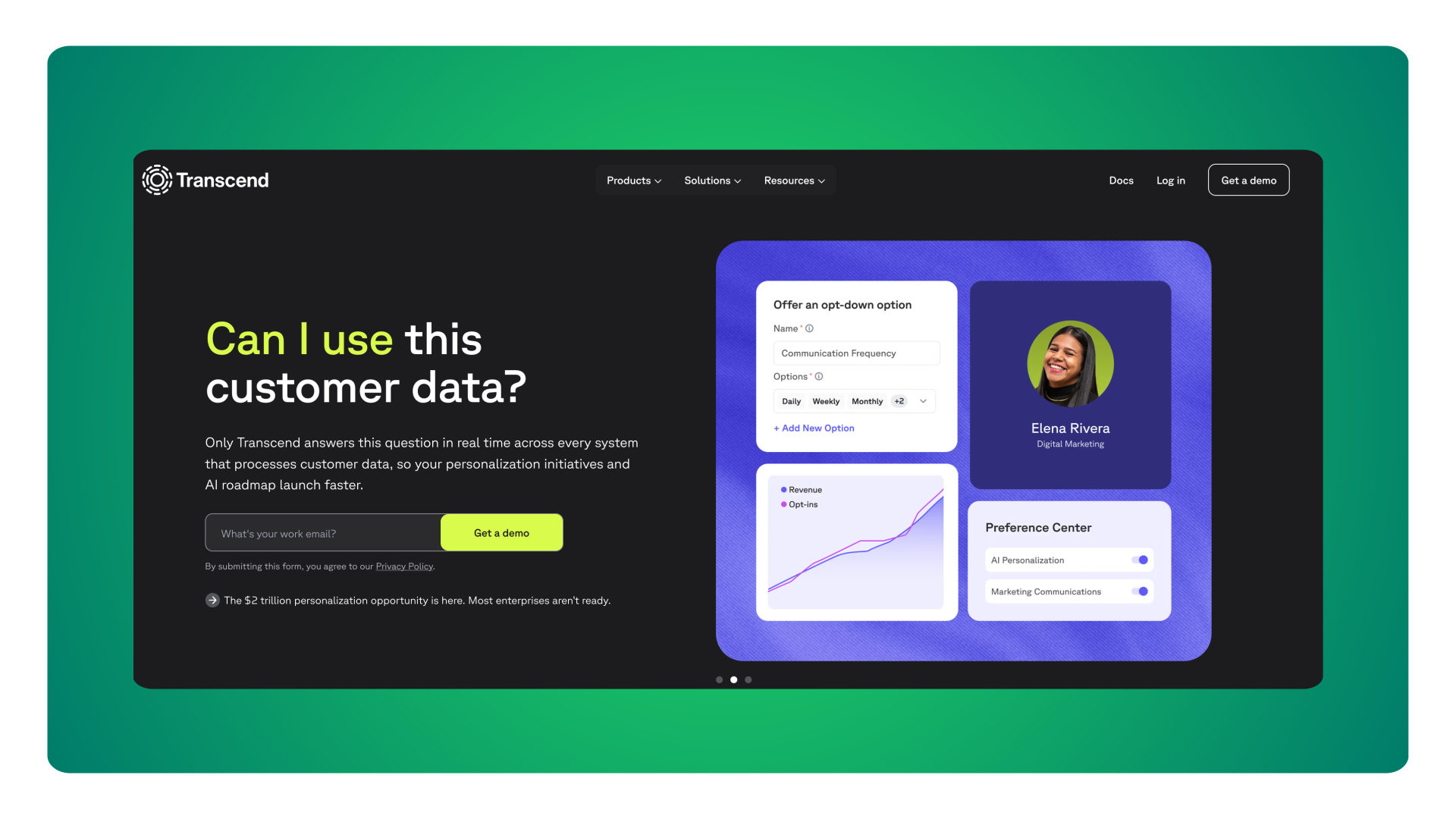
Best for: companies with engineering resources that want privacy infrastructure built around APIs, covering consent and DSAR automation.
Transcend is a developer-first privacy platform, competing directly with Ketch in many of the mid-market and enterprise buyer segments.
It offers consent management, data discovery & classification, preference management, and more. It's one of the fastest-growing players in the category. The trade-off, however, mirrors Ketch's: extracting full value usually requires engineering involvement for setup and customization, and pricing is custom (enterprise).
- Where it wins vs Ketch: API-first architecture, end-to-end-encrypted request processing, strong fit for engineering teams.
- Trade-off: engineering dependency to deploy and custom enterprise pricing; not a fast no-code option.
Other Ketch alternatives worth knowing (enterprise data governance)
Beyond the seven above, a few enterprise platforms surface in Ketch evaluations when the priority is broad data governance specifically.
- Securiti: an enterprise 'PrivacyOps' platform that unifies privacy, security, and governance (GRC), with strong data discovery and classification across structured and unstructured systems. It matches Ketch's 2026 AI-privacy framing, but is broader and heavier than most mid-market teams need.
- BigID: enterprise data intelligence and discovery, frequently shortlisted alongside OneTrust for full privacy programs at large data estates.
- Privado: code-level data mapping and privacy risk analysis aimed at engineering and AppSec teams, useful if your concern is what data your own applications collect.
DSAR automation: where Ketch alternatives differ
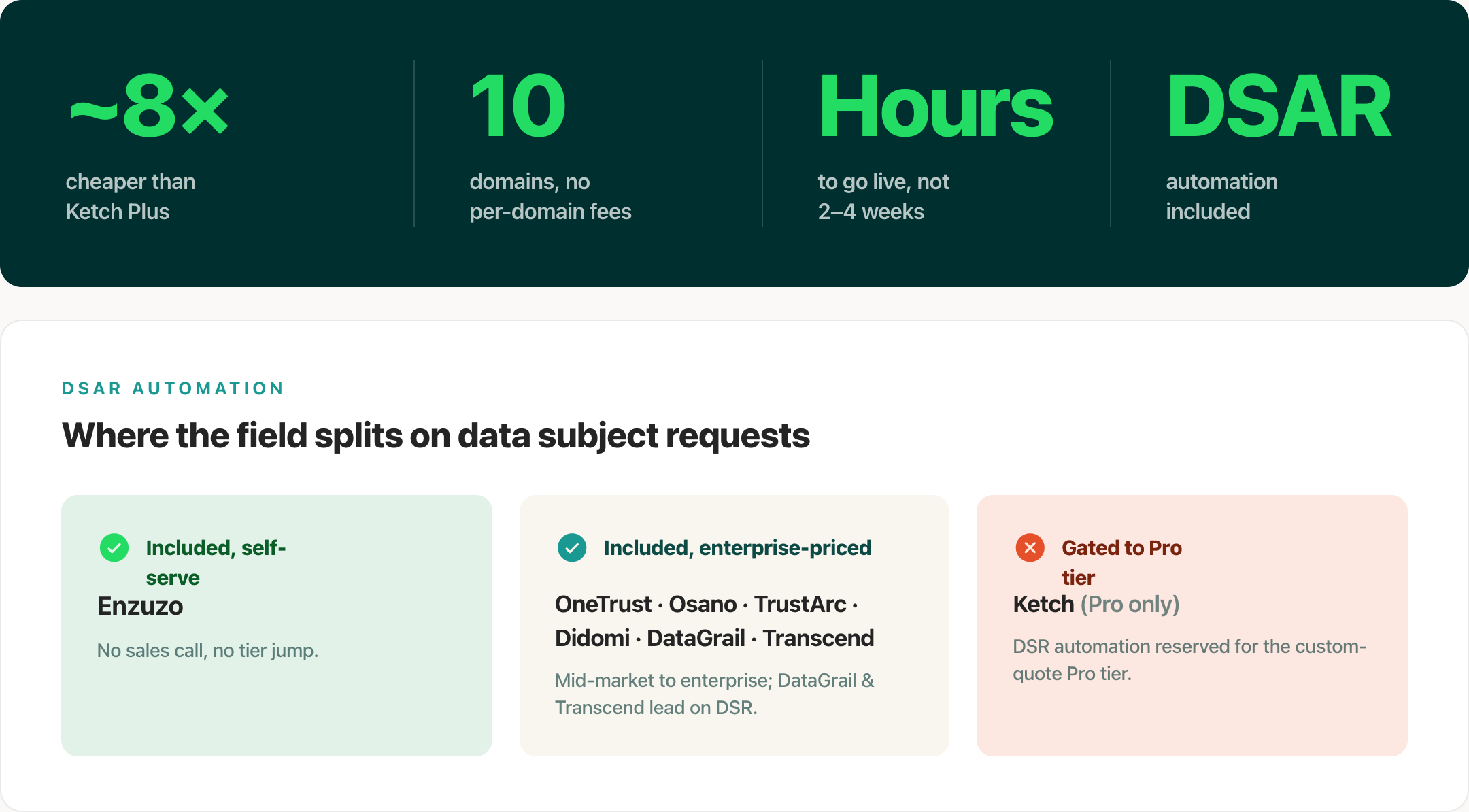
Data subject access requests are where the entry-tier and enterprise tools split most sharply. This is important because privacy laws such as GDPR Article 15 and California's CCPA grant individuals the right to request the deletion of their data. If you expect a meaningful volume of these requests, it's best to evaluate carefully:
- Included at self-serve pricing: Enzuzo includes DSAR automation in its paid plans, so a GDPR Article 15 or CCPA right-to-delete workflow does not require a sales call.
- Included, enterprise-priced: OneTrust, Osano, TrustArc, Didomi, DataGrail, and Transcend all offer DSAR or rights fulfillment, but at mid-market-to-enterprise pricing and with longer setup. DataGrail and Transcend in particular are built around DSR automation across a connected SaaS stack.
- Gated: Ketch reserves DSR automation for its custom-quote Pro tier, so the Free, Starter, and Plus tiers do not include it.
How to switch from Ketch to Enzuzo
Migrating off Ketch is straightforward if you're looking to port over consent tags via Google Tag Manager:
1. Export your current cookie categories and consent configuration from Ketch so you can mirror them.
2. Create your Enzuzo account and add your domains
3. Install via Google Tag Manager. Enzuzo provides a GTM container setup that handles consent signaling and Google Consent Mode compatibility
4. Configure geo-targeting so the right banner shows in each jurisdiction (GDPR for the EU/UK, CCPA/CPRA and other US state laws for the US).
5. Turn on DSAR intake and generate your policies if needed
6. Verify and go live. Confirm consent logs are recording and that tags fire only after consent.
FAQs
How much does Ketch cost?
Ketch has four published tiers: Free ($0, 1 domain, 5K visitors), Starter ($150/month, 1 domain, 30K visitors), Plus (from $499/month, 1+ domains, 100K visitors, annual billing required), and Pro (custom quote). DSAR automation, data mapping, and risk assessments are only available on the Pro tier, and additional domains are billed as separate line items.
What is the best Ketch alternative for multi-domain companies?
Enzuzo is the best Ketch alternative for multi-domain companies because it covers 10 domains for $59/month (billed annually) with no per-domain charges, while others like Osano bill additional domains as separate line items. Enzuzo also includes DSAR automation and API access at that price.
Is TrustArc or Ketch better?
It depends on your need. TrustArc is stronger for regulated industries that require privacy assessments, certifications, and consulting alongside consent. Ketch is stronger for modern consent management with a native mobile SDK and AI-privacy tooling. If you mainly need cookie consent, DSAR, and multi-domain support at a lower price, a lighter platform like Enzuzo covers that core without enterprise pricing.
What are the best DSAR automation tools compared to Ketch?
Enzuzo, OneTrust, Osano, TrustArc, Didomi, DataGrail, and Transcend all offer DSAR automation. Ketch gates DSR automation to its custom-quote Pro tier. Among these, Enzuzo is the only one that includes it in a self-serve plan, while OneTrust, Osano, TrustArc, Didomi, DataGrail, and Transcend offer it at mid-market-to-enterprise pricing.
Does Enzuzo handle consent across mobile apps like Ketch?
Enzuzo manages consent across up to 10 domains from a single dashboard, which covers most multi-brand and multi-property setups. For native in-app mobile consent collection, Ketch's mobile SDK is currently the stronger option; Enzuzo is web-first at the consent layer.
What is Ketch best at?
Ketch's genuine strengths are its native mobile SDK (iOS and Android), complex consent workflows that feed into data warehouses, and teams building programmatic privacy operations at scale. For those requirements, Ketch is a well-built platform.
Osman Husain
Osman is the content lead at Enzuzo. He has a background in data privacy management via a two-year role at ExpressVPN and extensive freelance work with cybersecurity and blockchain companies. Osman also holds an MBA from the Toronto Metropolitan University.
LinkedIn →More related blogs
Your next read