Osman Husain
Cookiebot and iubenda are both widely used privacy and consent platforms, but they differ in pricing and feature sets. Cookiebot is a per-domain, per-subpage cookie scanner starting around EUR 7/month for one site, best known for mature E.U. coverage. iubenda bundles cookie consent with lawyer-drafted privacy policy and terms generation, per site, starting around EUR 5/month. Both handle consent management adequately but have subtle differences, which we'll explore in this review.
Cookiebot vs iubenda: the overlap in core markets
Cookiebot and iubenda frequently appear in the same evaluation because both are E.U.-centric, offer plug-and-play products, and have overlapping buyer segments.
Businesses looking for consent-first tools for E.U compliance coverage find that the two platforms can broadly meet their needs. The caveat: both Cookiebot and iubenda get progressively more expensive as you add more domains or expand into different markets.
The main difference between Cookiebot and iubenda. Cookiebot is a pure consent and cookie-scanning tool with a mature product and security certifications to match. iubenda bundles consent with a legal-document generator, positioning itself as a broader compliance toolkit for teams without in-house counsel.
I'll walk through what each does well, where each breaks down, and where a flat-priced multi-domain platform like Enzuzo changes the calculation.
At-a-glance comparison
| Dimension | Cookiebot | iubenda |
| Target segment | SMB to mid-market, EU + US mixed | SMB, EU/LATAM-heavy |
| Entry price | EUR 7/mo (Premium Lite, 1 domain, 50 subpages) | EUR 5/mo (Essentials, annual) |
| Pricing model | Per-domain + per-subpage tiers | Per-site + pageview overages |
| 4-domain minimum gotcha | ⚠️ Yes, Premium Small requires 4+ domains for the headline rate | No, but each site is billed separately |
| Multi-domain dashboard | ❌ Separate accounts per domain | ❌ No consolidated dashboard |
| DSAR automation | ❌ Not offered at any tier | ⚠️ Intake form only, no workflow |
| API access | ❌ Not offered at any tier | ⚠️ Higher tiers only |
| Shopify native | ✅ Dedicated app, Customer Privacy API sync | ⚠️ Basic (consent-script layer) |
| Global Privacy Control (GPC) | ✅ Honored automatically | ✅ Honored automatically |
| Whistleblowing / adjacent compliance tools | ❌ CMP only | ✅ Whistleblowing tool + paid Accessibility Widget |
| Certifications | ✅ SOC 2 Type 2, HIPAA, ISO 27001, PCI, FedRAMP | Not prominently documented |
| US state law coverage (CIPA, VCDPA, etc.) | ⚠️ Single nationwide rule, not per-state | ❌ Thin past CCPA basics |
| Setup time | Hours (scanning overhead) | Hours |
| Support model | Email only, async | Email, dashboard flagged as confusing in reviews |
| Google Consent Mode v2 | ✅ | ✅ (paid tiers) |
Pricing as of July 2026. Cookiebot's Premium Small tier headline rate (EUR 15/domain) requires a minimum of 4 domains; buyers with 1 to 3 domains are pushed to the EUR 30/domain Medium tier. iubenda's pageview overages can push monthly cost up independent of domain count.
Cookiebot: The robust cookie scanner
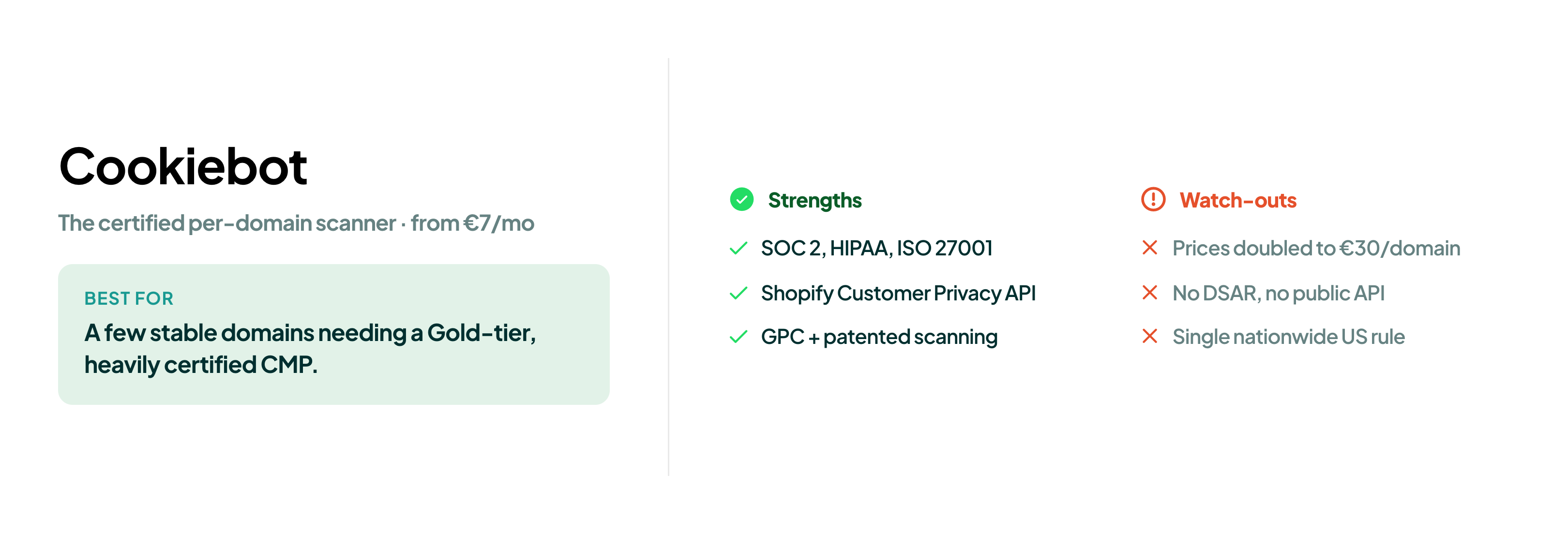
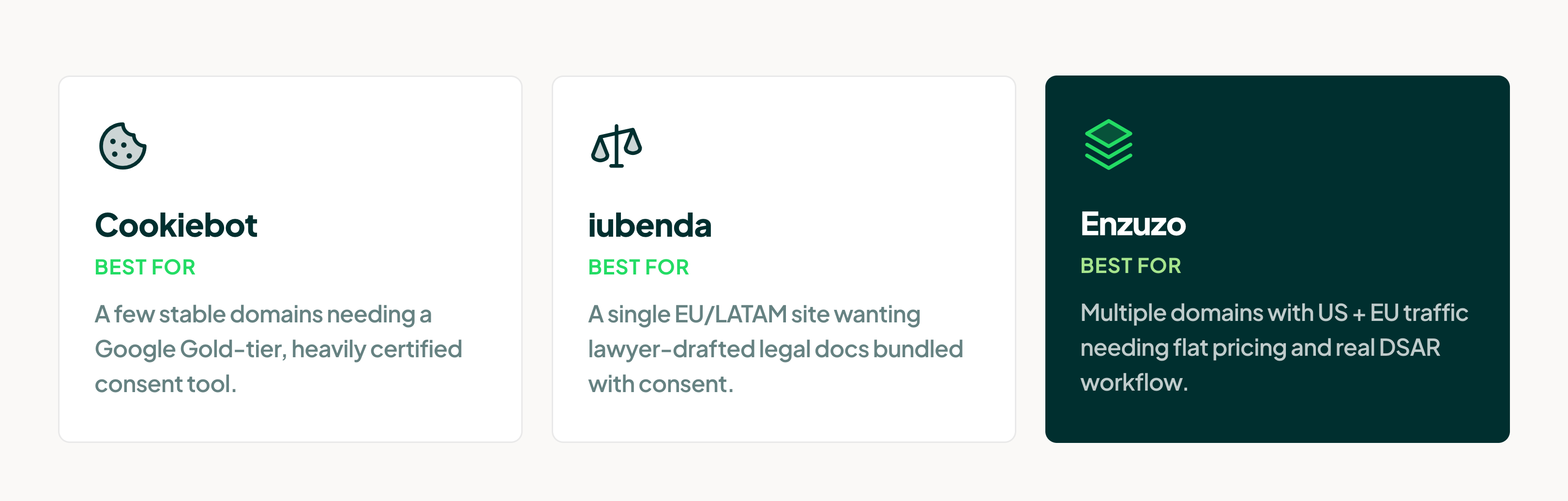
Best for: SMB to mid-market businesses that want a Google Gold Tier certified CMP with strong enterprise & security certifications.
What it does well
Cookiebot is a widely deployed CMP, with its European compliance roots spread across hundreds of thousands of websites and apps. It supports multiple languages, has patented cookie scanning technology, offers a customizable banner, and checks all the boxes for a modern platform.
Owned by Usercentrics since 2021, Cookiebot also carries enterprise-grade certification weight: SOC 2 Type 2, HIPAA, ISO 27001, and more. For a security questionnaire or formal procurement process, Cookiebot's certification posture is at parity with most enterprise CMPs.
Two more strengths worth crediting. Cookiebot has a dedicated Shopify app that syncs consent state to Shopify's Customer Privacy API automatically, real integration depth for ecommerce stores, not just a script drop-in. And according to Cookiebot's own documentation, the CMP honors Global Privacy Control signals automatically: when a visitor arrives with GPC enabled, the banner is suppressed and the opt-out is confirmed on screen.
Where it falls short
Cookiebot doubled its Premium tier pricing on August 18, 2025, moving the base rate from EUR 15 to EUR 30 per domain. What's more, the headline EUR 15/domain rate for the Premium Small tier requires a minimum of four domains. Buyers with 1 to 3 domains are automatically pushed to the EUR 30/domain Medium tier, effectively doubling their cost.
The math compounds from there. Four domains on Premium Medium runs about EUR 120/month before any features are added. Eight domains on Premium Large runs roughly EUR 400/month. And there's no DSAR automation at any tier and no public API at any tier; consent is the whole product, so anything beyond the banner means buying and stitching together separate tools.
Support is email-only with no published SLA at lower tiers. And while Cookiebot honors GPC opt-out signals automatically, its banner posture applies a single nationwide rule for US compliance rather than geofencing per state, which is a real gap if your traffic spans multiple US jurisdictions with diverging requirements. There have also been documented cross-domain consent sharing failures for businesses running iframe embeds or multi-property structures, where Cookiebot's workaround is to run separate accounts per domain, a cost multiplier on top of the pricing structure.
Who should still pick it: A business that needs a single, well-certified, Google Gold Tier CMP for a small number of stable domains, and doesn't need DSAR automation, API access, or per-state US compliance.
iubenda: The legal and consent bundle
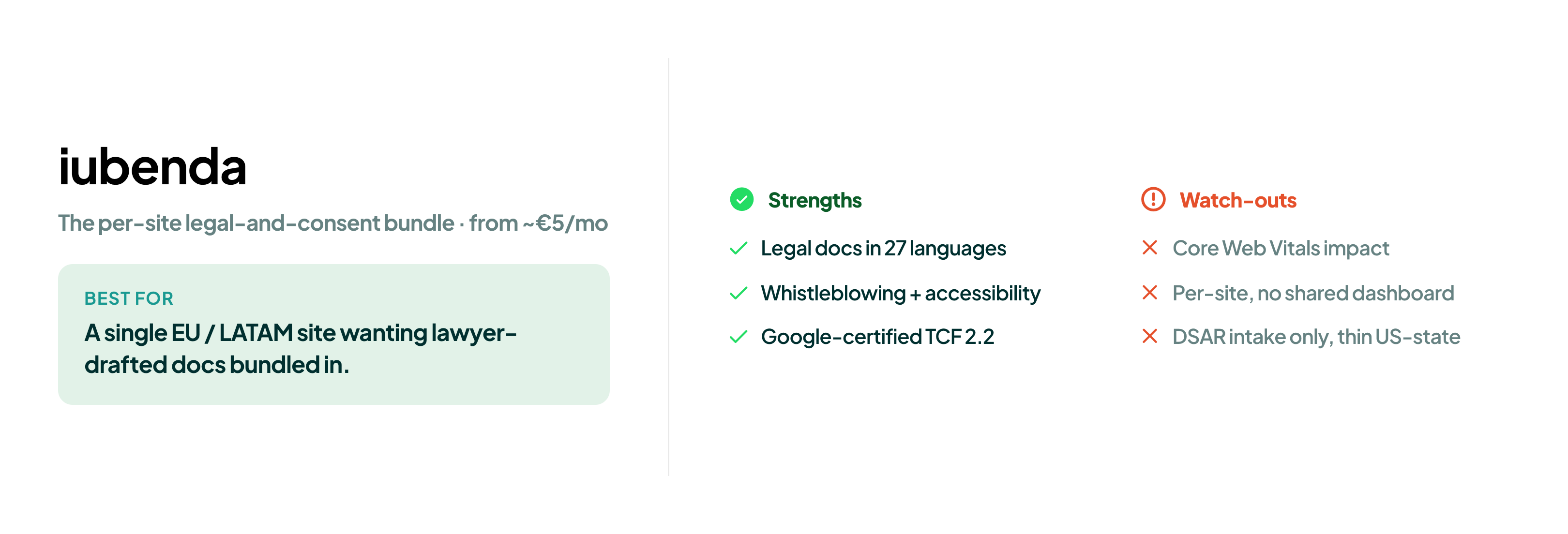
Best for: Single-site EU or LATAM SMBs that want a lawyer-drafted privacy policy and terms and conditions bundled with basic cookie consent, without paying for a separate legal-document tool.
What it does well
iubenda has operated out of Bologna, Italy for 15+ years, with a loyal customer base and wide brand recognition. The core differentiator versus Cookiebot is the bundle: lawyer-drafted privacy policy, cookie policy, and terms and conditions clauses, kept current with regulatory changes. It offers these in 27 languages with human translation, layered on top of a Google consent mode-certified product.
For a single site with modest traffic, the Essentials tier at roughly EUR 5/month (annual) genuinely undercuts Cookiebot's EUR 7/month Premium Lite tier.
iubenda also sells a Whistleblowing Management Tool that covers EU Whistleblower Directive obligations and an Accessibility Widget as a separate paid tier ladder starting around EUR 6/month. Neither exists in Cookiebot's product line.
Where it falls short
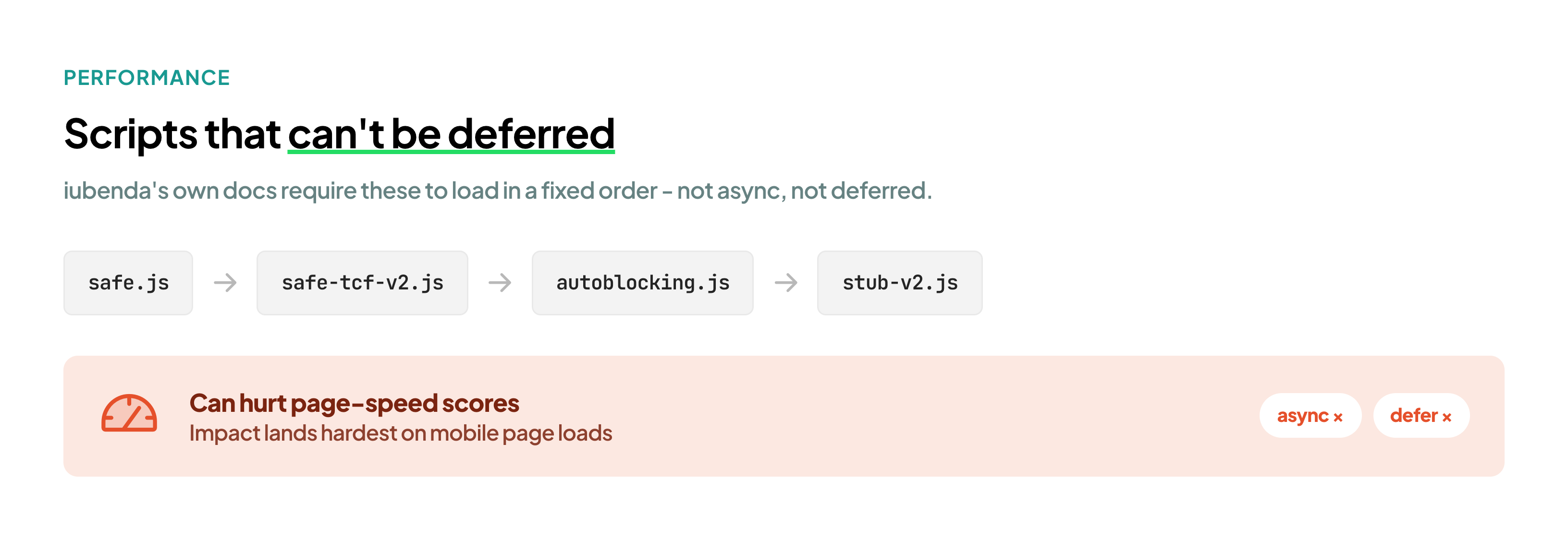
iubenda's biggest structural weakness is its Core Web Vitals impact: specific scripts (safe.js, safe-tcf-v2.js, autoblocking.js, stub-v2.js) must load in a defined order and cannot be async or deferred. The default setup can hurt page speed scores, which iubenda admits publicly. It's worth testing directly if your team prioritizes SEO & LLM visibility.
Like Cookiebot, there's no consolidated multi-domain dashboard; each site is a separate subscription with its own login and billing. DSAR handling is an intake form, not a workflow, with no request tracking or audit trail behind it. Shopify support exists but sits at the consent-script layer rather than the deeper Customer Privacy API layer. And U.S. state law coverage is thin, since the platform is built GDPR-first.
Pageview overages are the other variable cost: EUR 0.05 per 1,000 pageviews over your tier's cap, which means a growing site can see its bill rise with no domain or feature changes at all.
Who should still pick it: A single-site EU or LATAM business that wants lawyer-drafted legal documents bundled with basic cookie consent, for starter privacy and consent needs.
Cookiebot vs iubenda: The core tradeoff
The decision usually comes down to three questions:
Do you need legal documents, or just consent? iubenda bundles privacy policy and terms generation, and now adjacent compliance modules like whistleblowing management and a paid accessibility widget; Cookiebot offers a basic privacy policy generator but doesn't go into the same depth as iubenda.
Does certification posture matter to your procurement process? Cookiebot's SOC 2, HIPAA, ISO 27001, PCI, and FedRAMP certifications are more extensive than anything iubenda publishes. If you're filling out a security questionnaire, that matters; if you're a small team with no formal procurement process, it likely doesn't.
How many domains, and how much U.S. traffic? Both platforms bill per property (Cookiebot per domain, iubenda per site) with no flat multi-domain option, and both have thin US state law coverage relative to their GDPR depth. Neither solves the specific combination of multi-domain consent for traffic from North America and Europe.
The third option: Enzuzo for multi-domain consent management
Enzuzo is built for companies that outgrow both of these: multiple domains, meaningful US traffic alongside EU visitors, and a need for DSAR automation that's an actual workflow, not a form.
On pricing. Enzuzo's consent management platform runs $79 per month on the Pro plan for 10 domains in one flat price, one login, one dashboard. Compare that to Cookiebot at 8 domains on Premium Large (roughly EUR 400/month) or iubenda at 4 sites on Advanced (roughly EUR 80/month base before pageview overages).
On API access. Enzuzo offers a consent management API ideal to orchestrate banner visibility and geofencing by region, with rules that can be configured per state if needed. The built-in analytics is useful for marketers and developers both.
On DSAR. Enzuzo's DSAR automation includes intake, routing, and response tracking. Cookiebot doesn't offer DSAR automation at any tier. iubenda's is an intake form with no workflow behind it.
On Shopify. Enzuzo's Shopify integration operates at the Customer Privacy API layer. Cookiebot offers similar functionality, while iubenda's Shopify support sits at the consent-script layer.
On cross-domain reliability. Enzuzo treats multi-domain consent as a first-class feature in a single dashboard, rather than requiring separate accounts per domain, as Cookiebot's workaround does for feature parity.
On support. Slack-first with fast response times, versus Cookiebot's email-only, async support or iubenda's email support.
Want to see a flat-priced, multi-domain CMP running in your browser in under 10 minutes? Start a free Enzuzo trial. No credit card needed; DSAR automation and API included in Starter plans.
Or book a 20-min demo to explore the platform in-depth and audit your current setup

Where Enzuzo isn't the answer. If you need a formal security questionnaire answered with SOC 2, HIPAA, and FedRAMP certifications on file today, Cookiebot has that depth built out further than Enzuzo currently.
FAQs
Did Cookiebot really double its prices?
Yes. On August 18, 2025, Cookiebot's base Premium pricing doubled from EUR 15 to EUR 30 per domain, following Usercentrics's continued integration of the product. Customers on the Premium Small plan with fewer than 4 domains were automatically moved to the EUR 30/domain Medium tier, a change that triggered visible customer complaints on review platforms.
Is iubenda cheaper than Cookiebot?
At a single small site, yes, marginally: iubenda Essentials runs about EUR 5/month versus Cookiebot's EUR 7/month Premium Lite tier.
Does iubenda have a free plan, and what are its limits?
Yes. iubenda's free tier covers one site, one language, up to 3 services in the policy generator, and a limited pageview allowance. It works for a hobby site, but the limits bite quickly for anything commercial: Google Consent Mode support sits on paid tiers, the 3-service cap rules out most real websites, and pageview limits push growing sites into Essentials at around EUR 5/month.
Which has better certifications, Cookiebot or iubenda?
Cookiebot, by a wide margin. Its parent company Usercentrics holds SOC 2 Type 2, HIPAA (both achieved August 2025), ISO 27001 with ISO 27701 in progress, PCI compliance, and FedRAMP compliance. iubenda does not prominently document a comparable certification stack.
Does either platform have DSAR automation?
Not really. Cookiebot doesn't offer DSAR automation at any tier; you need a separate tool. iubenda includes a DSAR intake form on Advanced tier and above, but there's no request tracking, routing, or workflow automation behind it.
Do Cookiebot or iubenda support CIPA and US state privacy laws?
Both are thin on per-state coverage. Cookiebot applies a single nationwide rule for US compliance rather than per-state geofencing, and CIPA coverage isn't explicitly documented in its materials. iubenda is GDPR-first with basic CCPA support, and coverage of CIPA, VCDPA, CTDPA, and the wider 2026 state law wave is not well documented either. Both platforms honor Global Privacy Control opt-out signals automatically, which satisfies part of the CCPA/CPRA obligation.
What's the Core Web Vitals issue with iubenda?
iubenda's own help documentation acknowledges that specific scripts must load in a defined order and cannot be loaded asynchronously or deferred, which can affect Core Web Vitals scores in the default implementation. The impact shows up most on mobile page loads, where CPU and network budgets are tightest. iubenda publishes mitigation guidance, including server-side conditional embedding, because it's a known limitation of the architecture, not a rumor.
What does iubenda offer beyond cookie consent?
Quite a lot, and this is the clearest difference of iubenda versus Cookiebot. iubenda bundles lawyer-drafted privacy policies, cookie policies, and terms and conditions pages in 27 languages, and sells two adjacent compliance products: a Whistleblowing Management Tool, and an AccessiWay-powered Accessibility Widget. Cookiebot is a consent management platform only; everything beyond the banner requires separate tools.
If I run multiple domains, is either of these a good fit?
Not ideally. Cookiebot bills per domain with a 4-domain minimum gotcha on its cheapest multi-domain tier, and requires separate accounts per domain. iubenda bills per site with no consolidated dashboard at all. If multi-domain management is a priority, a flat-priced platform built around a single dashboard, like Enzuzo, is worth evaluating directly.
Osman Husain
Osman is the content lead at Enzuzo. He has a background in data privacy management via a two-year role at ExpressVPN and extensive freelance work with cybersecurity and blockchain companies. Osman also holds an MBA from the Toronto Metropolitan University.
LinkedIn →More related blogs
Your next read