Chantelle Golombick
iubenda helps with privacy policies, cookie policies, terms and conditions, consent banners, consent records, site scans, and Google Consent Mode v2. This review looks at where it works well for single sites and where growing teams, agencies, or multi-site businesses may need another option.
How I reviewed iubenda
The rubric I used to evaluate iubenda was its ease of consent management setup, UX, support turnaround time, and feature fit. I also checked public sentiment of the platform on sites like Capterra & G2 to guide this article.
What is iubenda?
iubenda is a privacy compliance platform for websites, apps, and online businesses. It helps teams create legal documents, manage cookie consent, store consent records, scan websites, and support Google Consent Mode v2.
The platform covers common privacy and consent tasks linked to the General Data Protection Regulation (GDPR), the European Union privacy law that governs personal data use. It also supports work related to the California Consumer Privacy Act (CCPA) as amended by the California Privacy Rights Act (CPRA), which gives California residents rights over certain personal information.
For website owners, iubenda's value sits in how it connects three things:
- What the business tells users in its privacy and cookie policies.
- What the visitor chooses in the cookie banner.
- How the website's tags and trackers respond to that choice.
For privacy and legal stakeholders, the value is documentation. The business can point to policy content, consent records, and banner behavior rather than relying on memory or screenshots.
That connection is important for stores and marketing teams. Privacy policies, banners, and tracking tools shouldn't operate in isolation. If they don't match, your business may have a clean-looking banner but no reliable consent handling behind it.
iubenda pricing
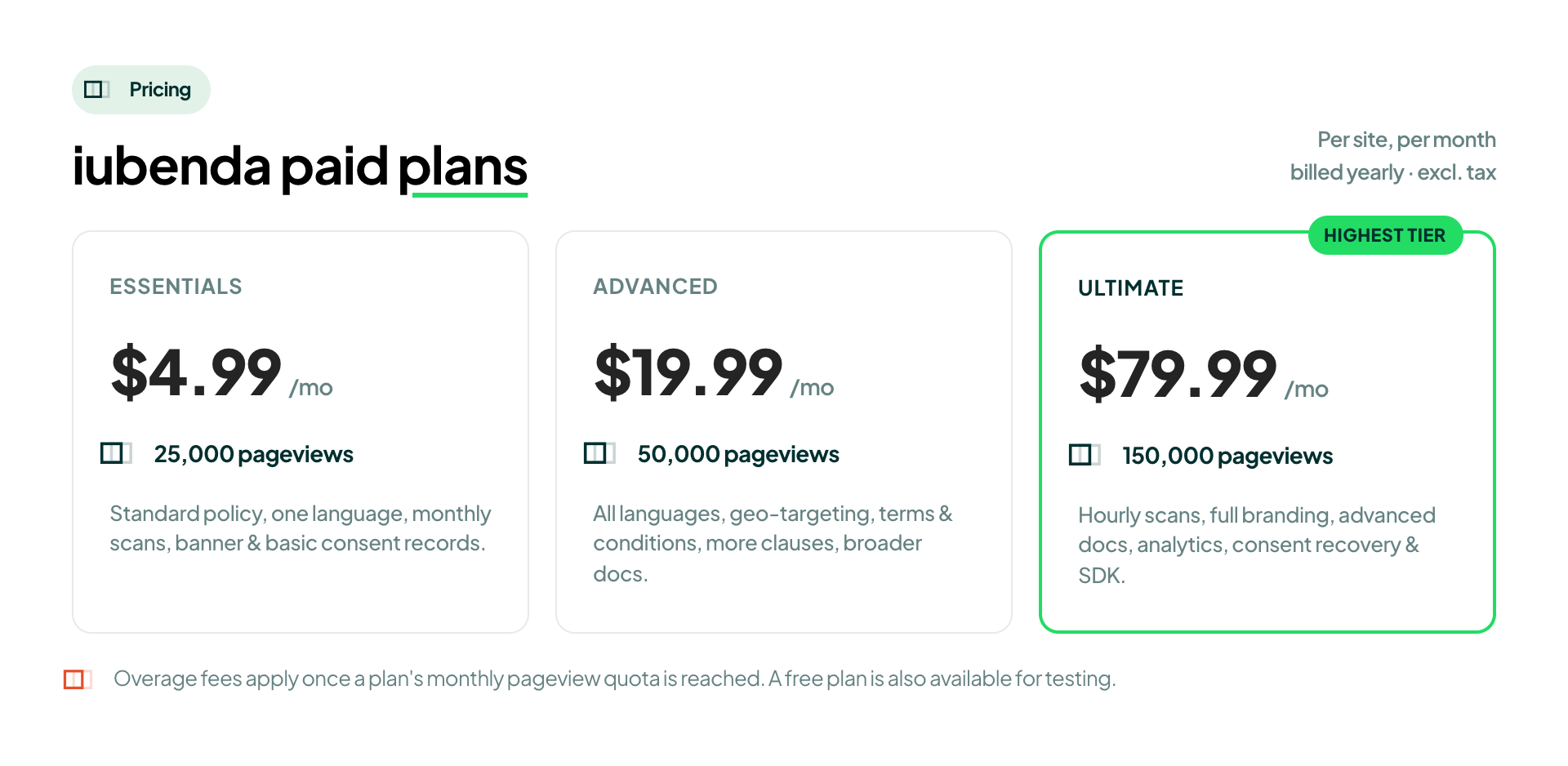
iubenda's pricing uses three main paid tiers for privacy and consent tools: Essentials, Advanced, and Ultimate. Pricing is per site, per month. Lower monthly prices apply to yearly billing.
A pageview means a page load or reload. For stores, this means traffic spikes from paid campaigns, sales periods, content traffic, and product launches can affect plan fit. iubenda charges extra once a plan's pageview quota is reached. Prices shown on iubenda's site exclude value-added tax and other taxes that may apply at checkout.
How much does iubenda cost?
| Plan | Yearly billing price | Monthly pageviews | Best fit |
| Essentials | $4.99 per site per month | 25,000 | Small websites with basic traffic that need a standard privacy and cookie policy, one language, monthly site scans, a cookie banner, and basic consent records. |
| Advanced | $19.99 per site per month | 50,000 | Fits growing websites that need all available languages, geo-targeting, terms and conditions, more policy clauses, monthly scans, and broader legal document coverage. |
| Ultimate | $79.99 per site per month | 150,000 | Fits higher-traffic or more active websites. It adds hourly site scans, full branding, advanced legal documents, detailed analytics, consent recovery, and a mobile software development kit, or SDK. An SDK is a developer package used to add platform functions to an app. |
iubenda also offers a free plan that helps very small sites test the platform before upgrading.
Overall, iubenda's price may seem low for one website. But this view changes once a team runs several stores, domains, or client sites. A Shopify agency with many client stores should calculate the total monthly cost based on domain coverage, traffic, DSAR volume, and support needs.
Before choosing a plan, check four numbers: monthly pageviews, number of sites, number of regions served, and number of people who'll manage privacy tasks after setup. Those four numbers often tell you more than the headline price.
iubenda features reviewed
iubenda's feature set works best when the business connects policy content, banner settings, tag behavior, and consent records. A banner by itself won't solve privacy work and a policy by itself won't control tags. The value comes from linking the pieces.
Privacy and cookie policy generator
iubenda's privacy and cookie policy generator helps teams create legal pages through guided selections. Users choose the services their site uses, add clauses, and publish the policy.
This can help teams that add marketing tools often. If a store adds a review app, chat widget, email platform, or analytics service, the policy should reflect that change. A generator gives the team a structured way to update the policy instead of leaving a static page untouched for months.
The weak point is input quality. The tool can't describe tracking tools that the team doesn't know exist. A good setup should start with a short data map that covers what the site collects, which tools receive data, where data goes, and which tools require consent before loading.
Cookie consent banner
iubenda's cookie banner collects visitor choices and connects them to website services. This matters for teams using analytics, ads, retargeting, personalization, affiliate tracking, or embedded media.
A banner should do more than appear. It must block or adjust trackers based on the visitor's choice. If a visitor rejects advertising cookies, ad tags should respond. If they change their choice later, the site should update.
For Shopify stores, testing should cover the theme, apps, checkout, product pages, cart, GTM setup, and ad pixels. Many tracking issues occur after installation, when a script loads outside the consent flow.
Google Consent Mode
Google Consent Mode v2 helps websites send consent signals to Google services. It works with a consent banner, receives the visitor's choices, and changes how Google tags behave.
This matters for e-commerce teams that rely on Google Ads, Google Analytics, Floodlight, and conversion tracking. If consent signals don't pass correctly, reporting can become harder to trust. A CMP helps connect the visitor's consent choice to the site's measurement setup.
iubenda is a Google-certified CMP for web and app environments. That makes it a practical option for teams that need a certified consent layer for Google advertising and analytics tools. That said, certification doesn't finish the work. Teams still need to configure the banner, connect tags, test consent states, and check non-Google tools such as Meta Pixel, email platforms, heatmaps, and review apps.
Consent database and proof of consent
A consent database stores records of user choices. These records may include the consent status, time, notice version, banner settings, or form involved.
For privacy teams, this creates proof that consent was collected through a defined process. For marketing teams, it supports cleaner list and tag management. For web teams, it creates a shared record that can reduce guesswork during troubleshooting.
This becomes useful after launch. If a user questions a marketing opt-in or a team changes the banner, the business can review consent records instead of relying on old tickets or screenshots.
Website scanning and compliance updates
iubenda's site scanning helps identify services running on a website. This can flag tools that need disclosure or consent review.
Scanning helps active marketing teams. New apps, campaign pixels, embedded videos, affiliate scripts, and chat tools can appear across a site over time. A scan can surface those changes so someone can review them.
Scan frequency varies by plan. Essentials and Advanced list monthly site scans. Ultimate lists hourly site scans. Teams with frequent campaign launches, active tag changes, or many contributors should weigh scan frequency against how often their site changes.
Evaluating iubenda or considering migrating away? Book a strategy call with a consent management expert to audit your current stack and see if Enzuzo can help.
Site performance and Core Web Vitals
iubenda's own help documentation acknowledges that its cookie consent scripts, including safe.js, safe-tcf-v2.js, autoblocking.js, and stub-v2.js, need to load in a specific order and can't be set to load asynchronously or with defer. That's a real constraint on page speed, and it means Core Web Vitals metrics like Largest Contentful Paint (LCP) and Cumulative Layout Shift (CLS) can be affected if the scripts aren't implemented carefully.
iubenda publishes its own mitigation guidance for this, including deferred script loading, server-side conditional embedding, and placing the cookie solution after at least one text or image tag on the page. Teams that actively monitor Core Web Vitals or run SEO audits should treat this as a setup consideration, not an afterthought, and re-test page speed after installing the banner rather than assuming it's performance-neutral.
iubenda whistleblowing management and data processing records
Beyond cookie consent and legal policies, iubenda's broader suite includes tools that come up less often in a CMP comparison but matter for compliance-heavy organizations.
Its Whistleblowing Management tool helps businesses collect and manage whistleblower reports as required by the EU Whistleblower Directive, which applies to organizations with 50 or more EU employees. Employees can submit reports from any device, including through a QR-enabled PDF form for physical posting, with an anonymous reporting option that keeps the whistleblower's identity hidden. Each report is logged and timestamped, and role-based permissions control who can see sensitive report details.
iubenda also offers a Register of Data Processing Activities, which documents how a business collects, stores, and processes personal data, addressing requirements under GDPR, LGPD, and Switzerland's FADP. This matters most for privacy and legal teams that need to show, not just tell, how data moves through the business.
Neither tool changes the core consent management or cookie banner comparison with Enzuzo, but they're worth knowing about if your evaluation includes broader privacy operations beyond the website layer.
How suitable is iubenda for U.S. state privacy law coverage?
iubenda's coverage of the growing list of individual U.S. state privacy laws, including Virginia's VCDPA, Connecticut's CTDPA, and California's expanding wiretap-adjacent rules like CIPA, is thinner and less explicitly documented compared to CCPA basics.
This matters most for businesses with meaningful US traffic, since state-by-state privacy law is expanding quickly and enforcement activity, including CIPA-related claims in California, has been increasing. A business that primarily serves EU visitors may not notice this gap.
A business with significant California traffic should confirm how iubenda's banner and policy tools handle state-specific consent and disclosure requirements before relying on it as the sole compliance layer.
iubenda pros and cons
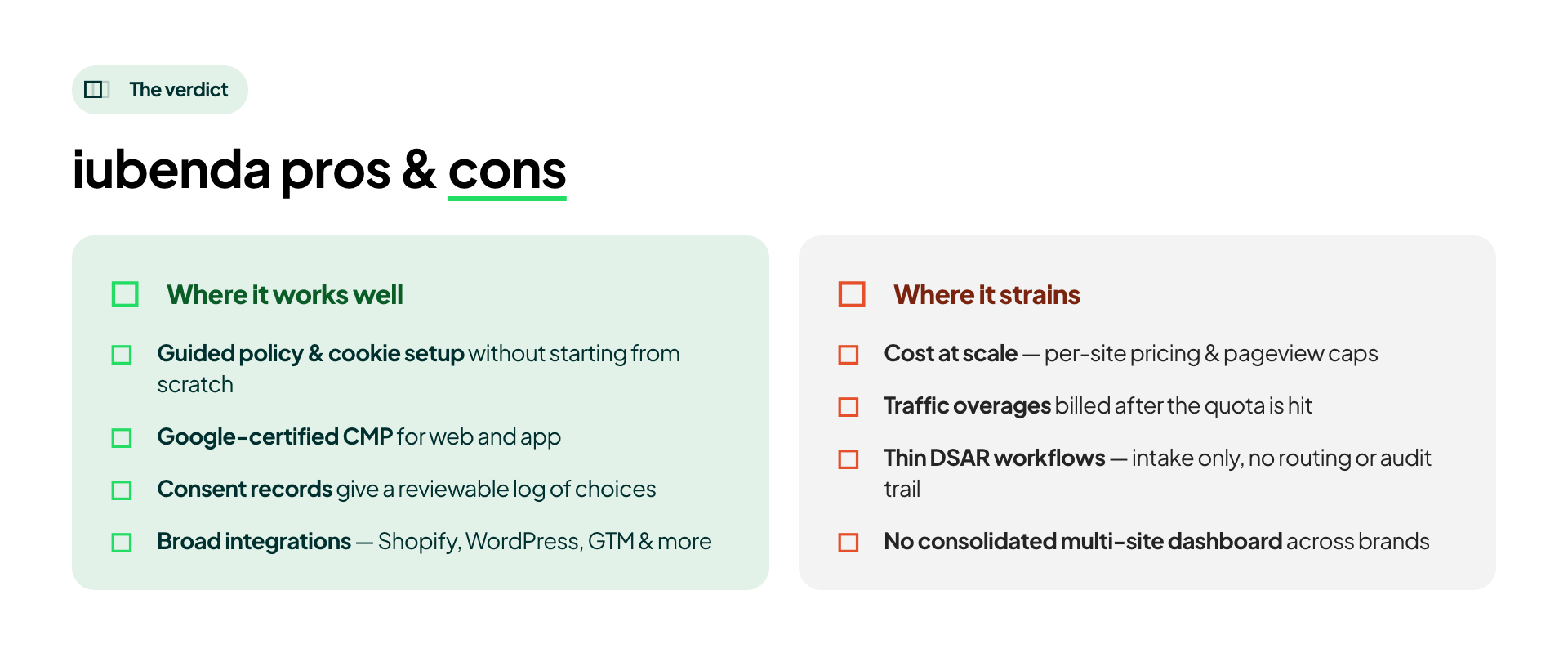
iubenda's strengths sit in guided policy creation, consent tools, Google CMP certification, multi-language support, and website scanning. Its limits appear around scale, setup effort, and privacy request workflows.
Pros
Privacy policy and cookie setup: iubenda helps smaller teams create and maintain privacy policies, cookie policies, and consent banners without starting from scratch.
Policy generation: Its generator lets teams add website services and update legal pages as their tech stack changes.
Cookie consent banner: Its banner collects visitor choices and connects them to website services and tags.
Consent records: Its consent log gives the business a record of user choices for later review.
Google-certified CMP status: iubenda is a Google-certified CMP for web and app, which helps teams using Google Consent Mode v2.
Integrations: iubenda supports common website stacks, including Shopify, WordPress, Google Tag Manager, and more, which can make setup easier.
iubenda cons
Cost at scale: Per-site pricing and monthly pageview caps need review for teams running several domains, stores, apps, or client sites.
Traffic overages: iubenda charges extra after the plan's pageview quota, so busy stores should check campaign, sale, and seasonal traffic patterns.
Setup work: A CMP gives structure, but someone still needs to connect tags, test consent states, and review scripts.
Ongoing maintenance: Marketing tools change often, so teams need a clear owner for checking new pixels, apps, and embedded services.
Workflow depth: Teams with recurring data subject access requests (DSARs), several stakeholders, or privacy work across departments may need a platform where request handling and operational tasks sit closer to daily work.
iubenda user reviews
Public review data is positive overall. Users often like policy generation, guided setup, integrations, and consent tools. Lower-rated comments tend to mention setup friction, navigation, advanced configuration, documentation, support, or pricing.
What users like about iubenda
Users who rate iubenda positively tend to focus on practical setup benefits. Reviewers often mention that iubenda makes privacy policies, cookie policies, and consent banners easier to create and maintain, especially for small teams that don't want to manage legal wording manually.
Several reviewers also value the platform's integrations. Users mention WordPress, plugins, website applications, and common content management systems as reasons the tool fits into their existing setup. For marketing and web teams, that matters because consent tools still need to work with tags, apps, and site changes.
Common iubenda complaints
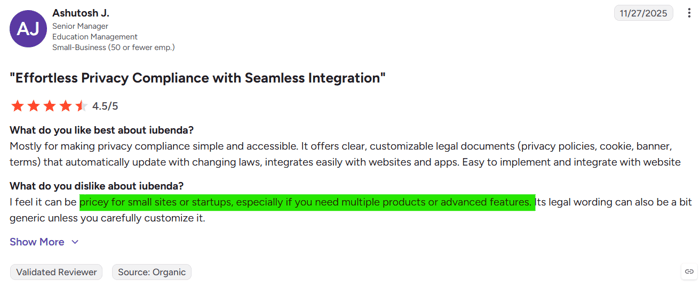
Common complaints cluster around implementation, support, and pricing. Some users say setup can take time, especially when a site has several apps, plugins, custom scripts, or a tag manager with many rules.
Pricing can also become less attractive as a business adds sites or traffic. A single store may fit within one plan. An agency or multi-brand business needs to account for each site, each pageview cap, and each plan feature.
Support and dashboard experience
Support sentiment for iubenda is mixed depending on where you look. Trustpilot reviewers tend to highlight positive, responsive interactions with individual support agents. G2 and Capterra reviewers report a more mixed picture, with some describing quick, helpful responses and others reporting slower response times during urgent issues. One G2 reviewer (February 2026) described the dashboard itself as confusing to navigate, a complaint that echoes the broader pattern of setup friction mentioned above.
Since experiences vary by platform and by issue type, businesses with time-sensitive compliance questions should test iubenda's support responsiveness directly before relying on it for anything urgent.
Who iubenda is best for and who should pick an alternative
iubenda works best for businesses that need a guided privacy setup for one or a small number of sites. It fits website owners who want legal documents, cookie consent, consent logs, and Google Consent Mode v2 without piecing together several separate tools.
A business should compare alternatives when privacy work spans many domains, stores, regions, teams, or data request types. At that point, the buying question changes from "Can we publish a banner?" to "Can our team manage this process month after month?"
Evaluating iubenda or considering migrating away? Book a strategy call with a consent management expert to audit your current stack and see if Enzuzo can help.
Comparison: iubenda vs Enzuzo
| Category | iubenda | Enzuzo |
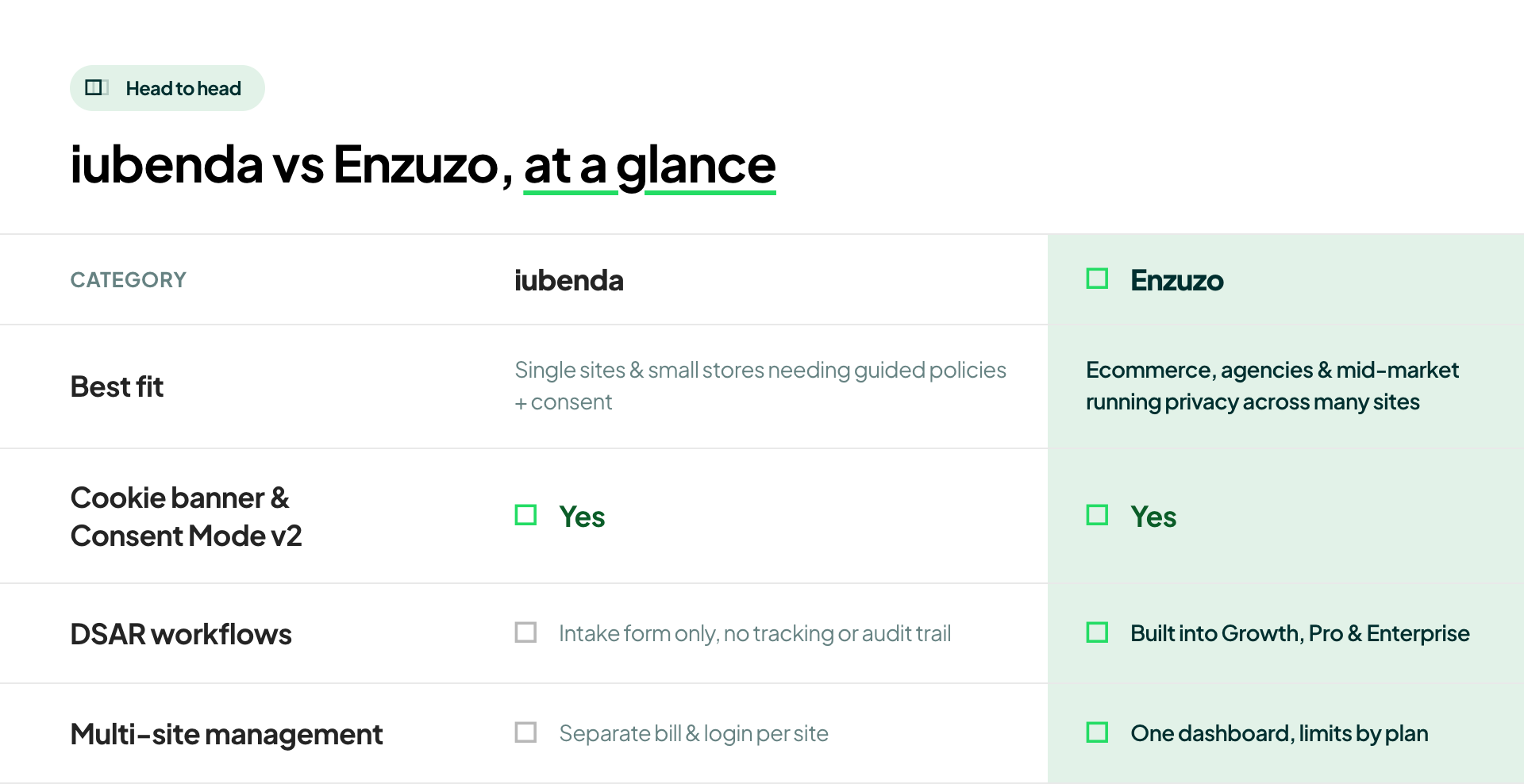
| Best fit | Single websites, apps, and growing businesses that need guided policies and consent. | E-commerce teams, agencies, SaaS platforms, and mid-market teams that need privacy workflows across sites. |
| Cookie banner | Yes | Yes |
| Google Consent Mode v2 | Yes | Yes |
| Google-certified CMP | Yes, for web and app | Yes, for web |
| Legal policy generation | Yes | Yes |
| Data subject access request workflows | Available through broader iubenda group products and higher privacy workflows, but less central to the core site plans. | Built into Growth, Pro, and Enterprise plan structures, with data subject access request (DSAR) limits varying by plan. |
| Shopify fit | Shopify integration available. | Strong Shopify and agency fit. |
| Scale question | Per-site pricing and pageview caps need review. | Domain, visitor, and request limits vary by plan, with stronger multi-site positioning. |
The table shows the practical split. iubenda is a good fit when the job is to set up one website or app with policies, cookie consent, consent records, and Google-ready consent signals. Enzuzo starts to make more sense when privacy work becomes a team process across multiple domains, Shopify stores, data requests, consent logs, and marketing tags that need regular review.
For teams comparing tools after outgrowing iubenda, the useful test is whether the next platform reduces repeat work across legal, marketing, and web teams. Enzuzo is the stronger fit when the answer needs to cover consent, privacy requests, store workflows, and multi-site management in a single place.
iubenda alternatives compared
 Best iubenda alternative for small businesses
Termly is a close option for small businesses as it can fit basic policy and consent needs.
Best iubenda alternative for agencies
Agencies should look closely at Enzuzo. Agency work needs repeatable setup, client visibility, domain coverage, and a process that doesn't rely on custom fixes for each store.
The right platform should help the agency handle cookie consent, policies, Google Consent Mode v2, and user privacy requests without rebuilding the process for each client.
Best iubenda alternative for enterprise teams
Enterprise teams should compare Enzuzo, Usercentrics, and OneTrust based on website count, regions, request volume, reporting needs, team roles, and technical stack.
OneTrust may fit large privacy teams with broad governance programs. Enzuzo can make sense for mid-market teams that want a lighter operational fit across consent, DSARs, website privacy, and marketing workflows.
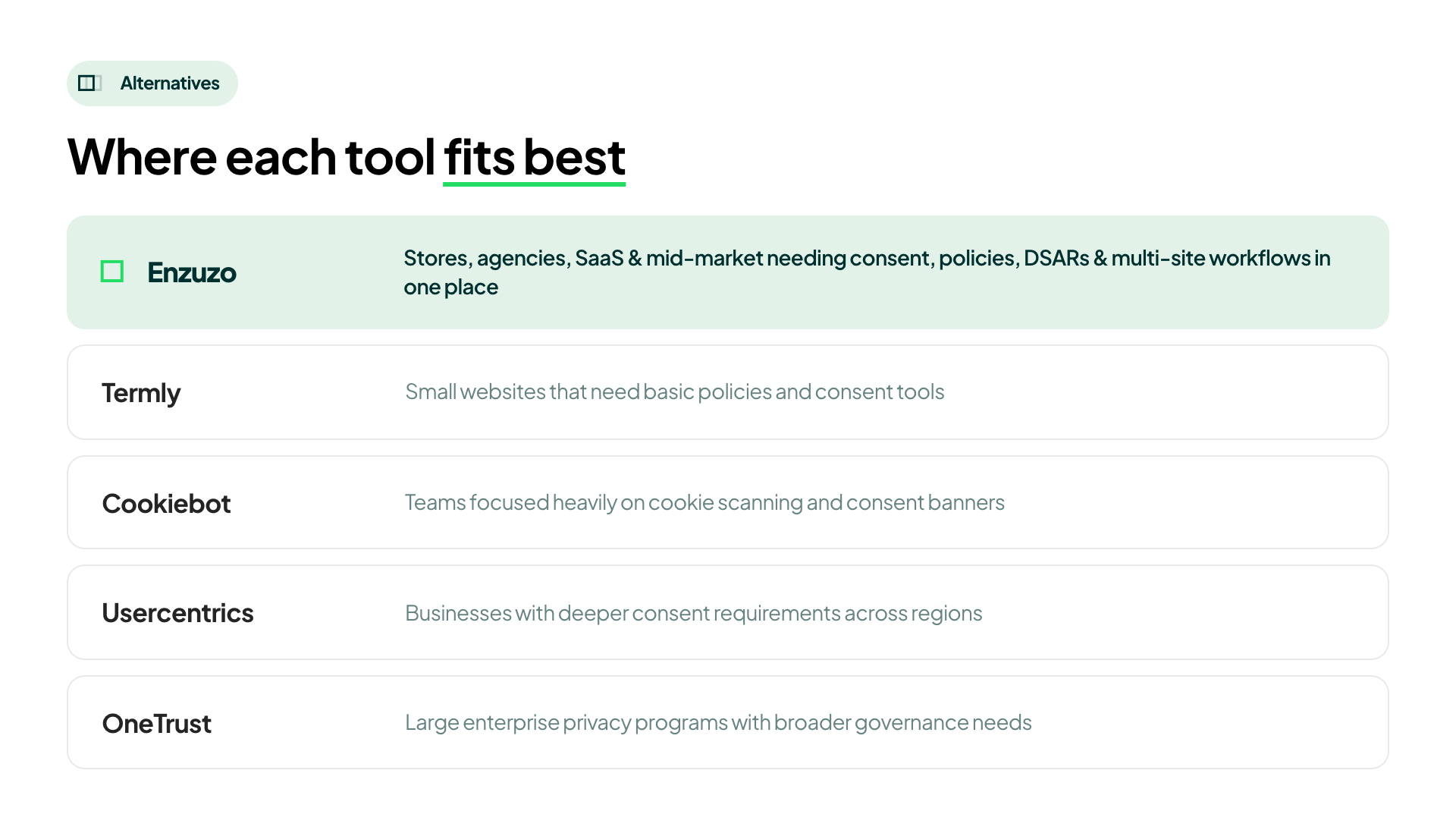
| Tool | Best fit |
| Enzuzo | Stores, agencies, SaaS platforms, and mid-market teams that need consent, policies, DSARs, and privacy workflows |
| Termly | Small websites that need basic policies and consent tools |
| Cookiebot | Teams focused heavily on cookie scanning and consent banners |
| Usercentrics | Businesses with deeper consent requirements across regions |
| OneTrust | Large enterprise privacy programs with broader governance needs |
FAQs about iubenda
Is iubenda a Google-certified CMP?
Yes. iubenda is listed as a Google-certified CMP for web and app. This supports businesses that need to pass consent signals for Google advertising and analytics tools.
Does iubenda support Google Consent Mode v2?
Yes. iubenda supports Google Consent Mode v2. Google Consent Mode v2 helps websites pass consent choices to Google tags so Google Ads, Google Analytics, and related tools can adjust behavior based on the user's consent choice.
What is the best iubenda alternative?
Enzuzo is the best iubenda alternative for teams that need consent management, privacy policies, DSAR workflows, Shopify-friendly privacy tools, and multi-site privacy operations in one place. Termly can work for simpler websites. Cookiebot and Usercentrics suit teams focused on consent management. OneTrust fits larger privacy programs with broad governance needs.
Can iubenda ensure regulatory compliance across GDPR, CCPA, and global privacy laws across the entire organization?
Only at the single-site level. iubenda's policy generator, cookie banner, and consent database can support GDPR, CCPA, and other regional privacy laws for one website or app. But iubenda's per-site pricing model means each website is a separate subscription with its own login and billing, so there's no consolidated dashboard for managing compliance across an entire organization's sites. Enzuzo includes multi-domain management in a single dashboard, which matters more as the number of sites or brands grows.
Chantelle Golombick
After more than a decade in corporate law and nearly five years in academia, Chantelle now writes about law, cybersecurity, and online privacy for leading privacy brands. Her work focuses on making complex legal and technical topics clear, useful, and grounded in how people use the internet every day.
More related blogs
Your next read