Best OneTrust Alternatives for SMBs: 5 Simpler CMPs (2026)

Osman Husain
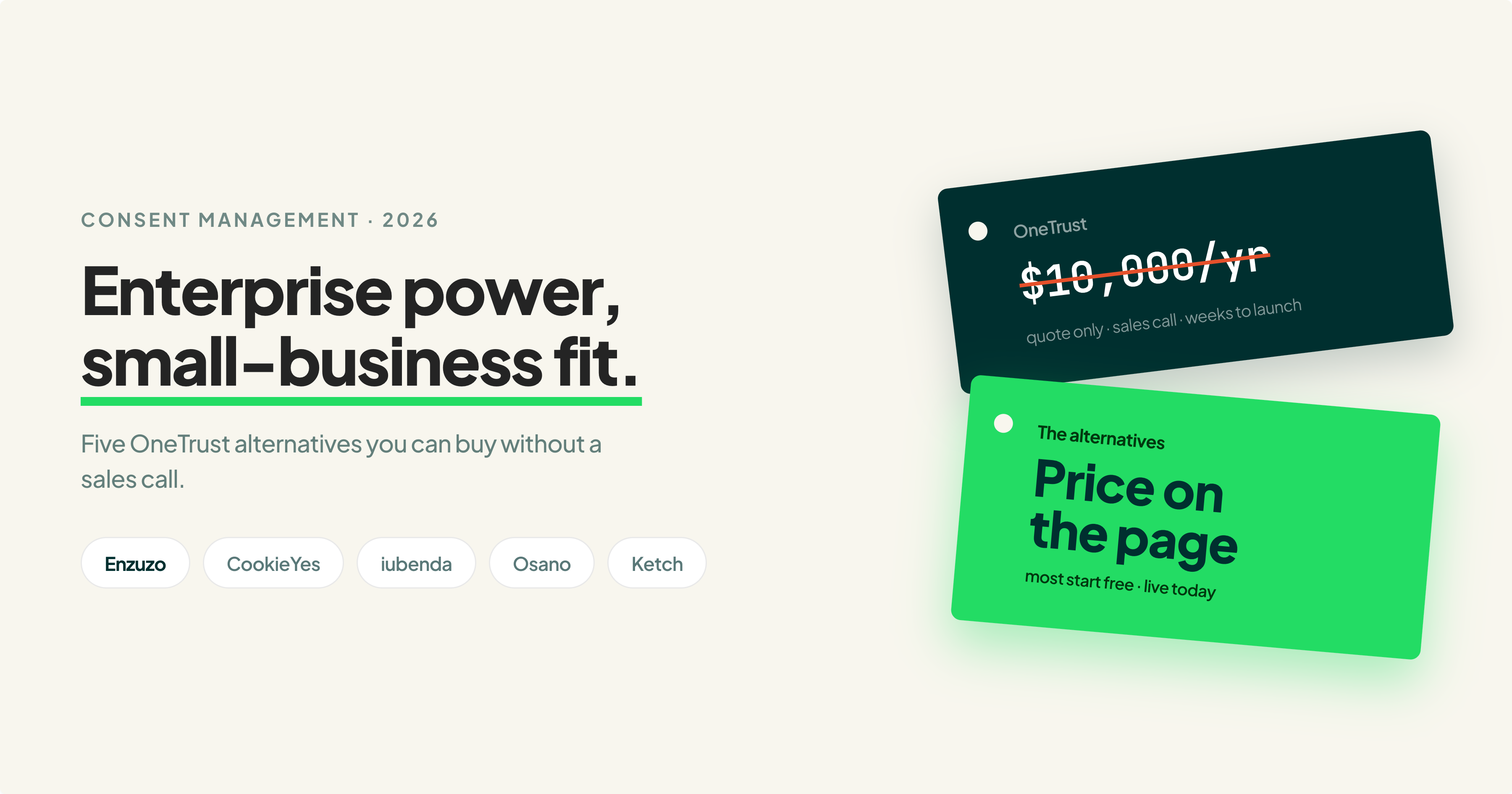
Quick answer: For a small business, the best OneTrust alternative is Enzuzo: it has a generous free plan, flat published pricing, and covers 10 domains on the Pro tier. CookieYes is cheapest for a single site, iubenda leads on multilingual legal documents, Osano adds a compliance guarantee, and Ketch fits API-driven SaaS teams. All five handle GDPR, CCPA, and Google Consent Mode v2.
OneTrust doesn't list pricing on its website. You fill in a form, book a call, and wait for a quote; minimum annual contracts usually start at around $10,000. For a company with a few thousand monthly visitors and no privacy team, that is more than what they need.
OneTrust is built for large, multi-team privacy programs that span the globe. You probably need a compliant cookie banner, Google Consent Mode v2 for your ads, and a way to handle the occasional data request. You do not need data mapping, third-party risk scoring, or an AI-governance module, that you might never use.
This guide compares five OneTrust alternatives that a small business can actually buy and run on its own: Enzuzo, CookieYes, iubenda, Osano, and Ketch. For each, we cover who it fits, what it costs today, where it falls short, and when to pick it.
The 5 best OneTrust alternatives for SMBs
- Enzuzo: best overall value. Free plan, flat pricing, 10 domains on one plan, DSAR and Shopify built in.
- CookieYes: cheapest way to put a compliant banner on a single site.
- iubenda: best for lawyer-drafted policies and multilingual or EU-facing sites.
- Osano: best if a documented compliance guarantee matters to you.
- Ketch: best for a small SaaS team with a developer who wants API and mobile SDK control.
How we compared them
We looked at each tool through a small-business lens, not an enterprise one. The criteria:
- Published price and free tier, because a small business decides without a sales call.
- Setup effort, how fast you go live and whether you need a developer.
- Multi-site cost, since many small businesses run more than one domain or store.
- Compliance coverage, GDPR, CCPA and US state laws, and Google Consent Mode v2.
- Depth past the banner, DSAR handling and support you can reach.
| Tool | Best for | Starting price | Free plan | Key limitation for a small business |
|---|---|---|---|---|
| Enzuzo | Overall value, multi-site | $9/mo (Pro $79/mo for 10 domains) | Yes | Not a full enterprise governance suite |
| CookieYes | Cheapest single site | $10/mo per domain | Yes | Per-domain pricing; light on DSAR |
| iubenda | Legal docs, multilingual | $5.99/mo per site (billed yearly) | Yes | Per-site pricing; documented page-speed impact |
| Osano | Compliance guarantee | $199/mo | Yes (1 site) | First paid tier jumps to $199/mo |
| Ketch | Developer-led SaaS | $150/mo (usable tier $499/mo) | Yes | DSR is a separate add-on; needs a developer |
1. Enzuzo
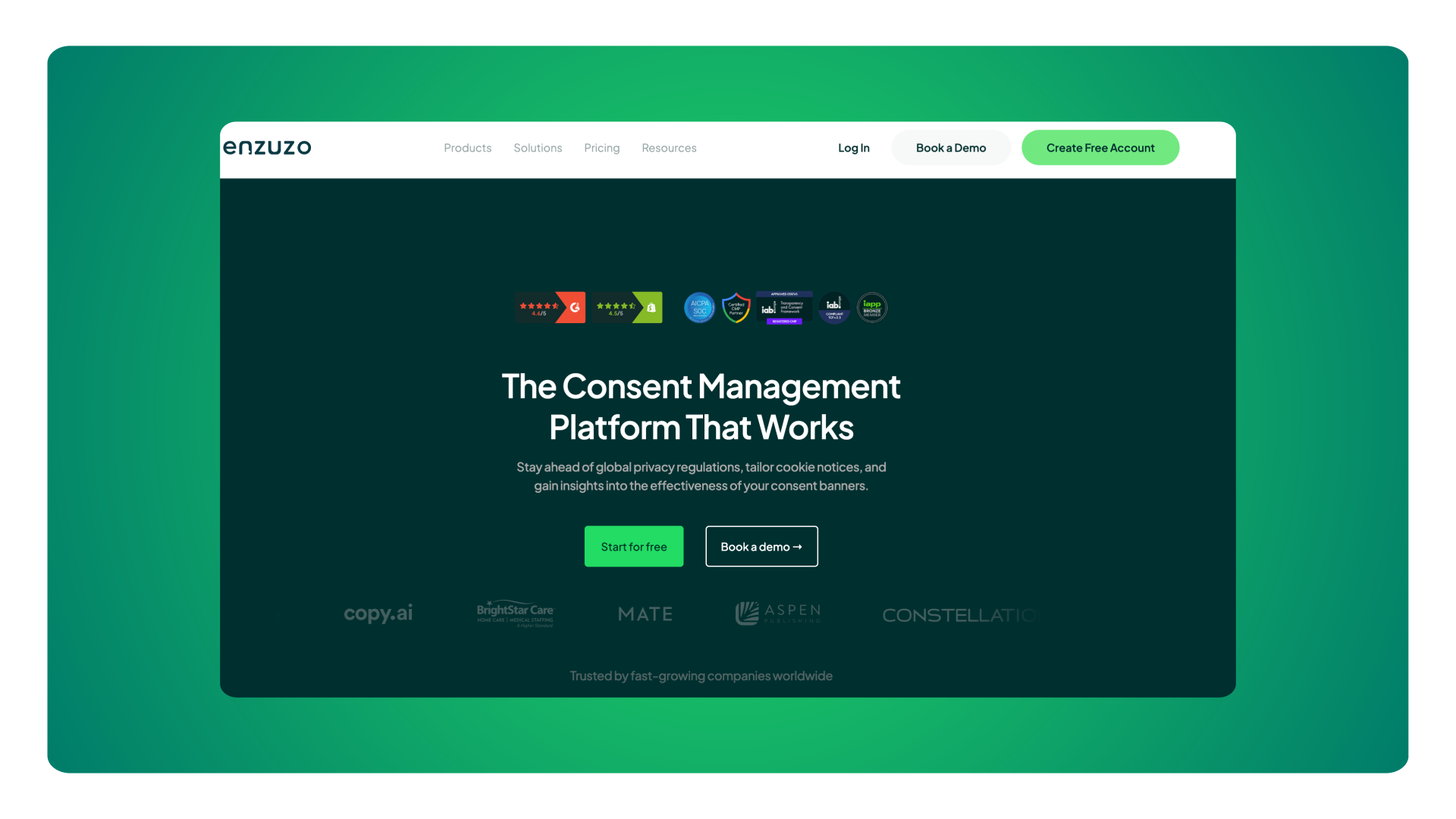
Best for: small and growing businesses that want a compliant banner, DSAR handling, and multiple sites on one flat, published plan.
Enzuzo is a consent management platform built for the smaller companies OneTrust prices out. It handles cookie consent, geo-targeted banners, DSAR requests, and privacy-policy generation, covers GDPR, CCPA, and U.S. state laws, and holds Google Gold CMP certification for Consent Mode v2.
It's a powerful alternative to OneTrust, with a history of helping businesses save time and complexity by migrating away.
What small businesses get:
- A free plan, then Starter at $9/month for one site
- Ten domains on the $79/month Pro plan
- Automatic cookie scanning, geo-targeted banners, and consent logs
- DSAR handling plus privacy-policy, terms, and EULA generators in the same tool
- A native Shopify integration, with WordPress, Webflow, and GTM connectors alongside it
Where it falls short: Enzuzo is not a full enterprise governance suite. If your team needs data mapping at OneTrust's scale, formal records of processing, or vendor-risk scoring, a heavier platform earns its cost. The self-serve plans also carry monthly visitor caps, so a high-traffic site moves up a tier or into a mid-market plan.
Pricing (verified September 9, 2026): Free for one site and 5,000 monthly visitors. Starter is $9/month ($7 billed yearly). Growth is $29/month ($22 yearly) for four domains. Pro is $79/month ($59 yearly) for ten domains and 30,000 visitors. Agency is $99/month billed yearly for 20 domains with white-labeling.
Choose Enzuzo if you want a clear price, setup in hours, enterprise-grade consent management, Slack-first support, and native apps for Shopify + Webflow.
Book a strategy call with an expert to audit your stack and see how to migrate from OneTrust
2. CookieYes
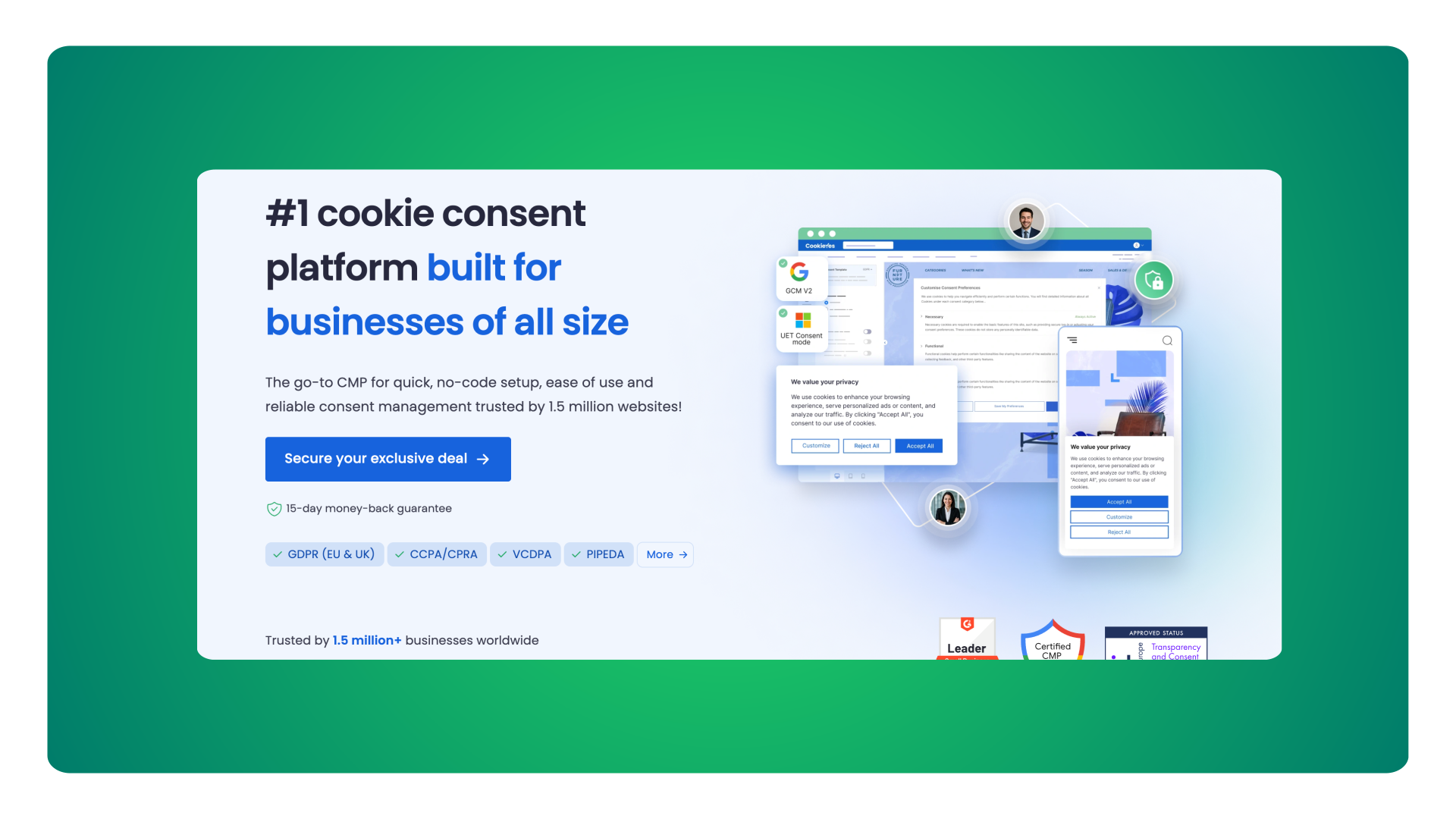
Best for: a single-site owner who wants the cheapest compliant cookie banner and nothing more.
CookieYes runs on well over a million sites and does one job cheaply: it scans your cookies and shows a banner. Compared with OneTrust, it is the opposite end of the market, fast to install on WordPress or Shopify and inexpensive for one domain. For a solo store or a brochure site, that is often all you need.
What small businesses get:
- A free tier and a $10/month Basic plan per domain (source)
- Automatic cookie scanning and Google Consent Mode v2 on every tier
- IAB TCF and geo-targeting on the $25/month Pro tier
- Fast install on WordPress, Shopify, or a custom site
Where it falls short (honestly): CookieYes prices per domain, so a small business with three sites pays three times, and pageviews are capped per tier with overage fees past the cap. It is light on DSAR automation and has no API, so the moment you need to handle data requests at scale or add a second and third site, the math turns against it.
Pricing (verified September 9, 2026): Free for 5,000 pageviews on one domain. Basic is $10/month per domain (100,000 pageviews). Pro is $25/month per domain (300,000 pageviews, adds IAB TCF and geo-targeting). Ultimate is $55/month per domain. Annual billing includes two months free.
Choose CookieYes if you run one site, want the lowest sticker price, and do not need DSAR handling or multiple domains.
3. iubenda
Best for: a small business that needs lawyer-drafted legal documents, often in several languages or for a European audience.
iubenda has run for more than 15 years and serves 150,000-plus customers, largely in Europe and Latin America . Its strength is legal documents: privacy and cookie policies drawn from a library of 2,400-plus clauses, translated into many languages by lawyers rather than by machine. For a small business selling across borders, that document depth is real.
What small businesses get:
- A free tier and an Essentials plan at $5.99/month per site billed yearly )
- Lawyer-drafted privacy, cookie, and terms documents in 27 languages
- Google CMP certification and IAB TCF 2.2 support
- Geo-targeting on the Advanced tier at $24.99/month per site
Where it falls short (honestly): iubenda prices per site with pageview overages, and it has no single dashboard to manage several domains, so multi-site owners juggle separate subscriptions. Its DSAR handling is an intake form rather than a workflow, and its US state-law coverage lags its European depth. iubenda's own help documentation acknowledges that its scripts can affect Core Web Vitals, the page-speed scores Google measures, and publishes guidance to mitigate it (source).
Pricing (verified September 9, 2026): Free tier available. Essentials is $5.99/month per site billed yearly (25,000 pageviews). Advanced is $24.99/month per site (50,000 pageviews, adds geo-targeting). Ultimate is $99.99/month per site (150,000 pageviews, adds Mobile SDK). Extra pageviews bill per thousand.
Choose iubenda if your priority is polished, multilingual legal documents for one site, and you run mostly EU traffic.
4. Osano
Best for: a small business that wants consent plus a documented compliance guarantee, and can absorb a higher entry price.
Osano pairs a cookie banner with DSAR handling and privacy-law monitoring, and it is known for a documented no-fines guarantee on its higher tiers. It is a friendlier, lighter program than OneTrust while still covering the basics a small company needs. The catch for a small business is where its pricing starts.
What small businesses get:
- A free Solo & Freelancers plan for one site
- Consent logging with geo-targeted banners
- DSAR handling and ongoing privacy-law monitoring
- A documented $500,000 no-fines guarantee on higher tiers
Where it falls short (honestly): the step from Osano's free plan to its first paid tier is steep. Plus is $199/month, which for a one- or two-person business is often more than the whole compliance budget, and the cost climbs on a blend of seats, domains, and visitors as you grow. The free plan works for a single small site, but the upgrade path is priced for mid-market teams, not micro-businesses.
Pricing (verified September 9, 2026): Free Solo & Freelancers plan (1 user, 1 domain, 5,000 monthly visitors). Plus is $199/month (2 users, 3 domains, 30,000 visitors). Higher Basic Privacy tiers are custom-quoted and carry the $500,000 guarantee.
Choose Osano if the compliance guarantee matters to you and you can start on the free plan or afford the $199/month step.
5. Ketch
Best for: a SaaS company with a developer that wants to control consent through an API and needs a mobile app SDK.
Ketch is a developer-first privacy platform that enforces consent through APIs across your apps and data systems. It is the most technical option here, with a mobile SDK for iOS and Android and banner customization that reviewers praise. For a small software team that wants consent wired into its own stack, Ketch is a real fit.
What small businesses get:
- A free tier and a $150/month Starter plan
- An API and automation layer for programmatic consent
- A mobile SDK for iOS and Android
- Google Consent Mode v2 and IAB TCF support, with ISO 27001 and SOC 2 Type II certifications
Where it falls short (honestly): Ketch's usable small-business tier is narrower than the $150 sticker suggests. DSR automation and data mapping are sold as separate add-ons rather than included, and the tier most teams land on, Plus, starts at $499/month and requires annual billing, a roughly $6,000 first-year commitment (source). It has no native Shopify integration and no privacy-policy generator, so a non-technical small business will not get much from it.
Pricing (verified September 9, 2026): Free for 5,000 monthly visitors. Starter is $150/month (30,000 visitors). Plus starts at $499/month billed annually (100,000 visitors). Pro is custom for larger deployments, and DSR automation and data mapping are priced separately.
Choose Ketch if you have engineering help, need a mobile SDK or API-driven consent, and can use the platform's technical depth.
Which OneTrust alternative is right for your small business?
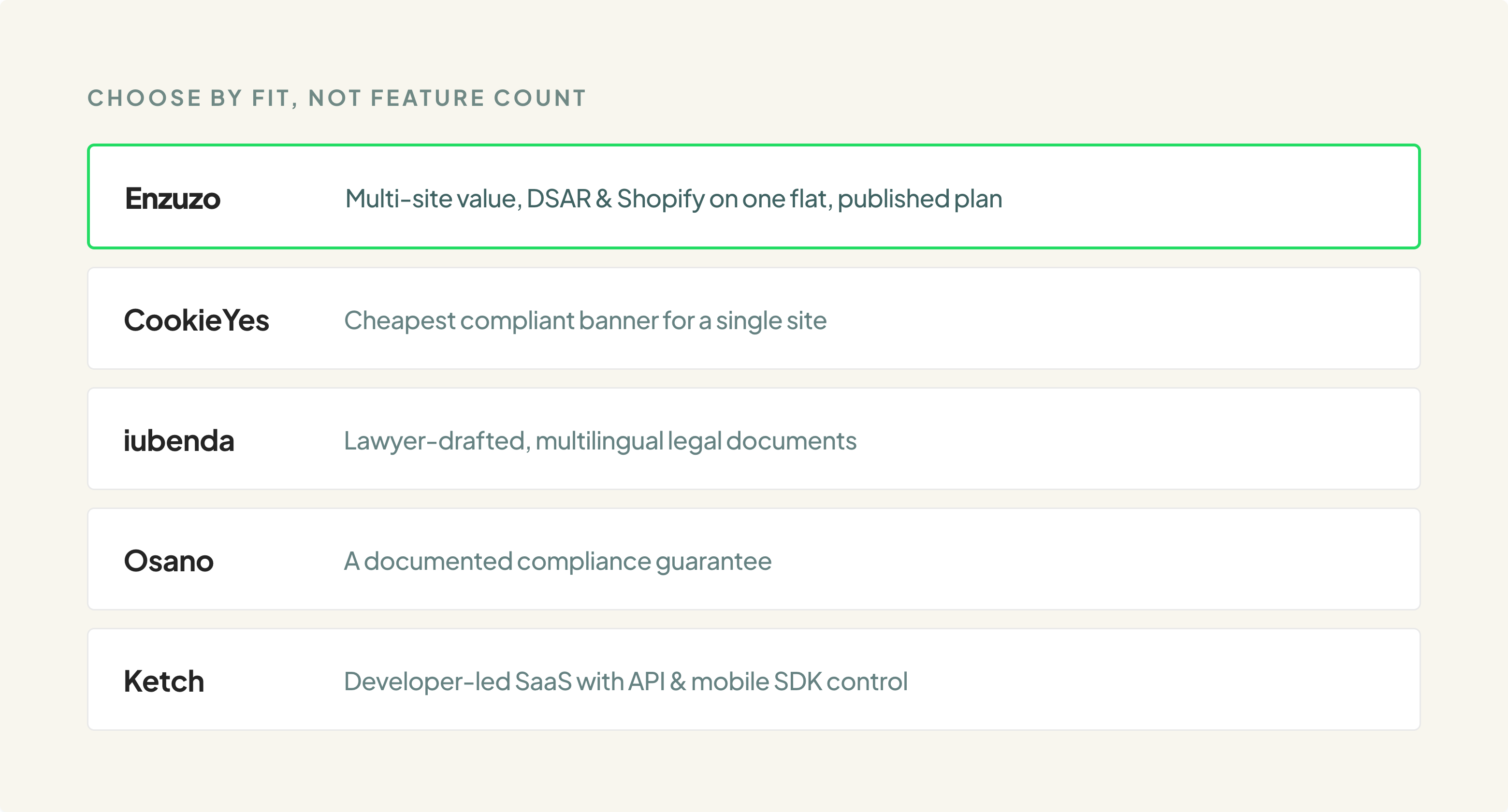
The right OneTrust alternative for your small business comes down to how many sites you run and whether you need robust consent management, a compliance guarantee, or developer control:
- Choose Enzuzo if you want published, flat pricing, consent management features that rival OneTrust, DSAR handling, and ecommerce support.
- Choose CookieYes if you run a single site and want the lowest sticker price for a compliant banner.
- Choose iubenda if your priority is multilingual, lawyer-drafted legal documents and your traffic is mostly European.
- Choose Osano if the documented compliance guarantee matters and you can start free or afford the $199/month tier.
- Choose Ketch if you have a developer and need API-driven consent or a mobile app SDK.
- Stay with OneTrust only if you need full enterprise governance (data mapping, vendor risk, AI governance) and have the people and budget to operate it, which most small businesses do not.
Why OneTrust rarely fits this segment
OneTrust earns its place at the enterprise end of the market, so it helps to be specific about why a small team looks elsewhere.
- No self-serve path. OneTrust publishes no prices and offers no free plan or online checkout. Every purchase runs through sales, which is friction a five-person company does not have time for.
- A minimum that dwarfs the need. Third-party estimates from Vendr put OneTrust's entry near $10,000 a year (source). A small business usually spends that on its entire software stack, not one banner.
- Setup measured in weeks. The platform assumes a rollout across teams, so implementations commonly run weeks and lean on professional services. A small business wants to be live this afternoon.
- Scope you will not touch. Data mapping, records of processing, vendor risk, and AI governance are the reason OneTrust costs what it does. Strip them away and you are paying for a suite to use a single feature.
If any of those describe your situation, one of the five tools below will fit better and cost far less.
What a small business actually needs from a CMP
A small business needs a CMP to cover five mission-critical things, and none of them should command a five-figure annual commitment. CMPs display your cookie banner, records what visitors agree to, and passes those choices to Google and your other tags. These five matter:
- Consent analytics & audit trails, clear consent records you can satisfy auditors and escape a wiretapping lawsuit.
- Setup you can do yourself, on WordPress, Shopify, Webflow, or a custom site, in an afternoon.
- Google Consent Mode v2, so your Google Ads and Analytics still measure conversions from EU and UK visitors.
- Coverage for regional laws, GDPR for European visitors and CCPA plus the newer US state laws for American ones.
- A basic way to handle data requests, since even smaller firms get emails asking to delete someone's data.
Anything past that, full data mapping, vendor risk, an AI-governance program, is enterprise scope. If you genuinely need it, OneTrust or a suite like TrustArc is the honest answer, and this guide is not for you.
Why SMBs are leaving enterprise CMPs
Small businesses are leaving enterprise CMPs because lighter tools cover what they need at lower prices and better support:
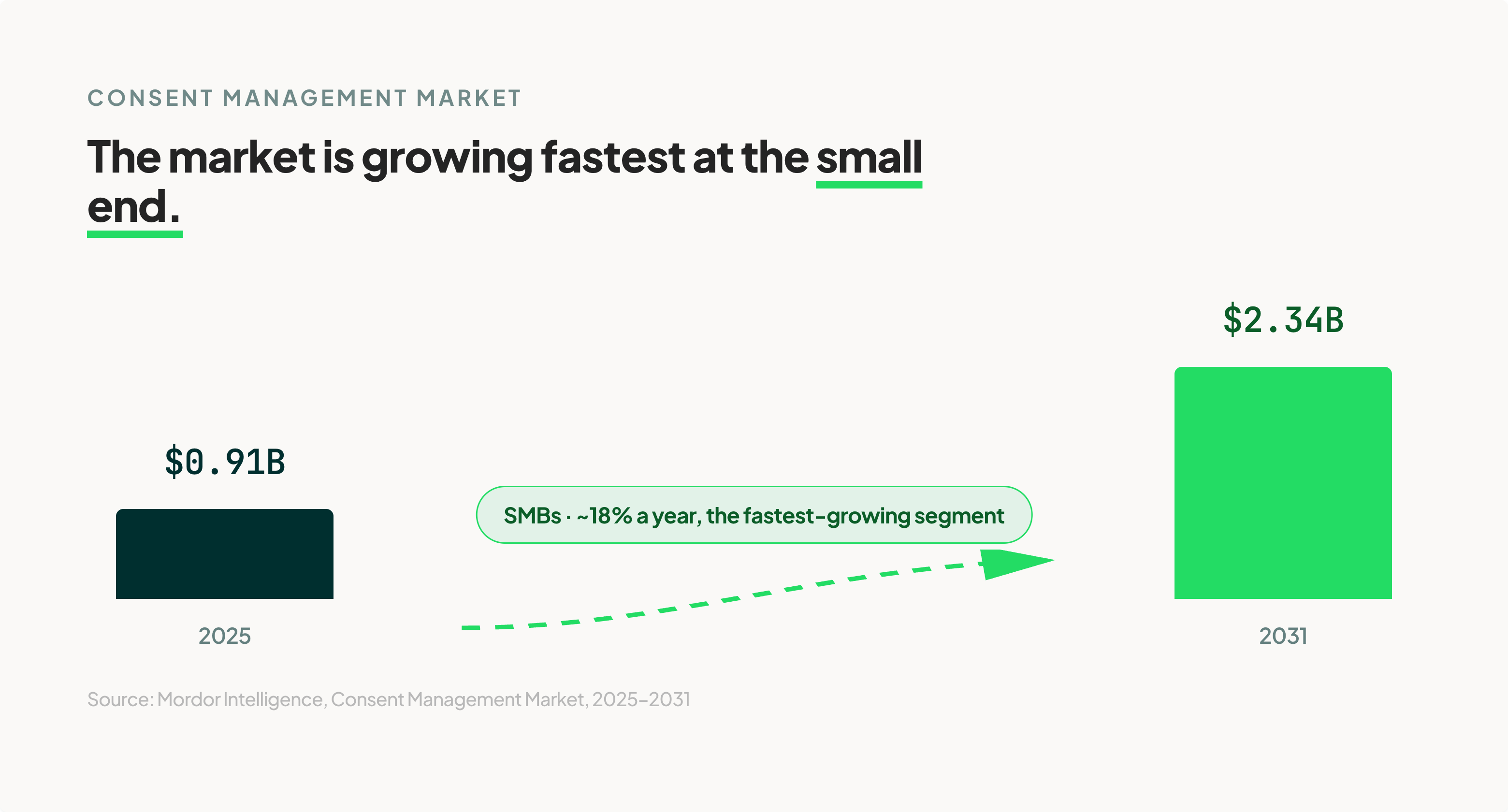
- The market is growing fastest at the small end. According to Mordor Intelligence, the consent management market is projected to grow from about $0.91 billion in 2025 to $2.34 billion by 2031, with small and mid-sized businesses the fastest-growing segment at roughly 18% a year. That wave of smaller buyers has pulled new tools into the market, sized for teams well below OneTrust's core base.
- Published pricing has become the dividing line. OneTrust and most enterprise suites are quote-only, while Enzuzo, CookieYes, iubenda, Osano, and Ketch all show prices. For a small business that wants to budget without a call, that's a big advantage.
- Google Consent Mode v2 is now table stakes. Every tool here supports it. If you run Google Ads to EU or UK visitors, or want accurate ad measurement data, there's no need to pay OneTrust tens of thousands a year.
Frequently asked questions
What is the best OneTrust alternative for a small business?
For most small businesses the best OneTrust alternative is Enzuzo, because it has a free plan, flat published pricing, and covers 10 domains on one paid plan with DSAR handling and a Shopify integration included. CookieYes is cheaper for a single site, and iubenda is stronger for multilingual legal documents. The right pick depends on how many sites you run and whether you need legal-document depth or a compliance guarantee.
Is there a free OneTrust alternative?
Yes, several OneTrust alternatives have real free plans. Enzuzo, CookieYes, iubenda, Osano, and Ketch each offer a free tier that covers a single small site, typically up to around 5,000 monthly visitors or pageviews. OneTrust itself has no free plan and no public pricing, so a free tier is one of the clearest reasons small businesses choose an alternative.
Which OneTrust alternative is cheapest for one website?
For a single website, Enzuzo Starter at $9/month is the cheapest paid plan that still includes DSAR handling and API access, and CookieYes at $10/month per domain is a close second for a banner alone. iubenda Essentials is $5.99/month per site billed yearly if you mainly want legal documents. All three also have free tiers for the lowest-traffic sites.
Do these small-business OneTrust alternatives support Google Consent Mode v2?
Yes, all five alternatives in this guide support Google Consent Mode v2. Enzuzo holds Google Gold CMP certification for it, and iubenda is a certified Google CMP Partner. If you run Google Ads to visitors in the EEA or UK, Consent Mode v2 support is what keeps your conversion measurement accurate, so confirm it is enabled on the tier you buy.
Can a small business handle GDPR and CCPA without OneTrust?
Yes, a small business can meet GDPR and CCPA obligations with any of these lighter CMPs. Each one shows a compliant banner, records consent, and supports the cookie and consent requirements both laws set. OneTrust adds enterprise governance features, data mapping and vendor risk, that most small businesses are not required to have and will not use.
The bottom line
Leaving OneTrust off your shortlist does not mean cutting corners on compliance. For a small business, it usually means buying software you can actually afford, install yourself, and grow into.
CookieYes is the cheapest banner for one site, iubenda leads on multilingual legal documents, Osano offers a compliance guarantee, and Ketch suits a developer-led team. For the large middle, small companies that want a price on the page, setup in hours, and more than one site on one plan, Enzuzo is the strongest fit.
Osman Husain
Osman is the content lead at Enzuzo. He has a background in data privacy management via a two-year role at ExpressVPN and extensive freelance work with cybersecurity and blockchain companies. Osman also holds an MBA from the Toronto Metropolitan University.
LinkedIn →More related blogs
Your next read
.jpg)