Osman Husain
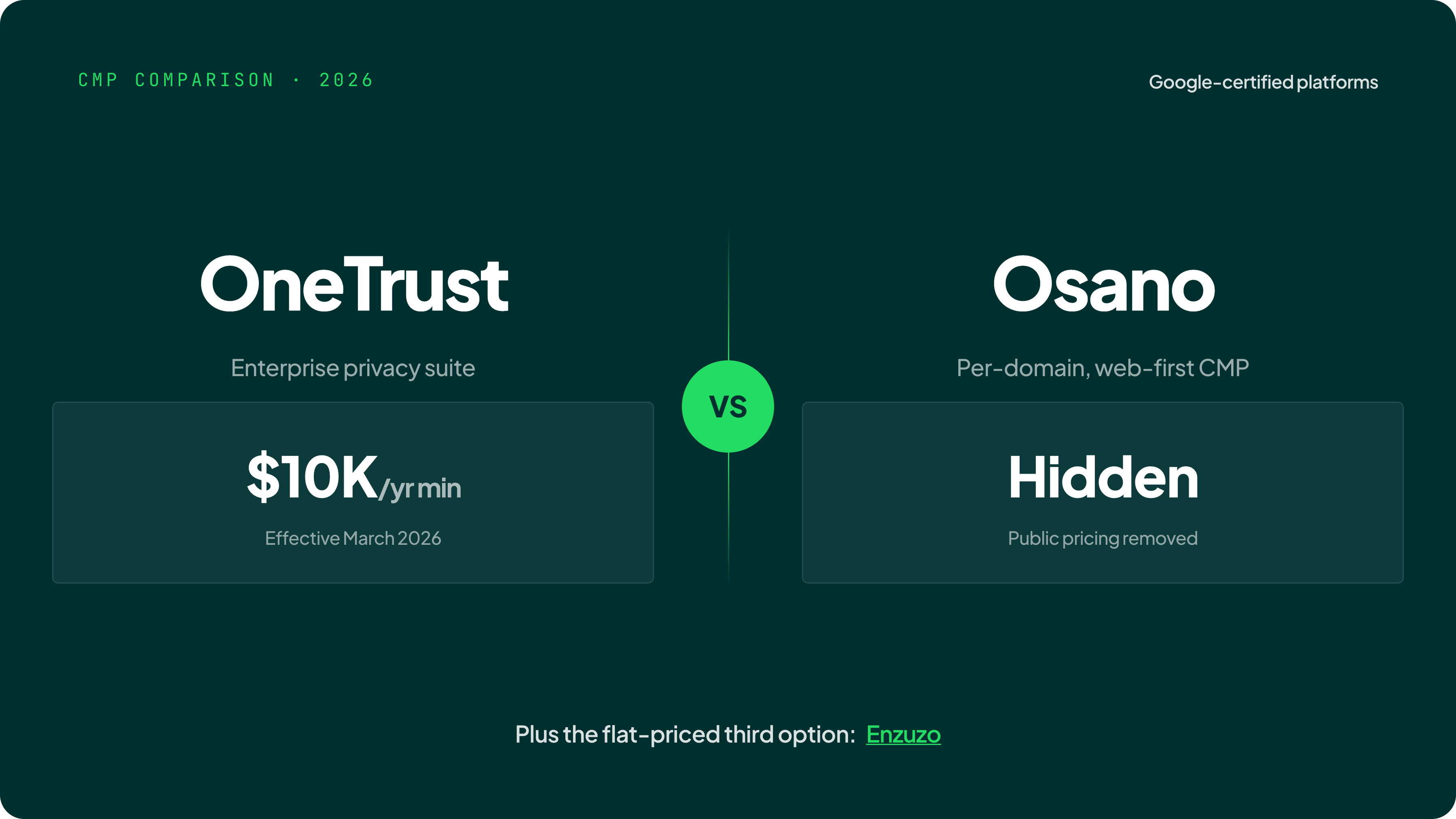
Quick Verdict: The comparison between OneTrust vs Osano comes up in buyer evaluations, but the two companies are best for different buyer segments. OneTrust suits large enterprises that need a full privacy governance platform and aren't fazed by its $10k/year minimum. Osano is best for teams that primarily need a robust consent management platform with some additional features like vendor risk management bolted on top.
This evaluation compares the two on feature depth, pricing, and overall best-fit. Enzuzo is revealed as a third option for teams that prefer a lightweight, flexible alternative.
How I researched OneTrust and Osano
I evaluated both platforms on the five primary buyer criteria that surface during CMP purchases, and gave each a head-to-head verdict:
1. Pricing and contract model (entry cost, transparency, multi-domain scaling)
2. Core CMP features and consent coverage (channels, languages, jurisdictions)
3. Implementation complexity and day-to-day admin (time to live, ownership burden)
4. Privacy governance, data mapping, and risk (how far each goes beyond consent)
5. Google Consent Mode and TCF (certification scope across web, app, CTV)
Sources: First-party data that surfaced through Enzuzo's conversations with other CMP buyers, vendor product and pricing pages, G2 and Capterra reviews, Trustpilot support ratings, and published CMP market share research. All pricing mentions are best estimates since both vendors now require a sales conversation before revealing any numbers.
Both OneTrust and Osano cover consent management, vendor risk, and U.S. state law coverage, with OneTrust going an additional step with many broader data privacy workflows. But they diverge on pricing, implementation complexity, customer support, and renewal sticker shock.
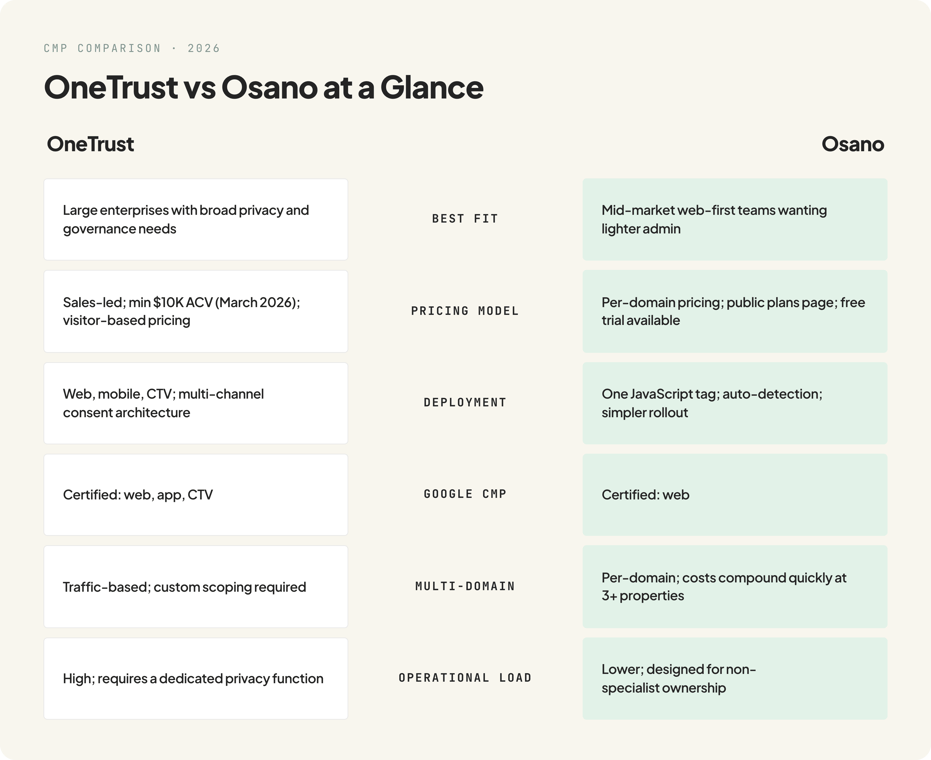
OneTrust vs Osano at a glance
|
Comparison point |
OneTrust |
Osano |
|
Best fit |
Large enterprises with broad privacy and governance needs |
Mid-market web-first teams wanting lighter admin |
|
Pricing model |
Sales-led; min $10K ACV (March 2026); visitor-based pricing |
Per-domain pricing; public plans page; free trial available |
|
Deployment |
Web, mobile, CTV; multi-channel consent architecture |
One JavaScript tag; auto-detection; simpler rollout |
|
Google CMP status |
Certified, web, app, CTV |
Certified, web |
|
Multi-domain pricing |
Traffic-based; custom scoping required |
Per-domain; costs compound quickly at 3+ properties |
|
Operational load |
High, broader scope requires dedicated privacy function |
Lower; designed for non-specialist ownership |
Pricing and contracts
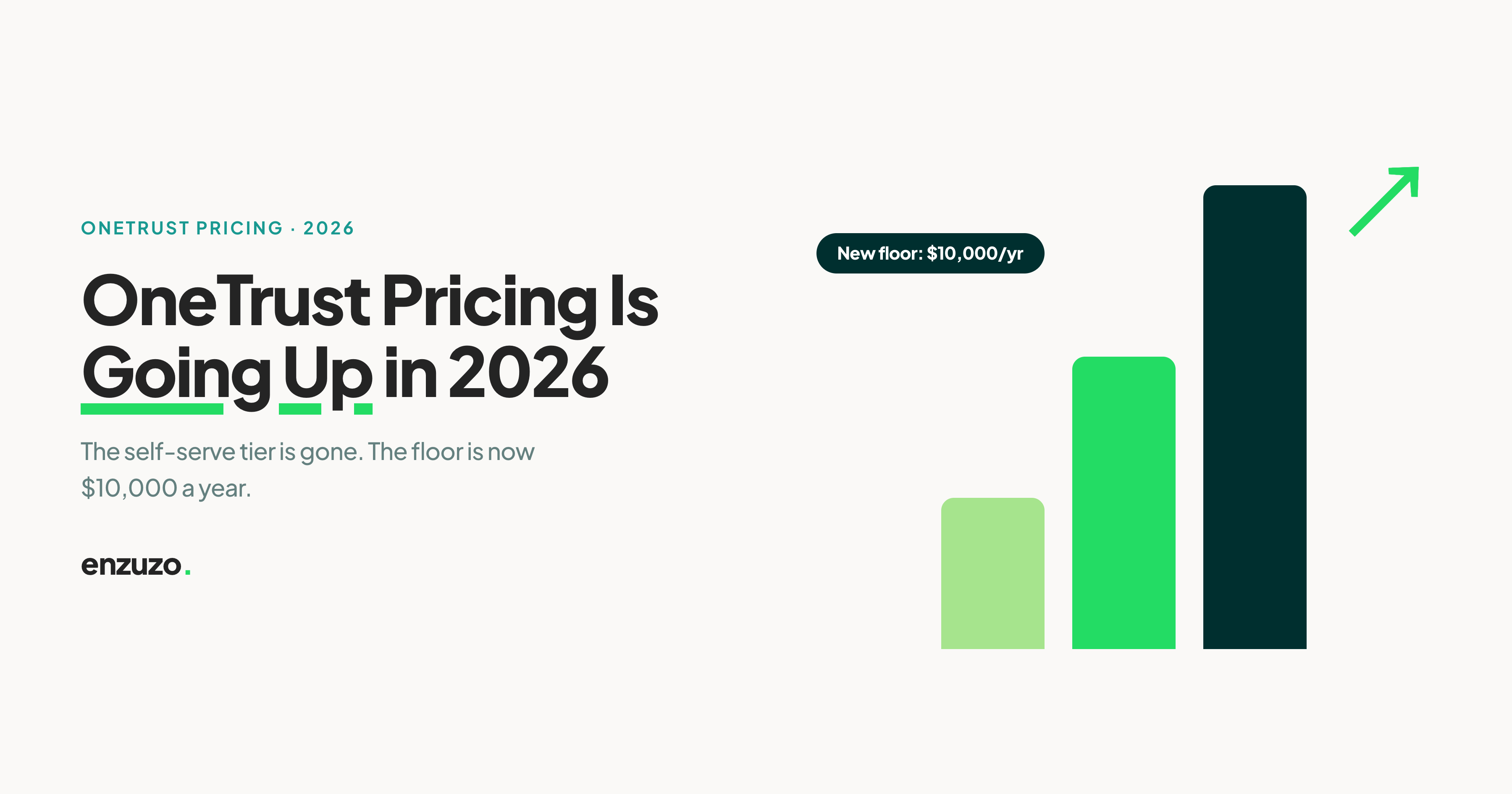
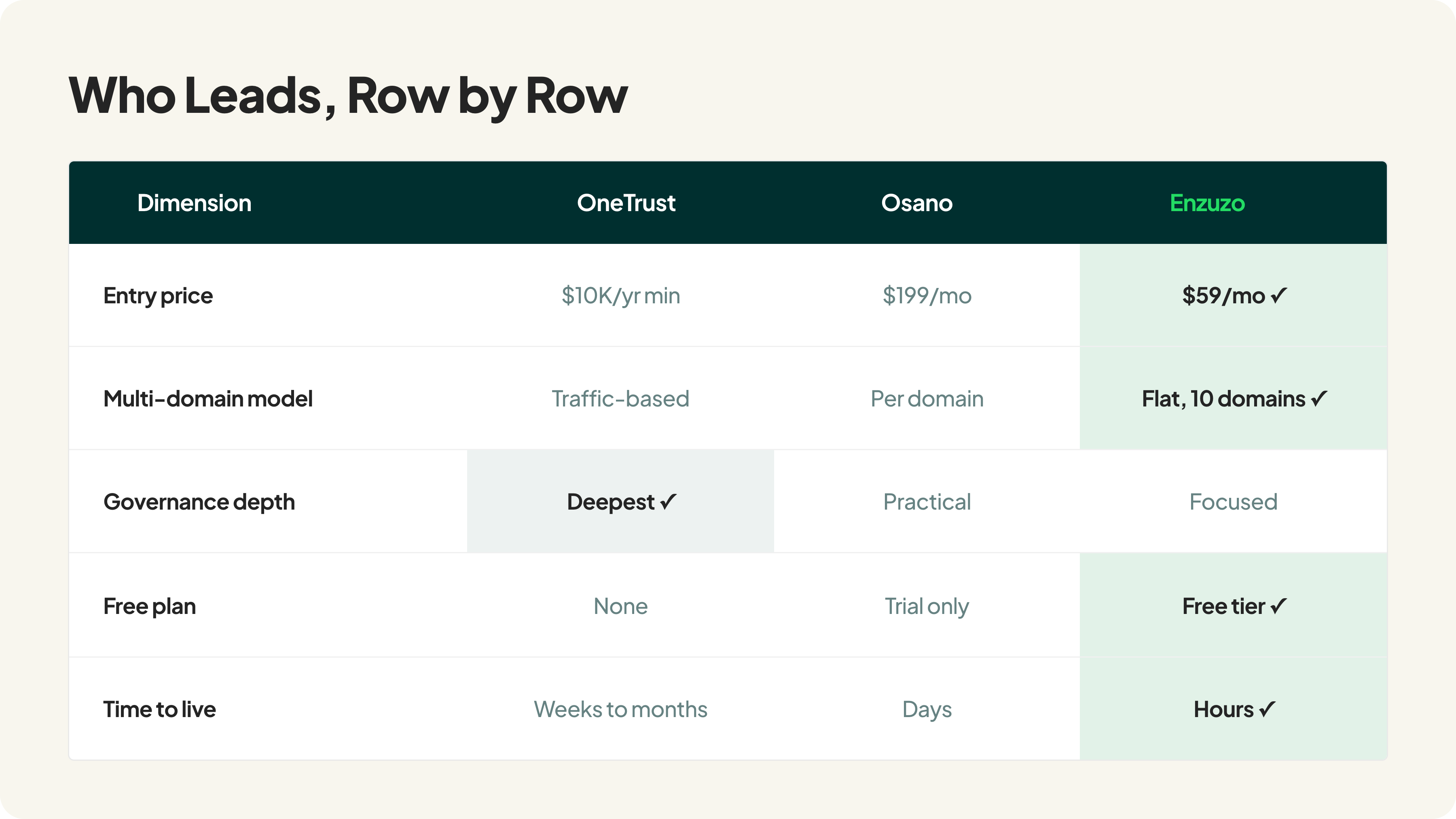
OneTrust has made some bold pricing moves in 2026, including a $10k/year minimum, shifting to traffic-based tiers instead of per-domain, and contract renewals that bumped the cost over 10x.
Osano, too, keeps pricing largely hidden, except for its base plan which starts at $199/month and caps traffic at 30,000 visitors. It's also very difficult to find this information on Osano's website, with the key push to book a demo first.
Neither company scores well on pricing transparency, but Osano will be cheaper than OneTrust for consent management alone. The key caveat: neither offers flat, multi-domain pricing, so expect variability if you do opt for one.
Consent management
OneTrust does a lot. You get consent and preference management across web, mobile, and CTV, multilingual banner templates, analytics, tracker discovery, and exportable logs. That range is really the whole point: OneTrust isn't a standalone cookie tool, it's a full privacy management platform.
Osano takes the opposite approach and keeps things simple. You drop in one tag, and it handles cookie classification, script blocking, and consent records automatically, with localization in 45+ languages. It covers GDPR, CCPA, and 50+ country regulations, without a dedicated privacy team to manage it. That simplicity is deliberate, and for most web-first teams, it's a real selling point.
Implementation complexity and day-to-day admin
Implementing OneTrust is a complicated task, which can take months of planning. You'll need a cross-functional team spanning legal, web dev, marketing, and project management. Ongoing administration and governance will also need a dedicated point of contact. But that's expected: this is a platform built for large privacy programs, so the heavy lift comes with the territory.
Onboarding Osano is easier. It classifies cookies automatically and won't need the same implementation timelines as OneTrust. Reviewers consistently give Osano the edge over OneTrust on ease of use and support responsiveness. It does have a ceiling, though. If your consent flows require deep customization, you can hit that limit sooner than you'd expect.
Privacy governance, data mapping, and vendor risk
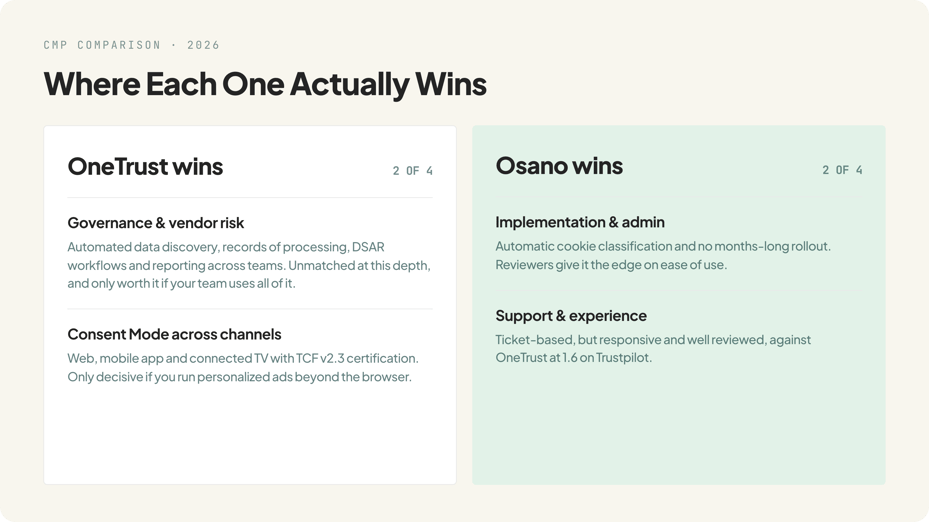
This is OneTrust's home turf. Its privacy operations go well past consent: automated data discovery, records of processing, vendor risk management, DSAR workflows, and compliance reporting across multiple teams. If consent is just one piece of a much bigger governance program for you, nothing else really competes at this level. It's also why a lot of enterprise buyers are fine with the $10K+ ACV, because the CMP is only a sliver of what they're actually paying for.
Osano has grown well beyond banners, too. Its vendor risk database tracks 11,000+ vendors with policy-change alerts and breach signals, and you also get data mapping, DSAR automation, and assessments. If you want practical governance tools but don't want to stand up a full risk program from scratch, that's genuinely useful coverage.
OneTrust wins on sheer governance breadth, but all that depth is only worth paying for if your team will actually use it. Osano's tools are more approachable and cover the essentials. If you need solid DSAR handling and vendor risk without the enterprise overhead, Osano is the more practical pick of the two.
Google consent mode and TCF
If you're running ads in more than one place, this is where OneTrust flexes. It handles Google Consent Mode across your website, your mobile app, connected TV, and it's fully TCF v2.3 certified. If you're a publisher running personalized ads across a mix of environments, browser, app, and connected TV, that multi-channel signal architecture is genuinely hard to match. This is one of the few spots where OneTrust's breadth isn't just nice to have, it's an actual technical requirement.
Osano keeps it simple, and for most teams that's the point. It wires straight into Google tags and GTM, so your consent signals just work with Google Ads and Analytics, which is really all most marketers are after. It nails the website side. Where it stops is apps and connected TV; that's not its game the way it is for OneTrust.
If you live on the web and run Google Ads and Analytics, Osano is plenty. If you're juggling ads across web, apps, and TV with TCF to worry about, OneTrust is the safer bet.
Support and customer experience
Once you're live, support is where these two diverge the most. OneTrust is the sore spot. It holds a 1.6 out of 5 rating on Trustpilot, and the recurring theme in reviews is slow response times and an unclear escalation path. Dedicated customer success is real, but it mostly shows up at the higher tiers, so smaller accounts feel hard done by.
Osano is the opposite story. Support quality and response time are two of the things reviewers praise most, and it's a big reason people rate it above OneTrust overall. The setup is a standard ticket-based model rather than a dedicated channel, but for most teams it's responsive and gets the job done without a lot of back and forth.
Between these two, Osano is the clear winner on support, it's responsive and well-reviewed, while OneTrust is the most common complaint. Worth knowing, though: the support model customers rave about most in this space is Enzuzo's. The Slack-first, direct-line approach is one of its most frequently cited differentiators, so if having a real person a message away matters to you, that's the one to look at.
When Enzuzo is a better option than both OneTrust and Osano
If you've come this far, you're probably now noticing the gap this comparison exposes. OneTrust has priced the mid-market out with its $10K minimum, and Osano, while lighter to run, gets more expensive as you add domains and no longer even lists its pricing publicly.
So if you're a growing team that needs certified, reliable consent tooling, you're stuck choosing between an enterprise contract you don't need and a bill that creeps up every time you experience a traffic spike.
That in-between spot is exactly what Enzuzo was built for: a Google Gold-certified CMP ideal for mid-market teams that don't need OneTrust's feature depth nor Osano's unclear pricing.
Enzuzo's helped many teams choose between OneTrust and Osano. Common reasons why Enzuzo wins out are pricing clarity, feature parity on consent maangement, and priority customer support delivered via Slack if requested.
Where Enzuzo wins over OneTrust:
-
No traffic-based or per-visitor pricing.
-
No sales process just to get started. You can see the price and go live yourself.
-
Live in hours, not months.
-
Flat pricing across 10 domains: PLG Pro is $59/month billed annually, and mid-market plans run $250–$300/month for high-traffic deployments.

Where Enzuzo wins over Osano:
-
Transparent, flat pricing that doesn't climb with your domain count or hide behind a sales call. This is the single most common reason teams choose Enzuzo over Osano.
-
Native Shopify integration (Osano has none), which makes it a far better fit for ecommerce.
-
Built-in privacy policy and DSAR form generation, so you're not stitching together separate tools.
-
A cleaner Google Consent Mode and GTM story for ecommerce and marketing teams.
-
One more thing customers bring up on their own: support. Enzuzo's Slack-first, high-touch model is one of its most frequently cited strengths, a direct line to a real person instead of a ticket queue.
Enzuzo isn't the right call if you need OneTrust-level governance across many functions and jurisdictions. But for SaaS teams, agencies, ecommerce stores, and mid-market companies that want certified consent tooling without the enterprise overhead, it's the most practical option in the category.
Book a strategy call with a consent management expert to audit your stack and explore Enzuzo's features in-depth.
OneTrust vs Osano quick decision guide
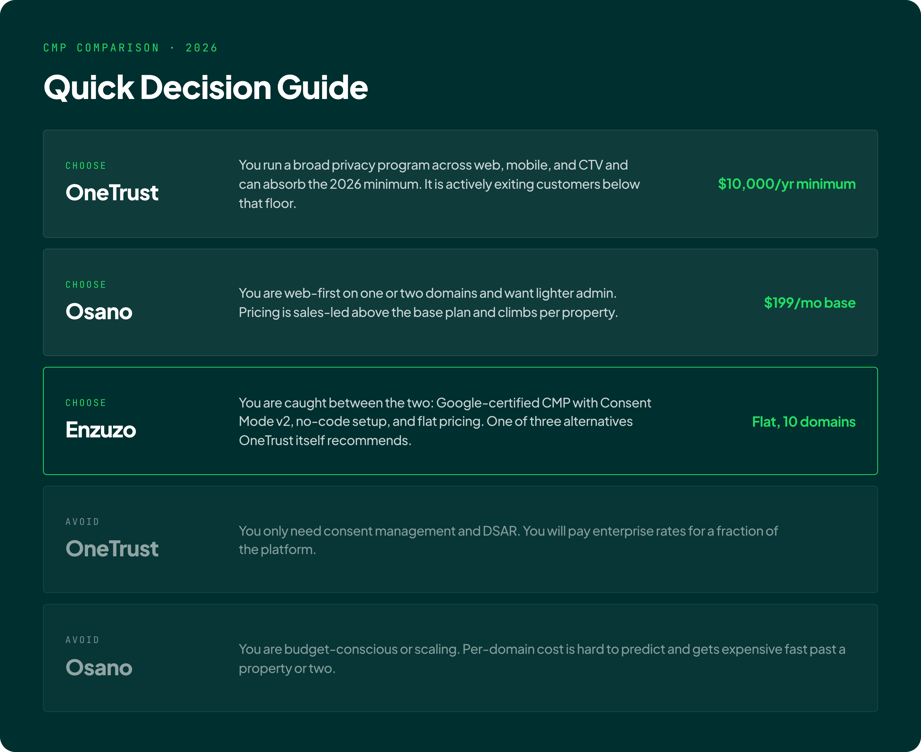
Choose OneTrust if you run a broad privacy program across web, mobile, and CTV and can absorb its roughly $10,000/year minimum (as of 2026). It's actively exiting customers below that floor.
Choose Osano if you're web-first on one or two domains and want lighter admin. Its pricing has moved off the public site (now sales-led), and its per-domain cost climbs quickly as you add properties.
Choose Enzuzo if you're caught between the two: a Google-certified CMP (Consent Mode v2) with no-code setup and flat pricing across 10 domains, built for the mid-market segment OneTrust is pricing out. It's one of three alternatives OneTrust itself recommends.
Avoid OneTrust if you only need consent management and DSAR. You'll pay enterprise rates for a fraction of the platform.
Avoid Osano if you're price-sensitive or anticipate rapid traffic growth: pricing is now sales-led and climbs with each added domain, so it's hard to predict and gets expensive fast past a property or two.
Final Verdict
OneTrust remains the strongest option for large enterprises running a broad privacy program, but its new $10K minimum means it's no longer a realistic choice for most mid-market teams.
Osano is the better pick between the two for web-first teams that want simpler deployment, lighter admin, and a faster path to compliance without committing to enterprise infrastructure.
Enzuzo deserves a serious look for any team being priced out of OneTrust or outgrowing Osano's per-domain model. It combines Google Gold certification, transparent flat pricing, advanced consent analytics, and a no-code setup, built specifically for the segment these two platforms aren't prioritizing.
OneTrust vs Osano FAQs
Which is better, OneTrust or Osano?
The answer depends on your use case. OneTrust is built for large enterprises running a full privacy program and priced to match, with a minimum around $10,000/year. Osano is the lighter, web-first pick for teams on one or two domains. For most mid-market companies, both are more than they need, which is why many end up shortlisting a purpose-built CMP like Enzuzo.
Is OneTrust or Osano more expensive?
OneTrust is the pricier of the two for most buyers, with a minimum contract near $10,000/year. Osano starts lower but charges per domain, so its cost climbs as you add sites. Neither publishes full pricing anymore; both now route you through a sales conversation.
How much does Osano cost?
Osano's base tier costs $199/month, but the real pricing now requires a sales conversation first. First-party data suggests it can cost $1k/month for 5 domains, with cost scaling by traffic and domaint count. Enterprise pricing is custom and needs to be confirmed directly with Osano.
How much does OneTrust cost?
OneTrust doesn't publish prices. As of 2026, its minimum annual contract is around $10,000. Pricing is visitor-based and negotiated through sales, so the real number depends on your traffic and which modules you buy.
OneTrust vs Osano for DSAR automation?
Both automate DSAR intake and fulfillment. OneTrust's workflows are deeper and built for large, multi-team privacy programs; Osano's are lighter and easier to run without a dedicated privacy function. If DSAR is your main need and you don't want enterprise overhead, a focused CMP like Enzuzo includes DSAR automation too.
OneTrust vs Osano for cookie banners and consent?
Both are Google Consent Mode v2 certified and handle geo-targeted banners, cookie classification, and consent records. OneTrust gives you more control and more configuration; Osano keeps it simple with a one-tag setup. The tradeoff is depth versus ease, so pick based on whether you have a team to manage the extra settings.
Is OneTrust more prescriptive or more flexible than Osano?
OneTrust tends to be more prescriptive. It walks you down structured workflows for things like DPIAs and policy mapping, which suits large teams that want guardrails. Osano is more flexible and lightweight, which web-first teams often prefer. Prescriptive means more control but more setup; flexible means faster with a lower ceiling.
OneTrust vs Osano for preference centers?
OneTrust offers richer, more configurable preference center management aimed at enterprises with complex consent and marketing needs. Osano covers the essentials for web-first teams without the heavy setup. If you need solid preference management but not the full OneTrust suite, it's worth comparing purpose-built CMPs as well.
OneTrust vs Osano for consent version tracking?
Both keep auditable consent records. OneTrust captures consent receipts with exportable logs built for enterprise reporting; Osano maintains searchable consent records that are easier to navigate day to day. For most mid-market needs, either is enough. The difference is depth of reporting.
Which is more enterprise-ready for IAB TCF, GPP, and ePrivacy?
OneTrust is the more enterprise-ready of the two for multi-framework needs, with TCF certification and consent signaling across web, app, and CTV. Osano covers TCF for web-first use cases. If you're a publisher running personalized ads across mixed environments, OneTrust's breadth is the safer fit.
What are the best OneTrust alternatives?
The most common OneTrust alternatives for consent management & DSAR are Enzuzo, Osano, and Ketch. For teams needing enterprise & AI governance workflows, your best bets are BigID & Securiti.
How do I migrate from OneTrust?
Migrating off OneTrust means re-implementing your consent banner, geo-targeting rules, and DSAR workflows on the new platform. With a lighter CMP, the switch is fast. Enzuzo, for instance, runs a guided 3-day migration and handles the transition with in-house privacy engineers.
Osman Husain
Osman is the content lead at Enzuzo. He has a background in data privacy management via a two-year role at ExpressVPN and extensive freelance work with cybersecurity and blockchain companies. Osman also holds an MBA from the Toronto Metropolitan University.
LinkedIn →More related blogs
Your next read