OneTrust vs Didomi (2026): Cost, Features & Best Fit
Table of Contents
OneTrust and Didomi are both enterprise consent and preference management platforms, but they're built for different customer profiles. OneTrust is a comprehensive governance, risk, and compliance suite that goes well beyond consent. Didomi is a focused consent and preference management tool with deep roots in IAB TCF and ad tech. Both are sales-led and priced for large organizations, so if you're mid-market, it's probably more than what you need.
OneTrust vs Didomi 2026
Two things have shifted in both organizations since the start of the year.
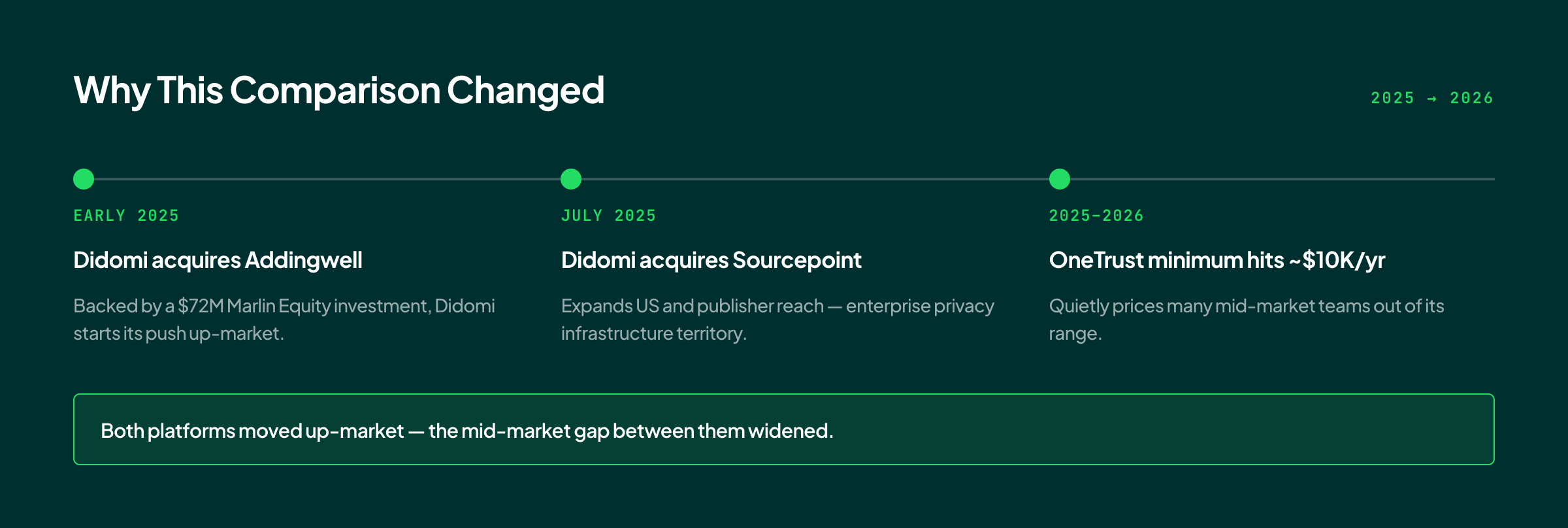
First, OneTrust raised its minimum contract to around $10,000 per year, which quietly pushed many mid-market teams out of its range. If you're comparing it to Didomi, price is now part of the decision in a way it wasn't before.
Second, Didomi got bigger. It acquired both Sourcepoint and Addingwell in 2025, following a $72 million private equity investment. It used these funds to expand its U.S. presence, deepen publisher reach, and move upmarket to enterprise privacy infrastructure.
Hence, the comparison between the two is more important than it once was.
Evaluation methodology
We looked at the five things that decide an enterprise CMP or privacy-platform purchase:
1. Scope and focus.
2. Consent and preference management (IAB TCF, geo-targeting, preference centers, ad-tech and CTV).
3. Privacy governance and DSAR (data mapping, RoPA, vendor risk, request workflows).
4. Pricing and contract model (transparency, minimums, free tier or trial).
5. Implementation and support (time to live, ongoing ownership).
Let's compare the two in specific buckets:
Scope and focus
This is the real difference between the two. OneTrust is a sprawling platform: consent is just one module alongside data mapping, records of processing, vendor risk, privacy assessments, and even ESG, GRC, and ethics tooling. If your privacy program spans many teams and use cases, that breadth is the whole point.
Didomi is deliberately narrower. It's a consent and preference management specialist, built to handle cookie consent, granular preferences, and the ad-tech signalling that publishers and media companies live on. It does that job well but doesn't try to be a GRC hub.
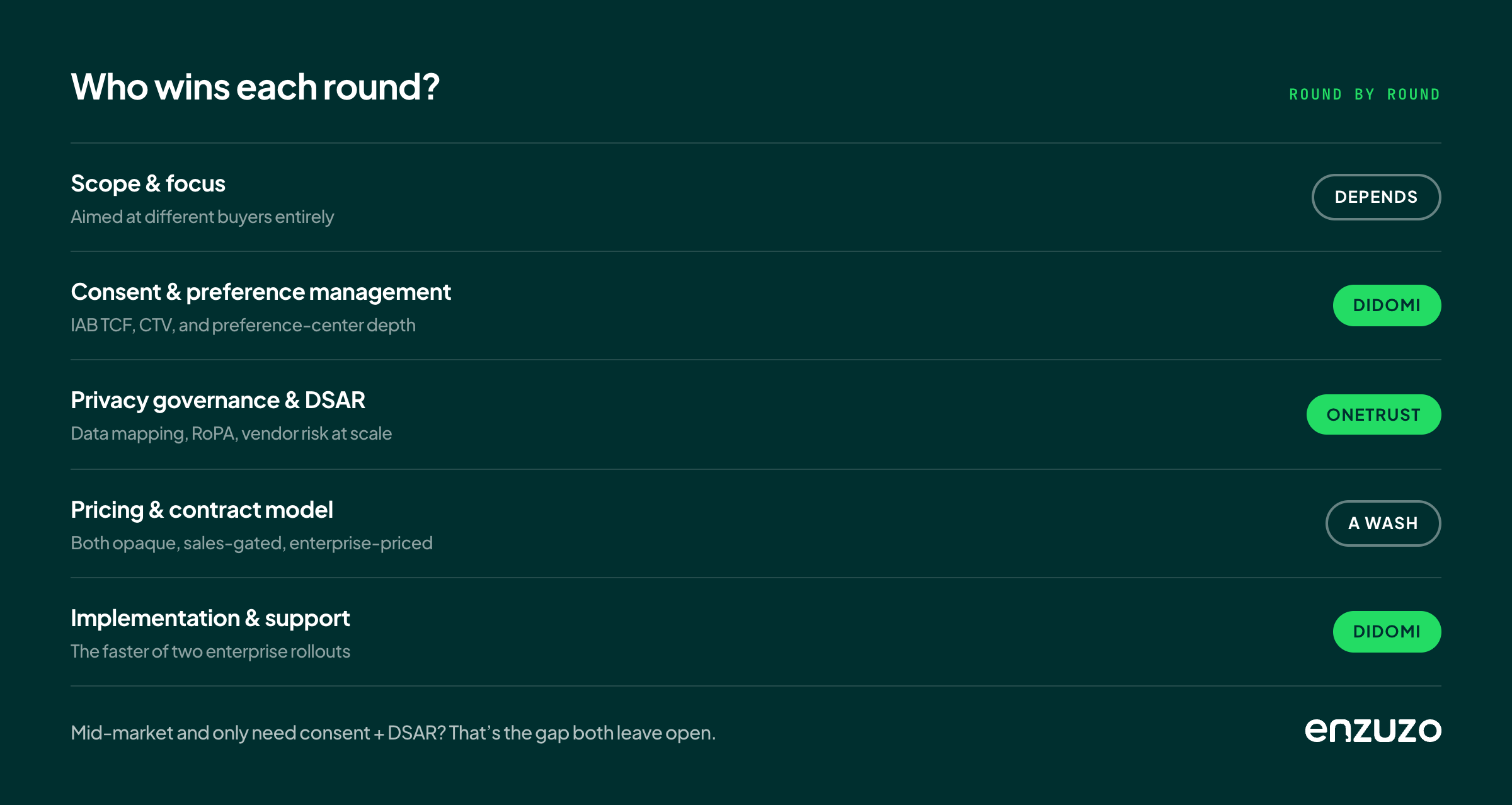
🏆 Verdict: Both do their job well, but they're aimed at different buyers. OneTrust wins if you need governance breadth across the business. Didomi wins if consent and preferences are the actual job.
If you only need consent management and don't want to spend heavily; that's the gap Enzuzo fills.
Consent and preference management
Didomi's home turf. It has deep IAB TCF and GPP support, cross-device and CTV consent, and a genuinely strong preference center that lets users manage communication preferences and data use across channels. For ad-tech-heavy publishers, that depth is hard to match.
OneTrust covers consent and preference management competently too, and it's Google Consent Mode v2 certified, but consent is one part of a much larger platform rather than the thing it's built around. You get solid coverage without Didomi's ad-tech specialization.
🏆 Verdict: Didomi takes this one for consent and preference depth, especially if you're a publisher or run complex ad-tech. OneTrust is more than enough for standard enterprise consent.
Privacy governance and DSAR
This is where OneTrust shines. Its governance depth is why enterprise clients flock to it: automated data discovery, records of processing, vendor risk management, full DSAR workflows, and compliance reporting across teams. Didomi cannot compete with OneTrust at this level.
Didomi does offer a privacy requests module, but reviews consistently describe it as basic relative to the depth of its consent. It's a consent specialist that added DSAR, not a governance platform.
🏆 Verdict: OneTrust wins clearly on governance and DSAR breadth. The catch is whether you'll use it, most mid-market teams need consent and straightforward DSAR, not a full governance suite, which is where a lighter tool like Enzuzo (DSAR included, no enterprise overhead) makes more sense.
Pricing and contract model
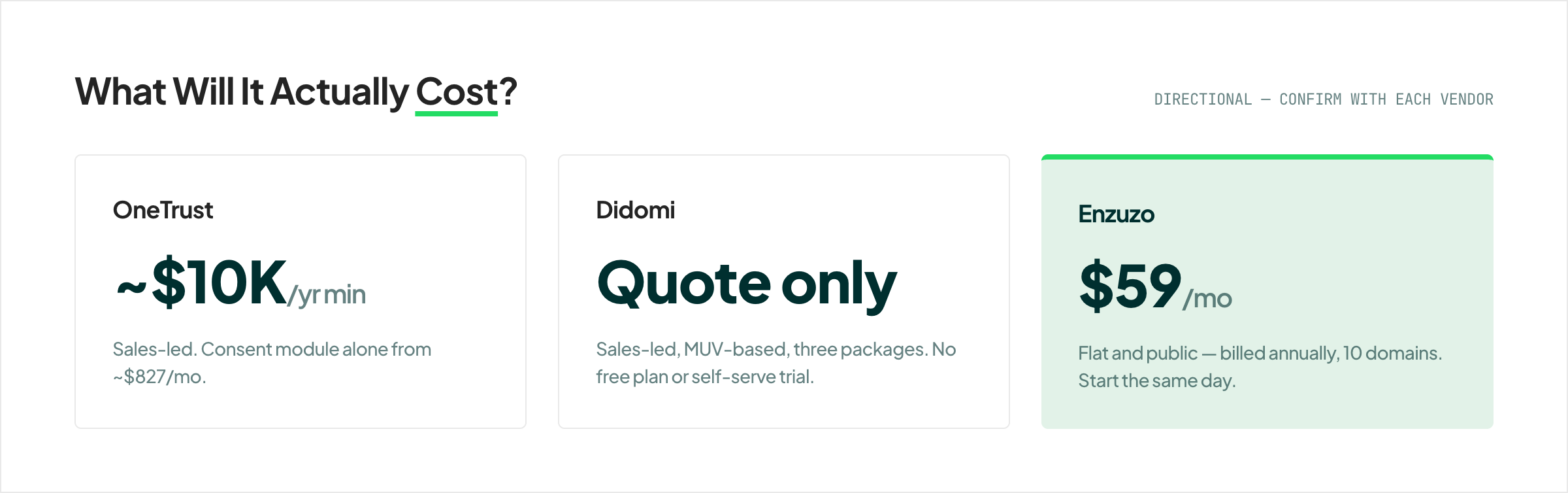
OneTrust doesn't publish prices publicly, but carries a minimum contract value of around $10,000 a year. Didomi also follows suit : it sells three sales-led packages (Essential, Advanced, Premium) priced on monthly unique visitors, with no free plan and no easy self-serve trial. Both mean a sales conversation before you see a number.
🏆 Verdict: It's a toss-up, and not in a good way. Both are opaque, sales-gated, and priced for enterprise.
Implementation and support
Both are enterprise deployments. OneTrust is the heavier lift, however, since onboarding runs months and typically needs a dedicated privacy engineer. OneTrust's support isn't great, either, sitting around around 1.7 out of 5 on Trustpilot.
Didomi is lighter than OneTrust but still enterprise: a sales-led setup with CSM-supported onboarding on larger plans, not a self-serve experience.
🏆 Verdict: Didomi is the faster of the two, but neither is quick. If deployment speed and a light admin load matter, that's the argument for a purpose-built CMP platform like Enzuzo.
When Enzuzo is a better fit than OneTrust or Didomi
It should be clear by now that both OneTrust and Didomi are vying for the enterprise market. OneTrust prices out mid-market and SMB with its $10K minimum, and Didomi is built for publisher-grade ad-tech complexity. That leaves a gap for teams that need certified, reliable consent without an enterprise contract or a sales cycle. That's what Enzuzo is built for: a Google Gold-certified CMP made for this segment.
Where Enzuzo wins over both:
- Transparent, flat pricing: PLG Pro is $59/month billed annually for 10 domains, versus a sales quote from either OneTrust or Didomi.
- Native Shopify integration built on the Customer Privacy API (neither OneTrust nor Didomi offers native Shopify).
- DSAR automation and privacy policy generator included, not bolted on or gated.
- U.S.-state geo-targeting covering CCPA, VCDPA, CPA, CTDPA, plus CIPA and Quebec Law 25.
- Live in days with Slack-first support, and complimentary onboarding offered
Honest limits: Enzuzo isn't an enterprise governance suite, so if you need OneTrust-level data mapping, RoPA, or vendor risk, it isn't that. It's consent and DSAR-focused rather than a full multi-channel preference center like Didomi's; there's no mobile app SDK either.

Which one should you pick?
- Choose OneTrust if you need a company-wide governance program (data mapping, RoPA, vendor risk, ESG, GRC) and have the team and budget to run it.
- Choose Didomi if consent and preference management is your core need, especially IAB TCF, ad-tech, and publisher or CTV use cases, and a sales-led contract is fine.
- Choose Enzuzo if you're mid-market or on Shopify, need certified consent and DSAR without enterprise pricing, and want to see the cost and go live in days.
- Avoid both OneTrust and Didomi if you only need consent and DSAR on a handful of domains and want transparent pricing; you'll pay enterprise overhead and sit through a sales cycle for capabilities you won't use.
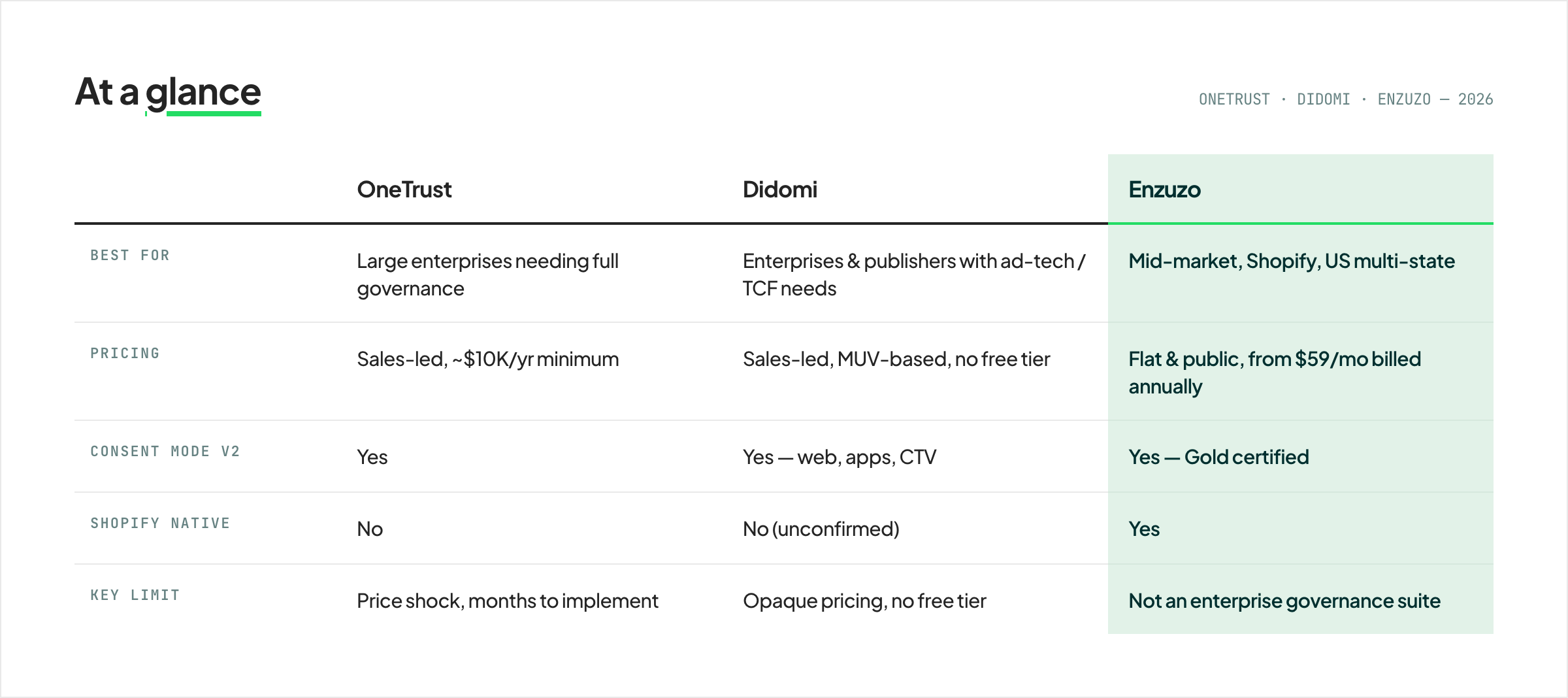
| Dimension | OneTrust | Didomi | Enzuzo |
| Best for | Large enterprises needing full governance | Enterprises and publishers with ad-tech/TCF needs | Mid-market, Shopify, US multi-state |
| Core focus | Broad privacy, security, and governance suite | Focused consent and preference management | Purpose-built consent for mid-market |
| Pricing | Sales-led, ~$10K/yr minimum | Sales-led, MUV-based, no free tier | Flat, public, from $59/mo billed annually |
| Google Consent Mode v2 | Yes | Yes (web, apps, CTV) | Yes (Gold) |
| Preference management | Yes (enterprise) | Yes (a core strength) | Consent/DSAR focused, not a full preference center |
| DSAR / governance depth | Full (RoPA, vendor risk, DSAR) | Basic DSAR; consent-first | DSAR included; not an enterprise governance suite |
| Shopify native | No | No (unconfirmed) | Yes |
| Key limit | Price shock, months to implement | Opaque pricing, no free tier, enterprise-focused | No mobile SDK, not a governance suite |
FAQs
Is OneTrust or Didomi better?
It depends on what you need. OneTrust is a broad privacy and governance suite (data mapping, RoPA, vendor risk, and more), while Didomi is a focused consent and preference-management specialist with deep IAB TCF and ad-tech roots. OneTrust wins on governance breadth; Didomi wins on consent and preference depth.
What's the difference between OneTrust and Didomi?
The main difference between the two is scope. OneTrust is a full privacy, security, and governance platform where consent is one module. Didomi is built specifically around consent and preference management, with strong ad-tech, IAB TCF, and CTV support. OneTrust is broader; Didomi is deeper on consent.
Which is easier to use for marketing teams, OneTrust or Didomi?
Didomi is generally the more marketer-friendly of the two. It's focused on consent and preference management with a lighter footprint, while OneTrust is a broad enterprise suite that usually needs a dedicated privacy engineer and a longer rollout. For a marketing team that wants to own consent without leaning on IT, a no-code CMP like Enzuzo is a good fit.
Does OneTrust or Didomi have better preference management and preference-center customization?
Didomi's preference center is one of its standout features. It lets users manage communication preferences and data use across channels and apps, with multi-regulation support. OneTrust also offers preference management, but as one module inside a much larger governance suite. If preference center customization is your priority, Didomi leads; if you need it inside a company-wide governance program, OneTrust is the better choice.
How much do OneTrust and Didomi cost?
Neither publishes pricing. OneTrust is sales-led with a minimum around $10,000/year. Didomi is also sales-led, priced on monthly unique visitors across three packages, with no free plan or self-serve trial. Both require a sales conversation to get a quote.
Is Didomi good for large media and ecommerce companies across multiple markets?
Yes, that's squarely Didomi's sweet spot. It's built for enterprises and publishers with high traffic, IAB TCF and ad-tech needs, and consent across multiple markets and regulations, which is why media and large ecommerce brands pick it. Smaller ecommerce teams, especially on Shopify, usually find it heavier than they need and choose a lighter CMP.
What are the best OneTrust and Didomi alternatives?
For teams priced out of OneTrust's roughly $10,000 minimum or blocked by Didomi's sales-gated pricing, the common alternatives are Enzuzo, Osano, Cookiebot, Ketch, and Axeptio. For mid-market and Shopify teams, Enzuzo is the closest fit with transparent flat pricing and DSAR included.
What's the best OneTrust and Didomi alternative for mid-market teams?
Enzuzo. It's a Google Gold-certified CMP built for the 50 to 500 employee mid-market, with transparent flat pricing, native Shopify, DSAR included, and per-US-state geo-targeting, without the enterprise sales cycle both OneTrust and Didomi require.

Osman Husain
Osman is the content lead at Enzuzo. He has a background in data privacy management via a two-year role at ExpressVPN and extensive freelance work with cybersecurity and blockchain companies. Osman also holds an MBA from the Toronto Metropolitan University.