Best Didomi Alternatives (2026): 7 Options Ranked & Reviewed

Osman Husain
Didomi is a strong enterprise consent management platform (CMP). It's French-built, with deep ad-tech expertise, and enterprise-ready since its acquisition of Sourcepoint in 2025. But it's pricey, ships with features many teams don't need, and technical customer support is hard to reach.
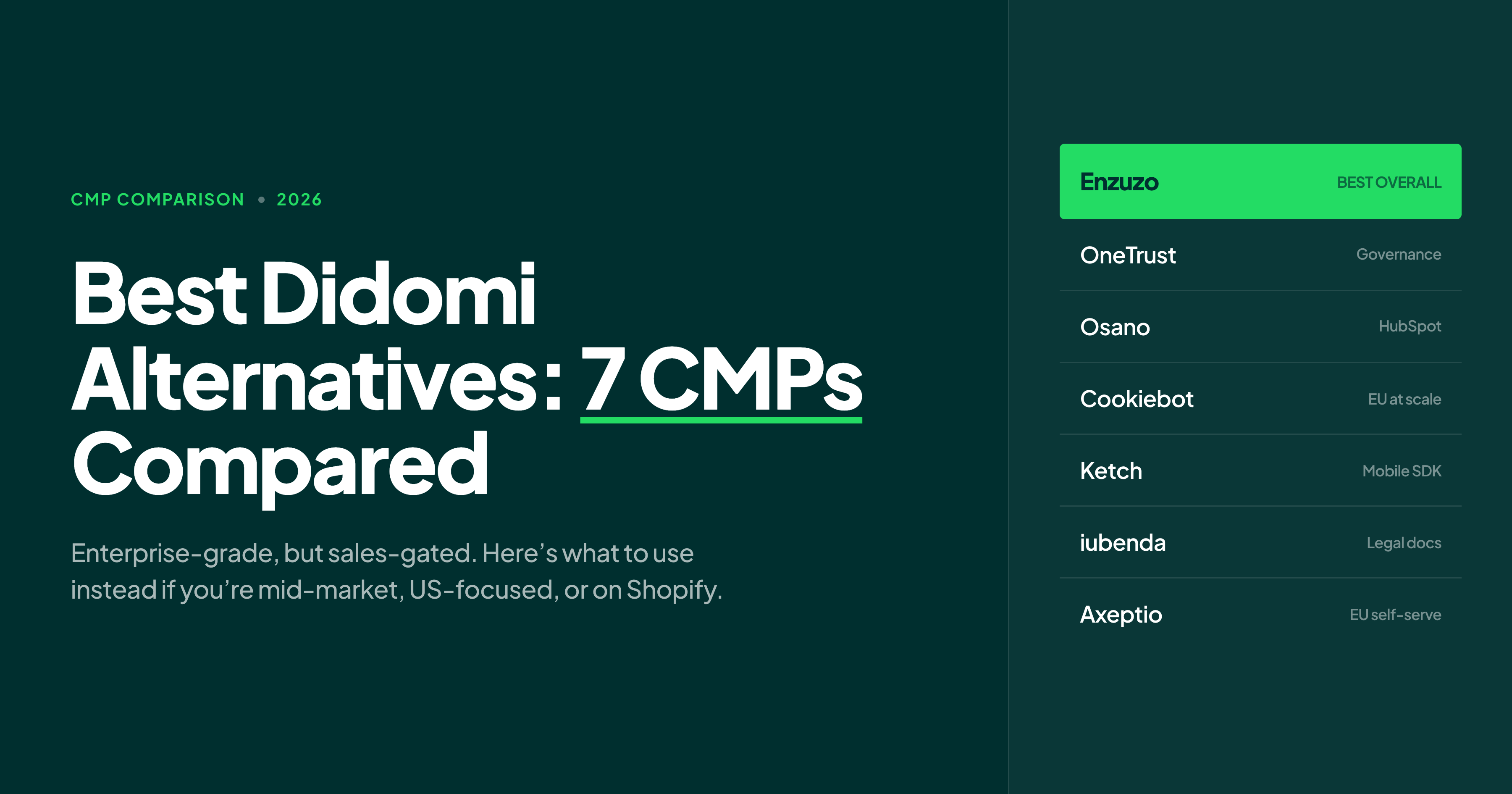
Here are our top 7 Didomi alternatives, and who each one is really for:
-
Enzuzo: best overall for mid-market and Shopify. Google Gold-certified CMP, flat pricing across 10 domains, DSAR included & Slack-first support
-
OneTrust: best if you genuinely need a full enterprise governance suite beyond consent.
-
Osano: best for HubSpot-centric teams that want built-in privacy-law alerting.
-
Cookiebot: best for EU/GDPR-first sites that need cookie consent.
-
Ketch: best if you need a mobile app SDK and top-tier banner UX.
-
iubenda: best for lawyer-drafted, multilingual legal documents on one site.
-
Axeptio: good self-serve option with a free tier.
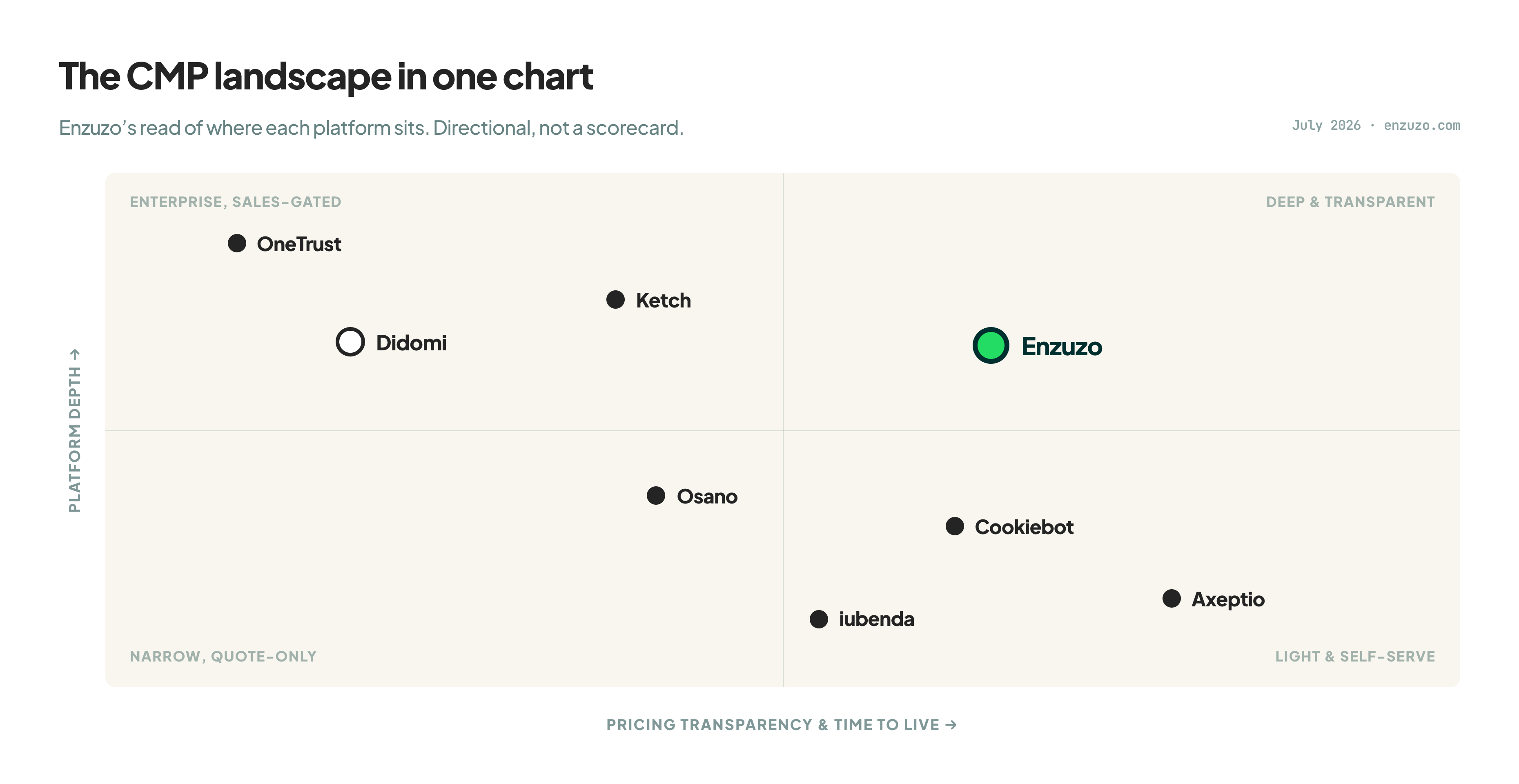
Two quick groupings before you dig in. If you picked Didomi for real enterprise scale, your true peers are OneTrust, Ketch, and Osano. If you were really just priced out or want a lighter option, the transparent options are Enzuzo, Cookiebot, Axeptio, and iubenda.
Why look for a Didomi alternative?
Didomi is a genuinely capable platform, so this isn't a takedown. Here's the honest picture.
What Didomi does well: It's one of the more established CMPs in the market, with deep IAB TCF and ad-tech roots that publishers and media companies lean on. It's genuinely strong on preference management; its preference center lets users control communication preferences and data use across channels and across web and apps, not just cookies, which is a real reason enterprises pick it.
It's Google Consent Mode v2 certified across web, apps, and CTV, supports the Global Privacy Platform (GPP), and covers GDPR plus a growing list of US state laws. After buying Sourcepoint in July 2025 , it added US publisher reach and server-side tagging, so it's pushing further into enterprise privacy infrastructure.
Where it falls short: Didomi doesn't publish pricing and has no free plan, so you can't evaluate it without booking a sales call and working through a quote. Its three packages (Essential, Advanced, Premium) are all sales-driven.
Didomi's DSAR capabilities are basic next to its consent depth, there's no native Shopify integration, and the whole thing is built for enterprise ad-tech complexity that most mid-market teams don't need.
For a team that only needs cookie consent, Google Consent Mode v2, geo-targeting, and DSAR on a handful of domains, that's a lot of overhead with low ROI.
Choosing Didomi alternatives
I evaluated each platform on the things that actually govern a buyer decision for consent management tools.
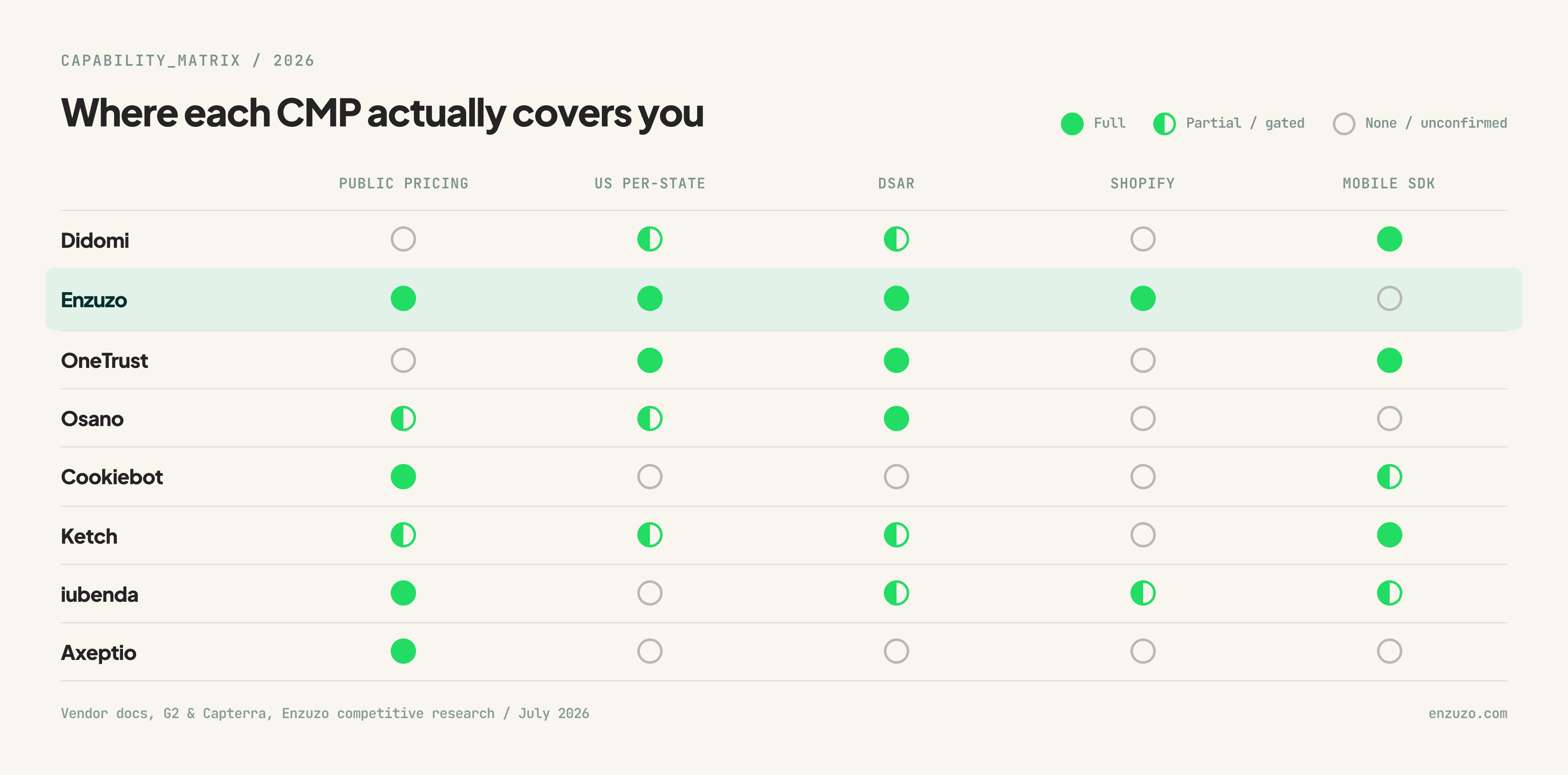
Coverage: EU/GDPR depth, US state laws (CCPA and beyond), and whether it handles per-state rules.
DSAR and privacy requests: included or bolted on, workflow depth.
Pricing transparency and model: public vs sales-gated, flat vs per-domain vs per-visitor, free tier or trial.
Consent essentials: Google Consent Mode v2 certification, IAB TCF support, geo-targeting.
Platform fit: Shopify, WordPress, HubSpot, mobile SDK, multi-domain management.
Time to live and support: self-serve vs sales cycle, onboarding load.
Sources: vendor pricing and product pages, G2 and Capterra reviews, published CMP market research, and Enzuzo's own first-party data. Competitor pricing can change without notice; figures verified July 2026.
Didomi alternatives at a glance
| CMP | Best for | Pricing model | GCM v2 | Shopify native | DSAR | Key limit |
| Enzuzo | Mid-market, Shopify, US multi-state | Flat, 10 domains, self-serve | Yes (Gold) | Yes | Yes, included | No mobile SDK; not an enterprise suite |
| OneTrust | Large enterprise governance | Sales-led, ~$10K/yr min | Yes | No | Yes (full) | Price shock, months to implement |
| Osano | HubSpot-centric, 1-2 domains | ~$199/mo per domain | Yes | No | Yes | Per-domain cost scales badly |
| Cookiebot | EU/GDPR-first, at scale | Per-domain + per-subpage | Yes (Gold) | No | No | No DSAR, weak US per-state |
| Ketch | Mobile SDK, banner UX | Starter $150/mo; Plus from $499/mo | Yes | No | Yes (Pro tier) | DSR gated to Pro, engineering-heavy |
| iubenda | Multilingual legal docs, 1 site | Per-site + pageview overage | Yes | Basic | Intake only | Per-site cost compounds, thin US coverage |
| Axeptio | EU-native, branded banners | Free + ~€29-129/mo | Yes (Gold) | Unconfirmed | Unconfirmed | EU-centric, lighter feature set |
The 7 best Didomi alternatives
1. Enzuzo: best overall for mid-market and Shopify
If Didomi feels like too much platform and too little pricing clarity, Enzuzo is the straightest swap for a mid-market or e-commerce team. It's a Google Gold-certified CMP with everything most teams actually use: geo-targeting, Google Consent Mode v2, DSAR automation, and value-added features like legal policy generators.
Pricing is flat and public, so you can start today without a sales call.
The differences that matter versus Didomi: transparent flat pricing across 10 domains (no per-visitor sales quote), native Shopify integration built on the Customer Privacy API, DSAR included rather than bolted on, and per-US-state geo-targeting that covers CCPA, VCDPA, CPA, CTDPA, plus CIPA and Quebec Law 25. You're live in days, not a procurement cycle.
Honest limits: Enzuzo isn't an enterprise governance suite, so if you need RoPA or vendor risk management at Didomi or OneTrust scale, it won't fit.
Enzuzo is consent management and DSAR-focused rather than a full multi-channel preference center, so if your priority is communication-preference management across channels the way Didomi does it, that's not Enzuzo's core focus.
Pricing: PLG Pro is $79/month, or $59/month billed annually, for 10 domains. Mid-market plans run about $250 to $300/month for high-traffic sites, scaling to 1M+ visitors.
Choose Enzuzo if you're mid-market, sell on Shopify, or need U.S. multi-state consent, and you want transparent pricing and DSAR included without an enterprise contract.
Considering your options? Book a strategy call with a consent management expert to audit your stack and see if Enzuzo is the right fit.
2. Osano: best for HubSpot-centric teams moving upmarket
Osano is a privacy-ops platform that wraps consent with TrustHub, a privacy-law alerting service that emails you when regulations change. Its standout is a native HubSpot DSAR integration, a 'no-fines' guarantee, and enterprise-adjacent features like vendor risk management.
The differences that matter versus Didomi: Osano leans US and mid-market where Didomi leans EU and enterprise, and it adds two things Didomi doesn't emphasize, TrustHub privacy-law alerts and a native HubSpot DSAR workflow. The honest tradeoff is the pricing model: Didomi's visitor-based pricing covers unlimited domains, while Osano charges per domain, so across several sites Osano can actually end up pricier.
Limits: Osano charges about $199 per domain per month, so the bill climbs fast once you're past a site or two. There's no native Shopify, and if you only need consent, you're still paying for TrustHub and vendor-risk features you may never touch. Its public pricing has also slipped behind a sales call lately.
Pricing: about $199/month per domain; roughly $995/month at five domains; enterprise custom.
Choose Osano if you're a HubSpot-centric team with one or two domains that values built-in privacy-law alerting.
3. Axeptio: best self-serve option with a free tier
Axeptio is a French CMP built around branded, well-designed consent experiences and EU data residency, which makes it a good fit if you're focused on Europe. It's a Google Gold Partner, IAB TCF v2.3 certified, and, unlike Didomi, its pricing is public with a free, self-serve option.
The differences that matter versus Didomi: both are French CMPs, but Axeptio flips the buying experience so you can try it in minutes instead of booking a sales call. It's TCF v2.3 certified with a real focus on branded banner design.
Limits: it's EU-centric and consent-first, so don't expect a full privacy platform. It doesn't include preference management, cross-app and CTV reach, or enterprise ad-tech scale. Treat it as a lighter cookie banner and consent tool until for lightweight teams.
Pricing: free tier for very low traffic; paid plans roughly €29 to €129/month by pageviews.
Choose Axeptio if you're an EU or French-market SMB that wants an affordable, self-serve, nicely designed consent banner with EU data residency.
4. iubenda: best for multilingual legal documents
iubenda is an Italian-origin tool with 15+ years behind it, known for lawyer-drafted, human-translated privacy policies in 27 languages alongside cookie consent. If your priority is airtight, localized legal documents on a single site, it's hard to beat on that specific job.
The differences that matter versus Didomi: iubenda solves a slightly different problem. Its core is lawyer-drafted, human-translated legal documents in 27 languages, which Didomi doesn't really do, and its pricing is public and cheap for a single site. But it's built for early-stage companies and doesn't scale well, since cost is per-site and compounds as you add domains. It also does not offer any of Didomi's ad-tech, TCF, or preference-management depth.
Limits: the pricing is per-site with pageview overages, so once you're running three or more sites it stacks up, and there's no single dashboard to manage them all from. DSAR is intake-form only, US per-state coverage is thin, and banner scripts can wreak havoc on website page load speed.
Pricing: free tier; Essentials around €5/month, Advanced around €20, Ultimate around €80 (mobile SDK is Ultimate only), plus pageview overages.
Choose iubenda if you're a single-site EU or LATAM SMB that prioritizes lawyer-drafted, multilingual legal docs.
5. OneTrust: best full enterprise governance suite
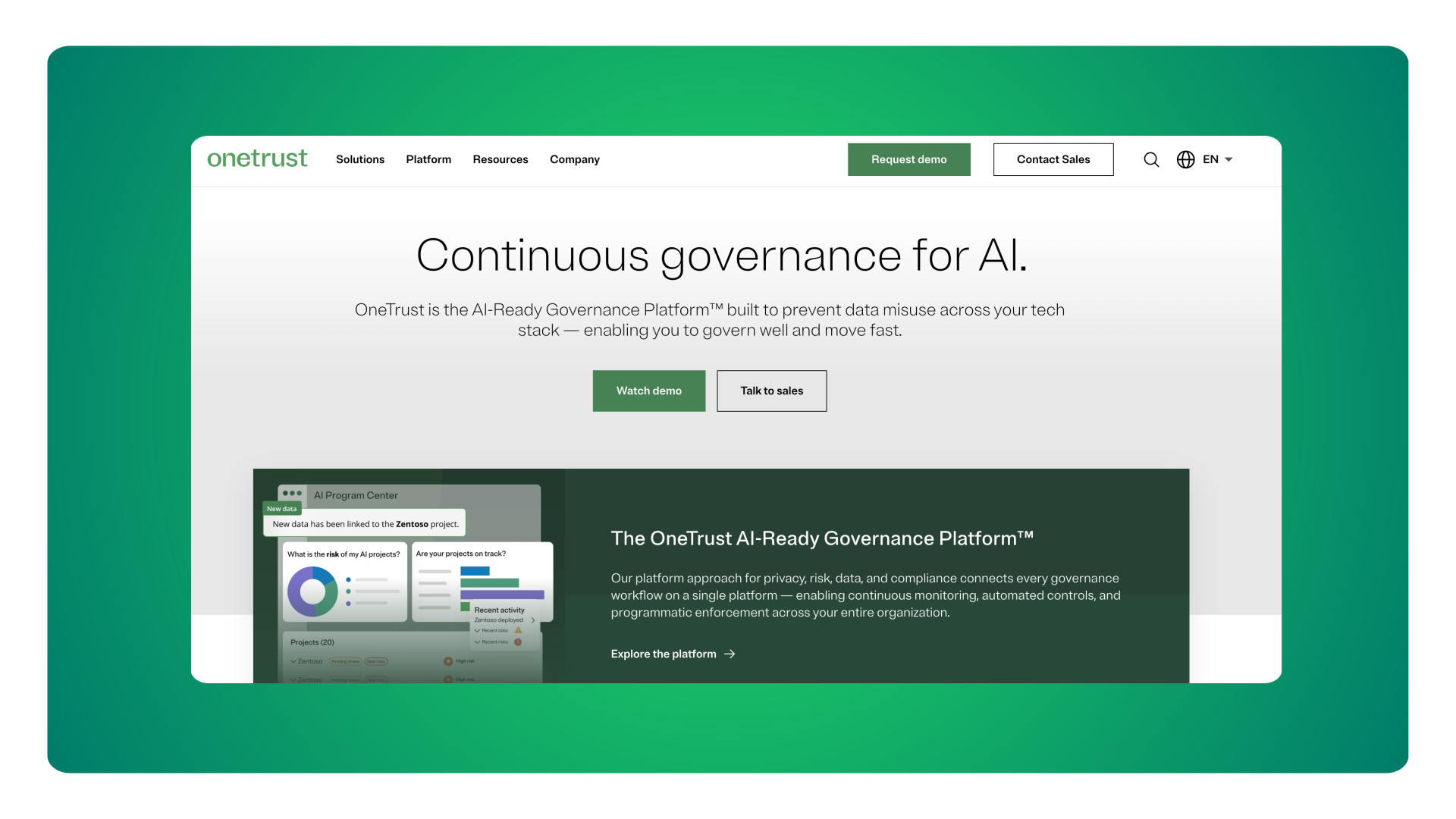
OneTrust is the other enterprise incumbent, and it goes well beyond consent into data mapping, RoPA, vendor risk, and DSAR at scale. If consent is just one input into a much larger privacy program, OneTrust is the clear winner since nothing matches its breadth.
The differences that matter versus Didomi: these are the two enterprise incumbents, and they're more alike than different, both sales-led, both a month-long implementation, and both priced for large organizations. The split is focus. Didomi goes deeper on IAB TCF, ad-tech, and publisher and CTV use cases, while OneTrust is a far broader governance suite that adds data mapping, RoPA, and vendor risk well beyond consent. Neither will show you a price without a call.
Limits: pricing is sales-led and starts around $10,000 a year, the rollout takes months, and you'll usually need a dedicated privacy engineer to run it. Most buyers end up using a fraction of what they pay for, and support is a common gripe.
Pricing: sales-led; roughly $10,000/year minimum
Choose OneTrust if you're a large enterprise that genuinely needs governance modules beyond consent and has a team to run them.
6. Ketch: best for mobile SDK and banner UX
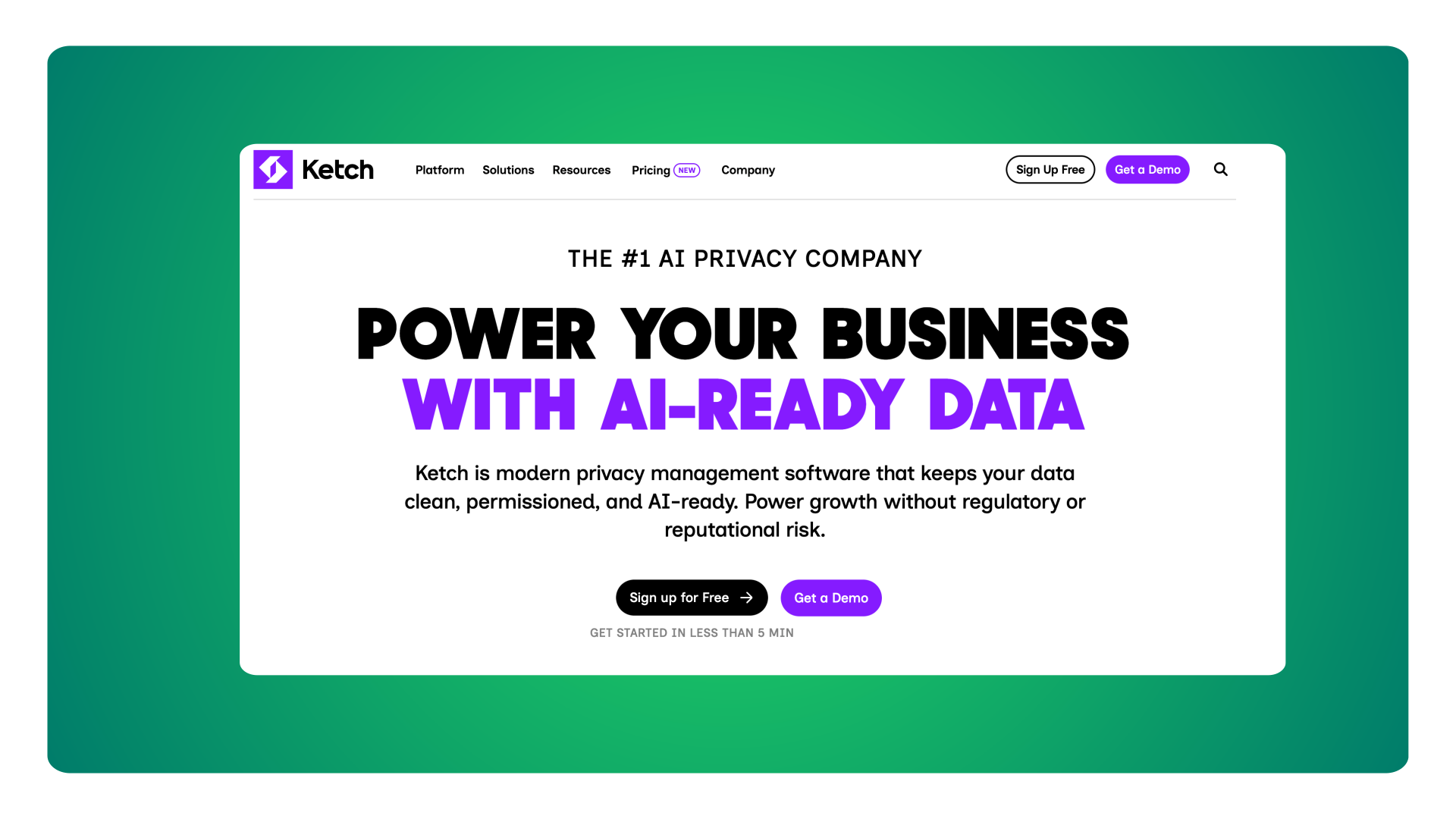
Ketch is another enterprise-adjacent option with a genuine mobile app SDK (iOS and Android) and banner UI customization that reviewers consistently praise. If mobile consent and polished UX matter, it's a strong pick.
The differences that matter versus Didomi: Ketch is the closest thing to Didomi with a visible on-ramp. It publishes a price ladder starting at a free tier and $150/month, so unlike Didomi you can see roughly where you'd land before talking to sales. The catch is depth-gating: DSR automation and data mapping sit behind the custom-quoted Pro tier, setup runs a few weeks and leans on engineers, and Didomi keeps the edge on TCF pedigree and preference management.
Limits: there's no native Shopify and the DSR automation and data mapping only show up on the Pro tier. Setup runs two to four weeks and requires deep technical involvement.
Pricing: Free tier; Starter $150/month; Plus from $499/month (annual); Pro custom.
Choose Ketch if you need mobile app consent and best-in-class banner UX and have engineering bandwidth.
7. Cookiebot: best for EU consent
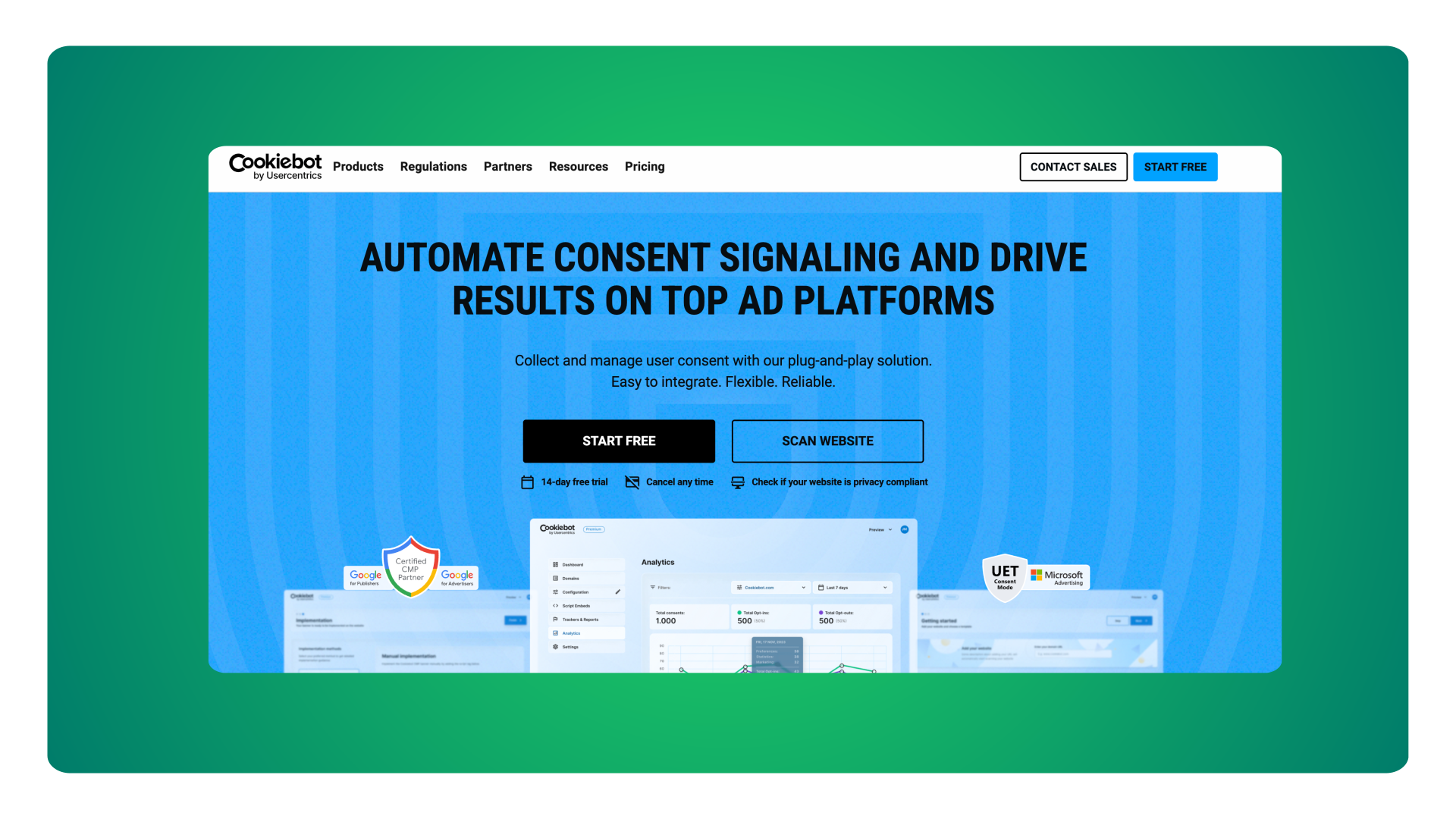
Cookiebot is a GDPR-first workhorse, carrying a strong compliance posture (SOC 2 Type 2, ISO 27001, and more). Its patented cookie scanning and 47+ languages make it a dependable EU-first choice.
The differences that matter versus Didomi: Cookiebot is narrower and simpler. It's a GDPR-first cookie-scanning tool with enterprise-grade certifications and huge scale, but it stops at consent: no DSAR at any tier, no API, and U.S. coverage is a single nationwide rule. It also lacks Didomi's preference management, ad-tech and CTV depth, and its per-domain plus per-subpage pricing adds up across a large site.
Limits: there's no DSAR at any tier, no public API, no native Shopify solution, and thin U.S. coverage. Pricing is per-domain plus per-subpage (which doubled last year), and new signups now get funnelled to the separate Usercentrics Web product.
Pricing: per-domain, per-subpage tiers, from a free plan and Premium Lite around €7/month up to €90/domain at the top.
Choose Cookiebot if you're EU/GDPR-first, need dependable cookie scanning at scale, and don't need DSAR, an API, or deep U.S. compliance.
Which one should you pick?
Stick with Didomi if you're a large enterprise or publisher with heavy IAB TCF and ad-tech needs across multiple regions, and a sales-led contract is fine.
Choose Enzuzo if you're mid-market, on Shopify, or need US multi-state consent, and you want transparent flat pricing with DSAR included, live in days.
Choose OneTrust or Ketch if you need enterprise scale but for a specific reason: OneTrust for full governance breadth, Ketch for a mobile SDK and banner UX.
Choose Axeptio or iubenda if you want an EU-native tool: Axeptio for self-serve branded banners, iubenda for multilingual legal docs.
Avoid Didomi if you want to see pricing before a sales call, need native Shopify, or only need consent and DSAR on a few domains, since you'll be overpaying for what you need.
FAQs
What are the best alternatives to Didomi?
The strongest Didomi alternatives in 2026 are Enzuzo, OneTrust, Osano, Cookiebot, Ketch, iubenda, and Axeptio. For mid-market and Shopify teams, Enzuzo is the closest fit with transparent flat pricing and DSAR included; for enterprise scale, OneTrust and Ketch are the nearest peers.
Does Didomi do preference management beyond cookie consent?
Yes, and it's one of Didomi's real strengths. Its preference center lets users manage communication preferences and data use across multiple channels and across both websites and apps, not just cookies. If deep multi-channel preference management is your main requirement, the alternatives that come closest are OneTrust and Usercentrics. Lighter, consent-first tools (including Enzuzo, Cookiebot, and Axeptio) focus on cookie consent and DSAR rather than full communication-preference centers, so match the tool to whether you need consent or full preference management.
How much does Didomi cost?
Didomi doesn't publish pricing. It sells through three sales-led packages (Essential, Advanced, and Premium) priced on monthly unique visitors, with no free plan and no easy self-serve trial. You'll need to book a demo and request a quote to see numbers.
Does Didomi have a free trial or free plan?
No. Didomi has no free plan and no straightforward self-serve trial. If a free tier matters to you, Axeptio, iubenda, and Enzuzo all offer free or low-cost self-serve entry points.
Is Didomi or OneTrust better?
They're both enterprise CMPs. Didomi has deeper IAB TCF and ad-tech and publisher roots and a strong preference center, while OneTrust is a broader governance suite (data mapping, RoPA, vendor risk) with a roughly $10,000/year minimum. Both are sales-led. For mid-market teams, both are usually more than needed. Read Onetrust vs Didomi.
Didomi vs Axeptio, which should you choose?
Both are French CMPs, but they serve different buyers. Didomi is enterprise and sales-led, deep on IAB TCF and ad-tech for publishers and large multi-region brands. Axeptio is SMB and mid-market friendly, with public self-serve pricing (including a free tier), Google Gold and TCF v2.3 certification, and a focus on branded, well-designed banners. Choose Didomi for enterprise ad-tech scale; choose Axeptio for an affordable, self-serve EU banner.
Which Didomi alternatives work across mobile apps?
Didomi handles consent across web, apps, and CTV. Among the alternatives, Ketch has a genuine mobile app SDK (iOS and Android) and OneTrust covers mobile at the enterprise tier. Most lighter CMPs, including Enzuzo and Cookiebot, are web-first and don't offer a native mobile SDK, so if in-app consent is a hard requirement, focus on Ketch, OneTrust, or Didomi itself.
What's the best Didomi alternative for Shopify?
Enzuzo, because it has a native Shopify integration built on the Customer Privacy API. Most other CMPs, including Didomi, Osano, OneTrust, and Cookiebot, don't offer native Shopify support.
What's the best Didomi alternative for mid-market teams?
Enzuzo is built specifically for the 50 to 500 employee mid-market, with transparent flat pricing across 10 domains, Google Consent Mode v2, DSAR automation, and per-US-state geo-targeting, without the enterprise sales cycle Didomi requires.
Is Didomi a good CMP?
Yes, for the right buyer. Didomi is a capable, established enterprise CMP that's strong on IAB TCF, GPP, preference management, and multi-region consent. It's a poor fit if you're mid-market or US/Shopify-focused, want transparent pricing, or need a free trial, which is why many teams evaluate lighter alternatives.
Osman Husain
Osman is the content lead at Enzuzo. He has a background in data privacy management via a two-year role at ExpressVPN and extensive freelance work with cybersecurity and blockchain companies. Osman also holds an MBA from the Toronto Metropolitan University.
LinkedIn →More related blogs
Your next read