
Osman Husain

iubenda and Osano are both consent management and data privacy platforms, but they're built for different buyers. iubenda is suited for early-stage businesses on a budget that want lightweight cookie consent tools for low-traffic sites. Osano is ideal for the buyer moving upmarket, offering broader privacy ops support and enterprise-adjacent features such as vendor risk management.
iubenda vs Osano: head-to-head
The comparison between iubenda and Osano focuses on speed, ease of use, cost, complexity, and feature depth. The two platforms share similarities: both are consent management platforms compliant with Google Consent Mode and offer a cookie consent banner that can be configured to meet different privacy regulations.
But that's largely where it ends: the honest answer is that iubenda and Osano don't compete for the same buyer segment. iubenda claims enterprise depth, claiming that companies like Lamborghini use its solution, but those claims don't stand up to an independent review. The reality is that iubenda is built for the SMB segment: single-site, E.U.-centric teams that want cookie consent and legal documents in one lightweight subscription.
Osano, on the other hand, has a much broader feature set than iubenda, includes tools needed for governance, risk, and compliance programs, and is the best fit for teams where privacy operations is a core business need. But, it's certainly not an affordable option.
We'll break down what each does well, where each falls short, and where a multi-domain platform like Enzuzo changes the math.
At-a-glance comparison
| Dimension | iubenda | Osano |
| Target segment | SMB, EU/LATAM-heavy | Mid-market to enterprise |
| Entry price | EUR 5/mo (Essentials, annual) | $199/mo (1 domain) |
| Pricing model | Per-site + pageview overages | Per-domain, scales linearly |
| Domains at entry tier | 1 (separate subscription per site) | 1 |
| Multi-domain dashboard | ❌ No consolidated dashboard | ✅ Yes, but billed per domain |
| DSAR handling | ⚠️ Intake form only, no workflow | ✅ Automated |
| API access | ⚠️ Higher tiers only | ✅ Yes |
| Shopify native | ⚠️ Basic (consent-script layer) | ❌ No |
| Privacy law monitoring | ❌ Not a feature | ✅ TrustHub alerts |
| US state law coverage (CIPA, VCDPA, etc.) | ❌ Thin past CCPA basics | ⚠️ Unclear, not prominently documented |
| Setup time | Hours | Days |
| Support model | Email, dashboard flagged as confusing in reviews | Standard ticket system |
| Google Consent Mode v2 | ✅ (paid tiers) | ✅ |
Pricing as of July 2026. iubenda's pageview-overage model and Osano's per-domain model both mean actual monthly cost depends heavily on traffic and domain count.
iubenda: The per-site legal and consent bundle

Best for: Single-site E.U. businesses want lawyer-drafted privacy policies, cookie consent, and terms and conditions in one subscription, without a dedicated privacy or legal team.
What it does well
iubenda has been operating for 15+ years out of Bologna, Italy, and has largely positive reviews. The core pitch is straightforward: lawyer-drafted privacy policy, cookie policy, and terms and conditions clauses, kept current with regulatory changes, available in 27 languages with human (not AI) translation.
The cookie consent side is a legitimate Google-certified CMP Partner with IAB TCF 2.2 validation, patented cookie scanning, and Google Consent Mode built in. For a single site under 25,000 to 50,000 monthly pageviews, the Essentials or Advanced tier is genuinely inexpensive, and the legal-document generator is a real time-saver for teams without in-house counsel.
Where it falls short
iubenda bills per site, not per organization. Each domain is a separate subscription with its own login and its own billing. There's no consolidated multi-domain dashboard, so a company running four sites is managing four separate iubenda accounts. At 4 sites on the Advanced tier, that's roughly EUR 80/month base cost before pageview overages.
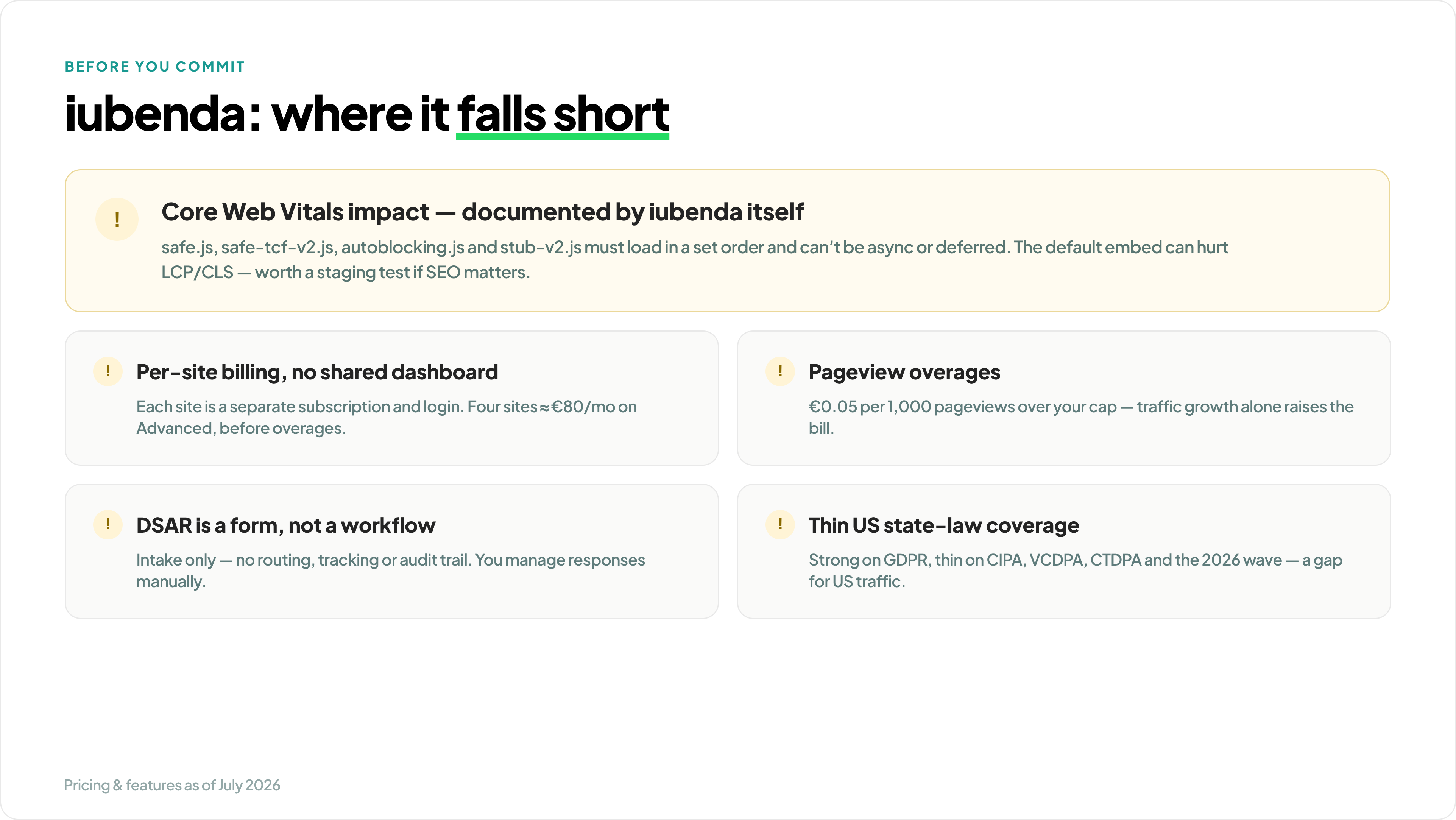
Pageview overages are the other cost variable to watch: EUR 0.05 per 1,000 pageviews over your tier's cap. A growing site can get pushed into unpredictable monthly bills purely from traffic growth, with no domain or feature changes.
The most citable weakness is one iubenda documents itself: its own help docs acknowledge Core Web Vitals impact, specifying that certain scripts (safe.js, safe-tcf-v2.js, autoblocking.js, stub-v2.js) must load in a specific order and cannot be loaded async or deferred.
iubenda publishes mitigation guidance for this, including server-side conditional embedding, because the default implementation can hurt page speed and Core Web Vitals scores. If your team tracks LCP or CLS as part of SEO, that's worth a direct test before committing.
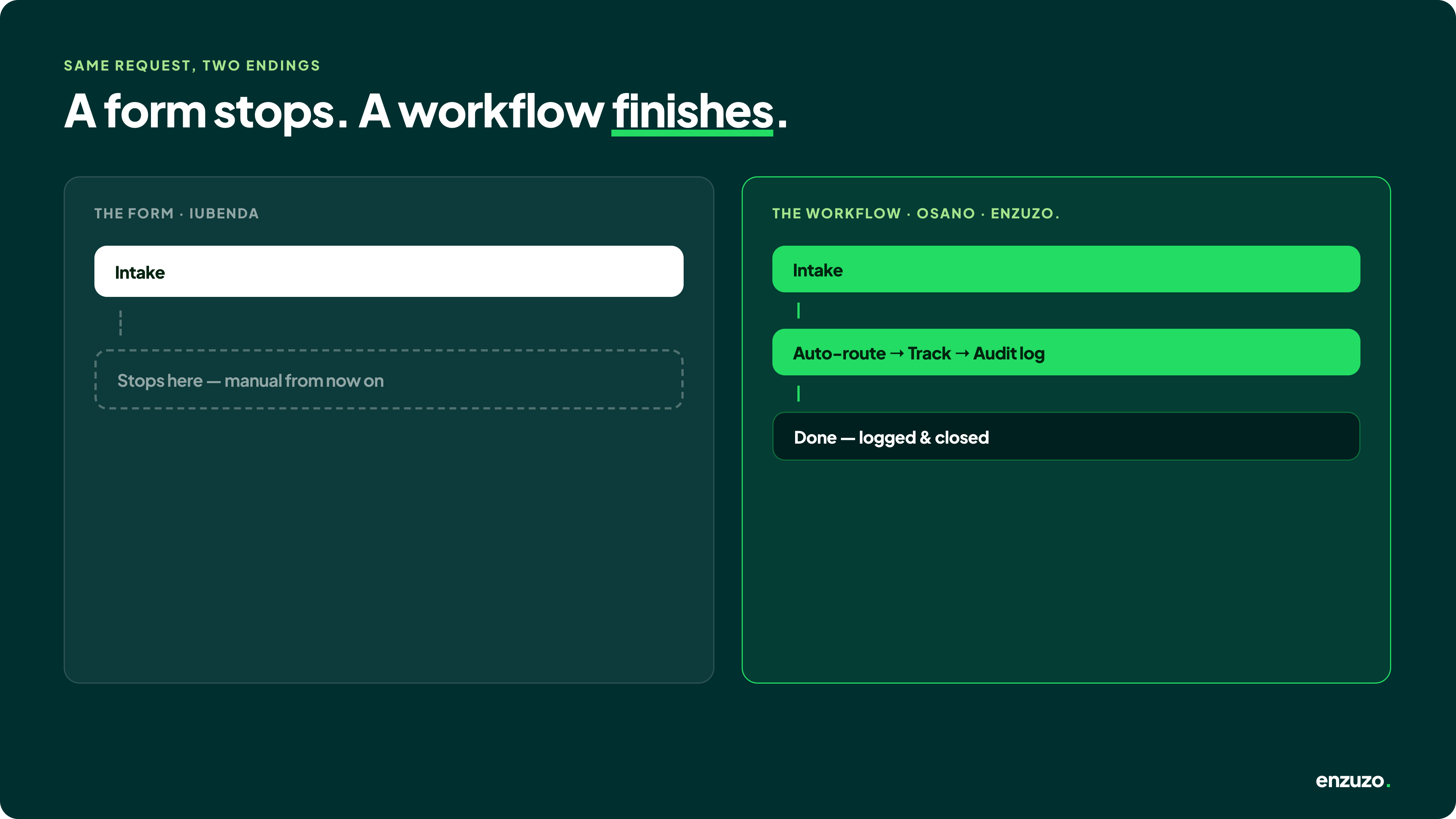
iubenda's DSAR handling is a form, not a workflow. Advanced tiers and above include a DSAR intake form, but there's no request tracking, routing, or audit trail; you're managing responses manually. And while iubenda covers GDPR thoroughly, documentation for U.S. state privacy laws (CIPA, VCDPA, CTDPA) is thin. If your traffic includes meaningful U.S. exposure, especially California, this is the gap that tends to trigger a switch.
Who should still pick it: A single-site EU or LATAM business that wants lawyer-drafted legal documents bundled with basic cookie consent, and doesn't need a multi-domain dashboard, DSAR workflow automation, or deep US state law coverage.
Osano: The privacy operations platform
Best for: Mid-market to enterprise teams that want a broader privacy operations platform, including features like third-party risk management.
What it does well
Osano positions itself as "data privacy made easy," and the product goes wider than consent management. TrustHub, its privacy law monitoring service, emails customers when new regulations pass or enforcement actions occur, which is a genuinely useful feature for compliance teams. Osano also has a native HubSpot integration for DSAR workflows, which is a real differentiator if your stack is HubSpot-centric.
The core CMP does what you'd expect at this tier: geo-targeting, DSAR automation, IAB TCF 2.3, Google Consent Mode v2 certification, a real multi-domain dashboard (even though each domain is billed separately), and API access. Setup takes days rather than hours, but the documentation is reasonable if your team has GTM experience.
Where it falls short
The pricing model is the headline issue. Osano costs $199 per month per domain for the basic plan - my breakdown of Osano pricing has more details. At 2 domains, that's about $398/month. At 10 domains, close to $1,990/month.
The multi-domain dashboard exists, but it doesn't change the fact that every additional domain is a new line item, and the math compounds fast for any company managing more than one or two properties.
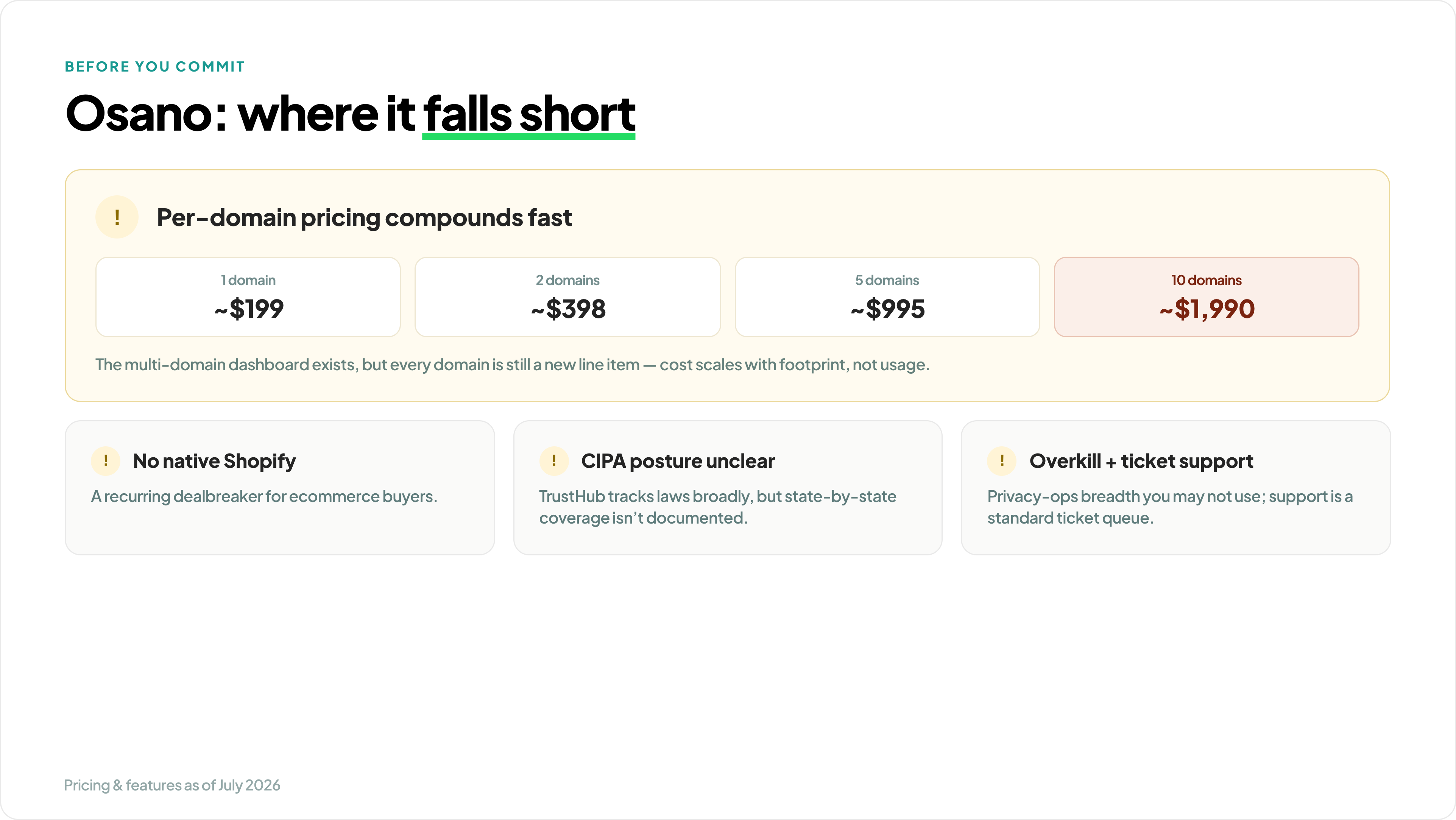
Osano has no native Shopify integration, which is a recurring dealbreaker for ecommerce buyers. CIPA-specific compliance posture isn't prominently documented; TrustHub tracks legislation broadly, but explicit state-by-state coverage isn't a clear, marketed feature the way it is for some competitors. And for a buyer who only needs consent management, TrustHub and the broader privacy-ops feature set can feel like paying for capability you won't use. Support is a standard ticket system rather than a dedicated, fast-response channel.
Who should still pick it: A mid-market or enterprise team that wants privacy law monitoring and DSAR workflows built natively into HubSpot, and has the budget to match.
iubenda vs Osano: The core tradeoff
Strip away the feature lists and the decision comes down to two different pricing philosophies applied to two different buyer profiles:
iubenda is cheap until you scale past one site. A single EU-heavy site with legal document needs and no dedicated privacy team gets real value from iubenda's bundled approach at a low price. The economics break down past 2 to 3 sites, where the lack of a consolidated dashboard becomes an operational headache, not just a cost issue.
Osano is capable but linearly expensive. The privacy-ops feature set (TrustHub, HubSpot integration, multi-domain dashboard) is genuinely more mature than iubenda's, but per-domain pricing means the cost scales with your footprint, not your usage. A company with 3+ domains pays a real premium for that maturity.
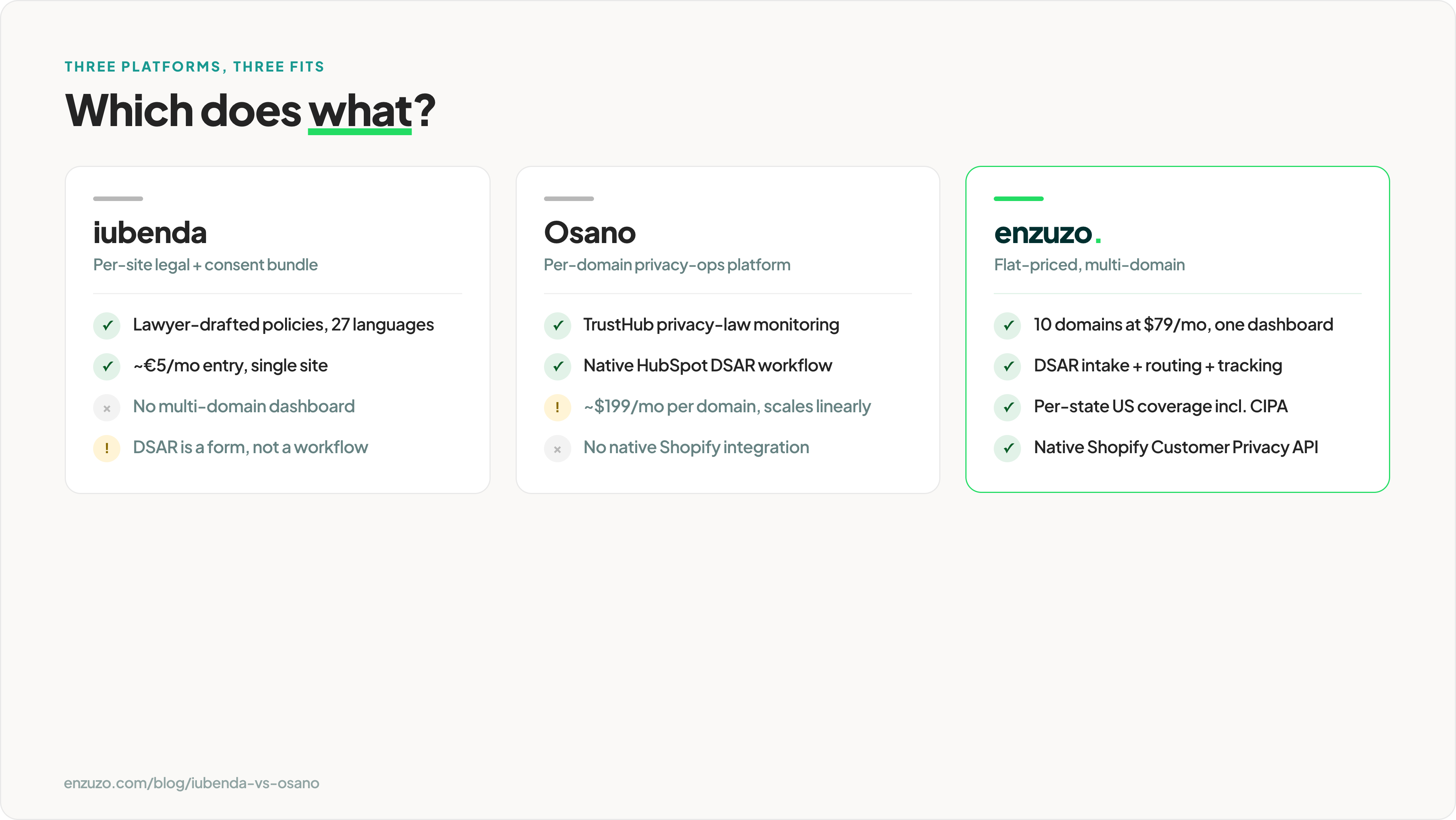
Neither platform solves the specific problem of teams that need a pure consent management platform that has support for multiple domains, API access, U.S. state law coverage, and DSAR automation. That's the gap Enzuzo fills.
The third option: Enzuzo for multi-domain consent management
We built Enzuzo's consent management platform for the buyer stuck between iubenda's per-site limits and Osano's per-domain cost. Specifically: a company running multiple domains (marketing site, app, regional sites, or several Shopify storefronts) that needs GDPR plus US state law coverage, DSAR automation with real workflow, and doesn't want the bill to scale with domain count.
On pricing. Enzuzo Pro is $79 per month and includes 10 domains in one flat price, one dashboard, one login. Compare that to iubenda's per-site billing (4 sites on Advanced runs about EUR 80/month base) or Osano's per-domain model (5 domains runs about $995/month). Growth, our 4-domain tier, is $29/month; Starter, for a single domain, is $9/month.
On compliance coverage. Enzuzo is Google Consent Mode v2 Gold Partner certified, supports IAB TCF, and geo-targets GDPR, CCPA, CPRA, VCDPA, CPA, CTDPA, Quebec Law 25, and [CIPA](https://www.enzuzo.com/blog/california-invasion-of-privacy-act), the US state-by-state coverage that's thin in iubenda and undocumented in Osano.
On DSAR. Our DSAR automation includes intake, routing, and response tracking, not just an intake form like iubenda's, and no HubSpot dependency required like Osano's setup.
On Shopify. Enzuzo has a native Shopify integration with Customer Privacy API depth. iubenda's Shopify support sits at the consent-script layer. Osano has no native Shopify integration at all.
On support. Slack-first, with real response times, versus iubenda's email support (flagged as confusing to navigate in G2 reviews) or Osano's standard ticket system.
Where Enzuzo isn't the answer. If you're a single-site EU business that mainly needs lawyer-drafted legal documents in 27 languages and light cookie consent, iubenda's Essentials tier at EUR 5/month is genuinely hard to beat on price, and we wouldn't try to talk you out of it. If TrustHub's privacy-law monitoring or a native HubSpot DSAR workflow is a hard requirement for your team, Osano covers that better than Enzuzo.
Want to see a flat-priced, multi-domain CMP running in your browser in under 10 minutes? Start a free Enzuzo trial. No credit card needed; DSAR automation and API included in the Starter plan.
Or Book a 20-min demo to audit your consent management stack

FAQs
Is iubenda cheaper than Osano?
At a single site or domain, yes, by a wide margin: iubenda Essentials starts around EUR 5/month versus Osano's roughly $199/month. The gap narrows as iubenda's per-site billing compounds; at 3 to 4 sites on the Advanced tier, iubenda's cost approaches what a flat 10-domain plan from a platform like Enzuzo would charge, while Osano at the same domain count would run well over $500/month.
Does either platform have a real multi-domain dashboard?
Osano does; iubenda does not. iubenda bills and manages each site as a separate subscription with its own login. Osano has one dashboard across domains, but each domain is still a separate line item on the bill.
Which has better DSAR support?
Osano's is more mature: automated intake, routing, and a native HubSpot integration. iubenda's DSAR support, available on Advanced tier and above, is an intake form with no workflow, tracking, or audit trail behind it.
Does iubenda or Osano support CIPA and US state privacy laws?
Neither documents this clearly. iubenda is GDPR-first with basic CCPA support and thin coverage of CIPA, VCDPA, CTDPA, and the broader 2026 wave of state laws. Osano's TrustHub tracks legislative changes broadly, but CIPA-specific compliance posture isn't prominently documented as a standalone feature.
Is the Core Web Vitals concern with iubenda real?
Yes, and it's not third-party speculation: iubenda's own help documentation specifies that certain scripts must load in a particular order and cannot be async or deferred, and it publishes mitigation steps because the default setup can affect page speed. If Core Web Vitals or SEO performance is a priority, test this directly on a staging environment before committing.
What's the actual difference in who these two are built for?
iubenda is built for SMB, mostly EU and LATAM, single-site businesses that want legal documents and cookie consent in one lightweight tool. Osano is built for mid-market to enterprise teams that want a fuller privacy operations platform and are comfortable with per-domain pricing. If you don't fit cleanly into either profile, particularly if you manage multiple domains and need US state law coverage, that's the gap a flat-priced, multi-domain platform like Enzuzo is built to fill.
Osman Husain
Osman is the content lead at Enzuzo. He has a background in data privacy management via a two-year role at ExpressVPN and extensive freelance work with cybersecurity and blockchain companies. Osman also holds an MBA from the Toronto Metropolitan University.
LinkedIn →More related blogs
Your next read