Termly vs Iubenda: What's Right For You in 2026?
Table of Contents
If you're comparing Termly and iubenda, you're likely a founder, marketer, or agency trying to get a website compliant with GDPR, CCPA, and Google Consent Mode v2. Both tools promise that, and both deliver up to a point.
This guide compares Termly and iubenda honestly on pricing, features, compliance coverage, and support. Then it explains where both tools hit a wall, and what to use instead when they do.
Termly vs. iubenda: Quick comparison
| Termly | iubenda | Enzuzo | |
| Best for | U.S. single-site SMBs | EU / multilingual sites | Multi-domain & growing teams |
| Entry paid price | ~$10/mo per site | ~$5/mo per site | $9/mo (Starter, 1 domain) |
| Domains per plan | 1 (per-site) | 1 (per-site) | Up to 10 (Pro, $59/mo) |
| Multi-domain dashboard | ❌ (Agency tier only) | ❌ | ✅ Included |
| DSAR handling | Intake form only | Intake form (Ultimate tier) | ✅ Full workflow + tracking |
| API access | ❌ | Higher tiers only | ✅ |
| Shopify-native | ❌ | Basic script only | ✅ Customer Privacy API |
| U.S. state law depth | ✅ Strong (attorney-drafted) | ⚠️ Thin past CCPA | ✅ Geo-targeted by state |
| Languages | English-focused | ✅ Up to 27 | Multi-language |
| Page-speed impact | Low | ⚠️ Documented (Core Web Vitals) | Low (lightweight script) |
| Google Consent Mode v2 | ✅ | ✅ | ✅ Certified |
| Support | Phone, email, chat (M-F) | Email, chat, forum | Slack-first, high-touch |
Pricing reflects published annual rates as of mid-2026 and is per-site for Termly and iubenda.
What's the difference?
Termly is a U.S.-focused compliance platform built around attorney-crafted legal documents. Its standout feature is the breadth of policy generators, 10 in total, from privacy policies to EULAs and accessibility statements, paired with a cookie consent banner.
It's a strong choice for American small businesses that want to stay compliant under U.S. state privacy laws. It also carries a 4.7/5 Trustpilot rating and BBB A+ accreditation.
iubenda is an Italy-based platform with 15+ years in the market and 2.5M+ sites. Its differentiators are language coverage, up to 27 languages with human-reviewed translations, and a broader suite that now includes an accessibility widget and whistleblowing management.
iubenda is also ISO 27001 certified, which procurement teams increasingly ask about. In short: Termly leans U.S. and legal-document-first, while iubenda leans EU/global and suite-first. For a single site in one jurisdiction, either works.
Pricing
Both publish entry pricing, and both are inexpensive to start.
Termly offers a free plan. Its Starter tier is ~$10/month (billed annually, or $14 monthly) for two policy generators and the CMP up to 50,000 banner views. Pro+ is ~$15/month annually for all generators and unlimited views, with custom Agency pricing.
iubenda also offers a free plan. Paid tiers run from ~$5/month (Essentials) to ~$25/month (Advanced) to ~$100/month (Ultimate), scaling by pageviews and features. Multi-language and geo-targeting unlock at the Advanced tier.
Here's the catch most buyers overlook: both price per site. A single subscription covers one domain, so three websites means paying three times, with three logins and three invoices.
iubenda also adds pageview-based overages, so a traffic spike can mean an unpredictable bill. For a one-site business, that's fine. For an agency or a multi-brand company, the per-site model is where low entry pricing is no longer cheap.
Termly vs. iubenda: Pros and Cons
Both tools earn their place at the entry level. Here's where each one is strong and where it falls short.
Termly
Pros
- Widest set of policy generators, 10 in total, all attorney-drafted for U.S. law.
- Strong U.S. state-law coverage, with clear documentation of which laws each product addresses.
- High user satisfaction: 4.7/5 on Trustpilot and a BBB A+ rating.
- Fast setup and a genuinely useful free plan for a single site.
- Phone support, which iubenda does not offer.
Cons
- U.S.-first, so EU consent signaling into ad networks is weaker, a common cause of dropped analytics.
- No native Shopify app and no API.
- DSAR is a form only, with no workflow or audit trail.
- Multi-domain management is locked to the custom Agency tier.
iubenda
Pros
- Deep international coverage, with policies in up to 27 languages and human-reviewed translations.
- Broader suite under one login, including an accessibility widget and whistleblowing tools.
- ISO 27001 certified, which helps in procurement and security reviews.
- Strong GDPR pedigree backed by an in-house legal team.
Cons
- Documented Core Web Vitals impact, acknowledged in iubenda's own help docs.
- Thin on U.S. state laws past CCPA basics.
- DSAR form gated to the Ultimate tier, with no full workflow.
- Per-site pricing plus pageview overages, so costs can be unpredictable as you scale.
Where both Termly and iubenda fall short
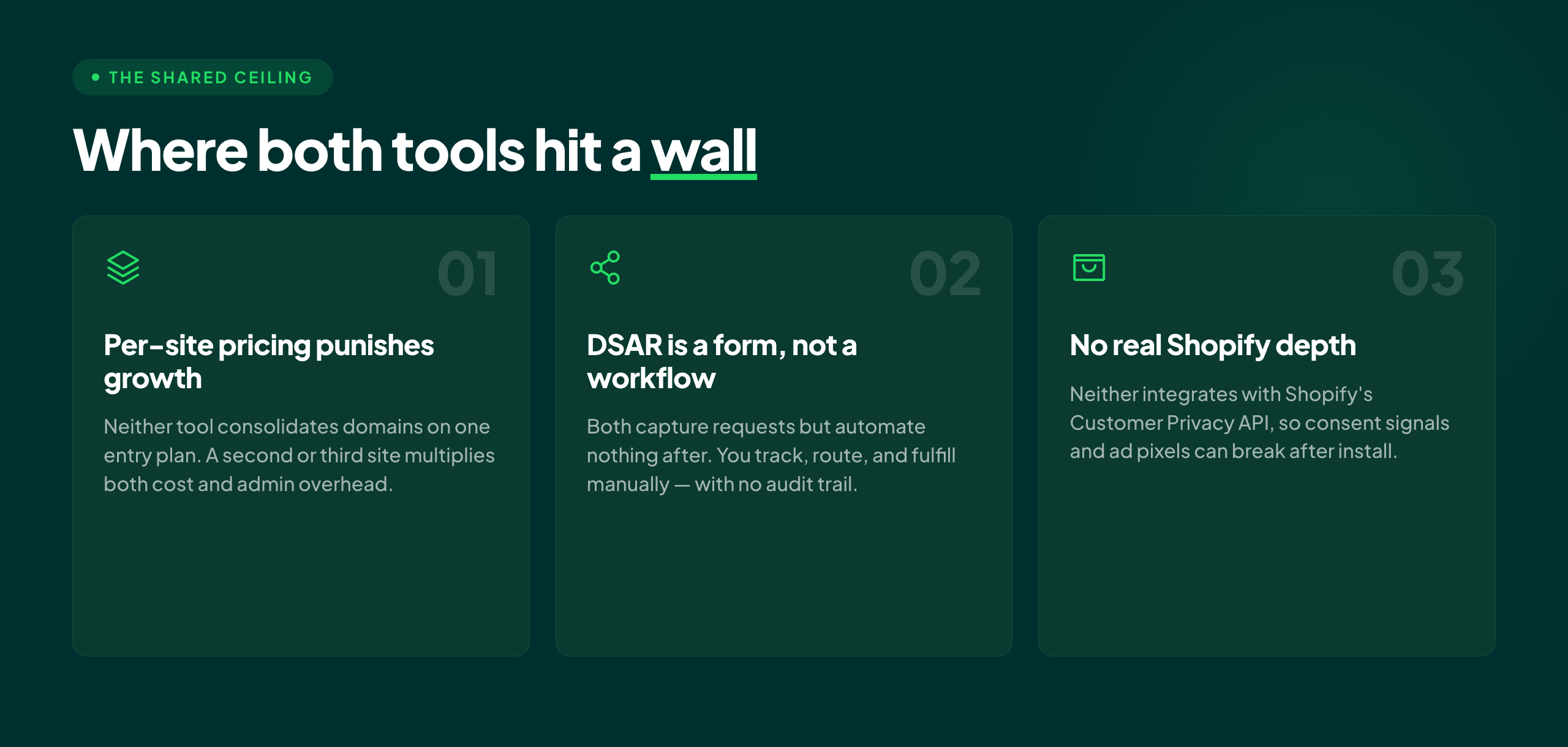
Both tools price per site, handle DSARs as a form rather than a workflow, and lack native Shopify depth. That's the trade-off readers should weigh before committing, and it's exactly the gap a multi-domain platform like Enzuzo is built to close.
1. Per-site pricing punishes growth
Neither tool consolidates multiple domains on a single entry-level plan. Termly only offers multi-domain management on its custom Agency tier, and iubenda has no consolidated multi-domain dashboard at all.
The moment you manage a second or third site, both cost and admin overhead multiply. That's the single most common reason teams outgrow these tools.
2. DSAR is a form, not a workflow
Both tools provide a data subject access request (DSAR) intake form, a box visitors can submit. Neither automates what happens next.
Once a request lands, you track, route, and fulfill it manually, with no audit trail. For any business with real DSAR volume or both California and EU exposure, that manual handling becomes a liability.
3. No real Shopify or e-commerce depth
Neither tool integrates natively with Shopify's Customer Privacy API. Termly has no Shopify app, and iubenda operates at the consent-script layer only.
For merchants who need consent signals wired correctly into their store and ad pixels, that's a meaningful gap. It's a common reason ecommerce stores report EU analytics and remarketing attribution dropping after install.
There's also a jurisdiction asymmetry worth naming. Termly is strong on U.S. state laws but thinner on EU consent signaling, while iubenda is strong on GDPR but thin on U.S. state laws past CCPA basics. Depending on where your traffic lives, one of them is always covering the wrong half of your map.
One issue worth flagging if you care about SEO or Core Web Vitals: iubenda's own help documentation acknowledges that its consent scripts can affect page performance.
The scripts have to load in a specific order and can't be deferred or loaded asynchronously. iubenda publishes mitigation guidance for this, but it's a structural trade-off, not a bug.
For a content site or store where LCP and CLS scores feed your rankings, that's a real consideration. A lightweight, Google-certified banner like Enzuzo's avoids the issue by design.

Enzuzo: the alternative to iubenda and Termly
Termly and iubenda are solid tools but are better suited for smaller businesses without complex needs. Enzuzo is a consent management platform that's a direct alternative to both, built for the buyer who outgrows per-site tools.
The core difference is the pricing model. Where Termly and iubenda charge per domain, Enzuzo's Pro plan covers up to 10 domains for $59/month, billed annually, in a single dashboard.
For a single site, Enzuzo's starter plan still includes DSAR automation and API access that the entry tiers of both competitors lack.
Here's what Enzuzo adds on top of what Termly and iubenda offer:
- Multi-domain on one plan: up to 10 domains, one dashboard, one bill, unified consent state.
- Real DSAR workflow: intake, routing, tracking, and audit trail, not just a contact form.
- Native Shopify integration: wired into Shopify's Customer Privacy API, not a generic script.
- U.S. state law geo-targeting: per-state consent rules covering CCPA, CIPA, and VCDPA, alongside GDPR, certified Google Consent Mode v2, and IAB TCF.
- API and headless support: for teams that need programmatic control.
- Slack-first support: fast, high-touch help instead of a ticket queue.
Enzuzo won't replace iubenda if your single hard requirement is policies in 27 languages. Termly's 10 attorney-drafted document generators also remain a genuine strength for U.S.-only legal paperwork.
But for the larger group of businesses that run more than one site, sell online, or have both U.S. and EU traffic, Enzuzo covers the whole map on one plan. You can read our in-depth iubenda review for a deeper look at that comparison.
Looking to switch away or want to compare your options? Book a strategy call with a product expert to see if Enzuzo is the right fit for your business.
Termly vs. iubenda vs. Enzuzo: Which should you choose?
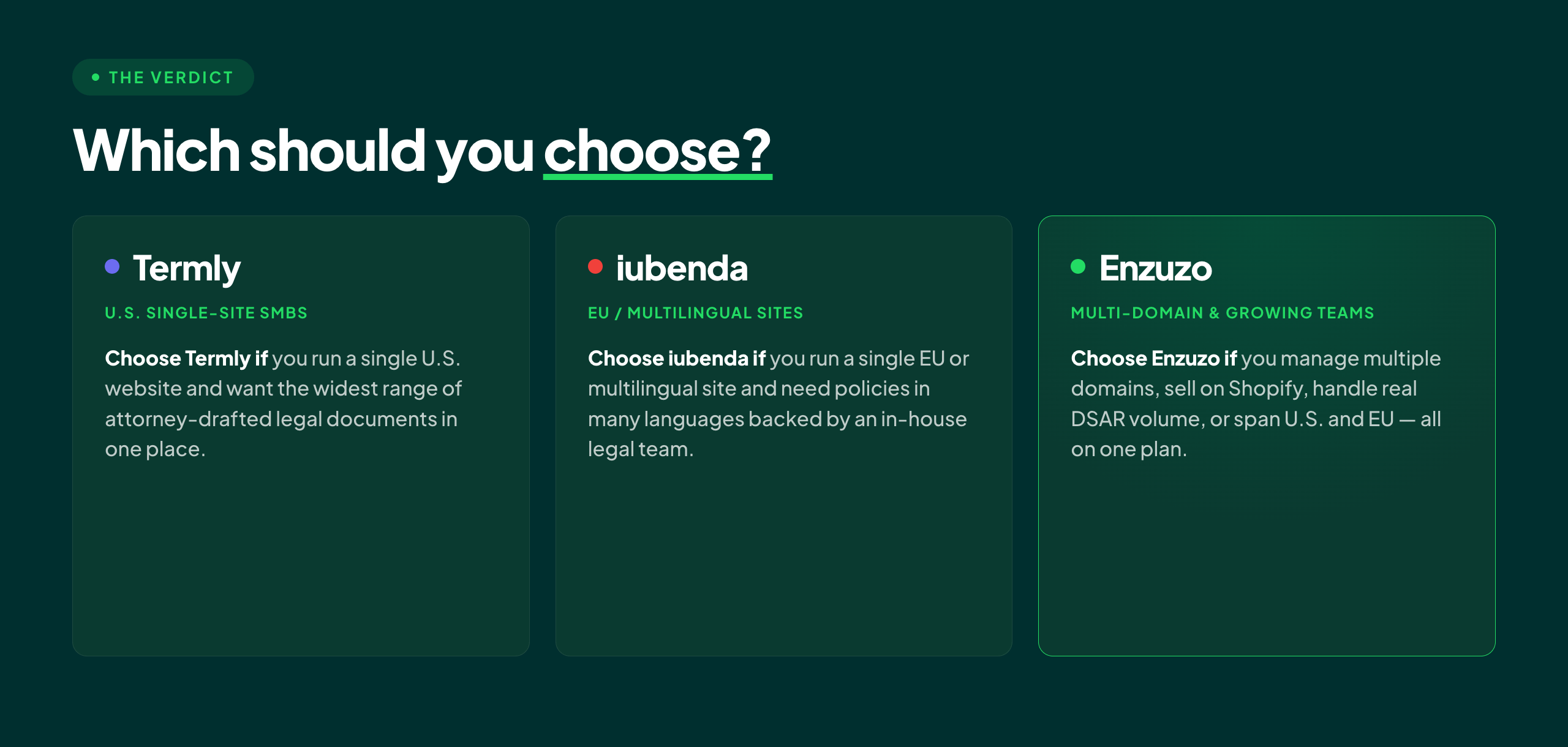
Choose Termly if you run a single U.S. website and want the widest range of attorney-drafted legal documents in one place.
Choose iubenda if you run a single EU or multilingual site and need policies in many languages backed by an in-house legal team.
Choose Enzuzo if you manage multiple domains, sell on Shopify, handle real DSAR volume, or operate across both U.S. and EU jurisdictions, and want it all on one plan instead of paying per site.
Frequently Asked Questions
Is Termly or iubenda better for GDPR compliance?
iubenda has the deeper GDPR and EU pedigree, with stronger multilingual policy support and ISO 27001 certification. Termly covers GDPR but is built U.S.-first. For EU-heavy traffic, iubenda is the stronger of the two; for full GDPR plus U.S. state-law coverage on multiple domains, Enzuzo covers both sides.
Is Termly or iubenda cheaper?
iubenda's entry tier (~$5/month) is cheaper than Termly's (~$10/month) for a single site. Both charge per site, though, so costs converge and then exceed multi-domain platforms as you add domains. At one site, Enzuzo Starter ($9/month) is cheaper than Termly; at 10 sites, Enzuzo Pro ($59/month) is far cheaper than running either tool 10 times.
Does iubenda slow down your website?
iubenda's own documentation acknowledges its consent scripts can impact Core Web Vitals, because they must load in a set order and can't be deferred. iubenda provides mitigation steps, but teams that monitor page speed or rely on SEO often weigh this carefully. Lighter alternatives like Enzuzo avoid the load-order constraint.
Do Termly and iubenda handle DSARs automatically?
No. Both provide a DSAR intake form but no automated routing, tracking, or audit trail. Requests are handled manually after submission. Enzuzo provides a full DSAR workflow.
Can I use Termly or iubenda with Shopify?
Neither integrates natively with Shopify's Customer Privacy API. Termly has no Shopify app, and iubenda runs as a generic consent script. Enzuzo offers native Shopify integration.
What's the best Termly or iubenda alternative for multiple websites?
Enzuzo is purpose-built for multi-domain management, covering up to 10 domains on a single plan and dashboard, versus the per-site model used by both Termly and iubenda.

Osman Husain
Osman is the content lead at Enzuzo. He has a background in data privacy management via a two-year role at ExpressVPN and extensive freelance work with cybersecurity and blockchain companies. Osman also holds an MBA from the Toronto Metropolitan University.