PIPEDA Compliance Requirements (2026): Everything You Need to Know

Osman Husain
PIPEDA compliance lets businesses show they adhere to Canada's federal privacy law. The key tenets focus on responsible handling of personal information: collect it for a stated purpose, use it only for that purpose, protect it, and make it accessible to the person it's about on request.
Compliance with PIPEDA is an ongoing program, not a one-time task. PIPEDA's requirements reach any business handling personal information during commercial activity across Canada, at any size, unless a substantially similar provincial law exists (currently applies to Alberta, British Columbia, and Quebec).
What does PIPEDA require your business to do?
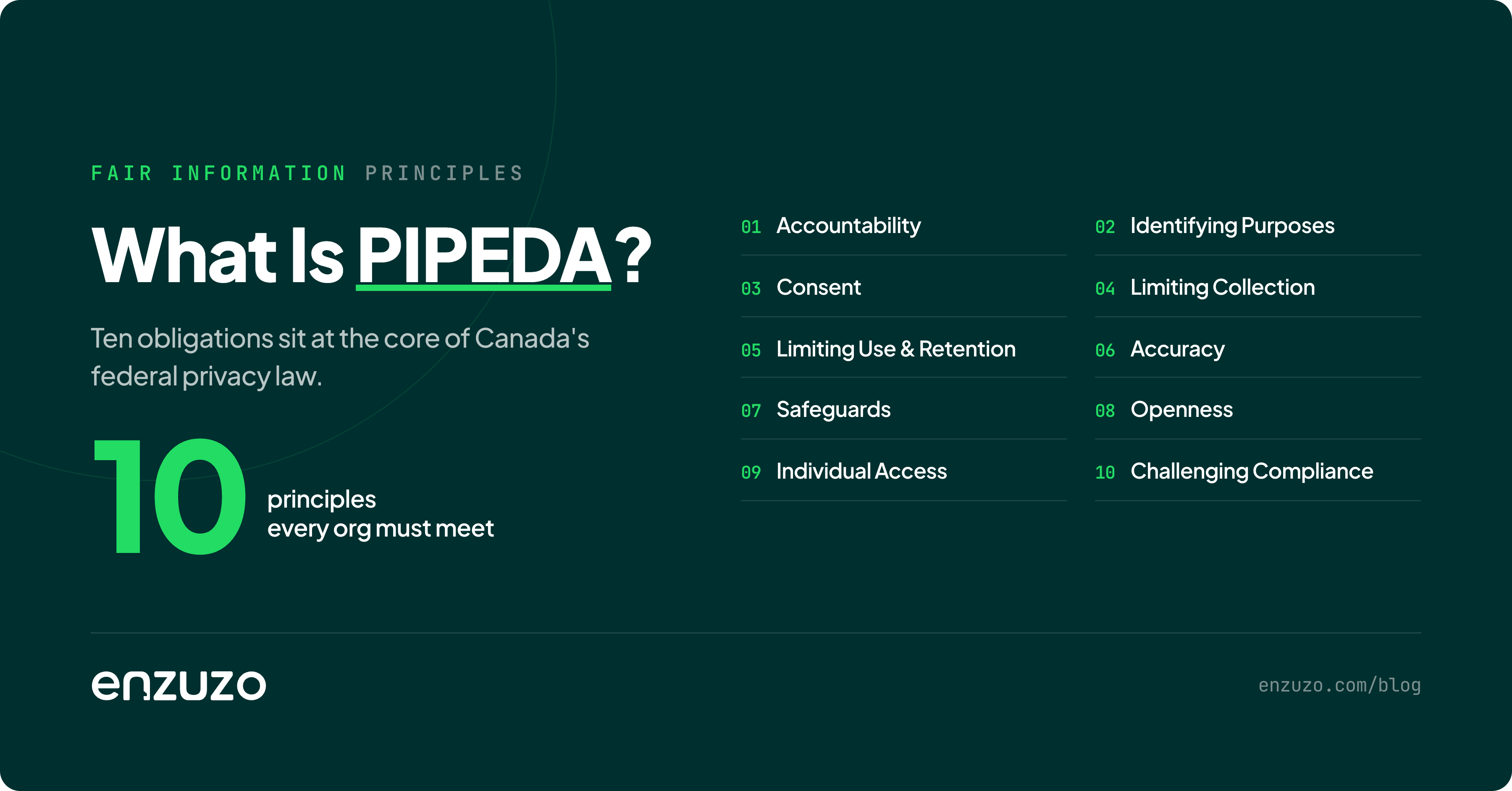
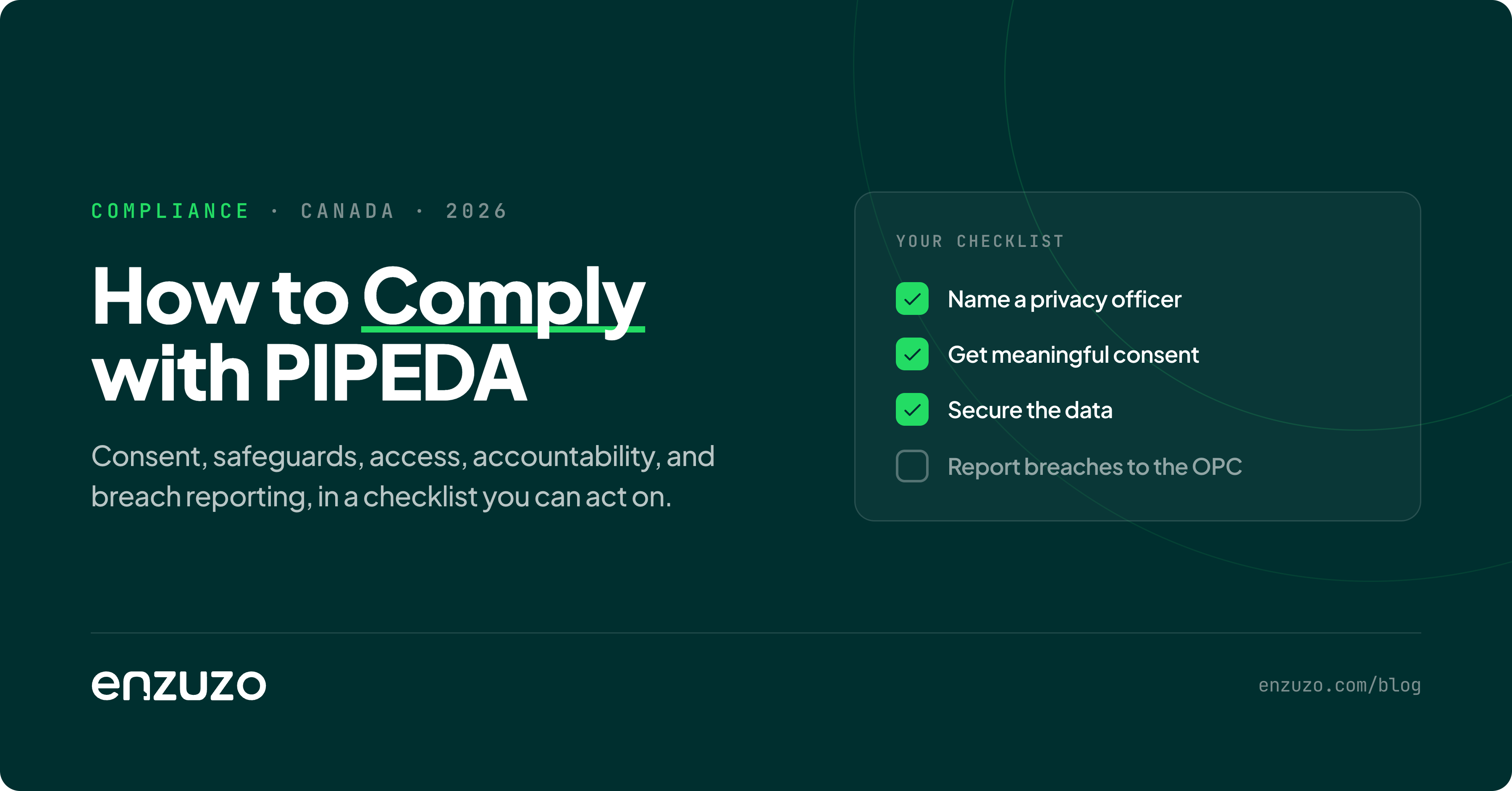
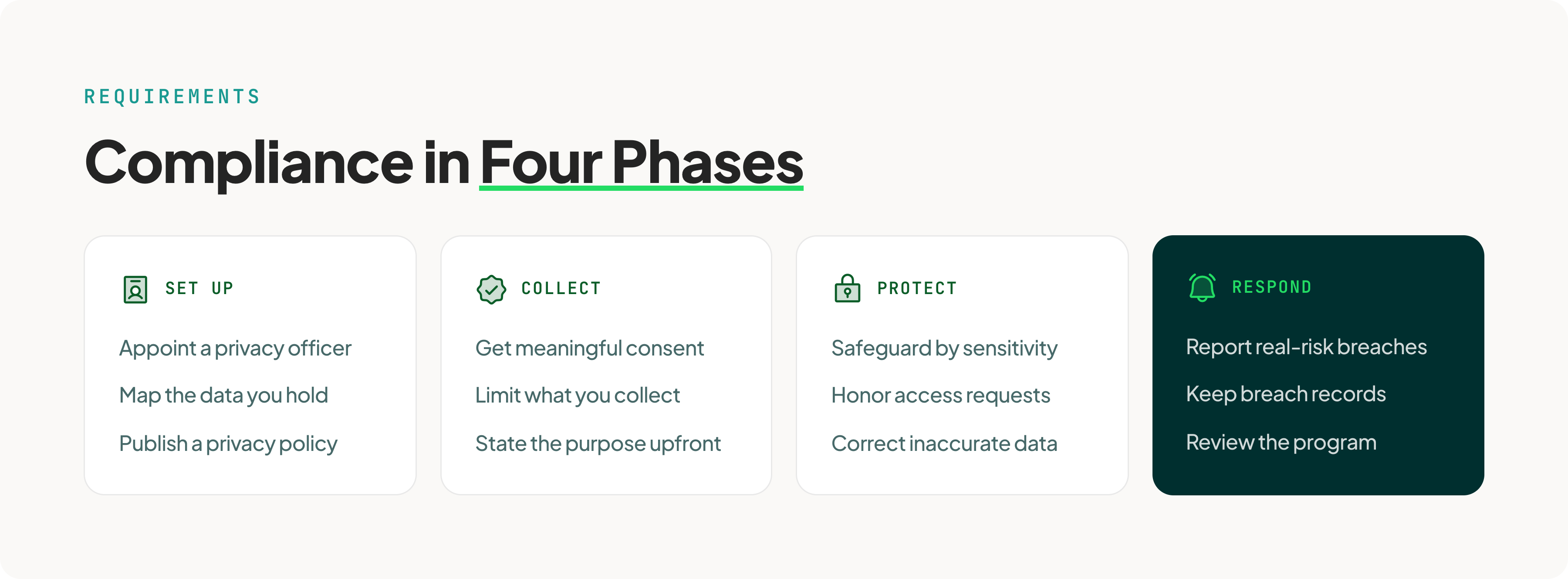
PIPEDA requirements come down to justifying every piece of personal information you hold: why you collected it, what you use it for, how you protect it, and how the person it's about can see it. Each of PIPEDA's ten principles becomes one of the practical duties below.
- Name a privacy lead. One person or team owns your privacy program, including policies, training, complaints, and breach response. You stay responsible for that data even when a vendor processes it for you (accountability principle).
- Identify each purpose before you collect. Collect personal information only for purposes a reasonable person would accept, and only what those purposes need.
- Get meaningful consent. People have to understand what they agree to, and sensitive information needs express consent.
- Limit use and retention. You use information only for the purpose you collected it for, keep it only as long as that purpose needs, then securely destroy or anonymize it.
- Keep it accurate. Anything you use to make decisions about someone must be accurate and current enough for that purpose (accuracy principle).
- Safeguard the data. More sensitive information needs stronger protection: a newsletter signup list and a medical record don't need the same controls (safeguards principle).
- Publish your practices. Your privacy information has to be easy to find and easy to read.
- Answer access and correction requests. A person can ask what you hold and challenge anything wrong. You respond within 30 days (section 8).
- Take complaints. You give people a simple, findable way to challenge how you handle their information, and you look into what they raise (challenging compliance).
- Report breaches. A breach with a real risk of significant harm goes to the Office of the Privacy Commissioner of Canada (OPC) and the people affected. You keep a record of every breach.
What are PIPEDA's consent requirements?
PIPEDA requires meaningful consent: a person has to understand what they agree to before you collect, use, or disclose their personal information (valid consent). The OPC says you have to make four things clear at the point of decision:
- what personal information you collect
- why you collect, use, or disclose it
- who you share it with
- any real risk of harm the person should weigh
The form of consent depends on sensitivity. For sensitive or unexpected uses, you need express, opt-in consent. For less sensitive information, implied consent can be enough, such as an opt-out checkbox a person leaves unticked (meaningful consent).
PIPEDA also bars you from making consent to unrelated collection a condition of getting the product or service (Schedule 1, 4.3.3). A person can withdraw consent at any time on reasonable notice, subject to legal or contractual limits (4.3.8). When someone withdraws, you tell them what that means for the service.
PIPEDA compliance: Step-by-step checklist
Any PIPEDA compliance checklist starts by confirming which law governs your activity and inventorying the personal information you hold, because every later step builds on both. Work each step below against your own systems, in order.
- Confirm which law applies. PIPEDA governs commercial activity across Canada. Alberta, British Columbia, and Quebec have their own private-sector laws that take over inside that province, and four provinces (Ontario, New Brunswick, Nova Scotia, and Newfoundland and Labrador) add their own health-information rules. Personal information that crosses a provincial or national border stays under PIPEDA wherever you are based (who PIPEDA covers).
- Inventory your personal information. List what you hold: what it is, who it came from, why you need it, which systems store it, who can reach it, and which vendors receive it. For higher-risk projects, a privacy impact assessment documents this inventory and its risks before launch.
- Tie each field to a purpose. Give every category of data a documented reason, and collect only what that purpose needs. If your team can't say why a field is needed, stop collecting it.
- Set up meaningful consent. Ask for consent at the moment it is relevant, in plain language, with express opt-in for anything sensitive. Give people a clear way to withdraw it.
- Set retention and deletion rules. Set how long you keep each category of data, then delete or anonymize it when that time passes.
- Keep information accurate. Check that anything you use to make decisions about a person stays accurate and current enough for the purpose.
- Apply safeguards that match sensitivity. Protect data with access controls, encryption, and monitoring scaled to how sensitive it is.
- Publish your privacy practices. Make a privacy policy people can find and understand, covering the five openness disclosures.
- Build access and complaint processes. Give people a route to see their information, correct it, and complain, and give your team a way to answer within 30 days.
- Vet vendors and transfers. Assess any processor before you share data, and put privacy, security, and retention terms in the contract. The contract should cover what the vendor may use the data for, its safeguards, how fast it tells you about a breach, and what happens to the data when the deal ends. A processor outside Canada is allowed, but the duty to protect the data stays with you.
- Prepare for breaches, then train and test. Document how you assess and report a breach, keep a record of every one, train anyone who touches personal data, and rehearse the plan.
How do you handle a PIPEDA access request?
You're obliged to respond to PIPEDA access requests within 30 days of receiving one, according to section 8 of the law. Data subjects can ask what data you hold, how you have used it, and who you shared it with. Responses must be in a widely understood format.
Businesses can extend the deadline by up to 30 days for complicated requests. However, people must be informed and kept up to date with the new deadline, the reason, and reminded of their right to complain to the Commissioner. All access requests must be free of cost, with a nominal fee charged only when there are reasons to do so.
Some information is exempt, such as anything that would reveal another person's personal information or is covered by solicitor-client privilege, meaning confidential communications with your lawyer.
Silence counts as a refusal, so a missed deadline gives the person grounds to complain to the Commissioner (section 8(5)). Knowingly destroying it is an offence.
Does PIPEDA require a privacy policy?
PIPEDA requires you to make your practices available in plain language, and a published policy is how businesses meet that duty. The openness principle sets out five things you have to disclose (Schedule 1, 4.8.2):
- the name or title and contact information of the person accountable for your privacy practices
- how a person can get access to the information you hold about them
- a description of the personal information you hold and what you use it for
- any brochures or other material that explain your policies and practices
- what personal information you make available to related organizations, such as subsidiaries
PIPEDA compliance for SaaS, ecommerce, and remote teams
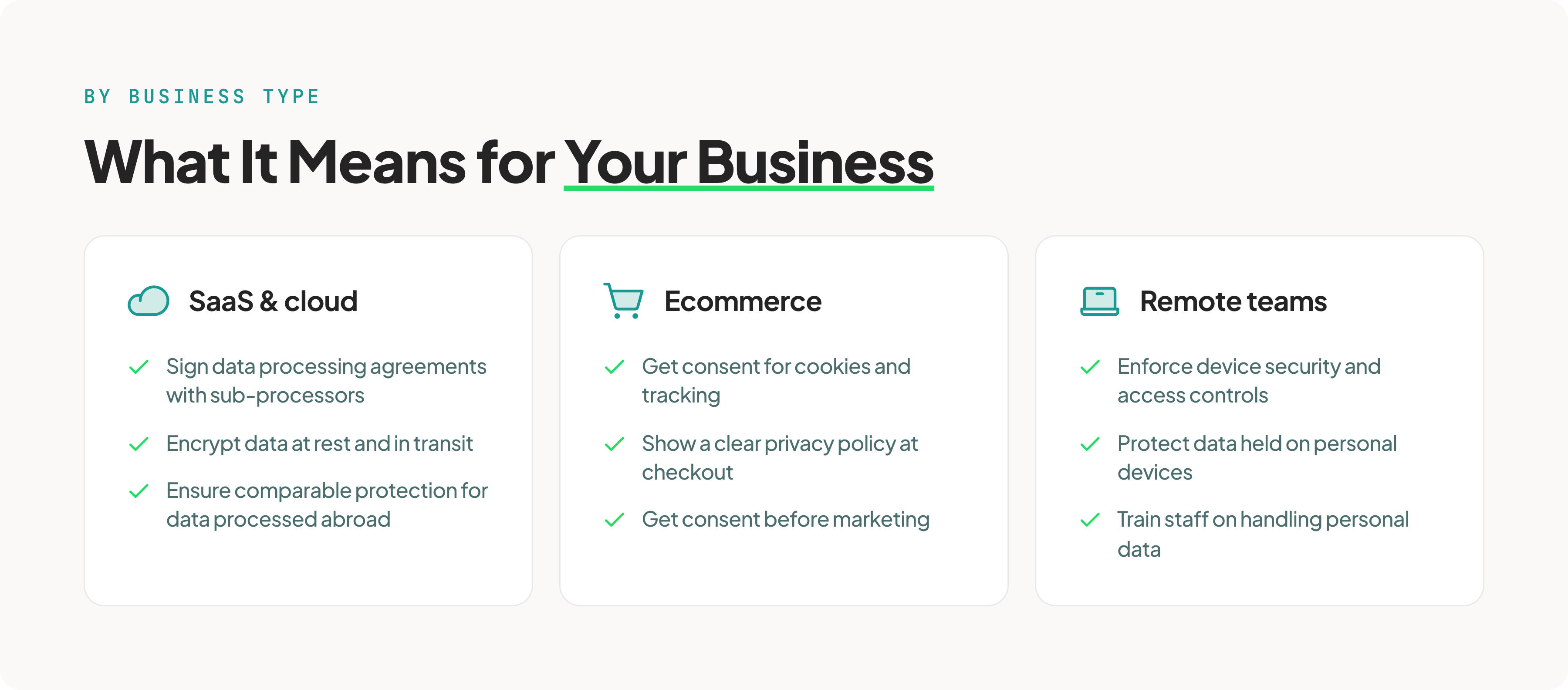
PIPEDA applies the same principles to every business, but the practical work differs by business model.
SaaS companies often handle personal information on behalf of users. When processing personal data, businesses stay accountable for it under PIPEDA's accountability principle, so the key documents here are data processing agreements with sub-processors, data encryption, and safeguards for international data transfers.
Ecommerce stores handling payment details, addresses, and purchase history call for stronger safeguards and for clear consent before reusing data for marketing. Cookie consent banners with audit trails are key here. Email marketing also falls under CASL, Canada's anti-spam law, which sets its own consent rules for commercial messages.
For remote teams, the safeguards follow the data to home networks and personal devices. Access controls, encryption, and clean offboarding matter most.
PIPEDA requirements for small businesses
PIPEDA sets no revenue or headcount threshold, so a two-person shop follows the same principles as a national bank. The obligation is the same at any size. The effort scales with the sensitivity and volume of the data you handle: a business holding health or payment records needs stronger safeguards than one keeping a mailing list.
For most small businesses that means a short, honest privacy policy, a clear reason for every field you collect, reasonable security on the systems that hold it, and a plan for access requests and breaches.
PIPEDA breach notification requirements
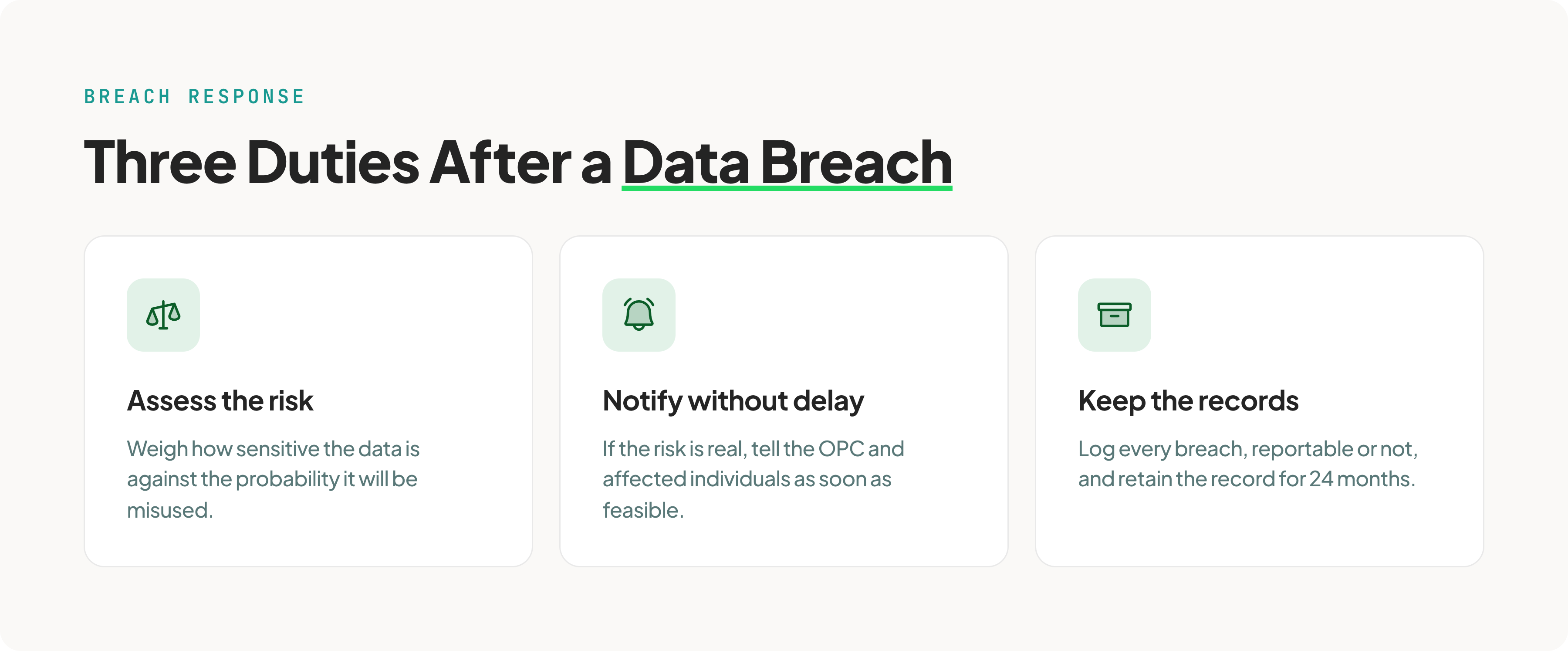
PIPEDA requires you to report a breach to the OPC and notify the people affected when it's reasonable to believe the breach creates a real risk of significant harm (section 10.1). Risk is assessed on two factors: how sensitive the information is, and how likely it is to be misused.
Both the breach report and the notifications should go out as soon as possible after breach detection, but PIPEDA does not set a strict deadline.
Significant harm is defined broadly. It includes identity theft, financial loss, humiliation, damage to reputation or relationships, lost job or business opportunities, and harm to a credit record.
When you notify individuals, you also notify any other organization or government body that can reduce the harm, such as a bank or credit bureau (section 10.2).
Every breach of security safeguards, reportable or not, goes into a record you keep for at least 24 months and hand to the Commissioner on request (section 10.3).
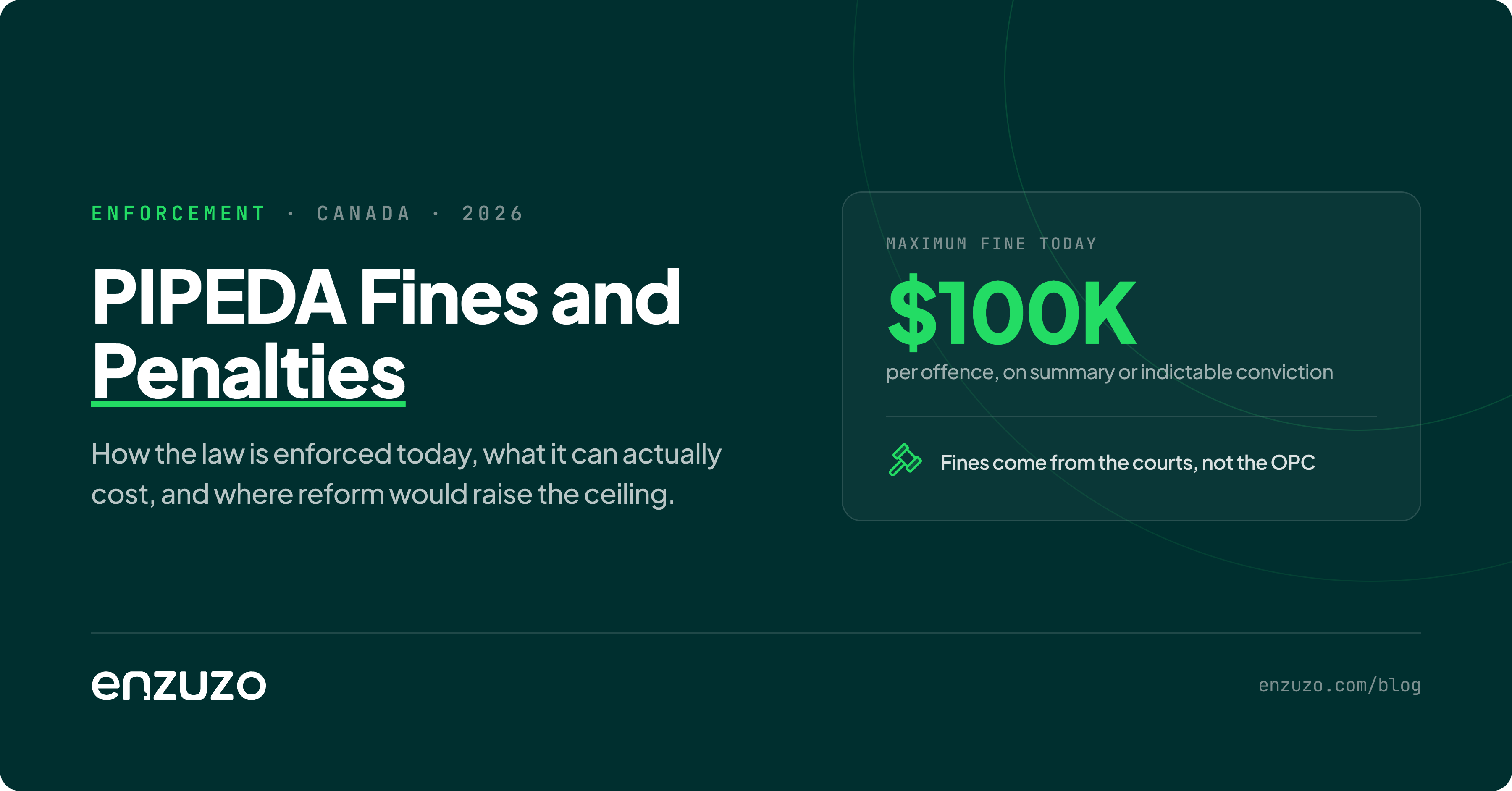
Knowingly failing to report a qualifying breach, or to keep these records, is an offence carrying a fine of up to $100,000, or up to $10,000 when a court prosecutes it as a lesser, summary offence.
Is there a PIPEDA certification?
PIPEDA has no official certification. The Office of the Privacy Commissioner of Canada doesn't certify, accredit, or approve organizations as compliant, and the Act contains no certification scheme.
You demonstrate PIPEDA compliance through your own privacy program and the records behind it: your policy, your consent flows, your breach log, and your responses to access requests. Vendors sell PIPEDA training and audit certificates, and those can help you build that program, but none of them carries weight with the regulator.
Enzuzo helps you meet PIPEDA consent and data request rules
Capturing consent and answering access requests are the two PIPEDA duties that repeat with every visitor and every request.
Enzuzo's consent management platform captures and records consent on your website, so you can show what a visitor agreed to and when. Its data request form gives people a route to ask what you hold, and gives your team one place to log and answer each request inside PIPEDA's 30-day window.
Book a demo with a PIPEDA compliance expert to learn more.
Frequently asked questions
What happens if a business violates PIPEDA?
The Office of the Privacy Commissioner of Canada investigates complaints and can take a matter to Federal Court. The court can order a business to change its practices and pay damages, including for humiliation. Separate fines of up to $100,000 apply for knowingly failing to report a breach.
Are business email addresses personal information under PIPEDA?
Yes, a work email is personal information, but PIPEDA doesn't apply to business contact details (name, title, work address, work email) used only to reach someone in their professional role (section 4.01). PIPEDA starts applying to that same address the moment you use it for anything else, such as marketing profiling.
Does PIPEDA require consent to use cookies?
Yes, PIPEDA requires consent when a cookie collects personal information, such as an identifier tied to a person. Routine analytics can rely on clear notice and an easy opt-out, while a detailed advertising profile calls for express opt-in. Either way, the visitor has to understand what the cookie does under the spirit of meaningful consent.
How long must I keep records of a data breach under PIPEDA?
You keep a record of every breach of security safeguards for at least 24 months after you determine the breach occurred, whether or not it was serious enough to report. The Commissioner can ask to see those records at any point, so the log covers every breach, including the ones that fell below the reporting threshold.
Osman Husain
Osman is the content lead at Enzuzo. He has a background in data privacy management via a two-year role at ExpressVPN and extensive freelance work with cybersecurity and blockchain companies. Osman also holds an MBA from the Toronto Metropolitan University.
LinkedIn →More related blogs
Your next read