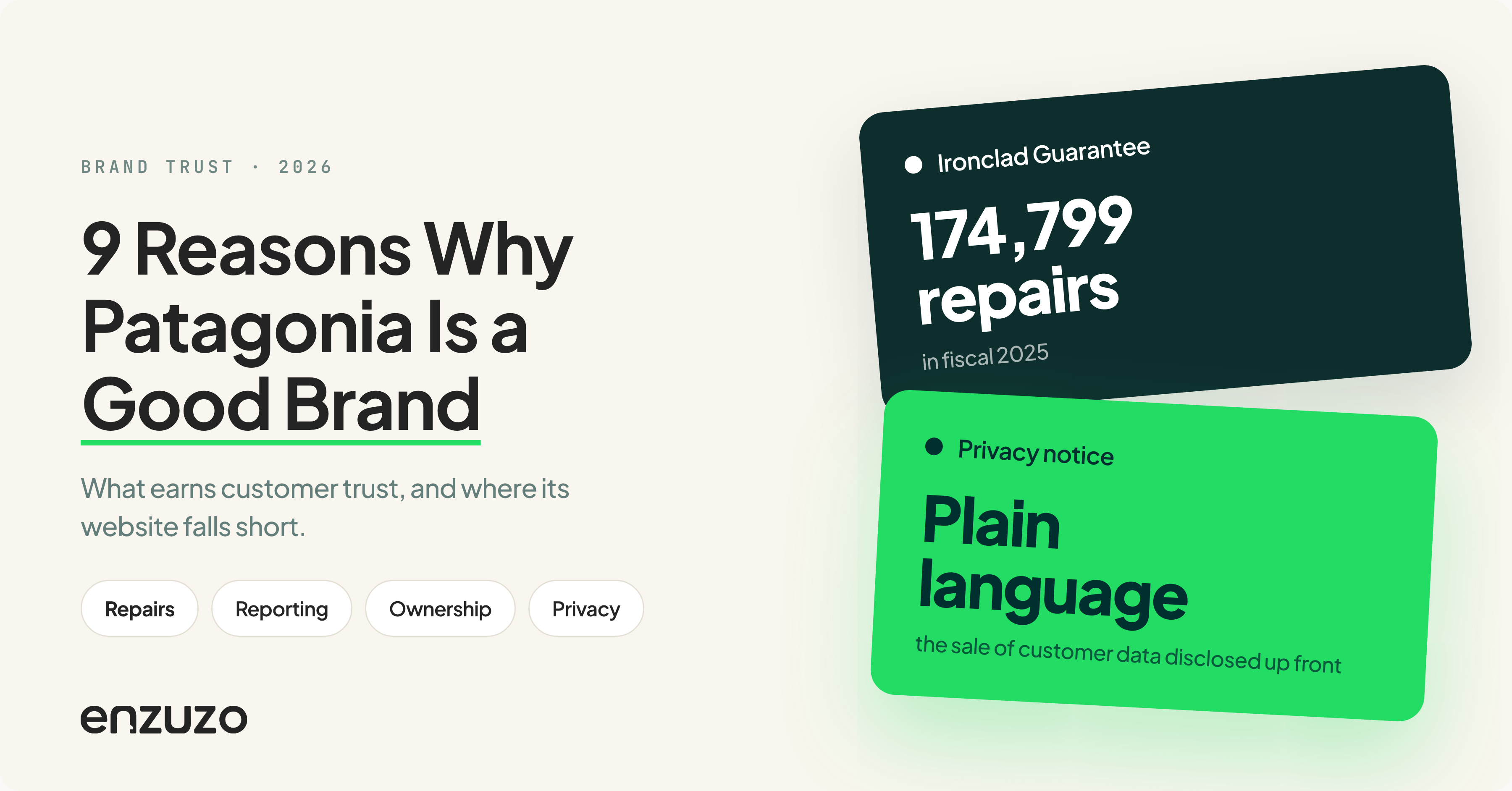
Patagonia is widely considered a good brand, known for repairable outdoor gear and a transparent business. It guarantees everything it makes, repaired 174,799 products in 2025, and has given 1% of sales to environmental groups since 1985.
Patagonia ranked 10th of 100 companies in the 2026 Axios Harris Poll 100 and first on ethics. Its drawbacks are premium prices and supply-chain and environmental problems it's still working on.
What is Patagonia?
Patagonia is an American outdoor apparel company that runs its environmental work through the business itself, from the products it designs to how it distributes profits. Its range goes past jackets and fleece into baselayers, packs, wetsuits, and food sold under the Patagonia Provisions label.
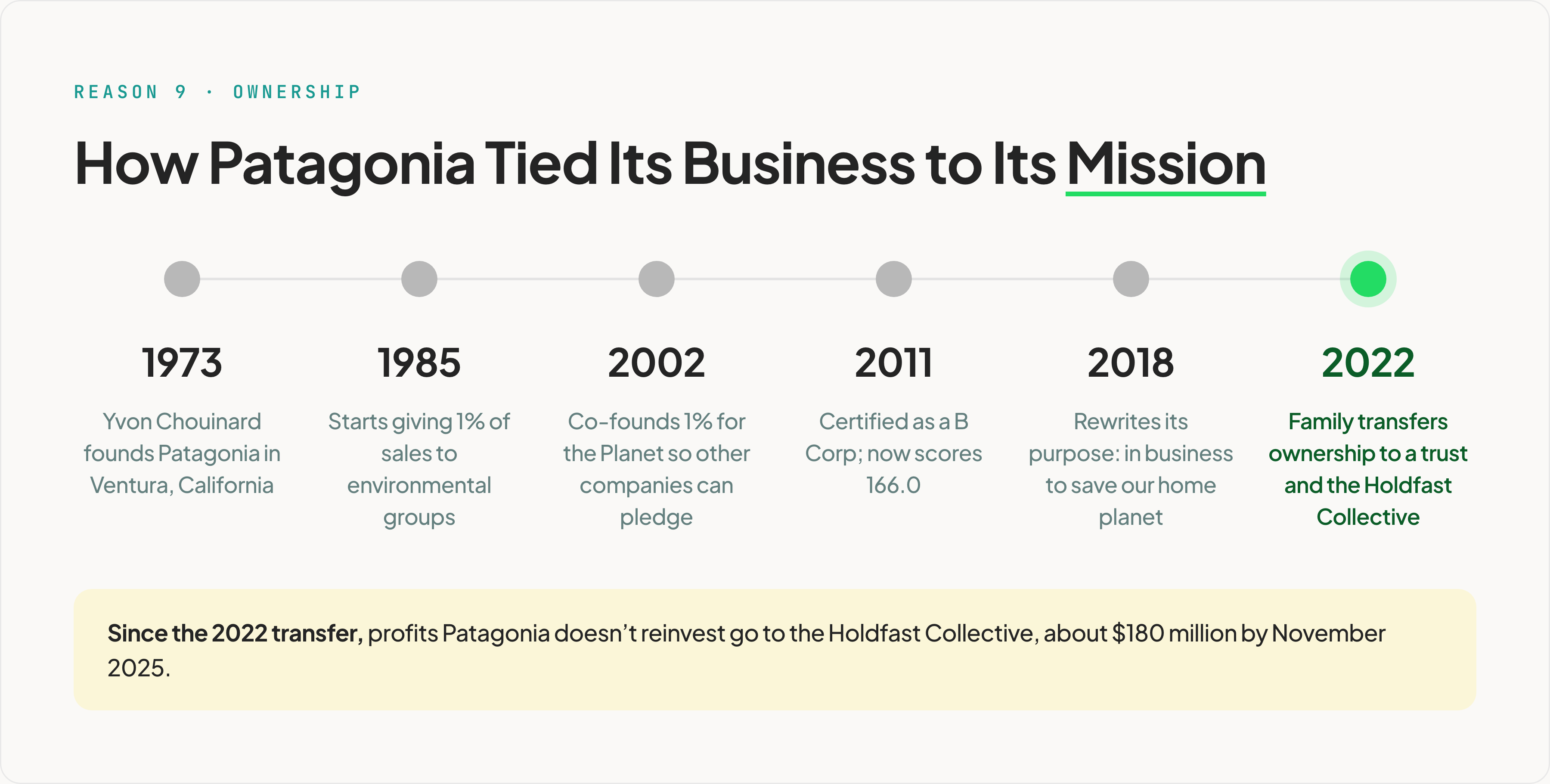
Patagonia is known less for a single product than for how it does business. In his 2022 ownership letter, Yvon Chouinard wrote that he started as a craftsman making climbing gear for his friends, then moved into apparel. In 2018, the company rewrote its purpose as one line: "We're in business to save our home planet."
Patagonia's core values put quality first, asking for products that are "useful, versatile, long-lasting, repairable and recyclable." The same page defines integrity as making sure "our actions match our words."
Why is Patagonia a good company?
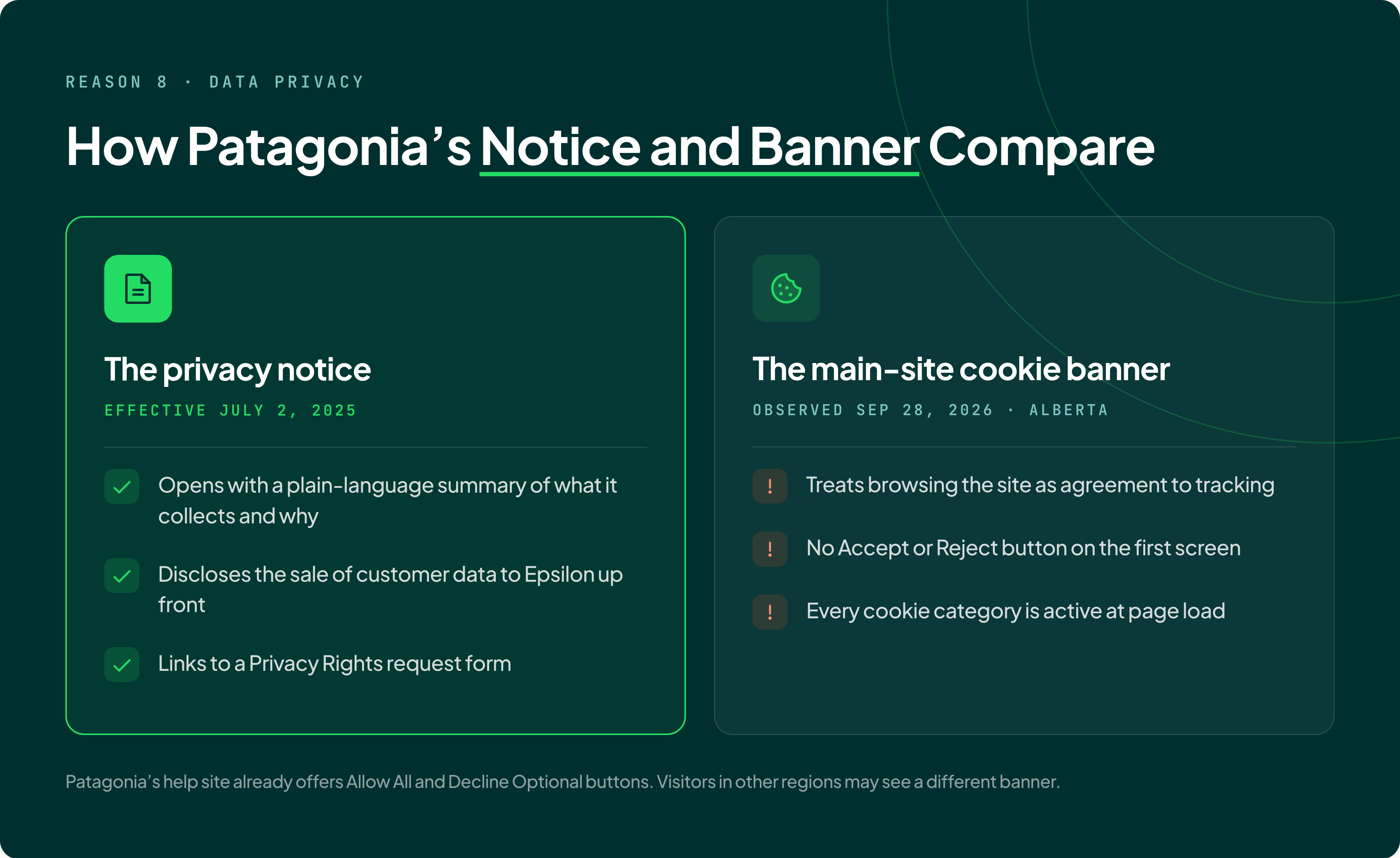
Patagonia is a good company in large part because it puts its least flattering facts up front, even in its privacy notice. The notice's opening summary says: "We 'sell' your name, mailing address, and purchase history to a marketing cooperative named Epsilon." Leading with the uncomfortable detail is a pattern across the company. It's a large part of why customers trust Patagonia.
Patagonia's candor extends to its guarantee, its environmental reporting, and its ownership. The cookie banner on patagonia.com is less open than the notice behind it, because it treats browsing the site as an agreement for tracking.
| Fact | Patagonia |
|---|---|
| Founded | 1973, by Yvon Chouinard |
| Headquarters | Ventura, California |
| What it sells | Outdoor clothing, packs, and gear, plus food under the Patagonia Provisions label |
| Ownership | Patagonia Purpose Trust (all voting stock, 2%) and the Holdfast Collective (all nonvoting stock, 98%), since September 2022 |
| Certification | Certified B Corp since December 2011, with a B Impact score of 166.0; California benefit corporation since January 2012 |
| Price positioning | Premium, not luxury |
| Giving | 1% of sales since 1985; $240 million in environmental grants since its founding, per its progress report |
| Reputation | No. 1 in the Axios Harris Poll 100 in 2021 and 2023; 10th in 2026, and first on ethics that year |
9 reasons why Patagonia is such a good brand
People trust Patagonia because its actions match its words. That shows in its returns, repairs, environmental reporting, giving, data practices, and ownership, and customers can check each one.
1. It offers easy return policies
Patagonia's return policy sets no time limit on returns of items bought from Patagonia. The company's returns page puts the idea in its own words: "At Patagonia, our business is building the best product. If something isn't working for you, we want to help."

Returns for fit or color should be in new condition with tags attached. Items returned after more than a year, or without a receipt, are reviewed under the Ironclad Guarantee and may get merchandise credit or a discount code. Patagonia recommends a $7 printable label for online returns and waives the fee for merchandise credit.
2. It provides DIY repair and care guides
Patagonia publishes DIY repair and care guides so customers can fix gear themselves. The guides cover jobs such as replacing a zipper slider or patching insulation. Patagonia backs them with a repair operation that fixed 174,799 products worldwide in its 2025 fiscal year.

Patagonia's Reno, Nevada, repair center alone fixed more than 40,000 garments in 2024, according to its footprint page. The point of both is the same: gear that gets repaired stays out of landfills and keeps working for its owner.
3. The Patagonia Ironclad Guarantee builds trust
Patagonia's Ironclad Guarantee covers everything the company makes. A product that disappoints on arrival or in use can go back for a repair, a replacement, or a refund.

The guarantee has one clear limit: damage from normal wear and tear gets repaired for a reasonable charge, so a worn jacket can still be fixed and worn again.
4. Patagonia's Worn Wear selection lowers prices
Worn Wear, Patagonia's used-gear program, resells gear after its first owner is done with it. In the U.S., customers can trade in clean, working Patagonia clothing and packs by mail or in Patagonia-owned stores. Most items earn about 20% of their original price in credit. The gear then goes on sale again through Worn Wear.
Patagonia has even asked customers to buy less. On Black Friday in 2011, it ran a New York Times ad headlined "Don't Buy This Jacket," asking shoppers to think twice before buying anything. Worn Wear puts the same idea into practice.
5. Patagonia champions environmental activism
Patagonia has given 1% of sales, not profits, to environmental groups since 1985, a practice it calls an Earth tax. In 2002, Yvon Chouinard and Craig Mathews founded 1% for the Planet so other companies could make the same pledge.
Patagonia's activism goes past writing checks. Its Action Works platform connects people with the grassroots groups Patagonia funds, through events, petitions, skilled volunteering, and donations. The platform drove more than 1 million actions for those groups in fiscal 2025.

6. It supports philanthropic efforts
Patagonia's environmental grants total $240 million since its founding. In fiscal 2025 alone, it gave $14.7 million in grants and in-kind support to 824 nonprofits.
Patagonia also gives time, not only money. Its employees logged 27,000 hours of paid volunteering in fiscal 2025. Skills-based volunteering saved Patagonia's grantees $2.4 million that year, according to its progress report.
7. Patagonia actively tries to reduce its eco-footprint
Patagonia publishes its environmental numbers, including the ones that went the wrong way. More than 90% of its styles use recycled inputs. In the 2025 fiscal year, 93% of its polyester and 89% of its nylon were recycled, as Trellis reported from the company's first impact report. All of its virgin cotton has been organic since 1996, and all of its down is responsibly sourced.
Patagonia's reporting also covers the factories that make its products. More than 90% of the line is made in Fair Trade Certified factories, where a premium on each item goes to a fund the workers control. In fiscal 2025, 39% of Patagonia's factories paid a living wage. Regenerative Organic Certified cotton made up 17% of its cotton that year, up from none in 2019, Forbes reported.

Patagonia's numbers also show where it has further to go. Preferred materials made up 86% of the Fall 2025 line by weight, against a goal of 100% by 2025. Total emissions reached 182,646 metric tons of CO2e in fiscal 2025, a slight rise from the year before, per Trellis. The company's climate goals, validated by the Science Based Targets initiative, call for net zero by fiscal 2040.

8. It explains its customer and data privacy practices in plain language
Patagonia tells customers in plain language what data it collects and why. Its privacy notice, effective July 2, 2025, opens with a short summary. The notice says readers came for clarity, "not to decode a legal chronicle of oxford commas and clauses."
That summary lists the data collected (name, email, and mailing address) and the main reasons: to deliver orders, take back returns, repair gear, improve the website, and market products and campaigns.
Patagonia's privacy notice links to a Privacy Rights request form for requests such as opting out of the Epsilon sale. The Do Not Sell or Share My Data button in each page footer opens the cookie settings panel, which points to the same form. The newsletter sign-up links to a separate Notice of Financial Incentive.
9. Patagonia's founder donated the company to fight climate change
Yvon Chouinard and his family gave Patagonia away in September 2022, in a transfer of ownership that sends the company's profits to environmental work. The Patagonia Purpose Trust took all voting stock, 2% of the company, and the Holdfast Collective, a nonprofit, took the nonvoting 98%. Profits the company doesn't reinvest now go to Holdfast as a dividend.
Patagonia sums up the change as "Earth is now our only shareholder." The company had paid about $180 million to Holdfast by November 2025, according to Fast Company. It was valued at about $3 billion at the time of the transfer, CNBC reported, and the gift took the form of the family's shares.
Is Patagonia good? Absolutely: it cares about customer trust
Patagonia is a good brand by the measures customers can check: its guarantee, its repairs, its published environmental record, and an ownership structure that sends profits to climate work. The cookie banner on its main site is the gap, and it's also the lesson that carries over most directly to other brands.
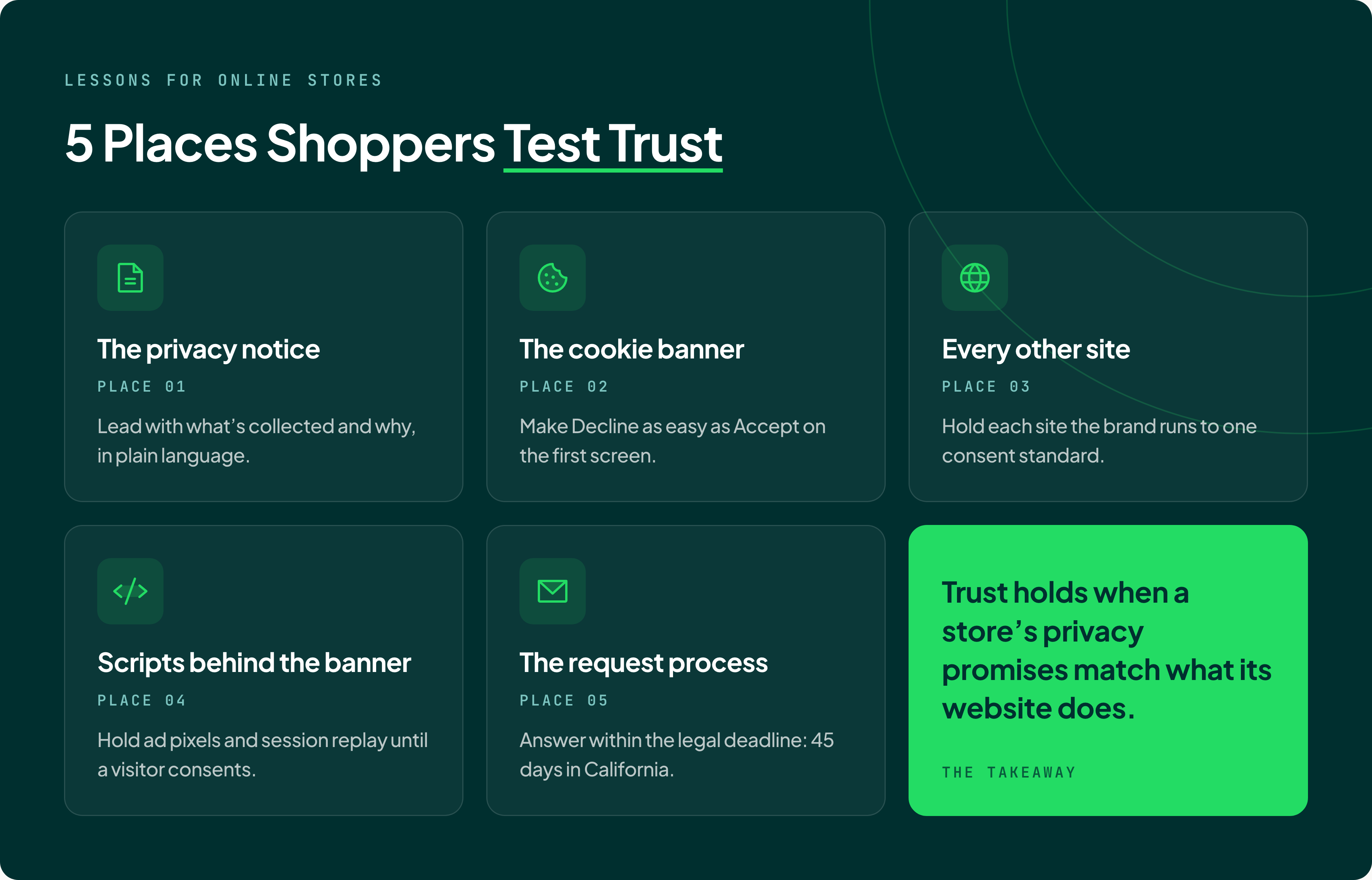
Customer trust holds only when a store's privacy promises match what its website does. If you run an online store, shoppers can test that match in five places:
- The privacy notice
- The cookie banner
- Every other site the brand runs
- The scripts behind the banner
- The request process
Is Patagonia ethical?
Patagonia is widely regarded as an ethical company, and its record includes transparency on supply-chain and chemical problems. Americans ranked it first of 100 companies on ethics in the 2026 Axios Harris Poll 100, and its B Impact score of 166 is more than double the 80 points that B Corp certification requires.
The ethical-fashion rater Good On You also rates Patagonia highly. Its rating, last updated April 2, 2026, scores the brand 4 out of 5 for planet, people, and animals.
Audits of Taiwanese fabric mills in 2012 found that migrant workers had paid labor brokers high fees to get their jobs, which Patagonia puts at up to $7,000. Patagonia published the findings, set a No Fees by 2020 goal, and says fees were widely eliminated in its supply chain by 2020.
For years, Patagonia's water-repellent gear used PFAS, a family of long-lasting chemicals. It first used a long-chain form, then a shorter-chain version that later research also linked to harm. Patagonia says that from Spring 2025, 100% of its new products are made without intentionally added PFAS. The pledge covers new products, so gear made before Spring 2025 may still carry the older treatments.
A 2023 Follow the Money investigation found Patagonia using some of the same factories as fast-fashion brands, including one in Sri Lanka with poor conditions. Patagonia's progress report also says about 85% of its products didn't have an end-of-life solution as of fiscal 2025.
Patagonia published the migrant-labor, PFAS, and end-of-life problems on its own pages, and its impact report quotes the Follow the Money criticism directly.
How does Patagonia's cookie banner compare with its privacy notice?
Patagonia's cookie banner is less open than its privacy notice. On September 28, 2026, a visitor in Alberta, Canada, saw this banner text: "By visiting our website you agree to the use of first and third-party tracking technologies, such as cookies." Its first screen offered a Change Preferences button and a close icon, with no button to accept or to reject.
The preferences panel behind that button lets visitors turn optional cookies off, but every cookie category, targeting and social media included, was active as soon as the page loaded.
Before any choice was made, the page had already loaded a session-replay tool, which records how a visitor moves through the site, and advertising pixels from TikTok, Snapchat, Pinterest, Reddit, and The Trade Desk.
Canada's federal privacy law, PIPEDA, is overseen by the Office of the Privacy Commissioner. Its behavioural advertising guidance says opt-out consent for ad tracking can be reasonable under conditions:
- The purposes are clear and not buried in a privacy policy.
- People are told at or before the time of collection.
- The opt-out is easy, takes effect immediately, and lasts.
- The data is limited to non-sensitive information.
Visitors in the EU or California may see a different banner from the one shown in Alberta.
Patagonia's help site, help.patagonia.com, already runs a banner with Allow All and Decline Optional buttons, a clearer choice than the main store's banner offers. Measured against Patagonia's own integrity value, the gap is consistency: the notice leads with the hard truth, and the main-site banner assumes the answer.
Why does a plain-language privacy notice build trust?
A plain-language privacy notice builds trust because shoppers can find the most sensitive fact without reading the whole document. Patagonia's notice leads with what it collects, why, and the sale to Epsilon, and only then gets into detail. A short summary on top of the full notice gives shoppers the answer without hiding the rest.
Enzuzo's privacy policy generator is one way to produce the full notice underneath that summary. Writing the summary by hand keeps it in the brand's own voice.
Why should a cookie banner make rejecting as easy as accepting?
A cookie banner that makes rejecting as easy as accepting lets shoppers answer either way in one click. When the first screen treats browsing as agreement, or pairs Accept with only a Preferences link, the default answer is yes. California's privacy regulations use this example: under § 7004, a banner offering only Accept All and Preferences isn't a symmetrical choice, while Accept All and Decline All is.
The same section of California's rules says a Yes button that's larger or more eye-catching than the No button isn't a symmetrical choice either. Rules in other regions vary, however.
Enzuzo's consent management platform can show a Decline button next to Accept on the banner's first screen. Enzuzo recommends keeping it switched on for visitors covered by the GDPR.
Enzuzo's banner can also switch between opt-in, opt-out, and hidden by country or region, starting on the Growth plan. More layouts appear in Enzuzo's cookie banner examples.
How can a brand keep one consent standard across all its sites?
A brand keeps one consent standard by checking every site it runs against the same banner rules. Patagonia's help site already shows Allow All and Decline Optional side by side, while the main store's banner doesn't. To a shopper, both banners carry the same brand's name.
Brands that run more than one site (a store, a help center, a blog, a regional domain) can list every site that sets cookies. Each one then gets checked against the same banner wording, the same default settings, and the same rules for when scripts may load. Writing that standard down once makes it easier to apply when a new site launches.
Online stores that honor Global Privacy Control respect an opt-out the shopper has already set once, in the browser. GPC is a browser setting that tells every site a shopper visits not to sell or share their data. California's privacy regulations, under § 7025, require businesses that sell or share personal information to treat an opt-out preference signal such as GPC as a valid request to opt out.
On Pro and Enterprise plans, Enzuzo can detect a visitor's Global Privacy Control signal and automatically opt them out of non-essential services and cookies once GPC support is turned on.
How can online stores make privacy requests easy to send?
Online stores can make privacy requests easy to send by putting a request form one click from the privacy notice, as Patagonia does with its Privacy Rights request form. Handling each request then takes three steps: confirming the shopper's identity, answering within the legal deadline, and keeping a record of the response.
Under California's regulations, § 7021 sets that deadline at 45 calendar days, and a business must confirm it received the request within 10 business days.
Enzuzo's DSAR software adds a data subject access request form to a site, and each request can be viewed and answered from the Enzuzo dashboard.
Frequently asked questions
Is Patagonia a luxury brand?
Patagonia is a premium outdoor brand, not a luxury brand. Its prices are near the top of outdoor clothing, but luxury labels sell scarcity and status, while Patagonia sells technical gear built for heavy use. The company's case for the price is cost per wear: a higher price spread over years of use and repair.
Is Patagonia worth the money?
Patagonia is worth the money for buyers who keep gear for years, because the company repairs its products and buys them back for credit. Wear-and-tear repairs carry a reasonable charge. Returns after a year or without a receipt may get merchandise credit instead of cash. Buyers who replace clothes every season get less value from those programs.
Is Patagonia good quality?
Patagonia is rated highly for quality. In the 2026 Axios Harris Poll 100, Americans ranked it 5th of 100 companies on products and services. Its gear is backed by repairs when it wears out. The Reno, Nevada, repair center fixed more than 40,000 garments in 2024. The Ironclad Guarantee covers products that don't perform.
Who owns Patagonia?
The Patagonia Purpose Trust and the Holdfast Collective have owned Patagonia since September 2022, when founder Yvon Chouinard and his family transferred their shares. The trust holds all the voting stock, which is 2% of the company, and Holdfast, a nonprofit focused on the environmental crisis, holds the nonvoting 98%. Profits that aren't reinvested go to Holdfast.
Is Patagonia an American company?
Patagonia is an American company, founded by Yvon Chouinard in 1973 and headquartered in Ventura, California. It's registered as a California benefit corporation, so its charter commits it to a public benefit alongside profit. It has also been a certified B Corp since 2011. It sells in its own stores, online, and through retailers internationally.
Why is Patagonia so expensive?
Patagonia doesn't publish how it sets its prices, so the premium can't be broken down item by item. What the company does publish are the commitments behind its products. More than 90% of the line is sewn in Fair Trade Certified factories, where a premium on each item goes to workers. All of its virgin cotton is organic, and 1% of sales goes to environmental groups.
Why is Patagonia so popular?
Patagonia is popular because it has held one of the strongest reputations among American companies for years. It has placed in the top 10 of the Axios Harris Poll 100 every year since 2021, including No. 1 in 2021 and 2023. The Ironclad Guarantee and Worn Wear trade-in credit also give buyers a practical reason to keep coming back.

Paige Harris
Paige is the growth marketing lead at Enzuzo and host of The Living Lab podcast, providing insightful articles in the privacy space.
More related blogs
Your next read