What Is Cookiebot? Features, Pricing, and Competitors (2026)

Mate Prgin
Cookiebot is a consent management platform (CMP) that scans a website for cookies and trackers, blocks them until a visitor agrees, and keeps a record of each choice. The Danish company Cybot launched it in 2012, and Usercentrics, the Munich-based privacy company, has owned it since a 2021 merger.
Cookiebot's banner appears on about 320,000 live websites, according to Wappalyzer, so many people meet Cookiebot as visitors clicking through a banner long before anyone compares it as a buyer.
Who owns Cookiebot, and how big is the company?
Usercentrics, a Munich-based data privacy software company, owns Cookiebot, and LinkedIn puts its workforce at 201 to 500 employees.
Cookiebot started in Denmark. Daniel Johannsen founded Cybot in Copenhagen in 2012 to run Cookiebot. In January 2021, growth equity firm Full In Partners bought a majority stake.
Full In Partners already backed Usercentrics, the consent software company that Mischa Rürup, Vinzent Ellissen, and Lisa Gradow founded in Munich. The firm had led Usercentrics' €17 million Series B in December 2020. On September 1, 2021, Cybot and Usercentrics announced a merger under the Usercentrics name, with Rürup leading the combined company.
The merger retained both brands separately. According to the announcement, Usercentrics would focus on enterprise customers, while Cookiebot would keep selling plug-and-play cookie compliance, mainly to small and mid-sized businesses.
The same split shows on Cookiebot's pricing page today, where Usercentrics Advanced is the sales-led option for multi-brand and multi-region businesses.
Five years on, the two brands have moved closer together. Cookiebot's Wix and HubSpot apps now carry the Usercentrics name, and new Cookiebot accounts now sign in through a Usercentrics login.
| Fact | Detail |
|---|---|
| Product name | Cookiebot |
| Owner | Usercentrics; the Cookiebot trademark belongs to Usercentrics A/S, a company registered in Denmark |
| Original developer | Cybot, founded in Copenhagen in 2012 by Daniel Johannsen |
| Headquarters | Munich, Germany (Usercentrics GmbH) |
| Industry | Data privacy software: consent management platforms (CMPs) |
| Ownership history | Full In Partners bought a majority stake in Cybot in January 2021; Cybot and Usercentrics announced a merger on September 1, 2021 |
| Funding | Cybot's funding was never disclosed. Before the merger, Usercentrics raised a €4 million Series A (2019) and a €17 million Series B led by Full In Partners (2020). Google took a minority stake in 2024. |
| Employees | No separate Cookiebot headcount; LinkedIn lists Usercentrics at 201 to 500 employees |
What does Cookiebot do?
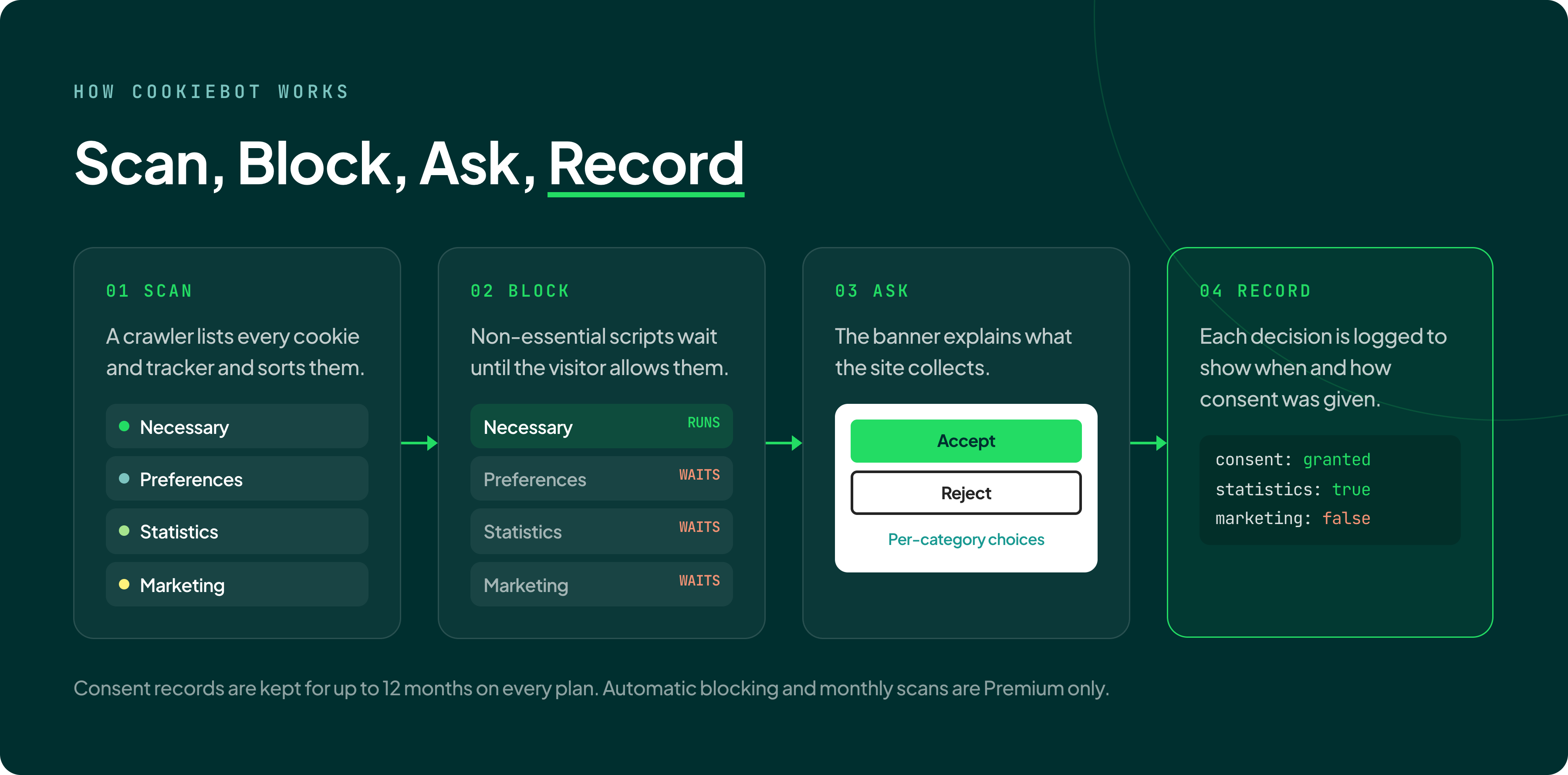
Cookiebot decides which of a website's tracking scripts may run for each visitor, based on the answer that visitor gives the Cookiebot banner. The work happens in four steps:
- Scan. A crawler visits the site, lists every cookie and tracker it finds, and sorts them into categories such as necessary, preferences, statistics, and marketing.
- Block. Scripts in the non-essential categories wait until the visitor allows them.
- Ask. The banner explains what the site collects and offers accept, reject, and per-category choices.
- Record. Cookiebot logs each decision so the site owner can show when and how consent was given.
How is Cookiebot different from Usercentrics?
Cookiebot is one of two consent products Usercentrics now sells, and the difference is how each is priced. Cookiebot's pricing page shows two tabs. Cookiebot Core covers the plans priced by page count. Usercentrics Advanced is priced by visitor sessions, covers unlimited domains, and is sold only through Usercentrics' sales team.
Advanced adds A/B testing, single sign-on, a customer success manager, support for 60 or more languages, and the option to remove Usercentrics branding.
What are Cookiebot's main features?
Cookiebot offers a free plan and five tiers in its paid plan. Here's a short description of each of its features:
Cookie scanner and cookie declaration
Cookiebot's scanner crawls Premium sites once a month and builds a cookie declaration, a public list of every tracker with its purpose and lifetime. Daily scans are a paid add-on, and the free plan gets only an initial scan.
Automatic blocking
Cookiebot's automatic blocking uses those tracker categories to hold back scripts without the site owner tagging each one by hand. It's a Premium feature, and on the free plan blocking is manual.
Banner design, languages, and geotargeting
Cookiebot's Premium banners support 47+ languages with auto-translation, custom branding, and fully custom banners built in HTML, CSS, and JavaScript. Premium also adds geotargeting, which shows visitors in different regions the banner the site owner has set for that region. The free plan is limited to one language.
Consent records and consent expiry
Cookiebot keeps consent records for up to 12 months on the free plan and on every Premium plan. Every plan includes an analytics dashboard with opt-in and opt-out rates.
Google Consent Mode v2 and other consent signals
Cookiebot switches on Google Consent Mode v2 by default, and Google's CMP Partner Program lists Cookiebot at its Gold tier. The free and Premium plans also pass consent to Microsoft UET and Amazon. Both honor Global Privacy Control, the browser signal that tells a site not to sell or share the visitor's data.
Legal frameworks and privacy policies
Cookiebot lists five legal frameworks on every plan: the GDPR, California's CCPA and CPRA, Virginia's VCDPA, Brazil's LGPD, and South Africa's POPIA. Neither plan lists a workflow for data subject access requests.
What are Cookiebot's strengths and weaknesses?
For site owners, Cookiebot's strengths are easy setup and automatic scanning, backed by Google and IAB Europe certifications. Its weaknesses cluster around billing that follows page and domain counts, and around support.
Strengths
- Setup is easy. Ease of setup is the most common praise on Cookiebot's Capterra listing, where Cookiebot rates 4.2 out of 5 from 53 reviews.
- The monthly Premium scan keeps the cookie declaration current without manual tracker lists.
- Traffic doesn't change the price. One Enzuzo customer running about 200 high-traffic sites said it chose Cookiebot because the fees aren't tied to traffic.
- Gold-tier Google CMP partner status and an IAB TCF registration cover the consent frameworks that ad-funded sites rely on.
Weaknesses
- Billing follows the highest page count Cookiebot's scanner has ever recorded, so one jump in pages can raise the price for good.
- Support is email-only on Premium, and the free plan gets the help center. Capterra reviewers rate customer service 3.9 out of 5.
- Reviews are polarized. Trustpilot shows 3.8 from 354 reviews, with 86% of ratings at either five stars or one, and unexpected charges are the most common complaint among recent one-star reviews.
- Regional setup takes effort: teams weighing a switch told Enzuzo a separate U.S. setup was hard to configure.
- A real-world study of a December 2023 crawl found that over 75% of 12,415 Cookiebot-powered websites loaded a tracker before a banner click, the second-highest rate of the four CMPs studied (OneTrust sites were at 61%, Didomi sites at 82%). The crawl ran from U.S. data centers, and two of the authors work for a CMP vendor.
For more Cookiebot strengths and weaknesses, read the Cookiebot review.
Who is Cookiebot best for?
Cookiebot is best for small websites and for high-traffic sites with few pages. Both types get a certified banner, Google Consent Mode v2, and a current cookie declaration without paying for a broader privacy suite. Strong fits include:
- WordPress and Wix sites
- High-traffic sites with modest page counts, since traffic doesn't raise the price
- Accounts with four or more domains of 50 to 349 pages each, which qualify for the $16 Premium Small tier
Cookiebot may be a poor fit when:
- The team wants live support beyond email, or A/B testing of banners, which Cookiebot offers only through Usercentrics Advanced
- The page count swings with seasonal catalogs or campaign pages
How does Cookiebot pricing work?
Cookiebot's price for each domain comes from tallying the unique pages (URLs) on each. Its scanner counts those and assigns pricing tiers. Here's what each tier costs;
| Plan | Pages per domain | Price per domain (USD) | Price per domain (EUR) |
|---|---|---|---|
| Free | Under 50, one domain only | $0 | €0 |
| Premium Lite | Under 50, one domain only | $8 a month | €7 a month |
| Premium Small | 50 to 349, accounts with 4+ domains | $16 a month | €15 a month |
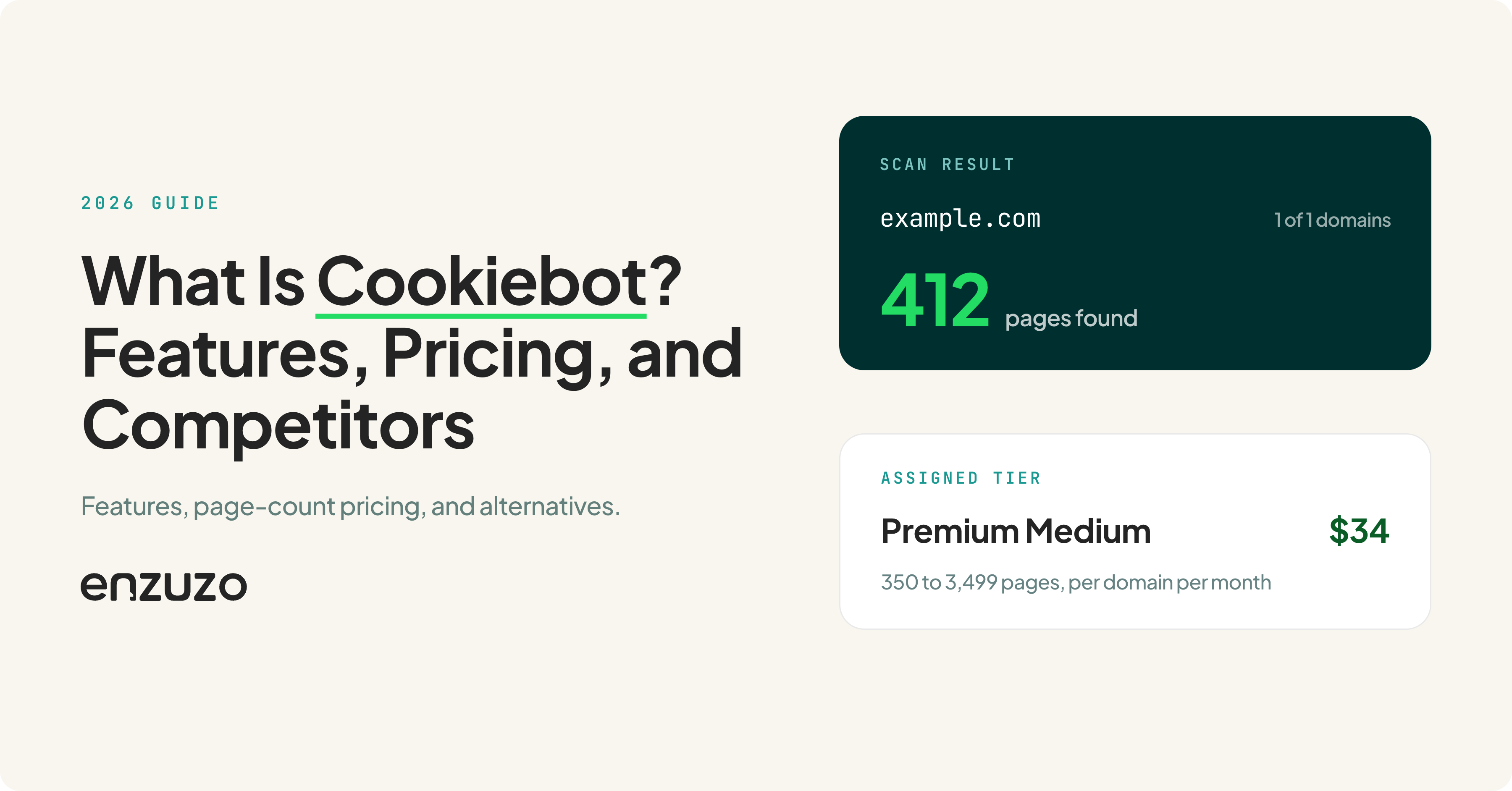
| Premium Medium | 350 to 3,499, plus domains of 50 to 349 pages in accounts with 1 to 3 domains | $34 a month | €30 a month |
| Premium Large | 3,500 to 6,999 | $56 a month | €50 a month |
| Premium XLarge | 7,000 or more | $96 a month | €90 a month |
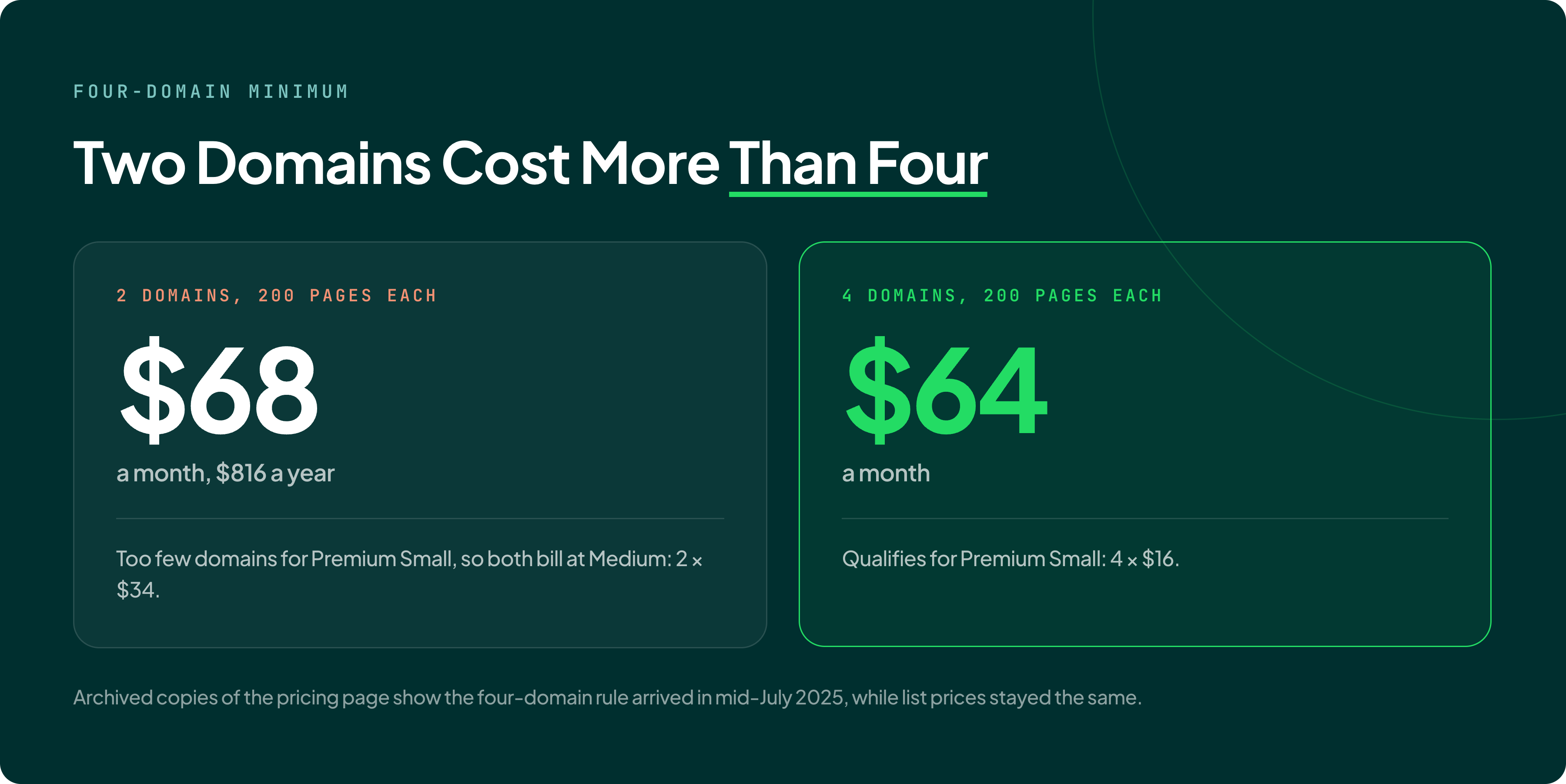
Cookiebot's four-domain minimum means two 200-page domains cost more a month than four. An account with two such domains can't use Premium Small, so both bill at Medium: $68 a month, or $816 a year. Four such domains qualify for Small and cost $64 a month.
When is Cookiebot the right choice for a website?
Cookiebot is the right choice for a site owner who needs a cookie banner on one or a few domains with small, stable page counts.
| Choose Cookiebot if... | Choose a broader platform like Enzuzo if... |
|---|---|
| The site is one domain with fewer than 50 pages, which fits the free plan or Premium Lite. | The business runs several domains or subdomains and wants them on one plan. |
| The page count is small and changes slowly. | Pages grow quickly (a blog, a product catalog, regional versions), which raises Cookiebot's price. |
| The main jobs are the banner, the cookie declaration, and Google Consent Mode. | The team also answers data subject access requests (DSARs) and wants that workflow next to consent. |
| The site sells ads through IAB TCF on one domain or a few. | The team wants IAB TCF on several domains under one plan, with consent records and privacy-request tools included. |
Which Cookiebot alternative fits each use case?
The best Cookiebot alternative depends on why a team leaves Cookiebot, such as page-based billing or the need for privacy-request tools.
| Use case | Best-fit options | Starting price | What sets it apart |
|---|---|---|---|
| Several domains without page-count pricing | Enzuzo | Growth: $29 a month for 4 domains; Pro: $79 a month for 10 | Priced per plan by domains and visitors, not scanned pages |
| Consent plus DSAR workflows | Enzuzo, Osano | Enzuzo Growth at $29 a month; Osano's DSAR intake starts on its quote-based Basic Privacy plan | Consent and privacy requests in one tool |
| Traffic-based pricing for small sites | CookieYes | Basic at $10 a month per domain for 100,000 pageviews | Priced on pageviews, with a pages-per-scan cap (600 on Basic) |
| One WordPress site | Complianz | Free plugin; premium from $59 a year for one site | Runs as a WordPress plugin |
| Many brands or regions | Usercentrics Advanced | Quote-based | Priced by visitor sessions, with unlimited domains, from the same company |
| Full enterprise governance | OneTrust | Quote-based | Privacy, AI governance, and vendor risk in one suite |
Enzuzo's consent management platform suits teams that want consent, DSAR workflows, and privacy policies on one plan. Like Cookiebot, Enzuzo is a Gold-tier Google CMP partner.
Enzuzo's roundup of Cookiebot alternatives adds detailed notes for each tool. Head-to-head pages compare Cookiebot vs CookieYes, Cookiebot vs Complianz, and OneTrust vs Cookiebot, and the Cookiebot review gives a scored verdict on Cookiebot itself.
Cookiebot's 14-day trial scans a site to decide which plan it qualifies for, so the trial shows a specific site's Cookiebot price before any comparison.
FAQs about Cookiebot
Is Cookiebot legit?
Cookiebot is a legitimate consent management platform, owned by Usercentrics and used on hundreds of thousands of websites. Google lists it as a certified CMP and rates it Gold tier in its CMP Partner Program. IAB Europe lists it as a registered CMP. Cookiebot also says it holds ISO 27001 and 27701 certifications. Trustpilot reviewers rate it 3.8 out of 5.
How much does Cookiebot cost per month?
Cookiebot costs $0 to $96 per domain per month, depending on how many pages its scanner finds. The free plan covers one domain under 50 pages. Premium plans run from $8 (Lite) to $16, $34, $56, and $96 as page counts rise, and accounts with one to three domains can't use the $16 tier. Yearly billing costs 12 times the monthly price.
Which websites use Cookiebot?
Wappalyzer detects Cookiebot on about 320,000 live websites, including track.toggl.com, themeforest.net, and tinypng.com, with 52% of detected sites in the United States. Cookiebot's homepage claims 2.4 million websites and apps. The gap likely reflects method: Wappalyzer counts live sites its crawler detects, and Cookiebot doesn't say how it counts.
How much money has Cookiebot raised?
Cookiebot's original developer, Cybot, never disclosed its funding. Full In Partners bought a majority stake in Cybot in January 2021, and Cybot then merged into Usercentrics, which had raised a €4 million Series A in 2019 and a €17 million Series B in 2020. Google took a minority stake in Usercentrics in 2024 without disclosing the amount.
Mate Prgin
Mate is the CEO & Founder of Enzuzo. He has an executive MBA from Ivey Business School and is a subject matter expert in data privacy and compliance.
More related blogs
Your next read