OneTrust vs Usercentrics: Pricing, Product & Best Fit (2026)

Osman Husain
OneTrust and Usercentrics are both worthy products in the consent management and data privacy space, but they ultimately target different buyers. OneTrust is an enterprise privacy suite with a minimum commitment of around $10,000 per year and an implementation timeline that can span weeks. Usercentrics offers fewer features than OneTrust but starts at €7 per month, and auto-upgrades pricing as traffic grows. They are both Google-certified consent mode partners but rarely compete in conversations focused on 1:1 feature parity.
Mid-market teams that find OneTrust too heavy and Usercentrics too unpredictable often choose a flat-priced CMP like Enzuzo instead.
Choosing between OneTrust and Usercentrics is really a choice between two different products: a full enterprise privacy platform versus a consent tool that grew out of the EU market. This comparison covers pricing, platform coverage, consent operations, and what reviewers say, based on July 2026 data.
Clearing up the confusion: did OneTrust acquire Usercentrics?
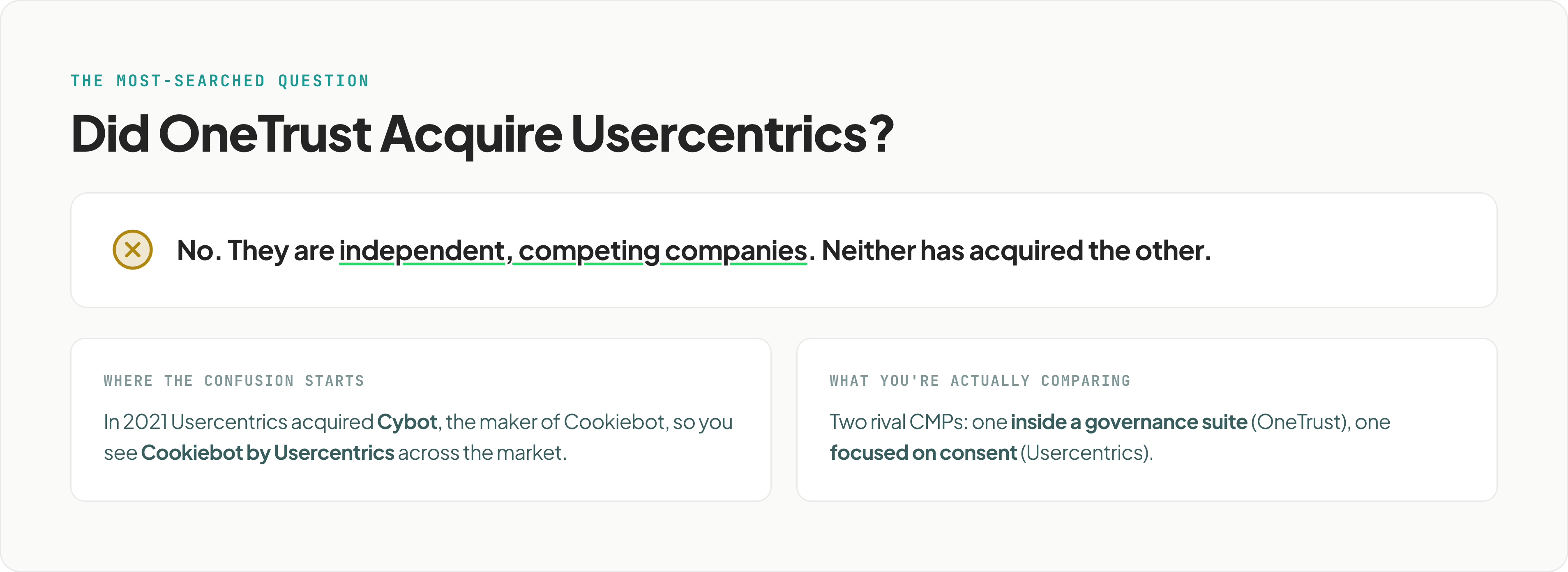
No, OneTrust and Usercentrics are independent companies and direct competitors. The confusion is understandable: Usercentrics acquired Cybot, the maker of Cookiebot, in 2021, so you'll see Cookiebot by Usercentrics across the market, and Usercentrics has since added MCP Manager, its AI-gateway product, to the family.
OneTrust has never owned Usercentrics, and neither has acquired the other. If you're comparing them, you're comparing two rival CMPs, one inside a governance suite and one focused on consent.
OneTrust vs Usercentrics feature breakdown
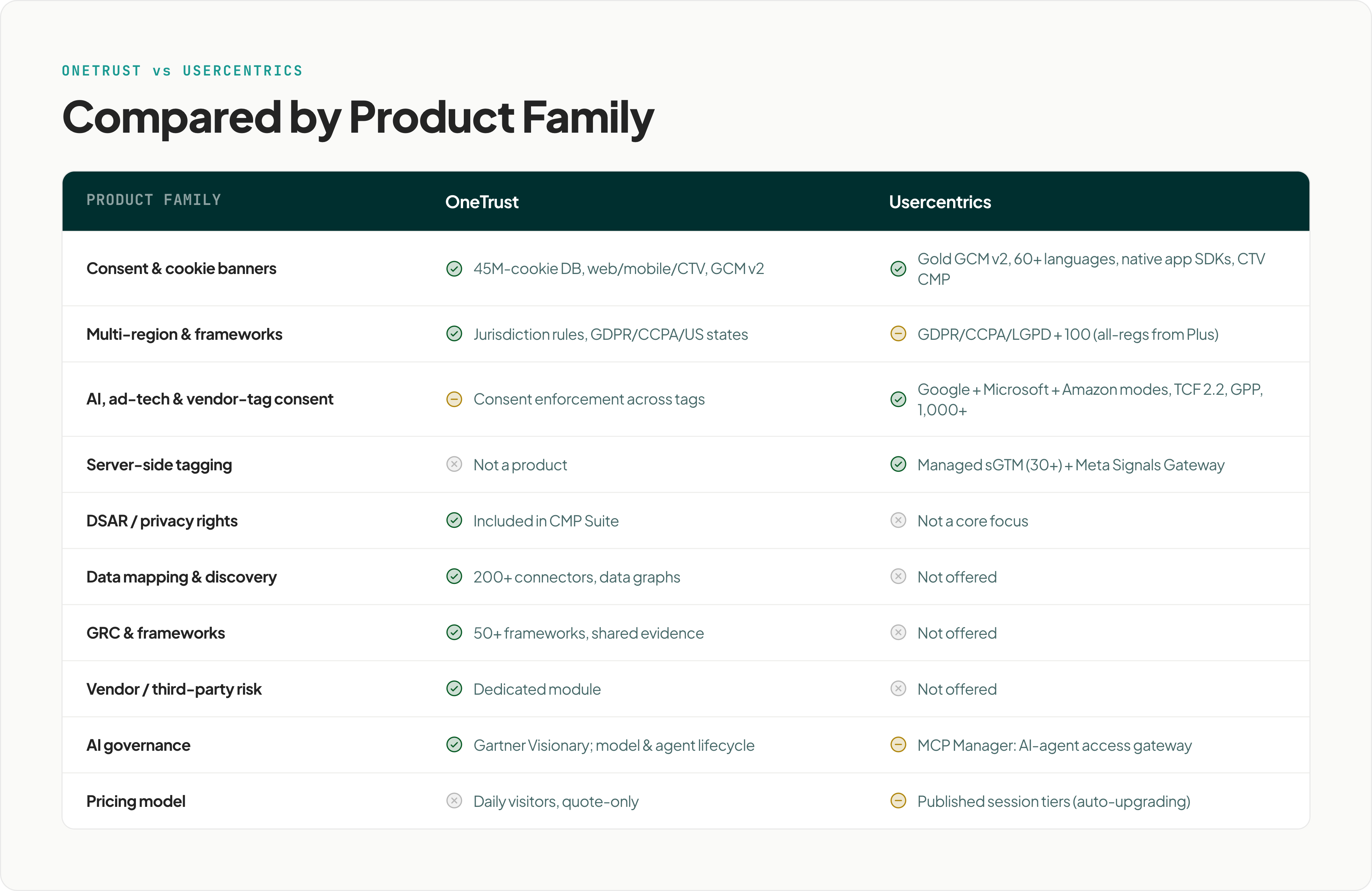
| Product family | OneTrust | Usercentrics |
|---|---|---|
| Consent and cookie banners | 45M-cookie database, web/mobile/CTV, GCM v2 | Gold-tier GCM v2, 60+ languages, native app SDKs (iOS, Android, Flutter, React Native, Unity), dedicated CTV CMP |
| Multi-region and frameworks | Jurisdiction rules, GDPR/CCPA/US states | GDPR/CCPA/LGPD + 100 frameworks (all-regs from Plus tier) |
| AI, ad-tech, and vendor-tag consent | Consent enforcement across tags | Google + Microsoft + Amazon consent modes, TCF 2.2, GPP, 1,000+ integrations |
| Server-side tagging | Not a product | Managed sGTM (30+ destinations) + Meta Signals Gateway |
| DSAR / privacy rights | Included in CMP Suite and Privacy Automation | Not a core focus |
| Data mapping and discovery | 200+ connectors, data graphs | Not offered |
| GRC and frameworks | 50+ frameworks, shared evidence | Not offered |
| Vendor / third-party risk | Dedicated module | Not offered |
| AI governance | Gartner Visionary; model and agent lifecycle | MCP Manager: AI-agent access gateway (private registry, RBAC, audit logs, PII filtering) |
| Pricing model | Daily visitors, quote-only | Published session tiers (auto-upgrading) |
Cookie banners and consent management
OneTrust and Usercentrics are both Google-certified CMPs, both support IAB TCF 2.2 and Google Consent Mode v2, and both scan and categorize cookies automatically. The separation starts with which surfaces they cover, and how.
Usercentrics ships native consent for each platform. Web gets no-code banners in 60+ languages, geo-targeting, a daily scanner, and 2,200+ legal templates. Apps get dedicated SDKs for iOS and Android plus Flutter, React Native, and Unity, which is why gaming names like Supercell and Ubisoft appear on its customer pages.
Television gets its own Google-certified CTV CMP covering tvOS, Android TV (Fire TV included), Tizen, and LG webOS, with cross-device consent sharing. Compare that with a rival like Ketch, which reaches mobile and CTV by rendering web banners inside WebViews; Usercentrics builds against each operating system directly, so the consent screen behaves like part of the app.
OneTrust answers with enterprise scale: a 45M+ categorized-cookie database, consent across web, mobile, and CTV, and a template library sized for multi-brand estates. A publisher monetizing apps and TV gets more from Usercentrics' purpose-built SDKs; a conglomerate standardizing consent across dozens of brands gets more from OneTrust's breadth.
Multi-region consent and privacy frameworks: OneTrust vs Usercentrics
OneTrust and Usercentrics both cover the global map. OneTrust applies jurisdiction-based rules across GDPR, CCPA, and a growing list of US state laws. Usercentrics covers GDPR, CCPA, LGPD, and 100+ frameworks with geo-targeting built in, though it gates all-regulations coverage to its Plus tier and above.
For a business spanning the EU, UK, and US, both serve the correct experience by region; the practical difference is that Usercentrics puts multi-regulation behind a paid tier, while OneTrust folds it into specific packages.
Consent for AI, ad tech, and vendor tags
Usercentrics is the specialist here, and the gap is the clearest product reason to choose it. One platform manages Google Consent Mode v2, Microsoft UET and Clarity Consent Mode, and Amazon Consent Signal, alongside IAB TCF 2.2, GPP, and 1,000+ marketing and ad-tech integrations.
If consent's real job on your site is to keep measurement and first-party data flowing, that coverage is hard to match. OneTrust enforces consent across tags competently, but signal quality for ad platforms isn't its center of gravity. On feeding clean, consented events to Google, Microsoft, Meta, and Amazon, Usercentrics is the clear winner.
Server-side tagging: a product OneTrust doesn't sell
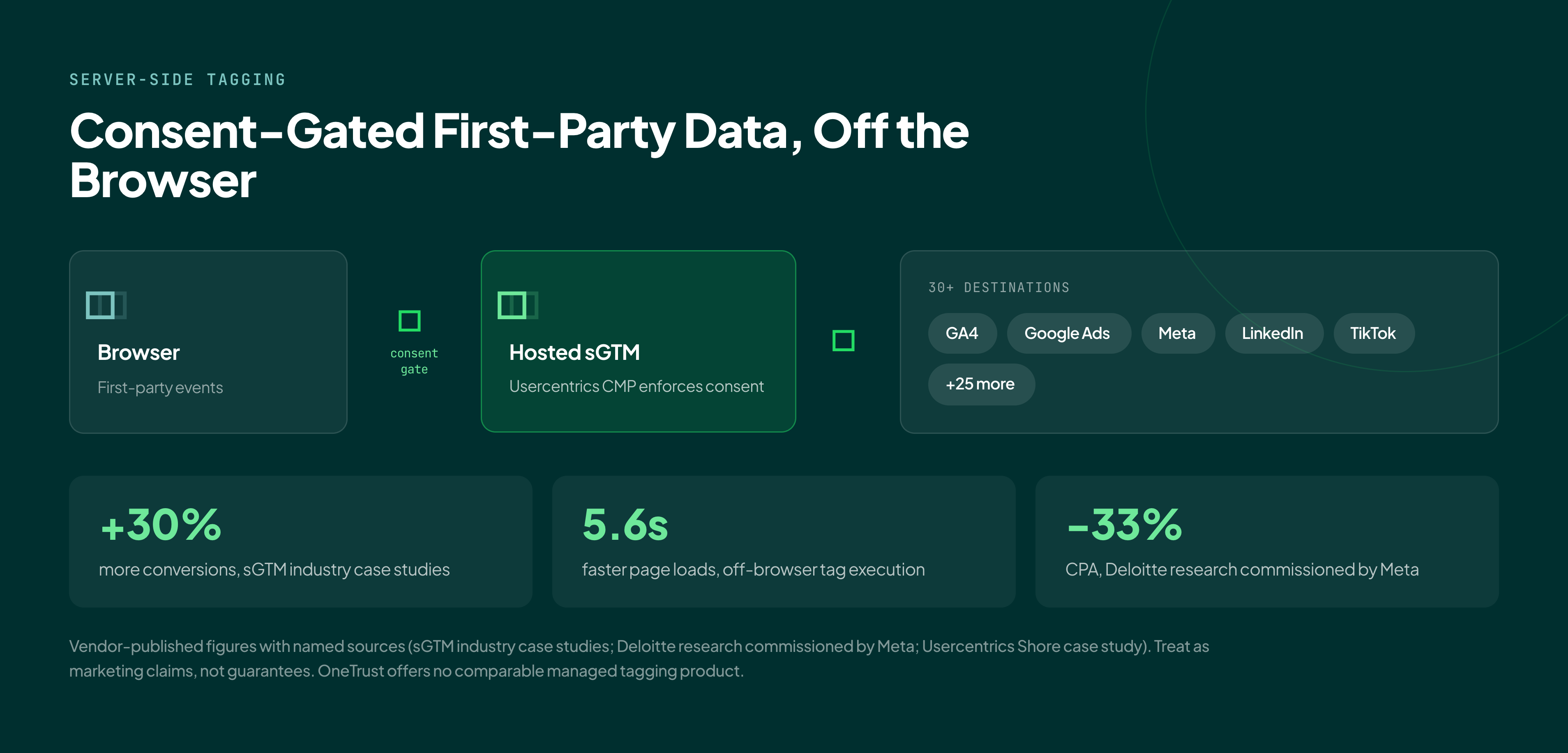
Usercentrics sells tracking infrastructure as managed products rather than configuration advice. Its hosted GTM moves tag execution off the browser and routes first-party data to GA4, Google Ads, Meta, LinkedIn, TikTok, and 30+ destinations, with native consent enforcement from the Usercentrics web CMP. Meta Signals Gateway adds a dedicated Meta pipeline: resilient Pixel, Conversions API, custom audiences, and offline conversion imports.
This results in better conversion tracking and ad attribution data: data from an internal Usercentrics case study reports 25 to 30% lower CPA and 54% more tracked conversions after moving server-side.
OneTrust offers no comparable managed tagging product; enforcing consent inside Google Tag Manager is the only option.
DSAR and privacy rights: OneTrust vs Usercentrics
OneTrust carries the deeper DSAR product. Rights automation ships inside its CMP Suite and Privacy Automation packages: request intake, identity verification, data retrieval, and secure response in one workflow. Handling rights at scale is a large part of what the suite exists to do.
Usercentrics stays consent-first, and privacy rights sit outside its core. It manages consent and preferences well, but a team whose top requirement is end-to-end DSAR automation will either pick OneTrust or bolt a dedicated rights tool onto Usercentrics.
AI governance: OneTrust vs Usercentrics
OneTrust governs the models and agents themselves: it inventories them, tiers their risk under the EU AI Act, NIST, and ISO 42001, and applies runtime controls.
Usercentrics governs what AI agents can touch. Its MCP Manager is a gateway between AI clients (Claude, ChatGPT, Cursor, GitHub Copilot) and the tools they connect to over the Model Context Protocol.
The gateway keeps a private registry of approved MCP servers, enforces role-based access control, writes forensic audit logs, and redacts PII before an agent passes it downstream. Published plans run $135 to $668 a month, with a custom Enterprise tier.
The distinction matters at buying time. A compliance team building an EU AI Act program needs OneTrust's suite. An IT team rolling out AI agents and worried about what those agents can read needs a gateway like MCP Manager.
Where OneTrust goes further: data mapping, GRC, and vendor risk
OneTrust maps and discovers data across 200+ connectors, runs a Tech Risk and Compliance suite spanning 50+ frameworks, and sells a dedicated third-party risk module with vendor screening and continuous monitoring. Usercentrics offers none of this, and doesn't pretend to; its platform ends at consent, preferences, and the data pipes that carry them.
Pricing: The big disparity between OneTrust and Usercentrics
OneTrust does not publish pricing, keeping its numbers gated behind a sales call. Its solution packages are metered on average daily visitors summed across your properties; procurement data puts the minimum commitment near $10,000 a year and median spend around $11,500.
For a Fortune 500 privacy program consolidating consent, data mapping, vendor risk, and DSAR in one suite, that can be rational. For a team that needs consent management specifically, it means paying for a platform where most modules go unused.
Enzuzo's OneTrust review dives into this in more detail.
Usercentrics publishes transparent session-based pricing, and the numbers look small at first: Essential at €7 per month, Plus at €15 per month, Pro at €30 per month, and Business at €50 per month.
| Plan | Price | Sessions/mo | Domains |
|---|---|---|---|
| Free | EUR 0 | up to 1,000 | 1 |
| Essential | EUR 7/mo | up to 1,500 | 1 |
| Plus | EUR 15/mo | up to 3,000 | 1 |
| Pro | EUR 30/mo | up to 15,000 | 3 |
| Business | EUR 50/mo | up to 50,000 | 10 |
| Corporate | Custom | 1M+ | Unlimited |
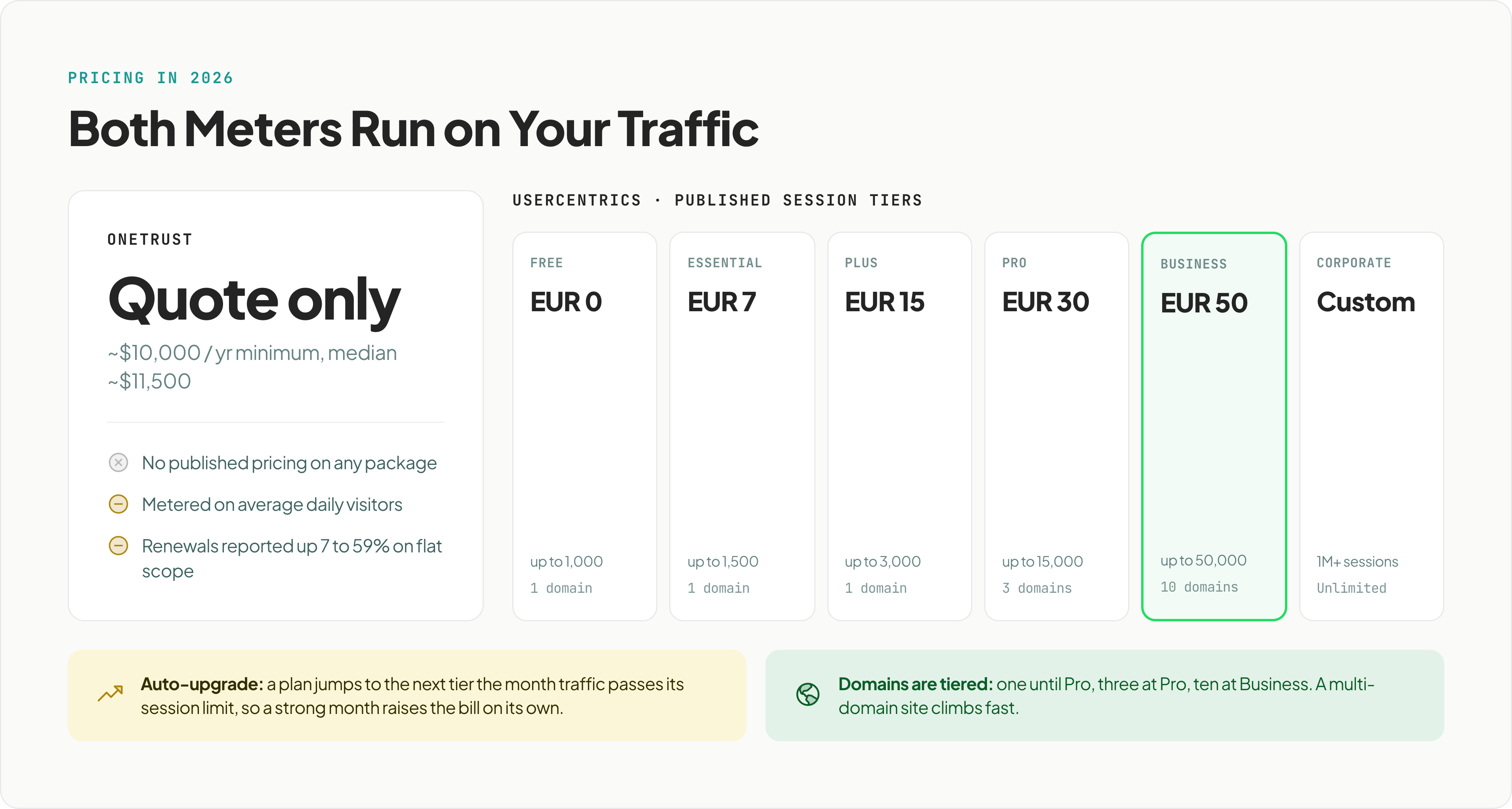
The devil is in the details: when you exceed your session limit on Usercentrics, your plan automatically transitions to the higher tier. Business scales to €100 per month at 100,000 sessions, €150 at 150,000, €200 at 200,000, and so on.
It is the same dynamic that frustrated Cookiebot customers when per-page pricing doubled in 2025, expressed through sessions instead of subpages.
The comparison in one sentence: OneTrust prices by negotiation, Usercentrics prices by your traffic, and neither has a true flat-priced option. That's the gap Enzuzo fills with predictable, scalable pricing on the Enterprise plan.
Where Enzuzo fits: the flat-priced alternative to both
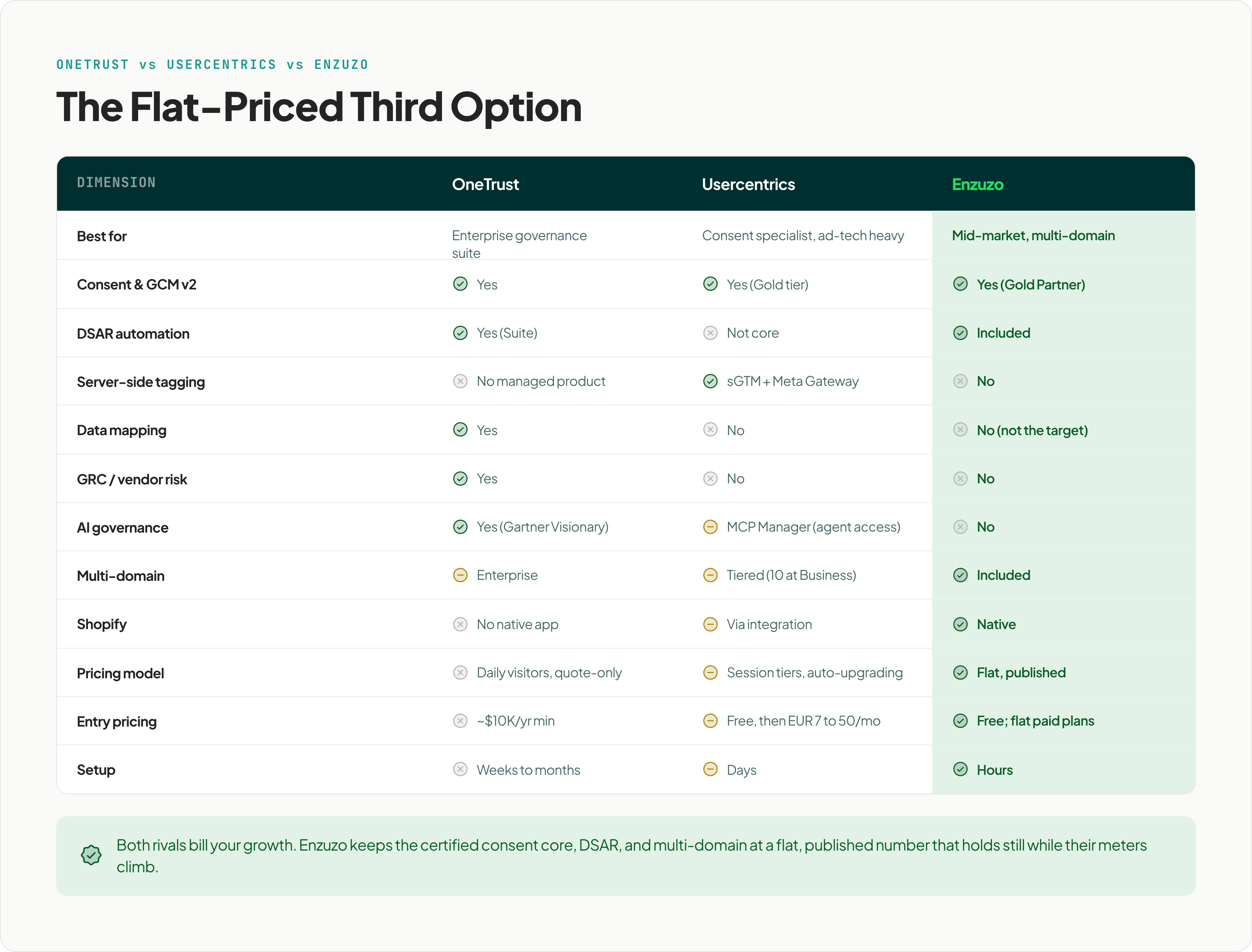
Both OneTrust and Usercentrics get progressively more expensive as your site grows. OneTrust's quote increases with daily visitors, starting at a $10,000 floor; Usercentrics' tiers step up on their own as sessions and domains accumulate. Enzuzo's consent management platform exists for teams that want the certified consent product at a predictable price.
Enzuzo, a Google CMP Gold Partner, deploys through Google Tag Manager, so Consent Mode v2 setup is a breeze. Plans are flat and transparent, multiple domains come standard, DSAR is included, and setup finishes in hours with Slack-based support.
Of the two vendors above, Usercentrics is the closer comparison, since both it and Enzuzo are consent specialists.
Comparing your options? Speak with a consent management expert to audit your current stack and walk you through what Enzuzo has to offer
Bottom line: which one should you choose?
- Choose OneTrust if you are an enterprise organization with a dedicated privacy team, need assessments, data mapping, and vendor risk in one suite.
- Choose Usercentrics if you are EU-centric, traffic is modest and stable, and you want a polished banner with transparent entry pricing, accepting session-based scaling as you grow.
- Choose Enzuzo if you are mid-market, run multiple domains or platforms, want DSAR handled, and want a bill that looks the same in month twelve as it does in month one.
FAQs
Did OneTrust acquire Usercentrics?
No. OneTrust and Usercentrics are independent companies and direct competitors. Usercentrics acquired Cybot, the company behind Cookiebot, in 2021, which is why Cookiebot is branded "by Usercentrics." OneTrust has made no acquisition of Usercentrics.
What is the difference between OneTrust and Usercentrics?
OneTrust is an enterprise privacy suite (consent, data mapping, vendor risk, DSAR, assessments) with custom pricing from roughly $10,000 per year. Usercentrics is a consent management platform priced per session, starting at €7 per month and scaling automatically with traffic. They overlap on cookie consent; everything else differs.
How much does Usercentrics cost?
Usercentrics Web starts at €7 per month for 1,500 sessions on 1 domain (Essential). Plus is €15 for 3,000 sessions, Pro is €30 for 15,000 sessions on 3 domains, and Business is €50 for 50,000 sessions on 10 domains. Exceeding a session limit automatically moves you to a higher-priced tier, reaching €200+ per month by 200,000 sessions.
How much does OneTrust cost?
OneTrust does not publish prices. As of 2026, its minimum annual commitment is around $10,000, with the consent management module commonly quoted near $827 per month and multi-year contracts standard. Final pricing depends on modules, domains, and negotiation.
Which is better for high-risk data processing: OneTrust or Usercentrics?
OneTrust. High-risk processing under GDPR usually requires DPIAs, assessment workflows, and audit trails, which OneTrust productizes and Usercentrics does not. Usercentrics can enforce stricter consent configurations but lacks the surrounding assessment tooling.
Who are OneTrust's main competitors?
In enterprise privacy suites: TrustArc, Securiti, and BigID. In consent management specifically: Usercentrics, Cookiebot, Didomi, Osano, Ketch, and Enzuzo. OneTrust itself refers mid-market customers that only need consent management to lighter CMPs, including Enzuzo.
Is there a cheaper alternative to both OneTrust and Usercentrics?
Cheaper alternatives to OneTrust include flat-priced CMPs that cover the same certified consent core without enterprise minimums or session-based scaling. Enzuzo's consent management platform covers 10 domains at $79 per month ($59 billed annually) including DSAR automation, and offers a free single-domain plan.
Is OneTrust or Usercentrics better for AI and ad-tech consent?
Usercentrics, for most teams. It manages Google Consent Mode v2, Microsoft UET and Clarity, and Amazon Consent Signal from one platform, with IAB TCF 2.2, GPP, and managed server-side tagging through sGTM and Meta Signals Gateway. OneTrust enforces consent across tags but is built around governance rather than ad-tech signal breadth.
Does Usercentrics offer AI governance?
Usercentrics offers AI-agent access governance through MCP Manager, a gateway that controls which tools and data AI agents such as Claude or ChatGPT can reach, with a private server registry, role-based access, audit logs, and PII filtering. It does not govern AI models themselves; model-lifecycle governance for EU AI Act programs is OneTrust's territory.
Is OneTrust or Usercentrics better for DSAR workflows?
OneTrust handles DSAR better, because rights automation ships inside its CMP Suite and Privacy Automation packages. Usercentrics is consent-first, so a team whose main need is end-to-end DSAR automation will find OneTrust more suitable.
Osman Husain
Osman is the content lead at Enzuzo. He has a background in data privacy management via a two-year role at ExpressVPN and extensive freelance work with cybersecurity and blockchain companies. Osman also holds an MBA from the Toronto Metropolitan University.
LinkedIn →More related blogs
Your next read