Privacy Policy Examples and Templates: 15 Real-World Breakdowns (2026)
Table of Contents
TL;DR
- A good privacy policy is plain-language, easy to find, and covers data collection, legal basis, user rights, third-party sharing, and retention periods
- GDPR requires 8 specific elements; CCPA requires opt-out rights and a "Do Not Sell" disclosure; PIPEDA requires 10 fair information principles
- The examples below cover enterprise SaaS to ecommerce, each annotated with what works and what you can borrow
- Skip to the bottom for a free privacy policy template and FAQ
What is a privacy policy?
A privacy policy is a legal document that explains how your business collects, uses, stores, and shares personal data. It tells your users what information you gather (names, email addresses, payment details, browsing behavior), why you need it, who you share it with, and how long you keep it.
Every website or app that collects personal data from users needs one. This includes basic data like email addresses collected via a newsletter signup form, cookie data collected via tracking scripts, and behavioral data collected through analytics platforms like Google Analytics or Meta Pixel.
Privacy policies are legally required in most jurisdictions. The GDPR (European Union), CCPA/CPRA (California), PIPEDA (Canada), and LGPD (Brazil) all mandate that businesses publish a compliant privacy policy that is easy to find and written in plain language.
What makes a good privacy policy?
A good privacy policy does more than satisfy legal requirements. It builds trust. Here are the five qualities that separate a strong privacy policy from a box-checking exercise:
1. Plain language
Legal documents don't need to read like legal documents. The best privacy policies are written for real people, not lawyers. Avoid jargon like "hereunder" and "aforementioned." Use short sentences and active voice. If your user's grandmother can't understand the key points in 90 seconds, it needs to be rewritten.
2. Easy to find
A privacy policy that requires three clicks to locate is effectively hidden. Place a link in your website footer (standard expectation), your signup and checkout pages (where personal data is actively collected), and any pop-up or consent banner that references data collection.
3. Genuine transparency about data collection
Be specific about what you collect and why. "We collect information to improve our services" is too vague to be meaningful. "We collect your IP address, browser type, and pages visited to analyze site traffic via Google Analytics" is transparent and builds trust.
4. Clear user rights and how to exercise them
Under GDPR and CCPA, users have rights over their data: to access it, correct it, delete it, or port it. Your privacy policy must explain these rights and include a practical mechanism for exercising them (typically a contact email, DSAR form, or self-service portal).
5. Regular updates with visible version history
Privacy policies are living documents. When your data practices change (new analytics tools, a new payment processor, an AI training program), your policy must reflect that. Mark the "Last Updated" date prominently and consider linking to a changelog.
Privacy policy requirements by regulation
Different laws require different things. If your users are in multiple jurisdictions, your privacy policy must comply with all applicable laws. Here's a quick reference:
| Regulation | Applies To | Key Requirements |
| GDPR (EU/EEA) | Any business with EU users | 8 required elements (see below); lawful basis for processing; explicit consent for sensitive data; data retention periods; DPO contact if applicable |
| CCPA/CPRA (California) | Businesses meeting revenue/data thresholds with CA users | "Do Not Sell or Share My Personal Information" link; categories of data sold; consumer rights (access, delete, correct, opt-out); annual update required |
| PIPEDA (Canada) | Canadian businesses + those handling Canadian residents' data | 10 fair information principles; accountability, consent, limiting collection, accuracy, safeguards, openness, access, and compliance |
| LGPD (Brazil) | Any processing of Brazilian residents' data | Legal basis for each processing activity; data subject rights; DPO appointment for larger processors; cross-border transfer rules |
| CalOPPA (California) | Websites collecting CA residents' data | "Do Not Track" signal disclosure; third-party tracking disclosure |
The 8 required GDPR elements
If you have EU users, your privacy policy must include all eight of these:
- Identity and contact details: who is the data controller and how can users reach you
- What data you collect: categories of personal data and how it is obtained
- Why you collect it: the specific purposes of processing
- Legal basis for processing: consent, contract, legitimate interest, legal obligation, vital interest, or public task
- Who you share data with: third parties, processors, and any recipients of personal data
- International data transfers: if data leaves the EU/EEA, what safeguards are in place (SCCs, adequacy decisions)
- Retention periods: how long each category of data is kept, and the criteria used
- User rights: right to access, rectification, erasure, restriction, portability, and objection
15 Privacy policy examples
We scoured the web for the best privacy policy examples to show you how they can help bolster your brand.
And these are the best of the lot — great data privacy statement samples from leading brands and eCommerce businesses to serve as your personal swipe file and inspire you to build your own privacy policy agreement.
The examples help shed light on how you collect personal information, whether you use location data, and what privacy laws you comply with. They're a great way to inform users of their rights, too.
1. Enzuzo
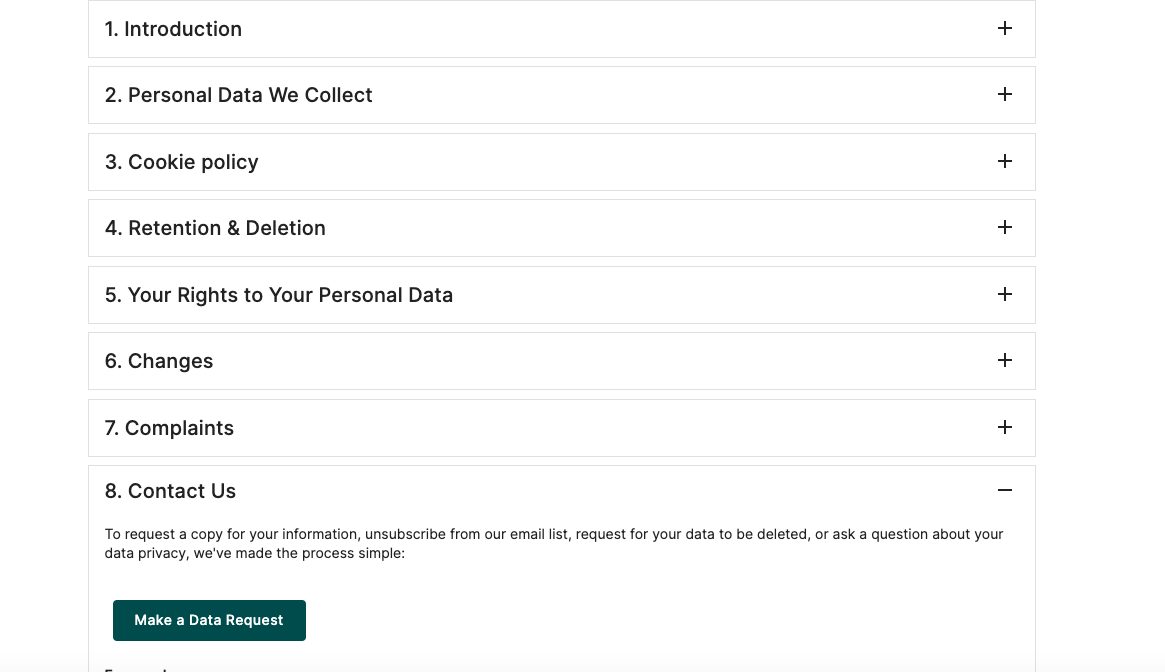
✅ What they do well: Pull-down menu navigation makes it easy to jump directly to the section you need. Each section uses bullet points and short paragraphs, which aids scannability. As a Canadian company, the policy explicitly references PIPEDA compliance and names the specific information principles it adheres to.
📋 What to borrow: The modular navigation pattern. Instead of one long wall of text, structure your policy so users can jump directly to "How we share your data" or "Your rights" without scrolling past irrelevant sections.
⚠️ What's missing: No visible "Last Updated" timestamp in the header, a minor trust signal that most users expect.
2. Airbnb
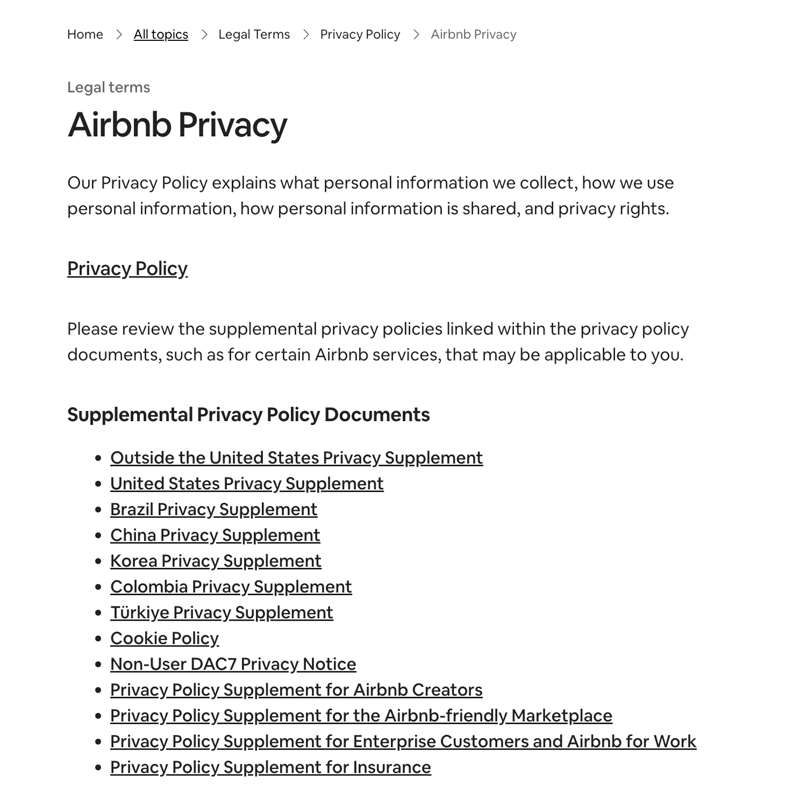
✅ What they do well: Clean, no-frills layout with no distracting graphics. The policy links to previous versions so users can see exactly what changed and when. This version history approach is exceptional for building trust, especially for users who may have originally agreed to different terms.
📋 What to borrow: The version history feature. Especially if you operate in regulated industries or have a long-tenured user base, showing "here's what changed in the last update and why" is a differentiator.
⚠️ What's missing: No summary section at the top, so users have to read into the document to understand the key points.
3. Slack
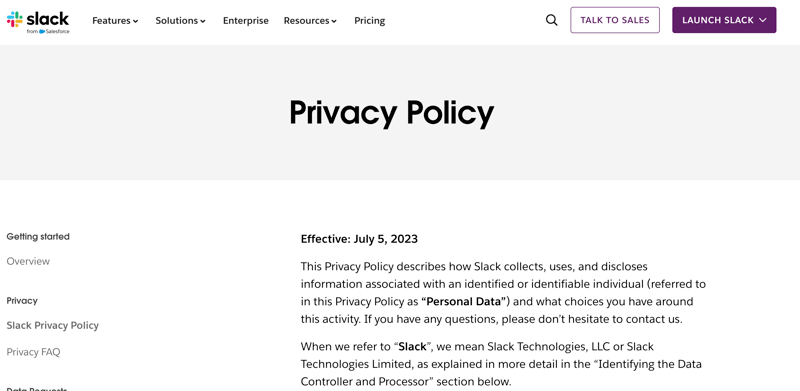
✅ What they do well: Table of contents with anchor links at the top. Explicit section on international data transfers with references to Standard Contractual Clauses, important for a product with a global enterprise user base. Clear explanation of how data moves across borders.
📋 What to borrow: The international data transfer section structure. If you have users in multiple jurisdictions, clearly explain the mechanism (SCCs, adequacy decision, or consent) used for each region's transfers.
⚠️ What's missing: The policy is long. The table of contents helps, but a 2-3 sentence "Key Points" summary at the very top would reduce cognitive load significantly.
4. Canva
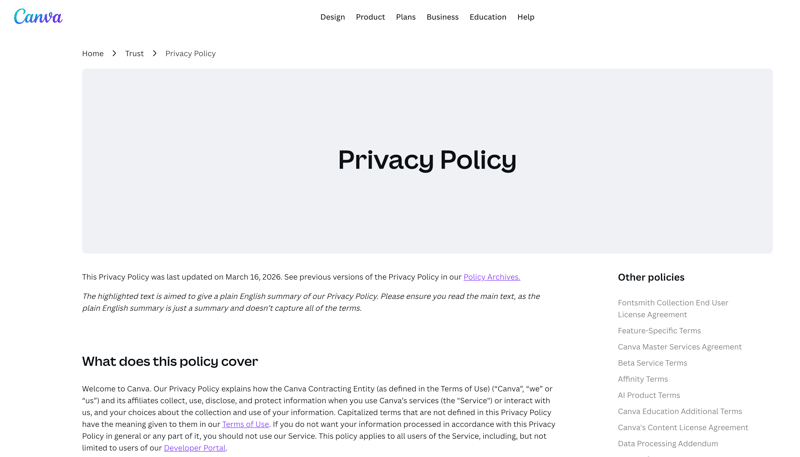
✅ What they do well: Explicitly covers log files, web beacons, device data, and user account data in separate sections, while most companies bundle this under a vague "cookies and similar technologies" heading. Written in Canva's friendly, accessible brand voice throughout, which reinforces trust without sacrificing legal accuracy.
📋 What to borrow: The granular technology breakdown. If you use log files, web beacons, pixels, or fingerprinting, name them individually. Users and regulators respect specificity.
⚠️ What's missing: No dedicated section on AI data use, notably absent for a product that has rolled out AI-powered design features in 2024/2025.
5. Best Buy
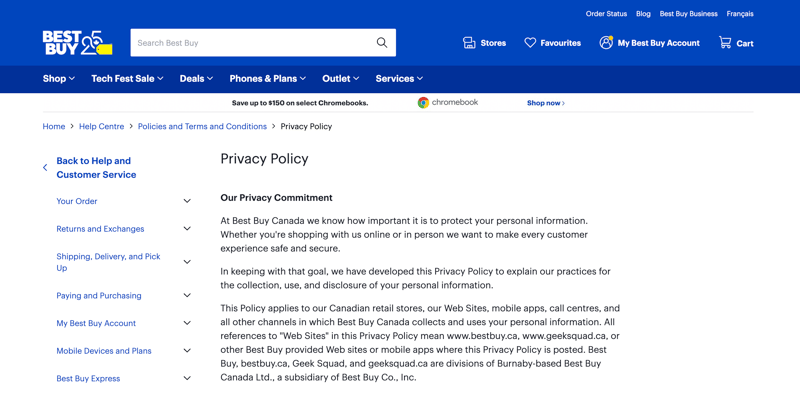
✅ What they do well: Opens with a "Highlights" section that summarizes the most important points from the full policy. This is the single most user-friendly structural choice a privacy policy can make. Most users only want to know the essentials, not read 4,000 words.
📋 What to borrow: The executive summary approach. Add a 5-bullet "Key Points" box at the very top of your policy covering: what you collect, why, who you share with, user rights, and how to contact you.
⚠️ What's missing: The highlights section doesn't include a "Last Updated" date reference, making it harder to judge how current the summary is.
6. Twitter
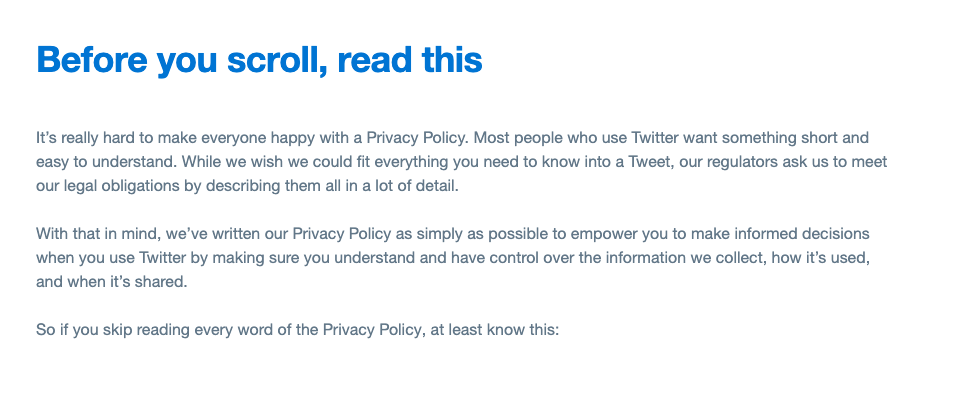
Twitter's privacy policy is a great example of how to reflect that your business understands the difficulty of legal terms by addressing them to make users feel safe.
✅ What they do well: Acknowledges upfront that users don't have time to read long policies and then genuinely tries to solve that problem with clear headings and accessible language. The policy covers mobile vs. web app distinctions explicitly, which most policies don't address.
📋 What to borrow: The self-aware tone. Opening your policy with acknowledgment that "we know this is hard to read" and then taking active steps to improve readability signals genuine transparency.
⚠️ What's missing: Given X's 2024/2025 changes to data practices around AI training, the policy has been controversial. It's a cautionary example of what happens when policy updates lag behind actual data practices.
7. Pinterest
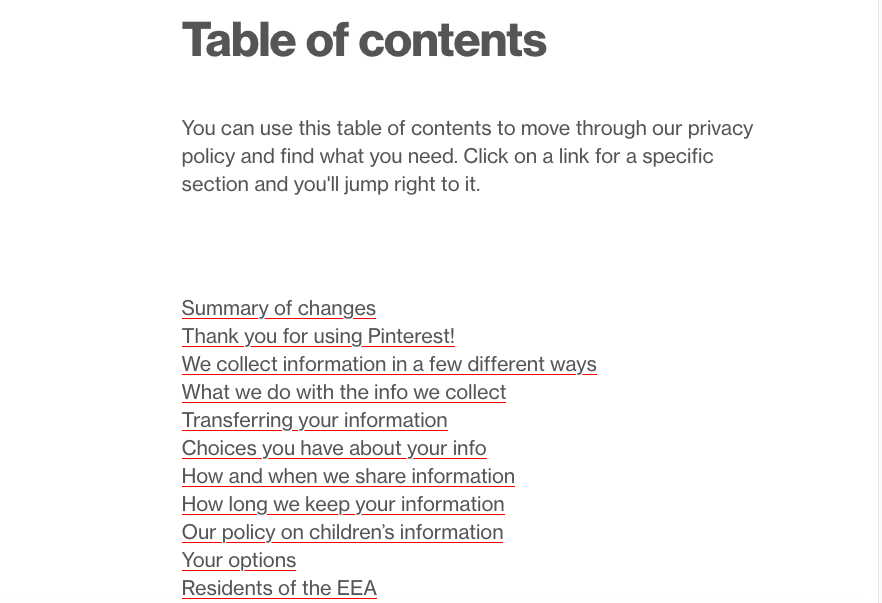
✅ What they do well: The page structure allows users to navigate the policy based on their own needs rather than forcing linear reading. Clear overview of all data categories. Strong on user rights: the policy explains not only that rights exist, but also how to exercise each one with specific links.
📋 What to borrow: The user rights section structure. For each right (access, deletion, portability, objection), link directly to the mechanism for exercising it. Don't just say "contact us."
8. Dune Jewelry
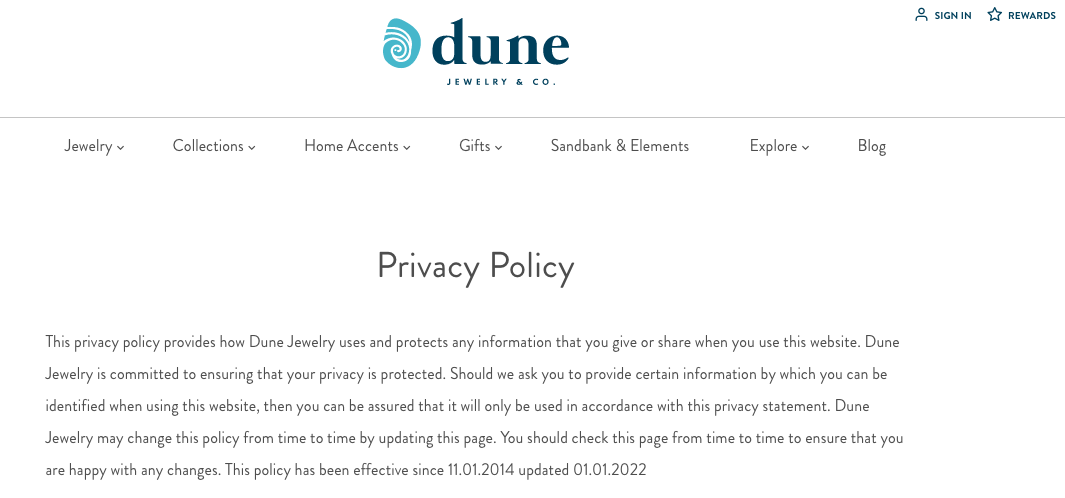
✅ What they do well: A strong example for small ecommerce businesses. Five clear sections with titled bullet-point lists. Covers the essentials without padding. It is ideal for a small brand that needs compliance without overwhelming its customers.
📋 What to borrow: The minimal, clean structure for SMBs. You don't need a 6,000 word policy to be compliant. If you're a small ecommerce store, Dune's format proves you can be thorough and readable at under 1,000 words.
9. Coursera
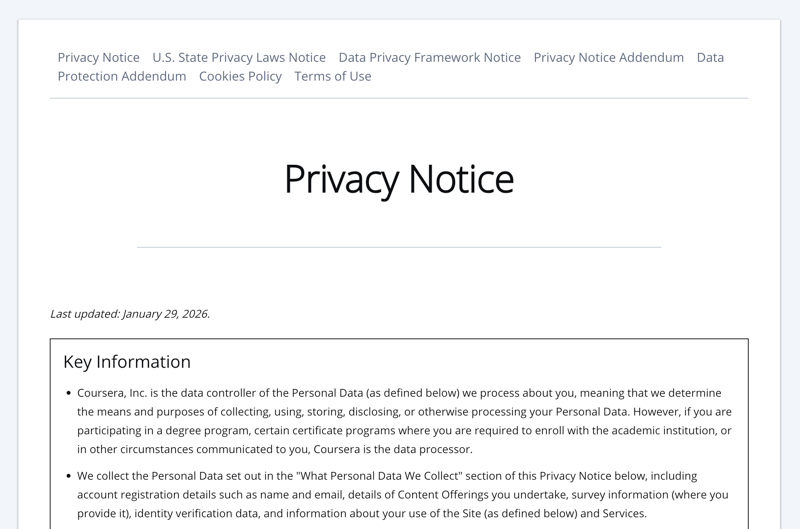
✅ What they do well: Opens with a "Key Points" summary section that immediately tells users the most important facts. This is a best practice that reduces user anxiety before they engage with the full document.
📋 What to borrow: The explicit statement of purpose. Coursera explains exactly why it collects each category of data (improving the platform, personalization, analytics, communications), not only that it collects it.
10. Google
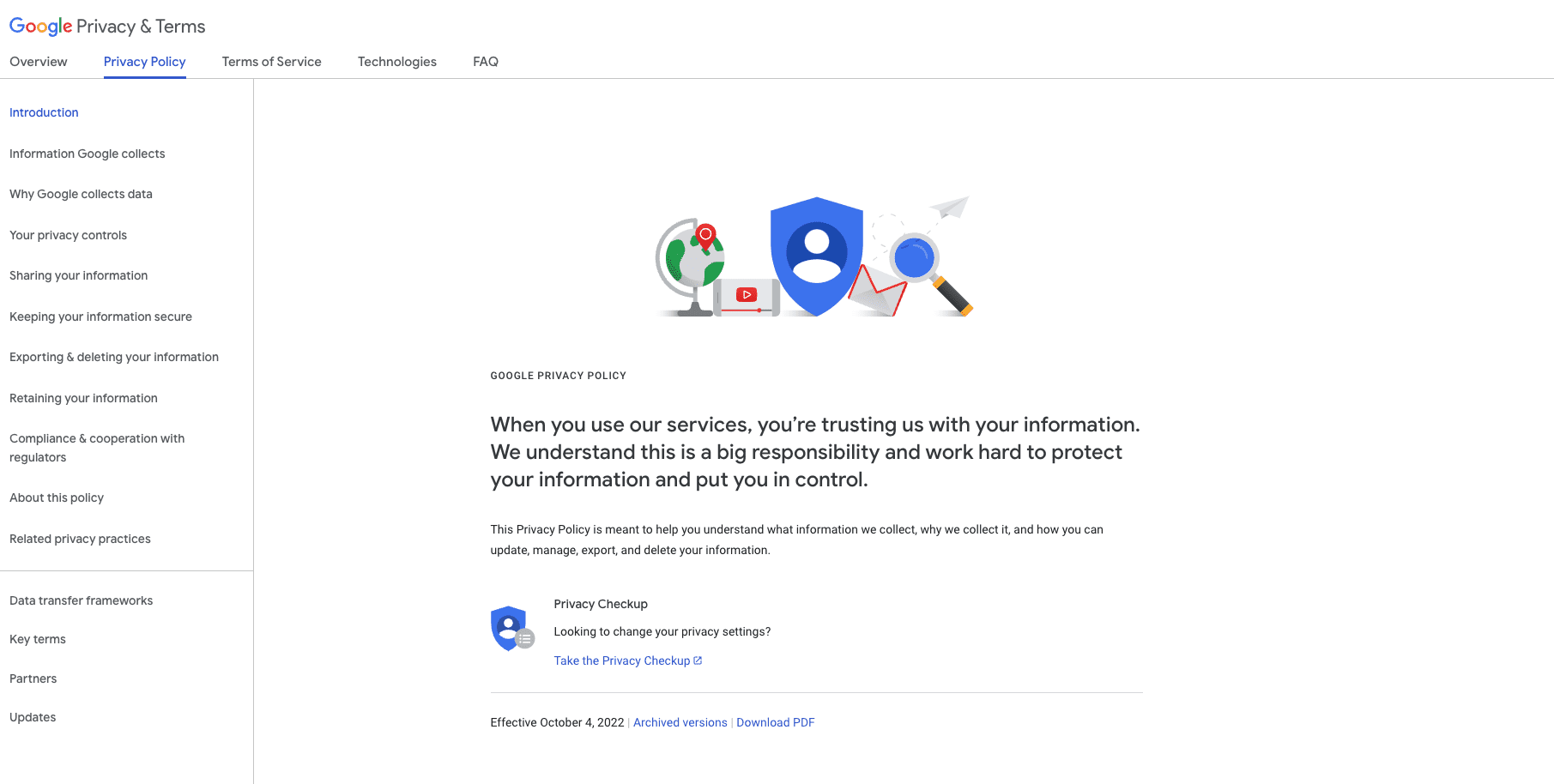
✅ What they do well: Uses video, graphics, and infographics embedded throughout the policy, making it arguably the most accessible privacy policy from a global consumer tech company. Allows PDF download for offline reading. Covers multiple products (Search, Maps, YouTube, Android) within a single unified policy with clear product-specific callouts.
📋 What to borrow: The multi-product structure if you operate a product suite. One unified policy with product-specific callouts is more maintainable and less confusing than separate policies.
⚠️ What's missing: Length and complexity are still significant for most users. The visual aids help but don't fully solve the comprehension problem.
11. Telegram
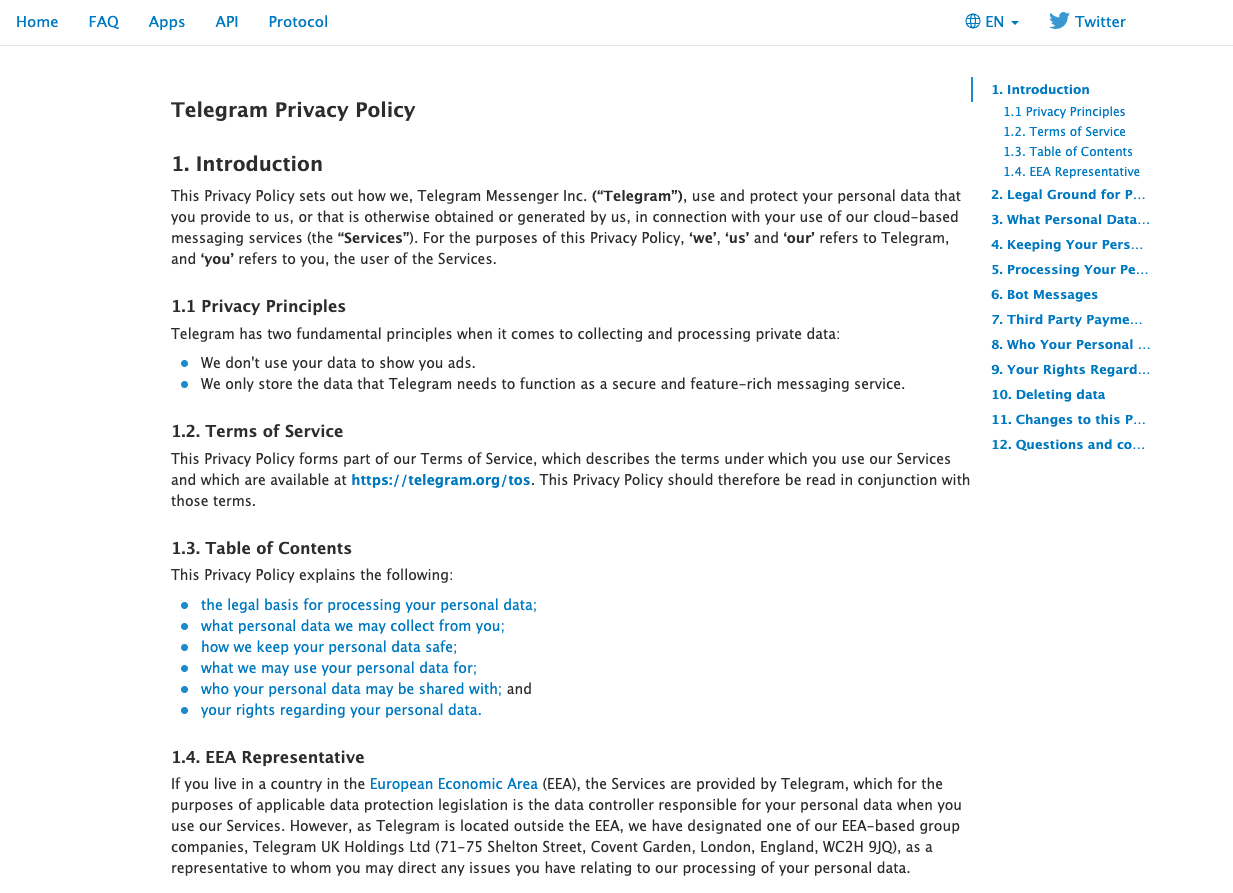
Telegram's privacy policy doesn't come with the same bells and whistles like Google's privacy policy, but it gets the job done. You won't find any videos or graphics, but you will get a pretty robust explainer of all that the policy encompasses in (largely monotonic) legalese.
✅ What they do well: Short, direct, and unapologetically minimal. For a product built around privacy, the policy reflects the product values and doesn't hide behind verbosity. Clear stance on what data Telegram collects versus what it explicitly does not collect.
📋 What to borrow: The explicit "what we don't collect" section. Stating what you don't do (sell data, build advertising profiles, share with law enforcement without legal process) can be as trust-building as stating what you do.
12. Apple
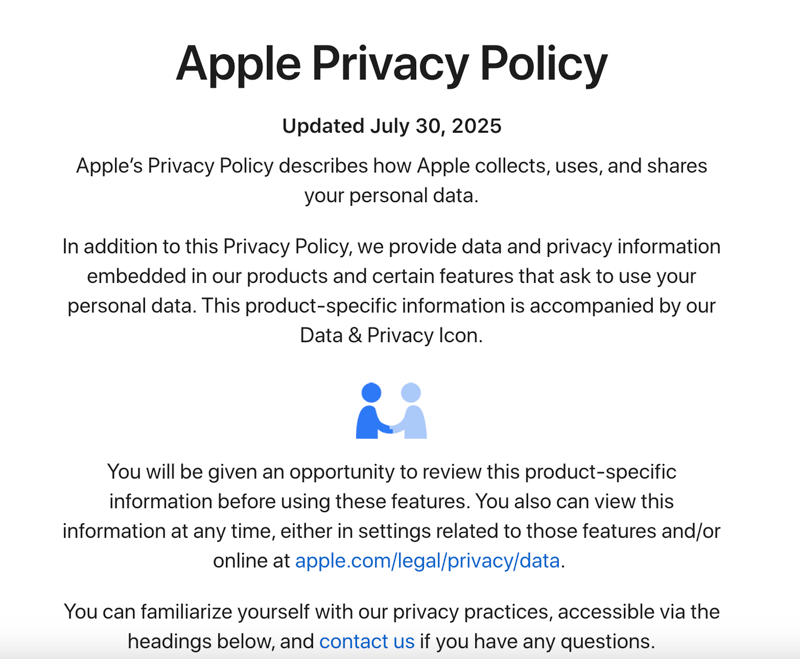
✅ What they do well: Separate policies per product (iOS, macOS, iCloud, App Store), each one focused and specific rather than one sprawling document. The policies explicitly address how Apple's privacy-preserving technologies (Differential Privacy, on-device processing) work. One of the few consumer tech policies that describes its engineering approach to privacy, not just its legal commitments.
📋 What to borrow: The product-specific architecture for larger businesses. If you have distinct products with different data profiles, separate policies reduce confusion and improve regulatory defensibility.
13. Notion
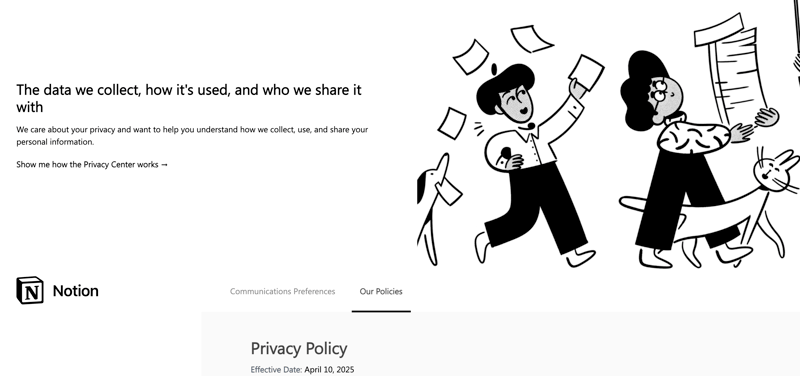
✅ What they do well: AI data use policy is prominent and specific, covering whether Notion AI uses workspace content for training (opt-in only, not default). This is a model for how SaaS companies should address AI features in their privacy policies as AI capabilities expand.
📋 What to borrow: A dedicated "AI features and your data" section. With AI now built into most SaaS products, users actively look for clarity on whether their data is used to train models. Addressing this directly reduces churn and support tickets
14. OpenAI
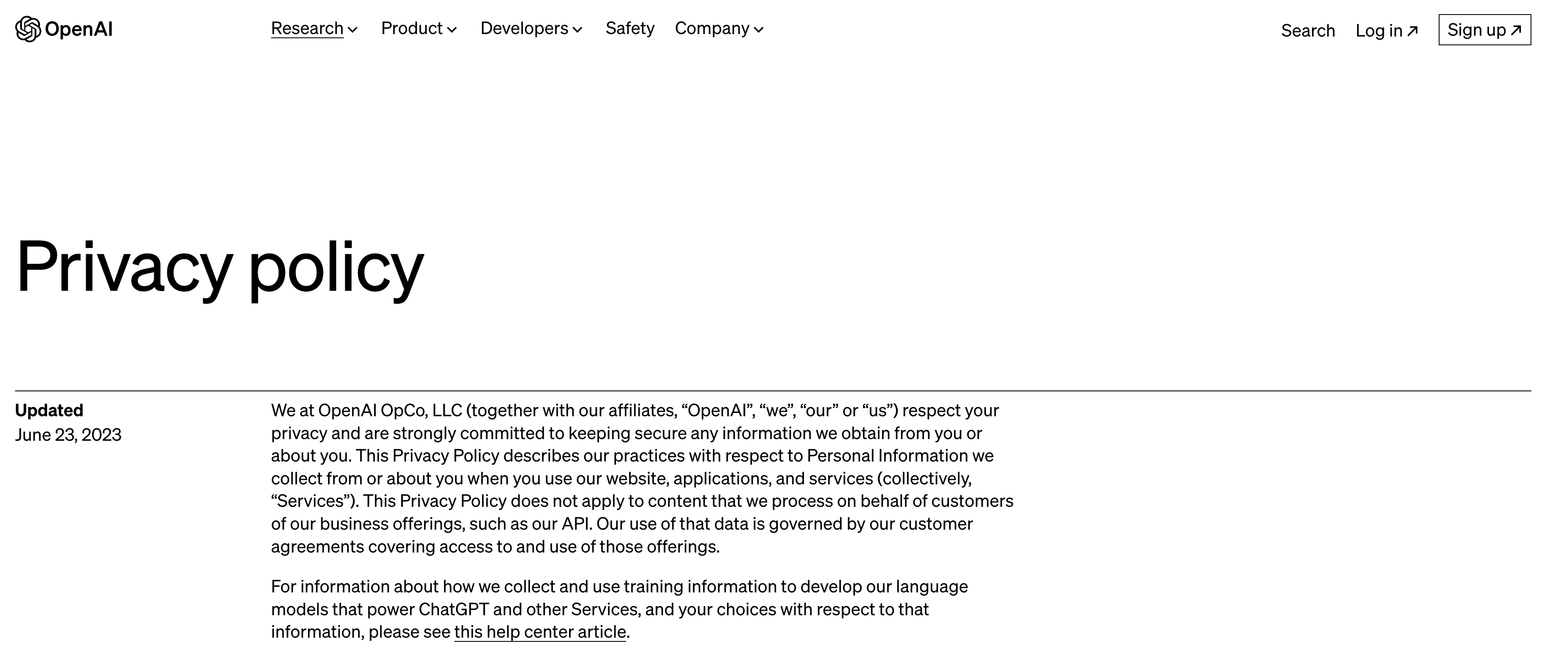
✅ What they do well: Distinguishes between API users (whose data is generally not used for training by default) and ChatGPT consumer users (whose conversations may be used with opt-out). Also addresses how to submit requests to exclude training data. Pioneered consumer-facing AI privacy disclosure that has now become an industry reference.
📋 What to borrow: The API vs. consumer product distinction. If you have a developer API and a consumer product, their data treatment often differs materially, so address both explicitly.
15. Shopify
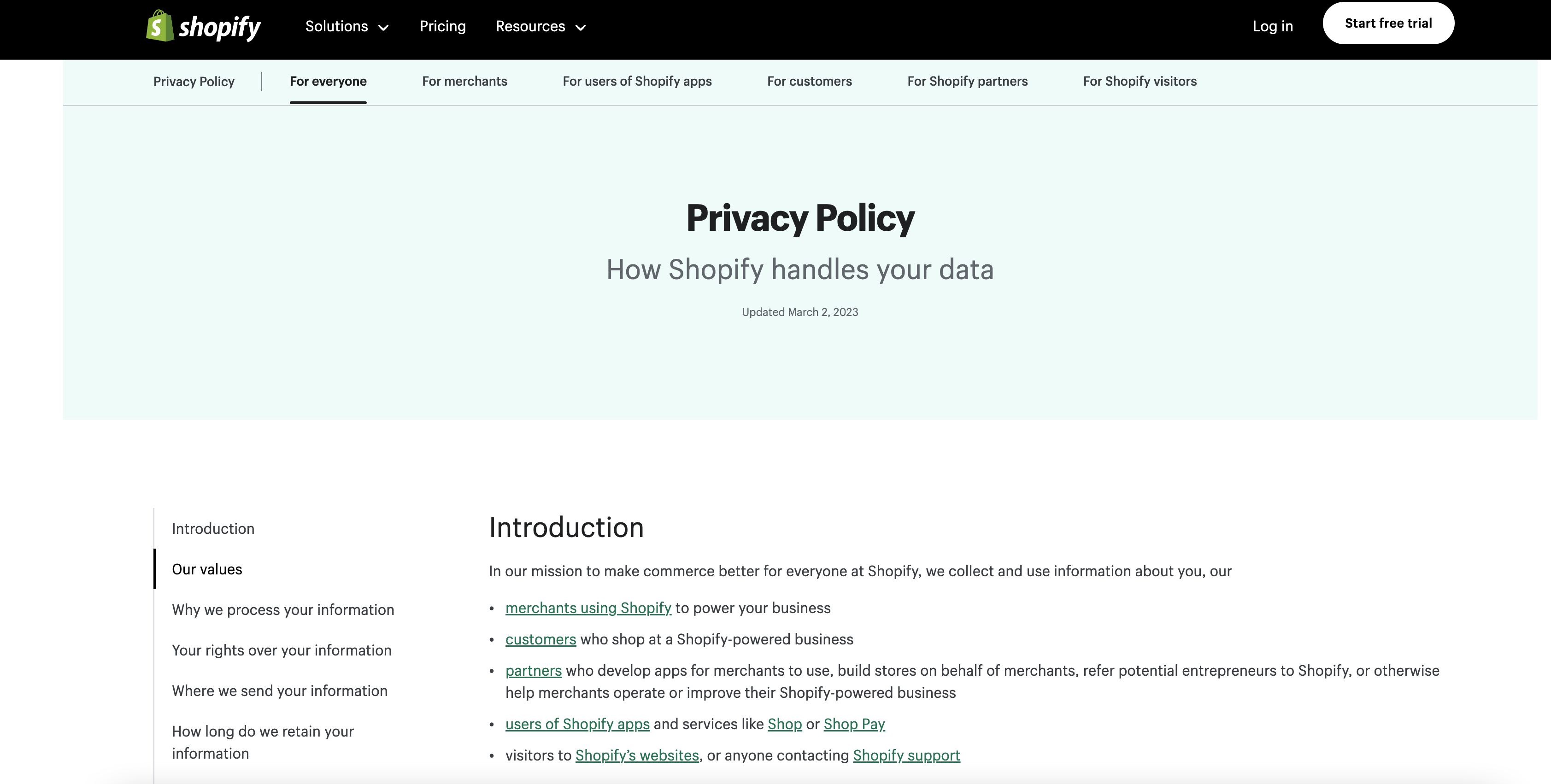
✅ What they do well: Distinguishes between Shopify as a data controller (for Shopify.com users) and a data processor (for merchants' customer data). This B2B/B2C duality is rare and legally important. Merchants reading it understand exactly where Shopify's obligations end and theirs begin.
📋 What to borrow: The processor vs. controller distinction if you operate a platform. If your product processes data on behalf of business customers, be explicit about who owns what obligations.
Free privacy policy template
If you're building your own privacy policy from scratch, Enzuzo's Privacy Policy Generator creates a compliant, plain-language policy in under 5 minutes. It covers GDPR, CCPA/CPRA, PIPEDA, and LGPD. It updates automatically when regulations change.
What you get:
- Auto-generated based on your business type and location
- Covers 30+ global privacy regulations
- Jurisdiction-specific clauses (EU users see GDPR rights, CA users see CCPA disclosures)
- Hosted with a permanent URL for your website footer
- Updates automatically when laws change, no manual tracking required
Generate your free privacy policy →
Manual vs. generator: which is right for you?
| Manual (hired lawyer) | Template (DIY) | Generator (Enzuzo) | |
| Time to create | 2–4 weeks | 2–4 hours | 5 minutes |
| Cost | $1,000–$5,000+ | Free | Free–$paid |
| Compliance coverage | High (if lawyer is current) | Varies | High (auto-updated) |
| Stays current | Only if you re-engage lawyer | Only if you update manually | Automatic |
| Best for | Enterprise / highly regulated | Budget-constrained, low-risk | SMB to mid-market |
FAQ
What should a privacy policy include?
A privacy policy should include: who you are and how to contact you; what personal data you collect; why you collect it and the legal basis (for GDPR); who you share data with; how long you keep data; user rights and how to exercise them; cookie and tracking technology disclosure; how users will be notified of changes; and a "Last Updated" date.
Do I legally need a privacy policy?
Yes, in most cases. If you collect any personal data (including email addresses, IP addresses, or cookie data) from users in the EU (GDPR), California (CCPA), Canada (PIPEDA), or Brazil (LGPD), a compliant privacy policy is legally required. Many third-party services like Google Analytics, Meta Pixel, and the Apple App Store also require you to have one.
What is an example of a private policy?
A simple private policy example is Basecamp's: it's direct, jargon-free, and explicitly states what the company does and doesn't do with user data. For small businesses, Dune Jewelry's policy is a strong model. For enterprise SaaS, HubSpot and Intercom are good references because they address GDPR legal bases, DPAs, and subprocessor lists.
What are the 7 principles of privacy?
The seven principles are drawn primarily from GDPR's data protection principles: (1) lawfulness, fairness, and transparency; (2) purpose limitation; (3) data minimization; (4) accuracy; (5) storage limitation; (6) integrity and confidentiality (security); and (7) accountability. PIPEDA uses a similar but distinct set of 10 fair information principles including accountability, consent, limiting collection, limiting use, accuracy, safeguards, openness, individual access, and compliance.
What is a good privacy policy for a website?
A good privacy policy for a website is one that's easy to find (linked in the footer, signup forms, and checkout), written in plain language, specific about what data is collected and why, clear about user rights and how to exercise them, and regularly updated. See Airbnb, Slack, and Best Buy as strong examples.
How long should a privacy policy be?
Length should match complexity. A small ecommerce store collecting email and shipping addresses may need only 500–800 words. A SaaS platform using multiple analytics tools, advertising pixels, and AI features may need 3,000–5,000 words. Prioritize accuracy and clarity over length. A shorter, specific, accurate policy is better than a longer, vague, template-copied one.
What's the difference between a privacy policy and a cookie policy?
A privacy policy covers all personal data your business collects: names, emails, payment info, behavioral data, and more. A cookie policy (or cookie notice) is more specific and covers only the cookies and similar tracking technologies your website uses, what each one does, and how users can manage their preferences. Under GDPR, a cookie policy (often delivered via a cookie consent banner) is typically required in addition to your main privacy policy.
How often should I update my privacy policy?
At minimum, whenever your data practices change (new third-party tools,, new products, new data types collected, or new markets entered). The CCPA requires updates at least once every 12 months. GDPR requires that your policy reflect your current, actual processing activities at all times. Best practice: review quarterly and update the "Last Updated" date even for minor changes.
Do I need a privacy policy if I only collect email addresses?
Yes. Email addresses are personal data under GDPR, CCPA, and most other privacy laws. If you collect them via a newsletter signup, contact form, or checkout (even just email alone), you need a privacy policy that discloses how that email is used, stored, and shared.
What happens if I don't have a privacy policy?
Fines vary by regulation. GDPR penalties reach up to €20 million or 4% of global annual turnover, whichever is higher. CCPA penalties are up to $7,500 per intentional violation. Beyond fines, operating without a privacy policy can violate the terms of service of tools like Google Analytics, Meta Ads, and the Apple App Store, risking account suspension.
Enzuzo is a consent management platform (CMP) that helps businesses comply with GDPR, CCPA, PIPEDA, and 30+ other privacy regulations. Generate your free privacy policy or book a demo to see how Enzuzo manages cookie consent, privacy policies, and DSARs for thousands of businesses worldwide.

Osman Husain
Osman is the content lead at Enzuzo. He has a background in data privacy management via a two-year role at ExpressVPN and extensive freelance work with cybersecurity and blockchain companies. Osman also holds an MBA from the Toronto Metropolitan University.