Terms and Conditions Examples: 16 Real Samples + Free Template

Osman Husain
A terms and conditions agreement is a legally binding contract between a business and its users that outlines the rules for using a product, service, or website. It protects the business from liability, intellectual property theft, and chargebacks while informing users of their rights and responsibilities. Any website, app, or online service that accepts users or processes transactions needs one.
A terms and conditions agreement defines the relationship between your business and everyone who uses your product, service, or website. Get it right, and it protects you from chargebacks, IP theft, and legal liability. Get it wrong, or skip it entirely, and you're exposed.
In this post, we've curated 16 terms and conditions examples from well-known companies across industries including retail, streaming, entertainment, and government. Each entry highlights what makes it effective and what you can adapt for your own agreement. We've also included a free template and a breakdown of everything your T&C should cover.
Editor's note: Terms and conditions, terms of service, and terms of use are often used interchangeably. Technically, they differ, but for the purposes of this post, we've included all three variations. The examples here cover all three formats.
Terms of service vs. terms of use vs. terms and conditions: What's the difference?
The three terms are related but not identical, and the distinction matters when you're deciding which document your business needs.
Terms and conditions is the broadest label. It typically covers the full scope of the legal relationship between a business and its users: acceptable use, payment terms, liability limitations, intellectual property, and dispute resolution. It's most common for ecommerce businesses, SaaS products, and any service with a transactional element.
Terms of service is used most often by software and technology companies. The framing emphasizes the service being delivered rather than the transactional terms; you'll see it on platforms like Spotify and X (Twitter), where users consume a service rather than purchase a product.
Terms of use is generally the lightest version, used by websites, publishers, and content platforms that want to govern how visitors interact with their site without necessarily entering into a commercial relationship. BBC Studios and the Government of Canada examples below both use this framing.
For a deeper breakdown, see our full guide on terms of service vs. terms of use vs. terms and conditions.
16 terms and conditions examples worth studying
The examples below come from companies with global operations, so they're designed to cover multiple regulations like the GDPR, CCPA, and more, making them a useful reference regardless of where your users are based.
1. Target
Link: target.com/c/terms-conditions
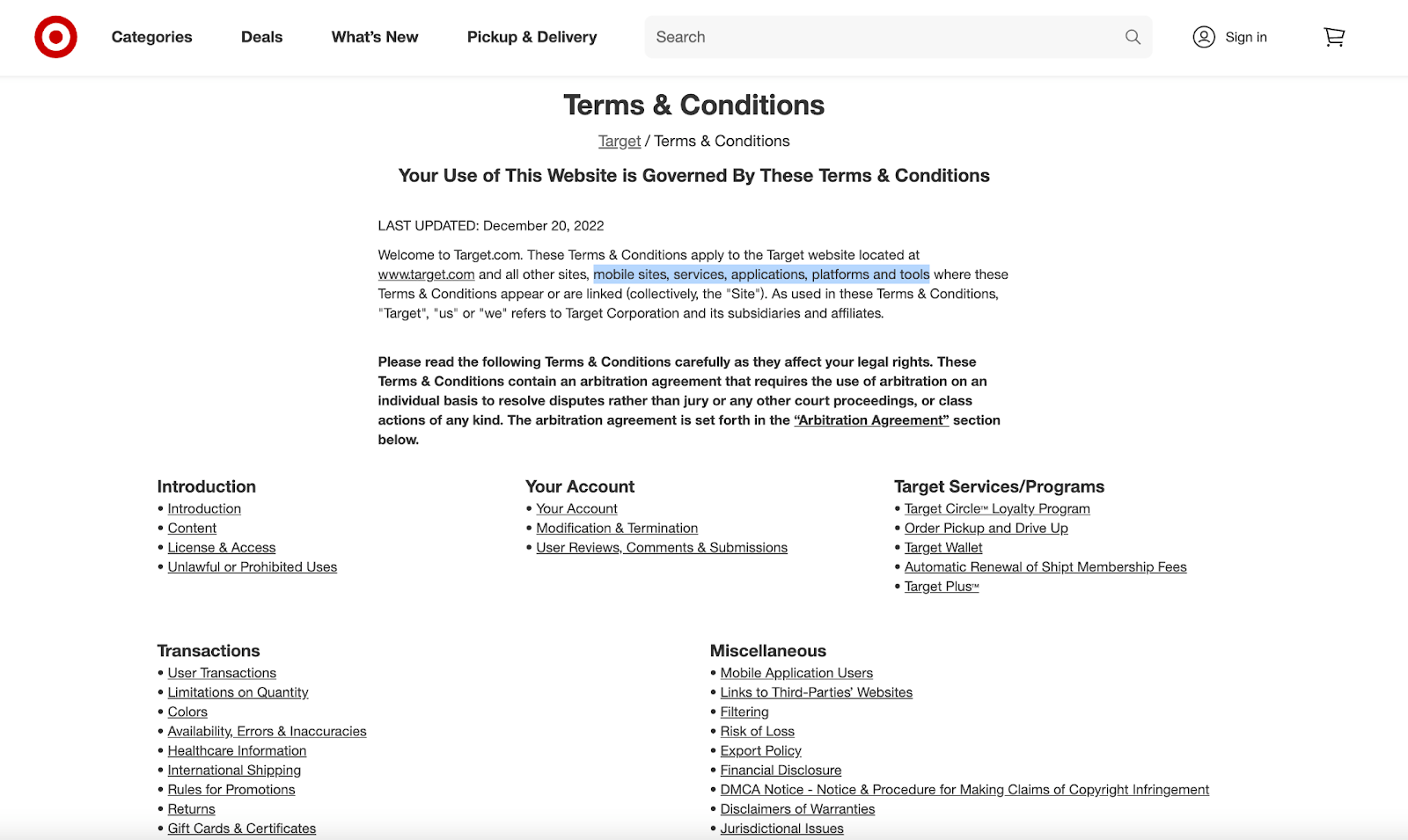
Target's agreement covers its website, mobile apps, services, applications, platforms, and tools under a single document. That's a wide scope, and the jump navigation at the top, letting users skip to specific sections, is what makes it usable at that length.
What to emulate: Jump links at the top of any long agreement. Readers rarely read T&Cs top-to-bottom; they look for the section relevant to their situation. Navigation anchors reduce friction and signal that the company has nothing to hide.
Best for: Multi-channel retailers and businesses operating across web, app, and physical locations.
2. Spotify
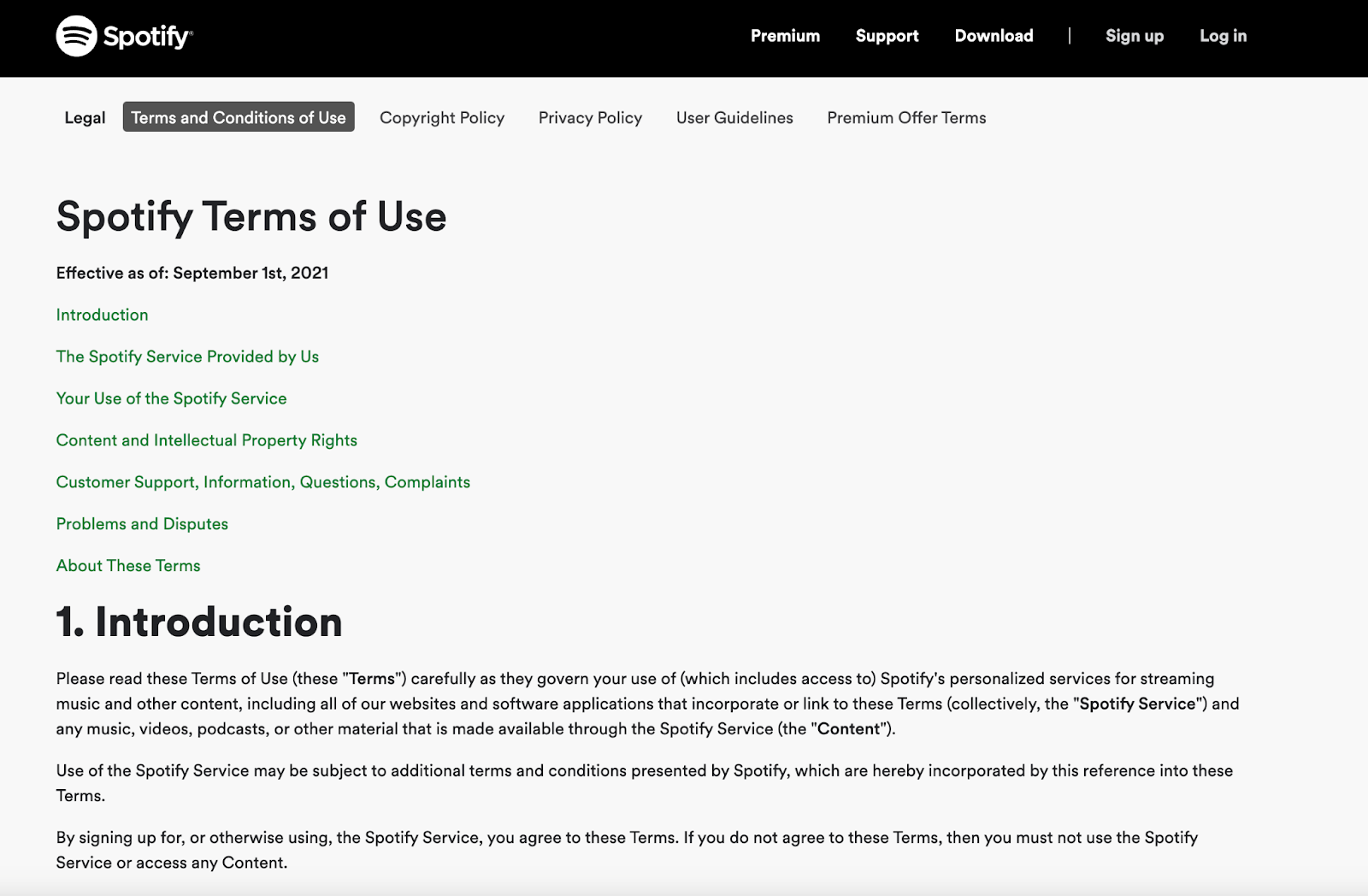
Link: spotify.com/us/legal/end-user-agreement
Spotify's agreement has to balance two competing interests: protecting artists' intellectual property while clearly communicating to users what they can and cannot do with streamed content. It does this without burying either party in legal language — the document reads clearly and avoids the dense paragraph blocks that make most legal agreements unreadable.
What to emulate: Plain language throughout. If your legal team insists on including complex provisions, pair each with a plain-language summary. Spotify's approach of clearly separating "what you can do" from "what we can do" is worth borrowing.
Best for: Two-sided marketplaces, platforms with both creators and consumers, and subscription-based services.
3. English Premier League
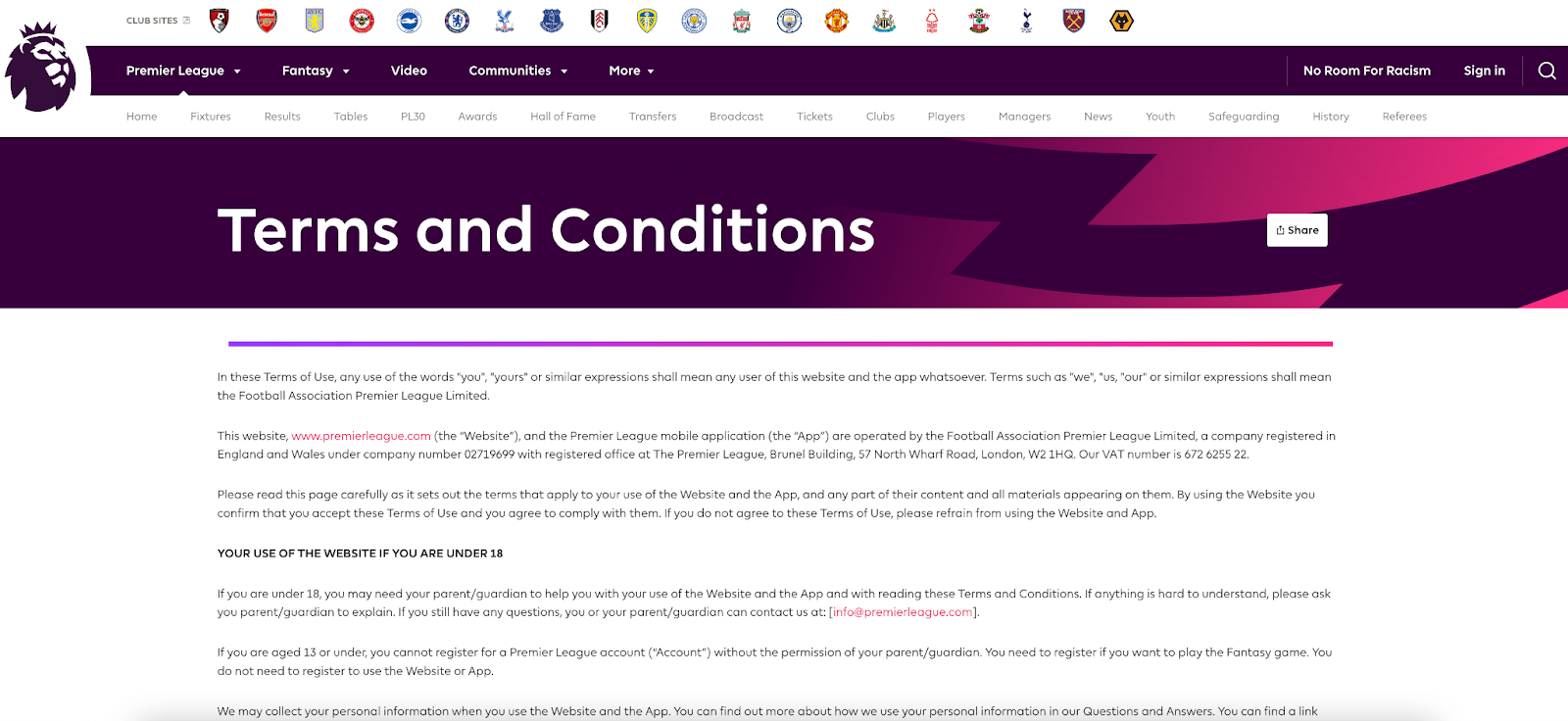
Link: premierleague.com/terms-and-conditions
The EPL's terms and conditions agreement is shorter than most on this list, but it does the job effectively. It governs how users interact with the site and the mobile app, but does not discuss activities related to its ecommerce platform.
What to emulate: Match the length of your agreement to the scope of your actual service. If you run an informational or community site, a short, focused terms of use is more appropriate than a sprawling multi-section document.
Best for: Media organizations, sports properties, and content publishers.
4. Ancestry.com
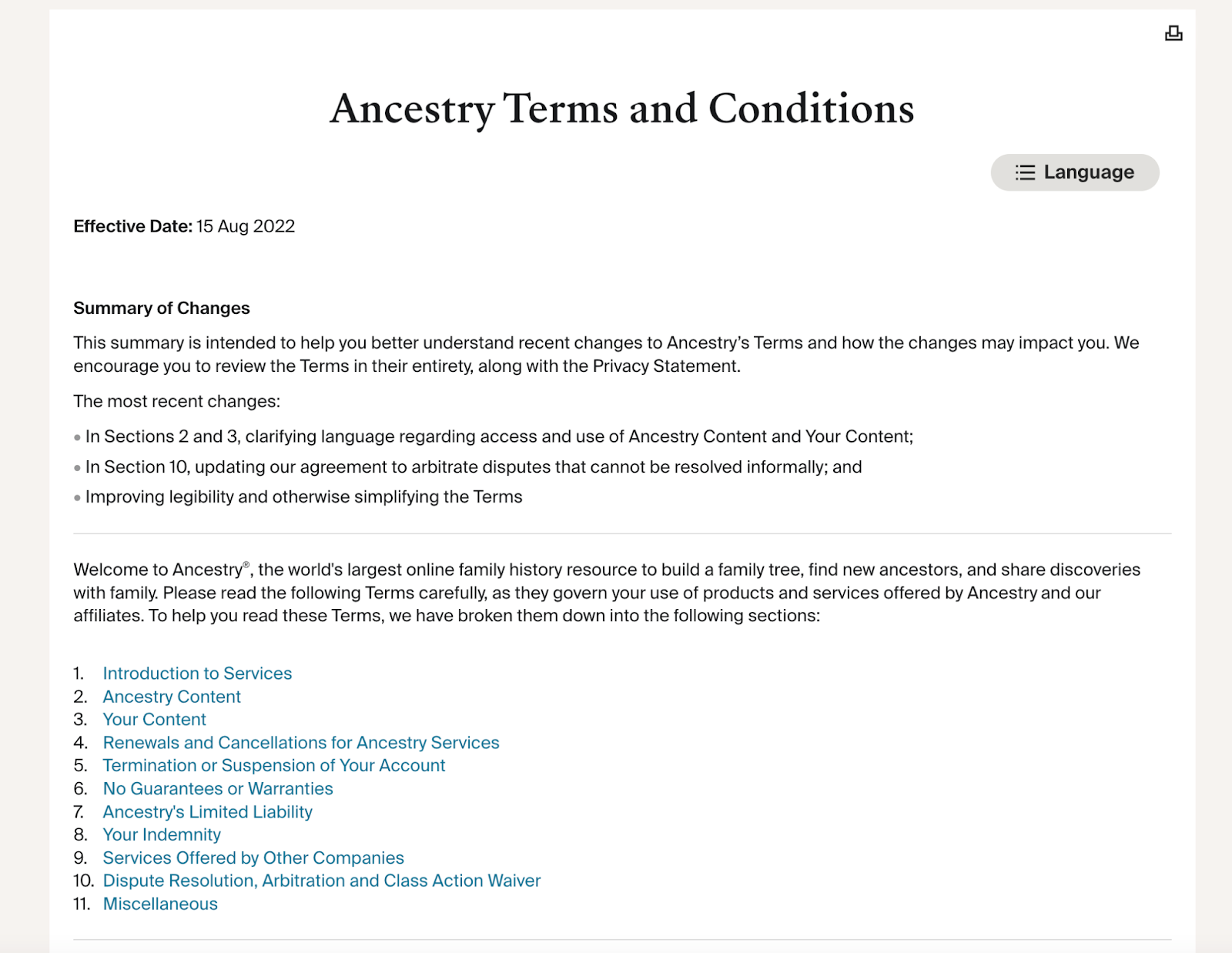
Link: ancestry.com/c/legal/termsandconditions
Ancestry collects highly sensitive personally identifiable information, including DNA. That makes their terms and conditions particularly consequential. The agreement is well-structured and clearly addresses how sensitive data is used to generate results, handling a uniquely complex user trust problem in plain language.
What to emulate: The more sensitive the data you collect, the more explicit your T&C needs to be about how that data is used, stored, and shared. Don't bury data handling in the privacy policy alone - surface it in the T&C too.
Best for: Health tech, consumer biotech, identity platforms, and any service that handles biometric or genetic data.
5. Costco
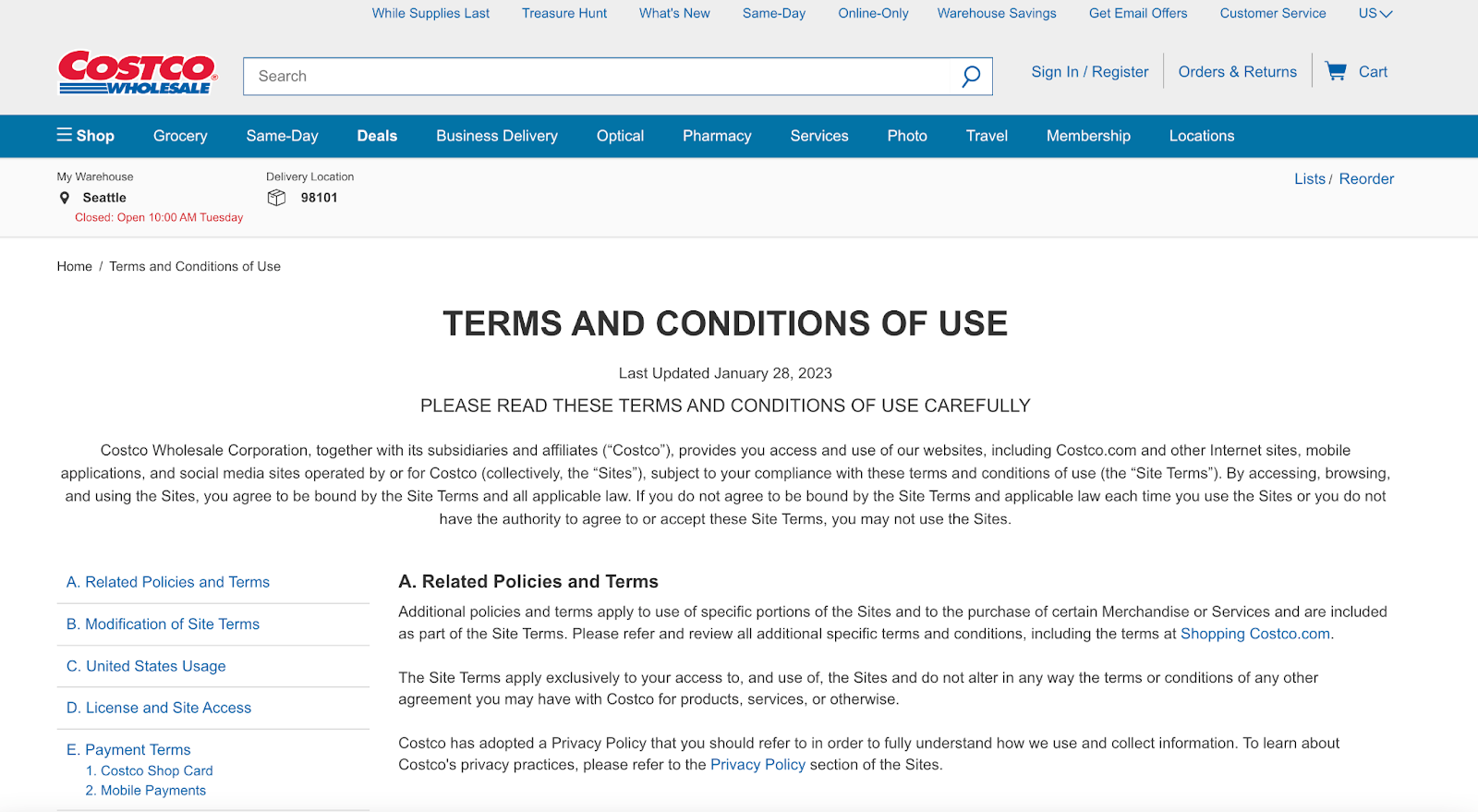
Link: costco.com/terms-and-conditions-of-use.html
Costco runs one of the largest membership retail operations in the world. Their agreement is complex and comprehensive, covering both retail and digital touchpoints. The section's links, while not as polished as Target's jump navigation, allow users to skip to specific provisions.
What to emulate: For membership-based businesses, make sure your T&C explicitly covers the membership relationship — what it entitles users to, when it renews, and the conditions under which it can be terminated.
Best for: Membership businesses, warehouse retailers, and subscription-based services with both digital and physical components.
6. Sony Music
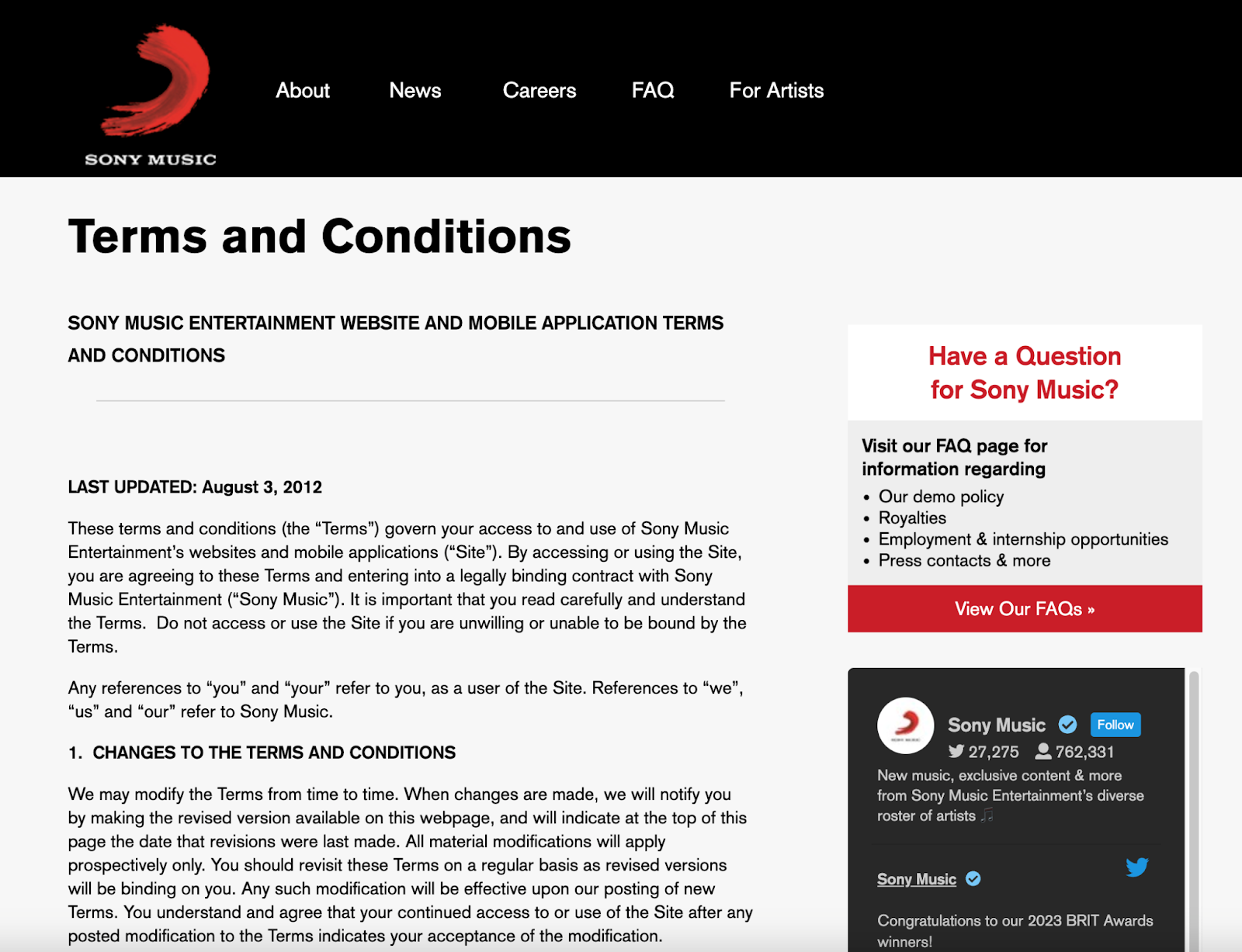
Link: sonymusic.com/terms-and-conditions
Sony Music's agreement handles the complex intellectual property landscape of a major music label. Like Spotify, it has to address the rights of both artists and listeners, though it does so from the rights-holder perspective rather than the platform perspective.
What to emulate: If your business involves third-party IP — whether you're licensing content, enabling user-generated content, or distributing creative work — your T&C needs an explicit IP ownership and licensing section. Sony's is thorough.
Best for: Record labels, content studios, licensing businesses, and creative platforms
7. Government of Canada
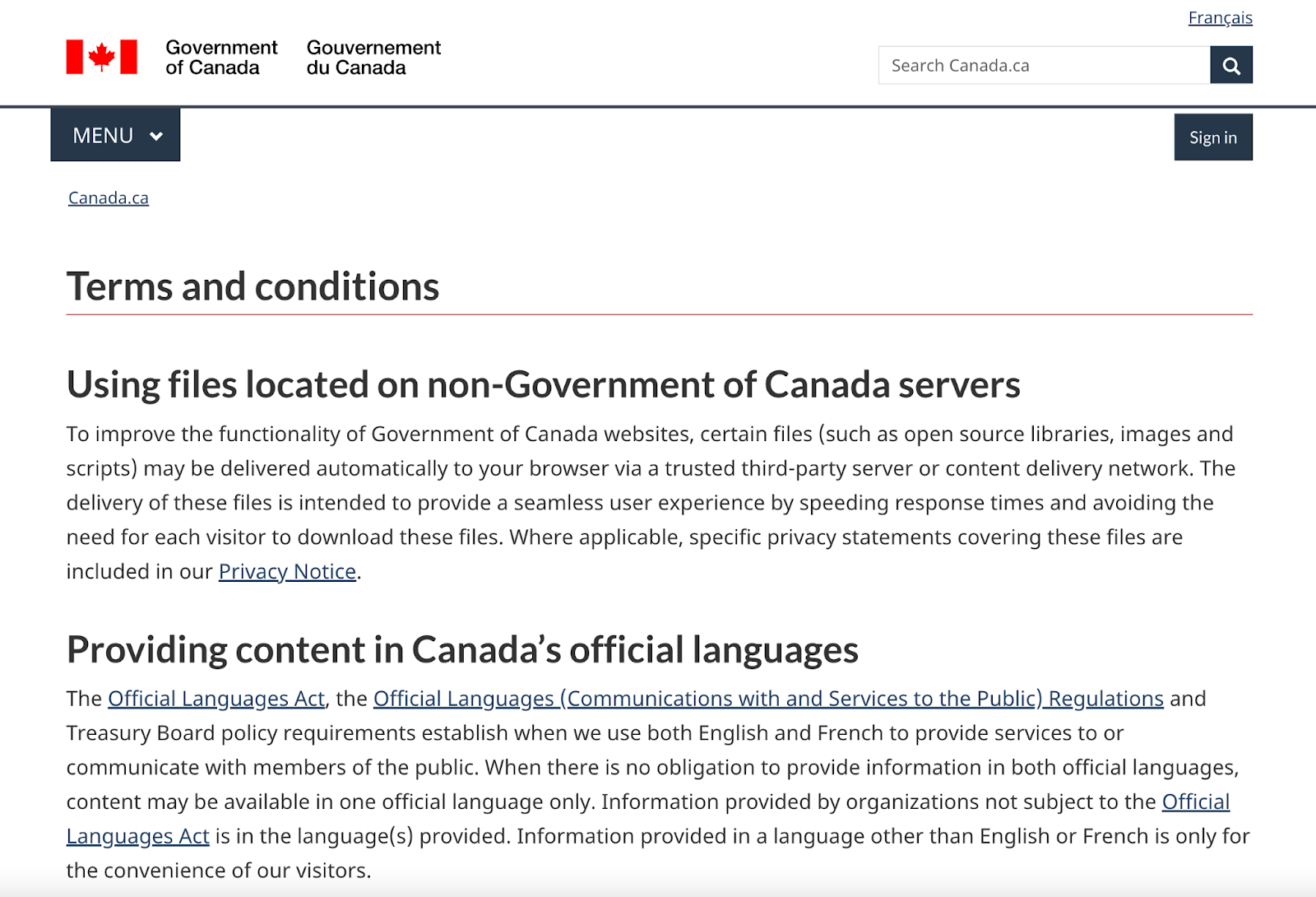
Link: canada.ca/en/transparency/terms.html
The Canadian government's terms of use is notable for what it covers: accessibility, social media posting, IP addresses, and user responsibilities, and for its tone. It reads like a public communication rather than a legal contract, which is appropriate for a government site where clarity and accessibility are priorities.
What to emulate: The tone. Most businesses over-legalize their T&Cs when plain language would serve users better. If the Government of Canada can write a readable terms of use, so can you.
Best for: Government agencies, NGOs, nonprofits, and public institutions.
9. Ryan Air
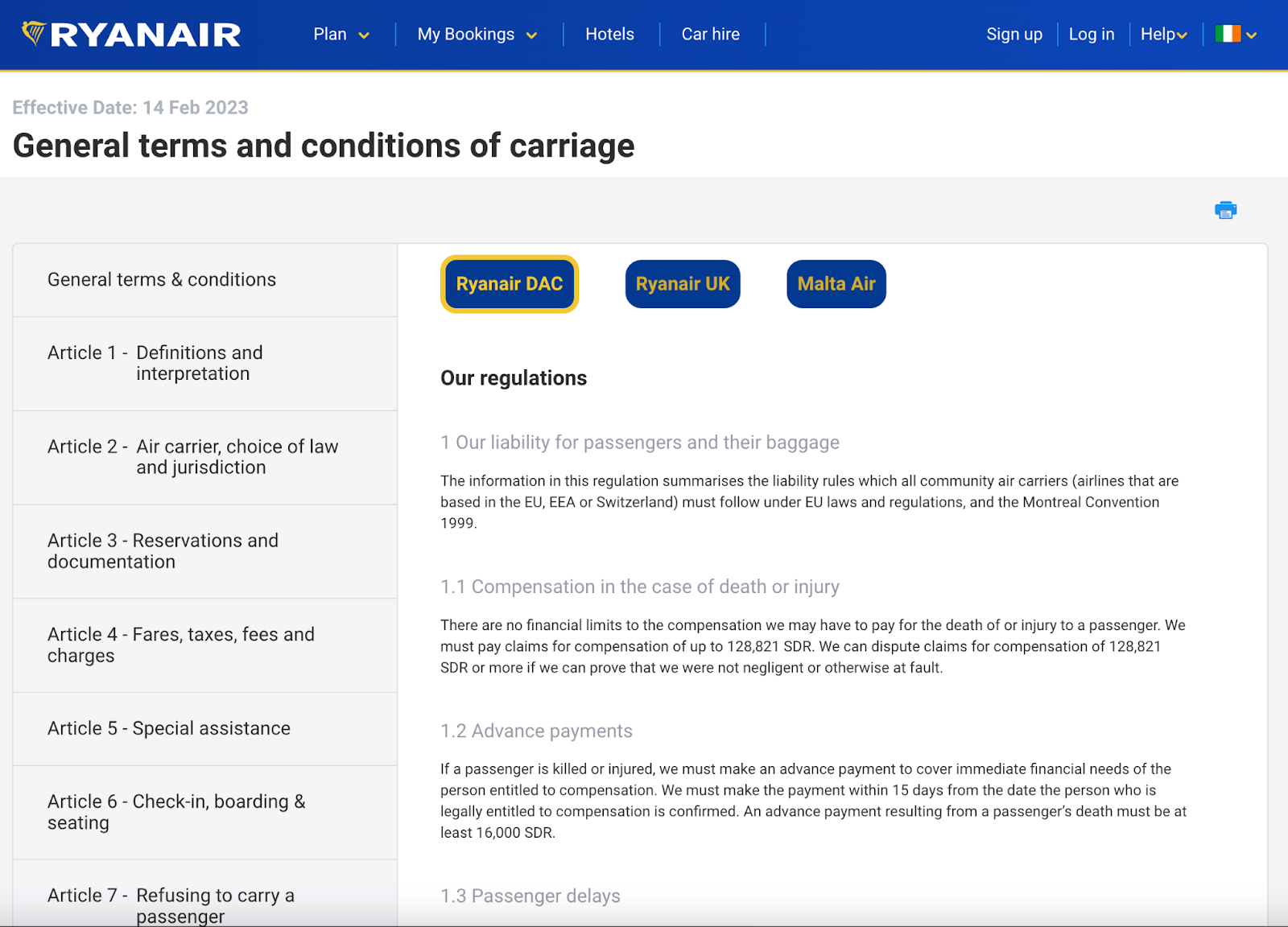
Link: ryanair.com
Travel is operationally complex — liability for passengers, compensation frameworks, baggage rules, delays, and international flight regulations all require explicit coverage. Ryanair's agreement is long, but it needs to be. The structure is clear enough that passengers can find the section relevant to their situation.
What to emulate: The liability and compensation sections. If your service carries real-world risk or involves physical delivery, your T&C needs to be explicit about what you are and are not responsible for.
Best for: Airlines, travel companies, logistics providers, and any service with physical delivery or real-world risk.
9. DoorDash

Link: help.doordash.com
DoorDash operates a three-sided marketplace: customers, restaurants, and drivers. Their agreement is dense, but it handles the complexity of governing multiple user types under a single document. The arbitration and dispute resolution sections are particularly detailed.
What to emulate: Arbitration clauses. DoorDash's agreement clearly specifies how disputes are handled, which jurisdiction applies, and how class action opt-outs work. If you operate in the US, this kind of provision is worth including and worth getting a lawyer to draft properly.
Best for: Gig economy platforms, two-sided and three-sided marketplaces, and on-demand delivery services.
10. BBC Studios
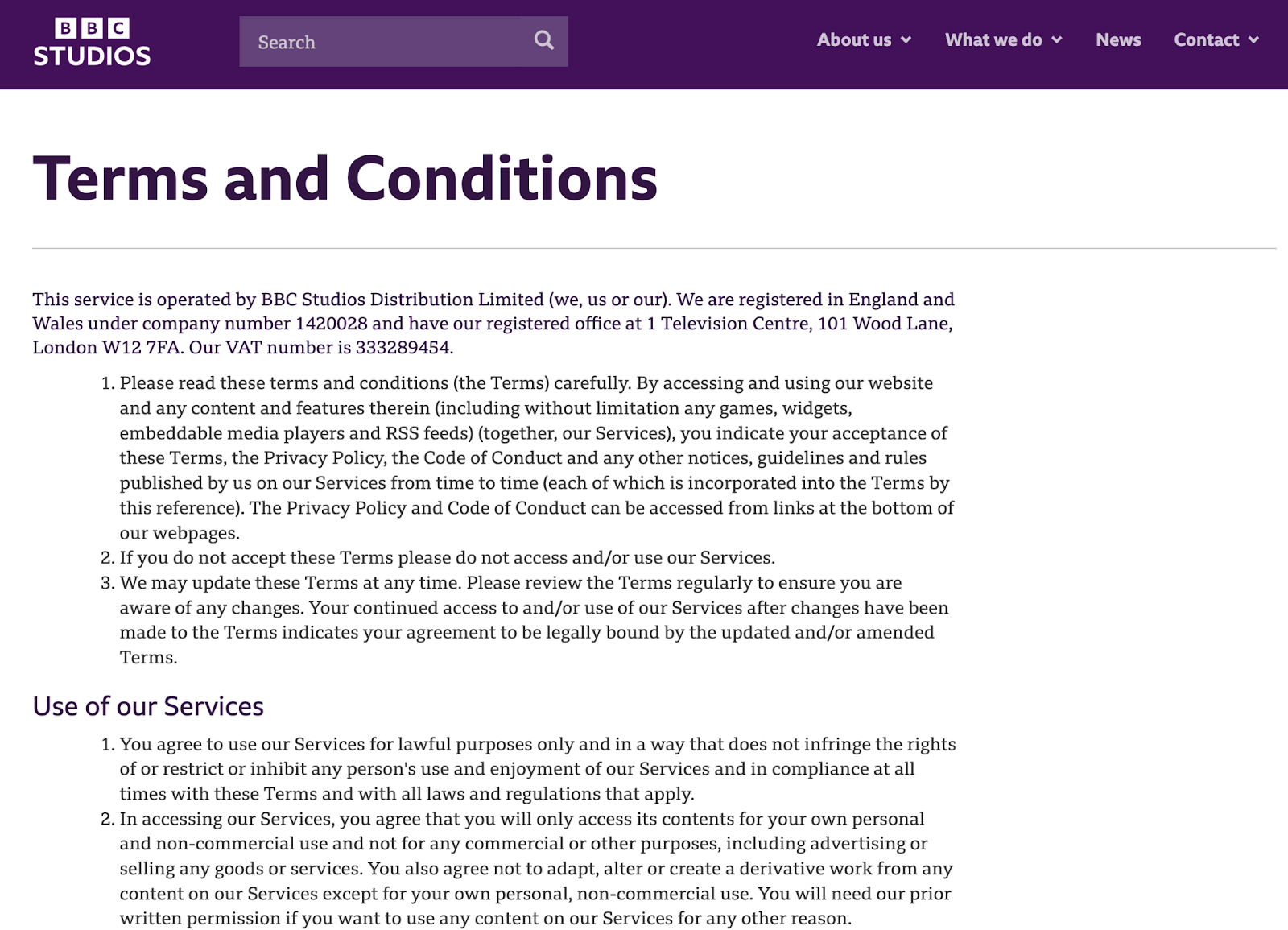
Link: bbcstudios.com/terms-conditions
BBC Studios addresses copyrights, intellectual property, user contributions, and liability — the core concerns for any content studio with a global digital presence. The IP section is especially thorough, which reflects the value of the content they're protecting.
What to emulate: User-generated content provisions. If your platform allows users to post, submit, or share content, your T&C needs to specify what rights you have to that content and what rights the user retains.
Best for: Content studios, production companies, publishers, and platforms with UGC.
11. Disney
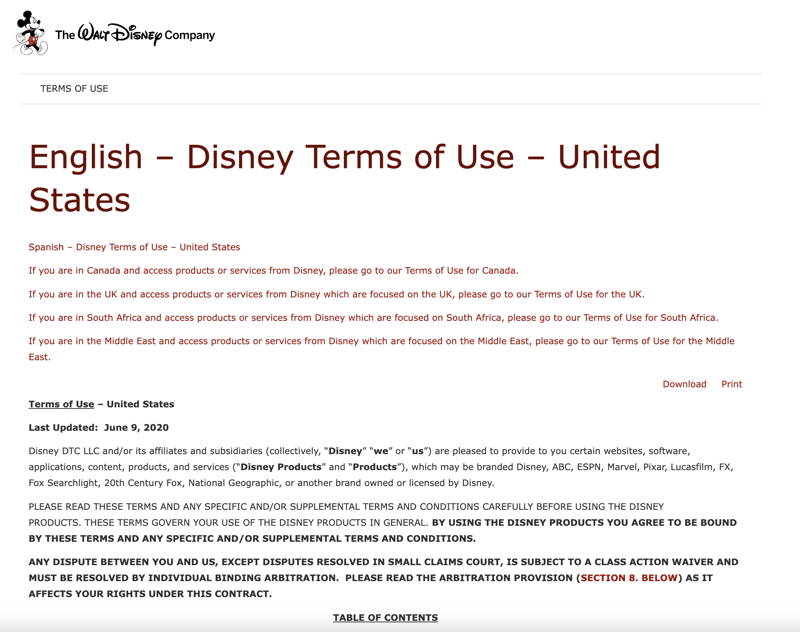
Link: disneytermsofuse.com/english
Disney's terms of use covers subscriptions, licenses, contests, liabilities, and user-generated content across one of the most complex brand portfolios in existence. Despite covering a huge amount of ground, it remains organized and reasonably readable.
What to emulate: The contest and promotion provisions. If you run giveaways, sweepstakes, or promotional campaigns, these need to be explicitly addressed in your T&C — especially if you operate across multiple jurisdictions with different promotional rules.
Best for: Consumer brands with digital subscriptions, entertainment companies, and any business that runs recurring promotions.
12. Apple
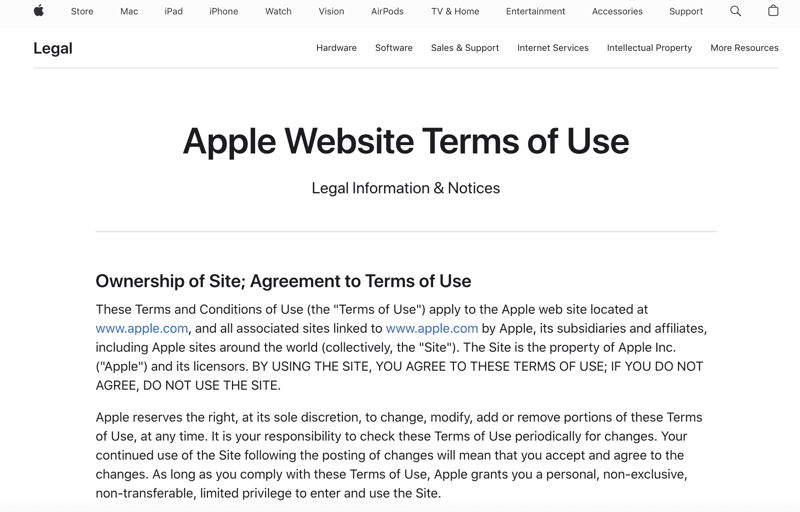
Link: apple.com/legal/internet-services/terms/site.html
Apple's site-level terms of service are notably brief — a conscious choice for a company whose marketing is built on clarity and simplicity. The agreement covers the essentials without overreach. The lesson here is about restraint.
What to emulate: Only include provisions that are actually relevant to your business. Copying a comprehensive enterprise-level T&C template when you run a simple informational site creates unnecessary confusion and may create obligations you didn't intend.
Best for: Product companies with simple website terms separate from their product-specific agreements.
13. Shutterstock
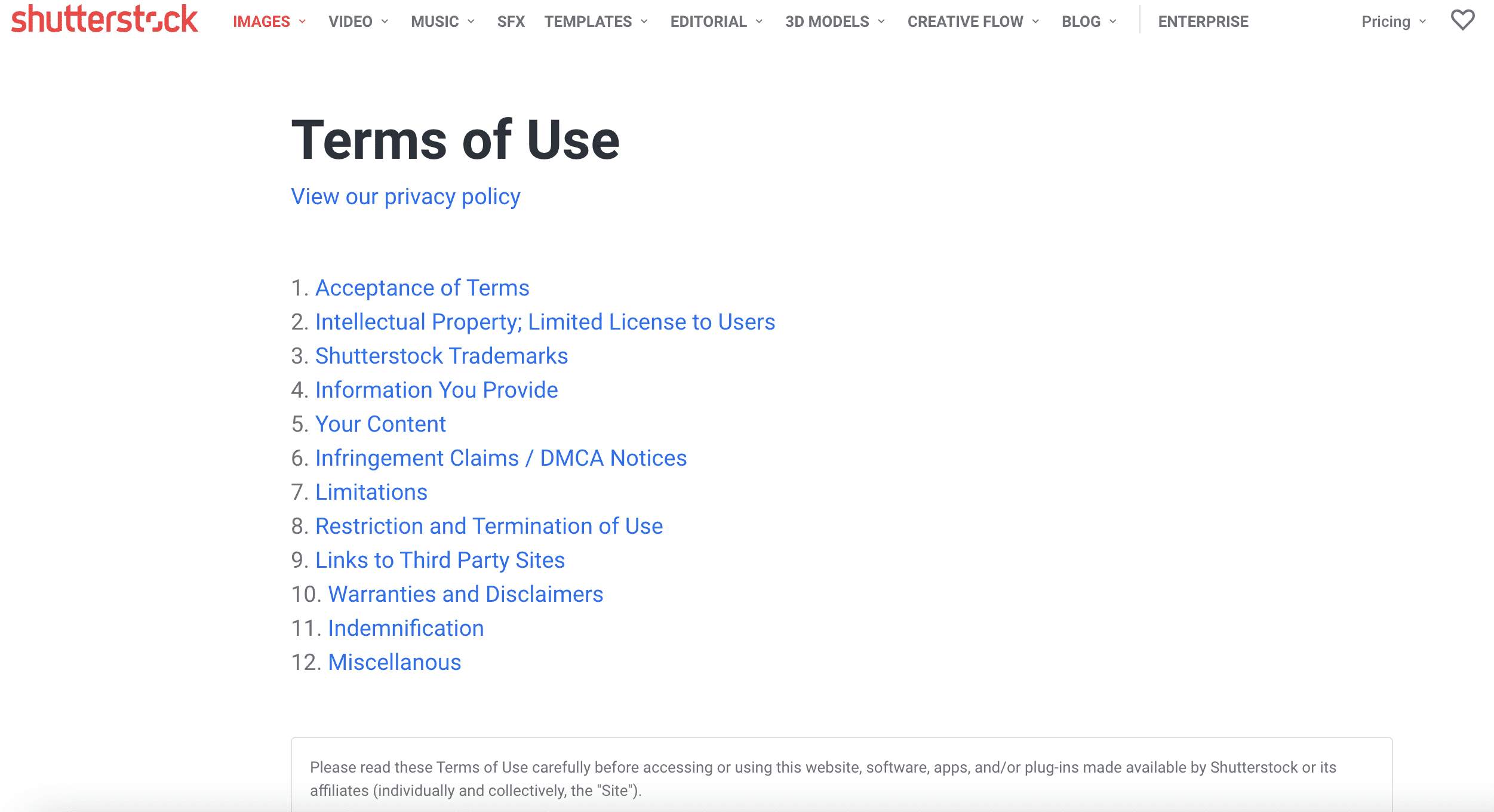
Link: shutterstock.com/terms
Shutterstock processes user-generated images and intellectual property at scale. Their twelve-section terms of use clearly delineates what contributors can upload, what buyers can do with licensed images, and how disputes are resolved. The licensing structure, distinguishing between royalty-free and rights-managed content, is handled well.
What to emulate: Clear license definitions. If your business sells or licenses any form of content or IP, your T&C should define exactly what the buyer receives: what they can do with it, what they can't, and for how long.
Best for: Stock media platforms, digital marketplaces, and SaaS tools that produce or distribute licensable outputs.
14. Roblox
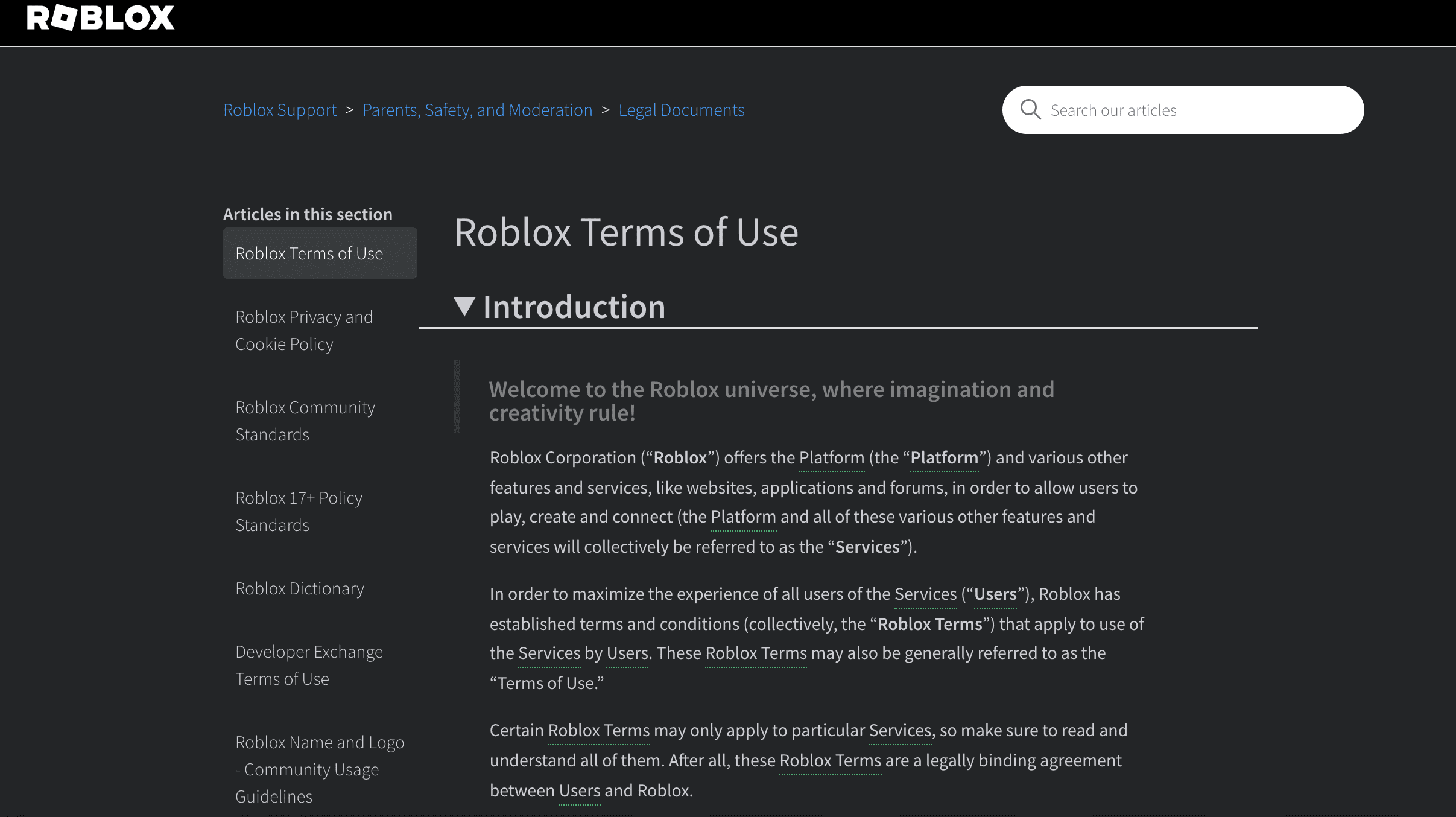
Link: en.help.roblox.com/hc/en-us/articles/115004647846
Roblox's terms of use has to address a uniquely challenging dynamic: a platform primarily used by minors, with UGC creation, virtual currency, and online community features. The agreement handles each of these dimensions explicitly, and the on-brand presentation signals accessibility rather than corporate distance.
What to emulate: Age-appropriate language and parental consent provisions. If your service is used by or accessible to minors, your T&C needs to address parental consent, data collection restrictions, and COPPA compliance explicitly.
Best for: Gaming platforms, educational tech, and any service with significant under-18 usage.
15. Unsplash
Link: unsplash.com/terms
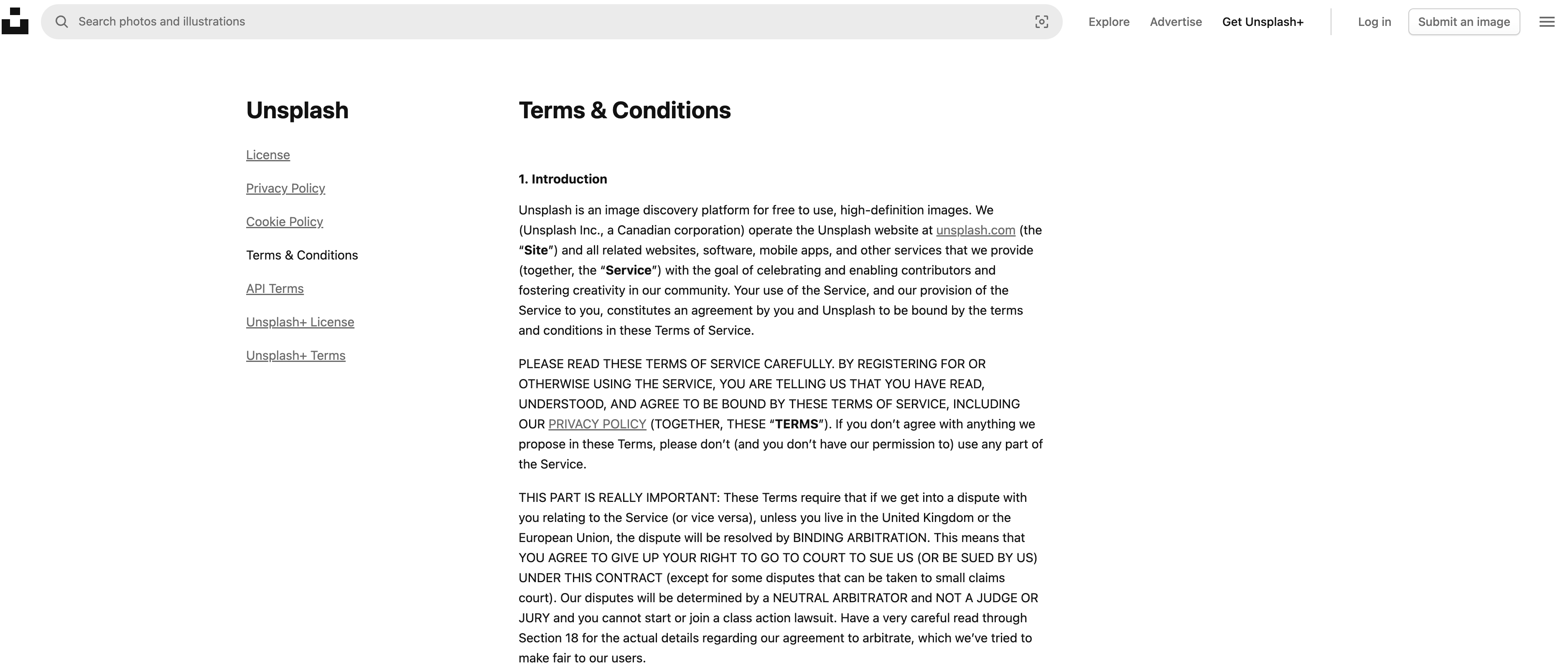
Unsplash handles the licensing complexity of a dual-tier image platform: some images are royalty-free, others are paid — without a lot of visual design polish on the terms page itself. What it does well is structure: clear headings, short paragraphs, and links to the privacy policy, cookie policy, and API conditions.
What to emulate: Cross-linking to related legal documents. Your T&C shouldn't try to cover everything, it should link out to your privacy policy, cookie policy, and any product-specific agreements where relevant. Unsplash does this efficiently.
Best for: Content platforms, API providers, and any service with layered licensing structures.
16. Enzuzo

Disclosure: Enzuzo also publishes its own terms of service, which you can view at enzuzo.com/terms-of-service. We've included it here as a reference, not as a ranked recommendation.
Enzuzo's terms of service is structured around readability: short blocks, clear section headings, and plain language throughout. It was generated using Enzuzo's own terms of service generator and is compliant with GDPR, CCPA, and other major privacy frameworks.
What to emulate: Breaking up policy text into short, digestible blocks rather than dense paragraphs. Most users will not read a T&C in full, but they will scan it. Short blocks with clear headings make key provisions findable.
Best for: SaaS companies and web-based businesses looking for a clean, compliance-ready format.
Free terms and conditions template - what's included
👉 Download the free terms and conditions template in Google Docs
The template covers the sections most businesses need, written in plain language that you can edit to match your specific product or service:
- Introduction and acceptance: establishes that using your service constitutes agreement to the terms
- Updates and modifications: explains how and when the agreement can change
- Website and content ownership: asserts your IP rights over the product, content, and branding
- Prohibited activities: defines what users are not permitted to do on your platform
- Rights to access and account termination: covers when and how access can be suspended or revoked
- Limitations of liability: caps your exposure for damages resulting from use of the service
- Privacy policy reference: links to your separate privacy policy and explains the data relationship
- Governing law: specifies which jurisdiction's laws apply to disputes
- Contact information: provides a route for users to raise questions or concerns
- User responsibilities: outlines what users are agreeing to be responsible for
The template is compliant with major data privacy regulations, including GDPR, CCPA, PIPEDA, and CPRA.
Template vs. generator: The Google Docs template gives you a starting point to edit manually. If you want a version that generates automatically based on your specific business type, jurisdiction, and product details, and stays current as regulations change, use Enzuzo's terms of service generator instead.
What should be in a terms and conditions agreement?
Every T&C is different, but the following sections appear in most well-drafted agreements. Use this as a checklist when reviewing or drafting your own.
Introduction: The opening clause confirms that by using the service, the user agrees to the terms. It should also state the legal entity entering into the agreement (your company name and jurisdiction) and when the agreement was last updated.
Updates and modifications: Explains your right to change the terms, how users will be notified of changes, and whether continued use constitutes acceptance of updated terms. This section protects you from users claiming they weren't informed of changes.
Website and content ownership: Asserts your intellectual property rights over the product, code, branding, and content you've created. It should also clarify what users can and cannot reproduce or distribute.
Prohibited activities: A clear list of what users are not permitted to do: scraping, reverse engineering, abusing the platform, or violating others' rights through your service. This section is particularly important for platforms with user-generated content.
Rights to access: Covers the conditions under which you can suspend or terminate a user's access. Be specific: vague language here creates enforcement problems.
Limitations of liability: Limit the financial exposure you accept if something goes wrong with your service. This section typically specifies the maximum damages a user can claim and excludes certain categories of loss.
Privacy policy: Your T&C should not try to contain your full privacy policy, but it should reference it explicitly and link to it. Note that if your business operates under GDPR or CCPA, the privacy policy itself must work alongside a cookie consent mechanism as a separate compliance requirement from the T&C. For more on how those pieces fit together, see our guide to consent management platforms.
Governing law: Specifies which jurisdiction's laws govern the agreement and where disputes will be heard. For US-based businesses, this is typically the state where you're incorporated. For global businesses, this section requires more careful drafting.
Contact information: Provides a route for users to ask questions or raise concerns about the agreement. Required by some privacy regulations.
User responsibilities: Outlines what users agree to be responsible for — maintaining account security, providing accurate information, and complying with applicable laws when using the service.
How to write terms and conditions for your website
Writing a T&C from scratch is a legal exercise, not a content one. Most businesses shouldn't do it entirely on their own. That said, understanding the process helps you make better decisions about what to include and when to bring in a lawyer.
Step 1: Identify your business model A SaaS product, an ecommerce store, and an informational blog have different legal exposure and different user relationships. Your T&C should reflect the actual scope of your service — not a generic template that assumes you're doing everything.
Step 2: Identify the jurisdictions you operate in If you have users in the EU, GDPR applies. If you have users in California, CCPA applies. Canadian businesses operating federally fall under PIPEDA. Each jurisdiction has different requirements for what must be disclosed and how disputes are handled.
Step 3: Cover the non-negotiable sections At minimum: acceptance mechanism, IP ownership, prohibited activities, liability limitations, governing law, and a privacy policy reference. These are the sections that do the most legal work.
Step 4: Write in plain language Dense legal prose makes your T&C harder to enforce, not easier. Courts have increasingly rejected agreements that users couldn't reasonably understand. Plain language protects you.
Step 5: Get legal review for anything high-stakes If you're processing payments, handling sensitive data, running a marketplace, or operating in multiple jurisdictions, get a lawyer to review the final document before you publish it.
Step 6: Keep it current A T&C that was accurate in 2021 may not be compliant in 2026. Review it annually at minimum, and update it whenever your product materially changes or a new regulation takes effect.
If you want a detailed guide, check out our resource on how to write terms and conditions. To skip the drafting process entirely, Enzuzo's terms of service generator produces a compliant, plain-language agreement based on your specific business details.
Frequently asked questions
What should a terms and conditions agreement include? A complete terms and conditions agreement should cover: acceptance of terms, IP ownership, prohibited activities, rights to access and account termination, limitations of liability, a reference to your privacy policy, governing law, contact information, and user responsibilities. The exact sections vary based on your business model and the jurisdictions you operate in.
Do I legally need terms and conditions on my website? There is no universal law requiring every website to have a terms and conditions agreement. However, specific regulations do require certain disclosures; GDPR requires information about data processing, CCPA requires disclosure of data sale practices, and COPPA requires parental consent for services directed at children. Beyond regulatory requirements, a T&C is the primary mechanism for limiting your legal liability, so most businesses with any user interaction benefit from having one.
What is the difference between terms of service, terms of use, and terms and conditions? Terms of service is most common for software and technology platforms. Terms of use typically governs how visitors interact with a website without a commercial relationship. Terms and conditions is the broadest label, covering the full scope of a business-user relationship including payment, IP, and liability. In practice, the three are often used interchangeably as the label matters less than the content.
Can I copy terms and conditions from another website? No. Another company's T&C is protected by copyright, and copying it is infringement. More practically, another company's agreement reflects their specific legal structure, business model, and jurisdiction, it won't accurately represent yours and may expose you to liability it wasn't designed to protect against. Use a template as a structural guide, then customize it for your business, or use a generator that produces a tailored agreement automatically.
How do I write terms and conditions for a small business? Start with a template that covers the standard sections: acceptance, IP, prohibited activities, liability, and governing law. Edit each section to reflect your actual product, jurisdiction, and user relationship. If you're running a simple website without ecommerce or sensitive data, a short, plain-language agreement is more appropriate than a lengthy enterprise-style document. For businesses that process payments or handle personal data, legal review is worth the investment.
Osman Husain
Osman is the content lead at Enzuzo. He has a background in data privacy management via a two-year role at ExpressVPN and extensive freelance work with cybersecurity and blockchain companies. Osman also holds an MBA from the Toronto Metropolitan University.
LinkedIn →More related blogs
Your next read