AI Voice Agent Compliance: Consent, Recording and Disclosure

Mate Prgin
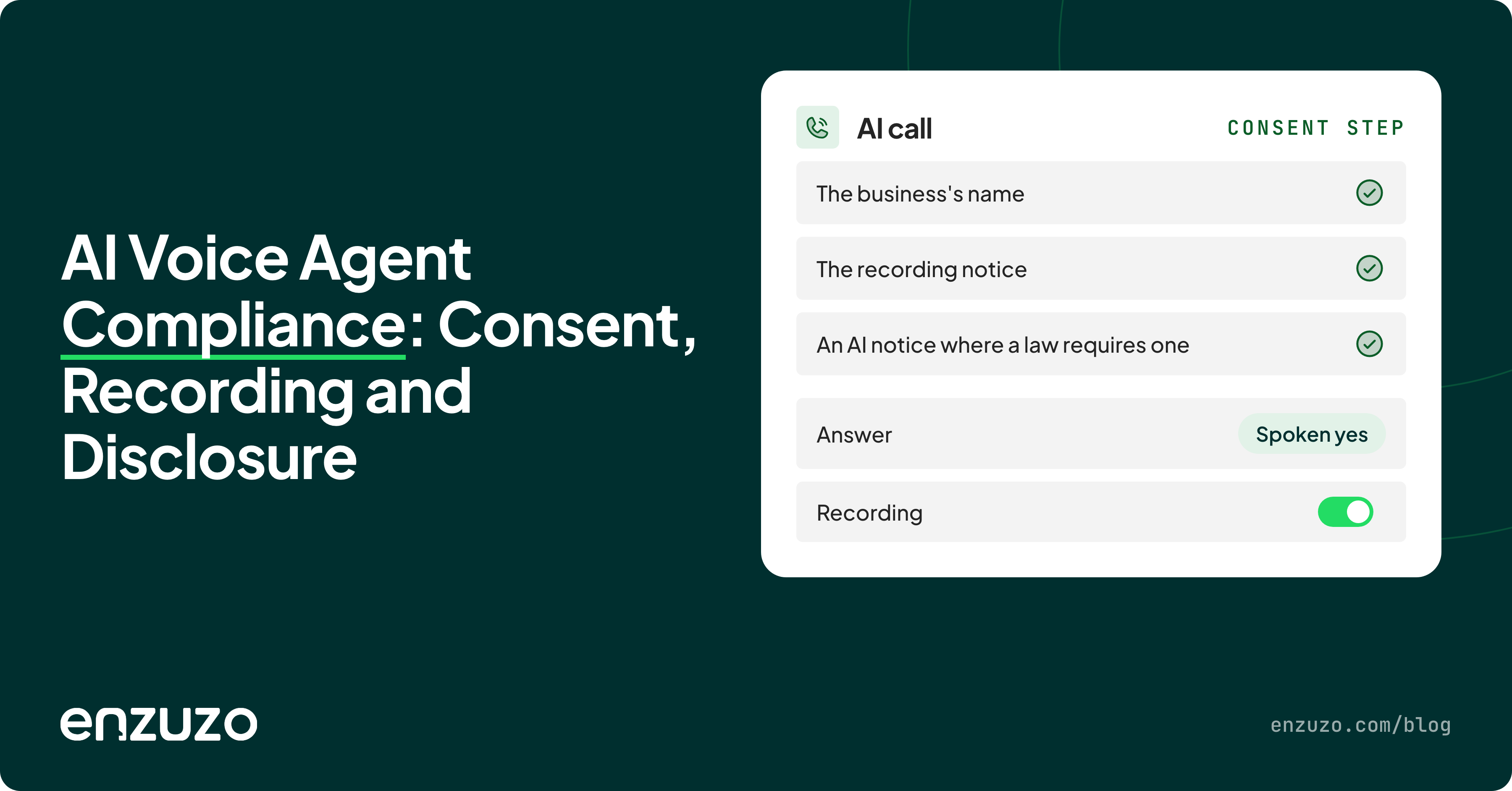
AI voice agent compliance is the set of legal rules a business must follow when it uses AI to place, answer, record or analyze phone calls.
The three rules are consent to call someone, consent to record or analyze the call, and disclosure that the voice on the other line is AI-generated, telling people they're talking to an AI.
The business that deploys the voice AI agent is responsible for compliance, not the software vendor powering the technology.
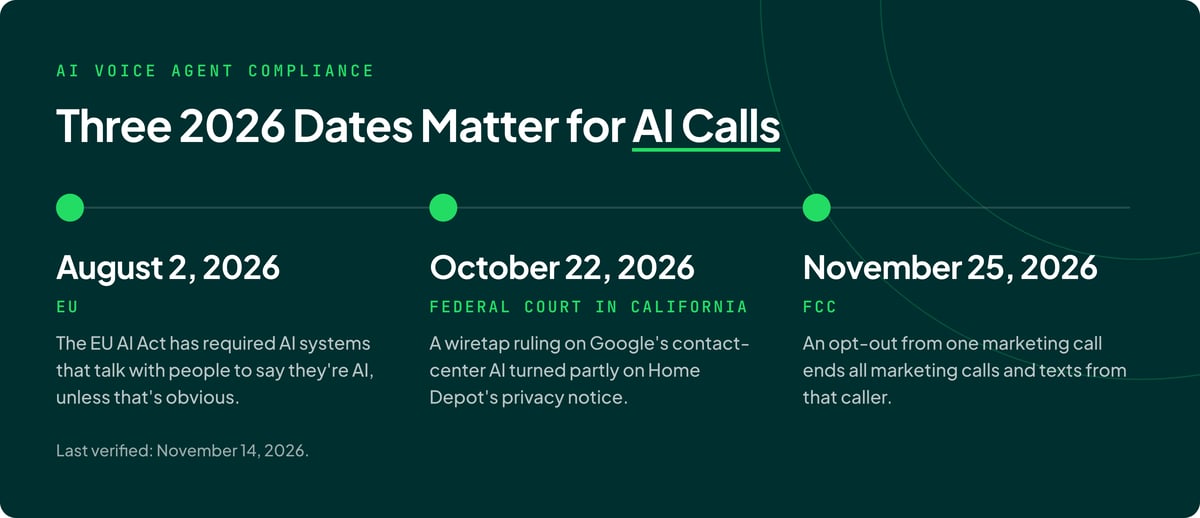
2026 was an important year for AI calls. In August, the EU AI Act came into force, requiring AI systems that talk to humans to disclose they're AI. In October, a US federal judge sided with Google when reviewing a lawsuit alleging that the tech firm illegally recorded phone calls to train its AI. And in November, new amendments to the Telephone Consumer Protection Act (TCPA) mean a single opt-out request made for marketing calls or text messages revokes consent entirely from that specific company.
Is it legal to use AI voice agents on phone calls?
Using an AI voice agent on phone calls is legal in the US only when each call meets specific consent, recording, and disclosure rules. US consent rules come from the Telephone Consumer Protection Act (TCPA), the federal law that governs robocalls.
Canada, the EU and the UK also allow automated marketing calls once the person has given prior consent.
An outbound sales call with an AI voice needs written consent before it’s placed. On the flipside, inbound calls such as an AI receptionist that answers the phone does not require explicit consent.
Rules that apply to inbound and outbound AI calls
The rules for an AI call depend on who places it, what it's for, and whether anyone records or analyzes it.
| Outbound marketing call with an AI voice | |
|---|---|
| Consent to call | Prior express written consent; Do Not Call lists and calling hours apply |
| Consent to record or analyze | One party under federal law; everyone on the call in 13 states |
| AI disclosure | The business identifies itself at the start and offers an opt-out; Maine, Utah, California and the EU add AI rules in some cases |
| Outbound informational call with an AI voice (reminders, notices) | |
| Consent to call | Prior express consent for cell phones, which can be oral |
| Consent to record or analyze | Same as a marketing call |
| AI disclosure | The business identifies itself at the start |
| Inbound call answered by an AI receptionist | |
| Consent to receive calls | None required |
| Consent to record or analyze | Same recording rules; in California, AI software that listens can face wiretap claims |
| AI disclosure | Maine since 2025, Utah on request, the EU since August 2, 2026, and California's AB 1609 for large businesses from 2027 |
| AI analytics on calls between people | |
| Consent to call | Follows whoever placed the call |
| Consent to record or analyze | The AI vendor can count as a third party listening in |
| AI disclosure | No AI speaks, so no AI-voice notice; the EU adds a notice duty for emotion recognition |
| AI notetaker on a call or meeting | |
| Consent to call | No call is placed |
| Consent to record or analyze | Recording consent rules apply; speaker recognition can create voiceprints under biometric laws |
| AI disclosure | Recording notice rules apply |
Most AI call compliance covers outbound calls where disclosure around recording and AI usage is mandatory. Inbound calls don't require explicit consent - such as the AI receptionist example highlighted earlier. Appointment confirmation calls or callbacks are considered outbound, since the calls originate from the business.
Is AI cold calling legal?
AI cold calling is legal only after the person has given prior explicit consent. Without it, a cold call with an AI voice is illegal.
The reason is a February 2024 FCC ruling: AI-generated voices, including voice clones, count as an artificial or prerecorded voice. The ruling allows no exception for technology that claims to work like a live agent or mimic humans.
Who is responsible for compliance: the business or the AI vendor?
The business that deploys an AI voice agent is responsible for most compliance duties, regardless of which vendor powers the tech.
AI vendors can be sued for non-compliance, too. Wiretap claims have been brought against vendors for using call data for their own purposes, such as the 2025 case of Ambriz v. Google.
The EU AI Act takes a narrower view in Europe. Both the company that built the AI tool and the deploying business, must design it such that people know they're talking to an AI.
Types of consent needed by an AI voice agent
An AI voice agent needs consent before almost every call it places.
AI voices count as artificial voices in the US, so the same rules for prerecorded calls apply to AI voice agents too. These have been in effect since February 2024.
Prior express consent
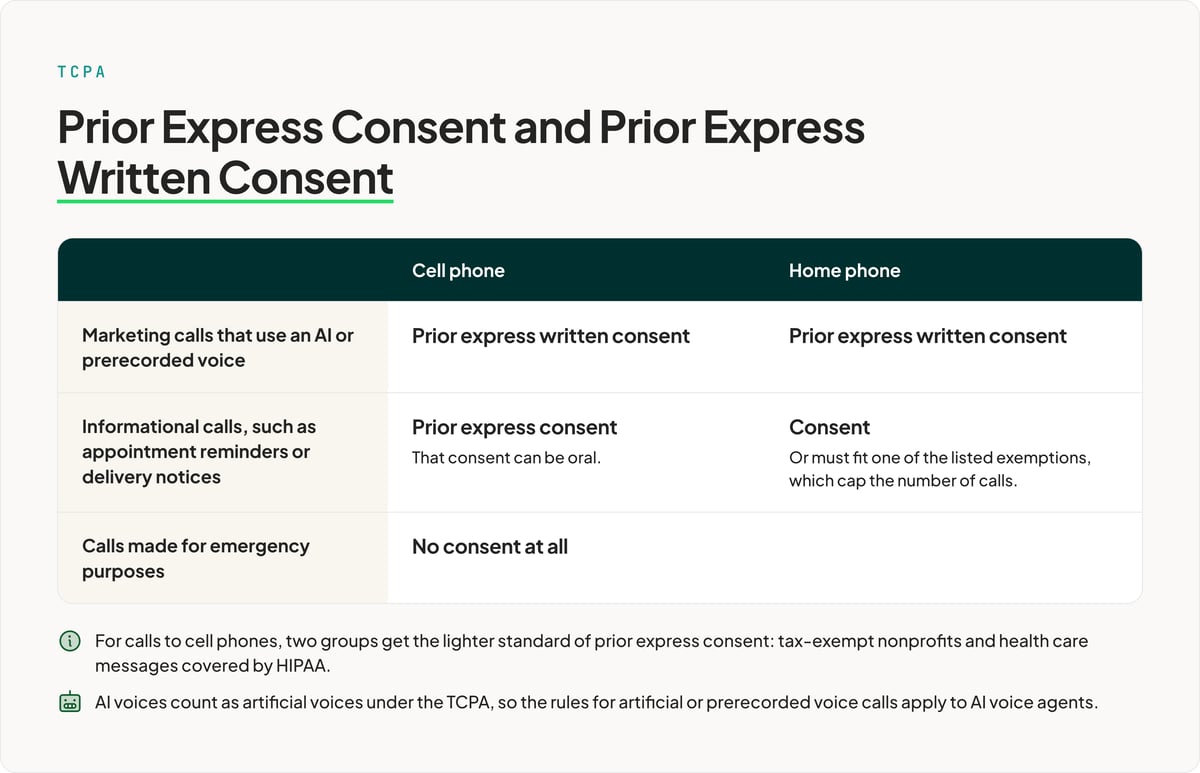
Prior express consent is the required standard for marketing calls that use an AI or prerecorded voice, whether they go to a cell phone or a home phone.
Informational calls, such as appointment reminders or delivery notices, need prior express consent when they go to a cell phone. That consent can be oral, such as an AI disclosing up front and asking for permission. Calls made for emergency purposes need no consent.
Oral consent can be enough under the TCPA for prerecorded calls, telemarketing included, in the US states of Texas, Louisiana, and Mississippi. This precedent was established on February 25, 2026, in Bradford v. Sovereign Pest Control, a case about prerecorded calls to a cell phone.
Opting out from AI calls
Opt-outs from AI calls must be honored within 10 business days of the request, a rule that's been in place since April 2025. Opt-out rules and requirements change on November 25, 2026, under FCC 26-67, too.
The new rules mean an opt-out from one marketing call or text ends all marketing calls and texts from that caller in perpetuity. An opt-out from an informational call can be treated as covering only that category of informational calls.
Callers may also request more ways to opt out. For example, via pressing a key on their number pad, or replying to a text with the word STOP.
For an AI voice agent, the practical change is a spoken opt-out that the agent recognizes, logs the consent choice, and passes on the signal.
Telemarketing rules: the FTC's sales rule, Do Not Call lists and state laws
Sales calls also carry record-keeping duties under the FTC's Telemarketing Sales Rule. Telemarketers have had to keep consent records and a copy of each prerecorded message for five years since May 16, 2024.
The FTC says voice-cloning tools that create a prerecorded message fall under the rule's messaging guidelines. The agency hasn't addressed real-time AI agents, yet. The safe path is to treat them as prerecorded-message calls, thereby complying with the FTC's guidance.
Do Not Call rules cover sales calls to people's homes and cell phones. Numbers on the National Do Not Call Registry can't receive sales calls, including AI-generated.
State laws can be even stricter than federal ones. Robocall rules tightened in Pennsylvania in October 2026, when Act 47 took effect, treating sales calls that use an automated dialing systems to deliver prerecorded voices as robocalls.
Those robocalls now need prior express written consent, including calls to business lines.
TCPA violation costs
A TCPA violation costs $500 per illegal call, or the actual loss, whatever is greater. A court can triple the award, up to $1,500 per call, when the violation was willful or knowing. The people who received the calls can sue, too, so a business can face multiple lawsuits when attempting to use AI voices for unconsented calls.
Political consultant Steve Kramer was fined $6 million in September 2024 for robocalls that used an AI imitation of President Biden's voice.
Can an AI voice agent record and analyze calls?
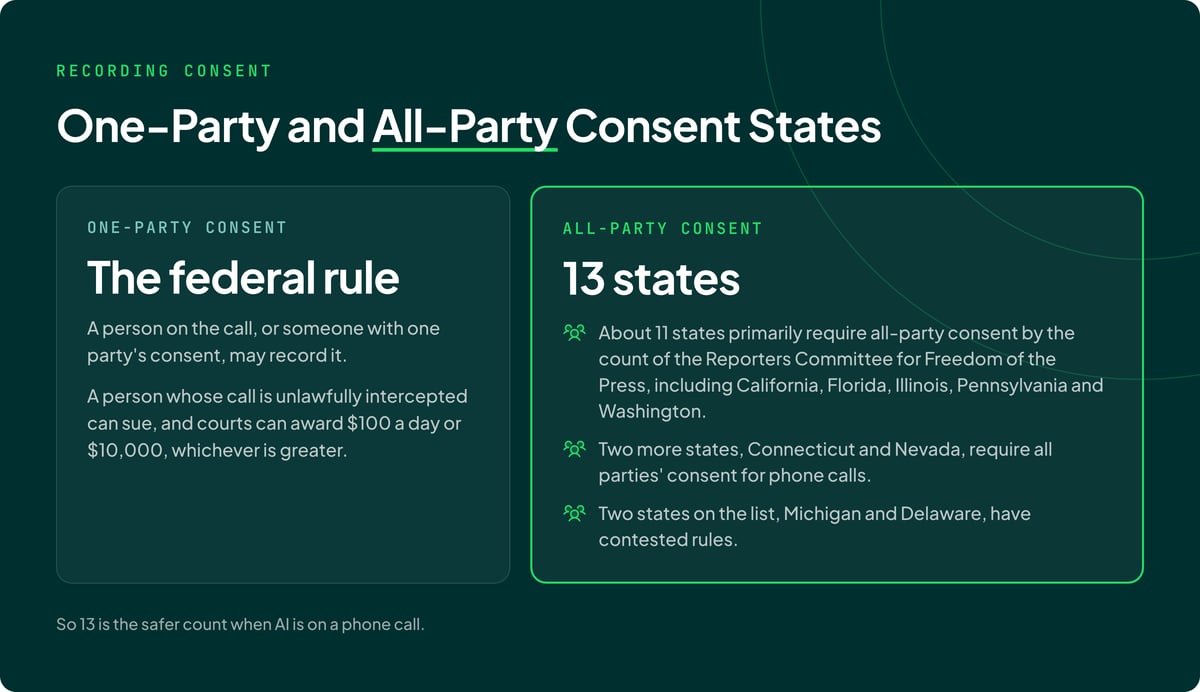
An AI voice agent may record and analyze a call only when the call meets the recording consent rule of each US state involved. In 13 states, that rule means everyone on the call must agree. Most AI call recording laws are older wiretap statutes that courts now apply to software.
One-party and all-party consent states
One-party consent is the US federal rule, which can be overruled by state-specific provisions.
About 11 states primarily require all-party consent, according to the Reporters Committee for Freedom of the Press, including California, Florida, Illinois, Pennsylvania and Washington. Two more states, Connecticut and Nevada, require all parties' consent for phone calls, bringing the total to 13.
A recorded warning at the start of the call, or a beep tone about every 15 seconds, can stand in for everyone's consent in Connecticut.
AI listening to calls can count as eavesdropping
An AI listening to a call can count as eavesdropping under California's wiretap law. That's because the law applies to any entity that listens on phone calls without the other party consenting to it. Courts have allowed claims under that law against software vendors, including an AI tool that took phone orders for Domino's.
Anyone harmed can sue for $5,000 per violation, or three times their actual damages if those are higher. They don't have to prove any damages to sue. These sections are included as part of the California Invasion of Privacy Act (CIPA).
Recording calls across state boundaries
A call between participants in two US states is decided under the stricter version. For example, a Georgia firm that recorded calls with California clients fell under California's recording law in Kearney v. Salomon Smith Barney (2006).
Telling the customer at the outset that the call is recorded is enough to comply. The safe assumption is that the stricter state's law applies, so tread cautiously.
What federal rules require on AI calls
Every artificial-voice call must state the identity of the business at the beginning of the message. The message must also give a phone number. Sales calls must offer a key-press opt-out during the call.
The FCC proposed an AI disclosure rule in August 2024. Callers would have to disclose AI use when they get consent and again at the start of each AI-voice call. That proposal has not been adopted, yet however.
State AI disclosure laws that apply to phone calls
AI disclosure laws depend on the type of business, the type of call, or a caller's question.
| California AB 1609 (Bus. & Prof. Code 22625 to 22628) | |
|---|---|
| Who it covers | Businesses with more than $500 million in yearly revenue that use a customer-service bot with California customers |
| When the AI must be disclosed | In the same medium, phone included, when a reasonable person is likely to be misled |
| Effective date | January 1, 2027 |
| California AB 2905 (Pub. Util. Code 2874) | |
| Who it covers | Calls placed with an automatic dialing-announcing device |
| When the AI must be disclosed | In a live, unrecorded opening announcement, before a recorded message that uses an AI-generated or AI-altered voice |
| Effective date | January 1, 2025 |
| Maine (10 M.R.S. § 1500-DD) | |
| Who it covers | Businesses that use an AI chatbot, text or voice, with consumers |
| When the AI must be disclosed | Clearly, whenever a reasonable consumer could think it's human |
| Effective date | September 24, 2025 |
| Utah (Utah Code 13-77-103) | |
| Who it covers | Businesses that use generative AI with consumers; licensed professionals in high-risk interactions |
| When the AI must be disclosed | When a person clearly asks; for licensed professionals, spoken at the start of the call |
| Effective date | May 7, 2025 (current version) |
| Texas TRAIGA (HB 149) | |
| Who it covers | Government agencies, and health care providers that use AI in a patient's care |
| When the AI must be disclosed | Health care: by the date the service or treatment is first provided |
| Effective date | January 1, 2026 |
There are some laws that look relevant but don't generally apply to business voice agents. For example, conversational AI services in Colorado must disclose AI use from January 1, 2027. The law, HB 26-1263, excludes AI built for customer service, ordering and payments, as well as HIPAA-covered entities and business associates.
The BOT Act in California and New Jersey's bot disclosure law cover online bots on websites and apps. That likely does not apply to AI voices, although it's best to consult with a lawyer for clarity.
The EU AI Act's disclosure rule
The EU AI Act's disclosure rule says AI systems that talk with people must tell them they're interacting with an AI, unless that's obvious, under Article 50. The notice must come during the first interaction.
Fines for non-compliance can reach EUR 15 million or 3% of worldwide annual turnover, whichever is higher.
AI call lawsuits
A slew of lawsuits in 2025 and 2026 hinged on two questions: whether the AI vendor counts as a third party listening in, and what the business told callers before the AI agent joined. The cases name the AI vendor as the defendant, quoting California's wiretap law.
Wiretap suits against AI contact-center software
In Ambriz v. Google (February 2025), a federal court let California wiretap claims proceed against Google's contact-center AI. The court considered whether the AI agent could be classified as an eavesdropper.
Ambriz v. Google was dismissed because two of the three litigants had agreed to a privacy notice that disclosed call recordings to service providers. Those service providers made it clear that Google was one of the receiving parties. Hence, they were unable to prove unconsented calls.
Taylor v. ConverseNow applied the same approach in August 2025 to AI phone ordering for Domino's. The parties agreed in June 2026 to end that case for good, before any class was certified.
Wiretap claims also went forward in November 2025 against a call-analytics vendor over calls to AT&T, in Valencia v. Invoca. No test was chosen there, because the complaint alleged the vendor actually used the data itself.
Thompson v. SoundHound AI, filed in 2026 in Alameda County Superior Court, makes similar allegations about an AI phone-ordering agent at restaurant chains. No ruling has been reported in that case, yet.
AI notetaker cases: Otter.ai and Fireflies
AI notetakers face wiretap claims and biometric claims, because they record meetings and can recognize speakers by voice. Claims against Otter.ai advanced in August 2026 under the federal Wiretap Act, California's wiretap law, and Illinois's biometric law.
Otter counted as a plausible third party because it allegedly keeps meeting data and trains on it. One-party consent didn't end the federal claim, because the federal law excludes recordings made to commit a civil wrong. The biometric claims survived on voiceprint capture. AI privacy violations includes the Otter case and other transgressions.
Fireflies faces a similar biometric class action, titled Fricker v. Fireflies.AI Corp.
It concerns voiceprints that the product's speaker recognition tech allegedly creates.
Website chatbots and tracking pixels face related wiretap claims. A 2026 reform, SB 690, limits one of them, the pen-register claim, to the Attorney General. It leaves the call-recording and wiretap sections untouched. It's reported to take effect on January 1, 2027.
Voice data rules: voiceprints, health information, card numbers and retention
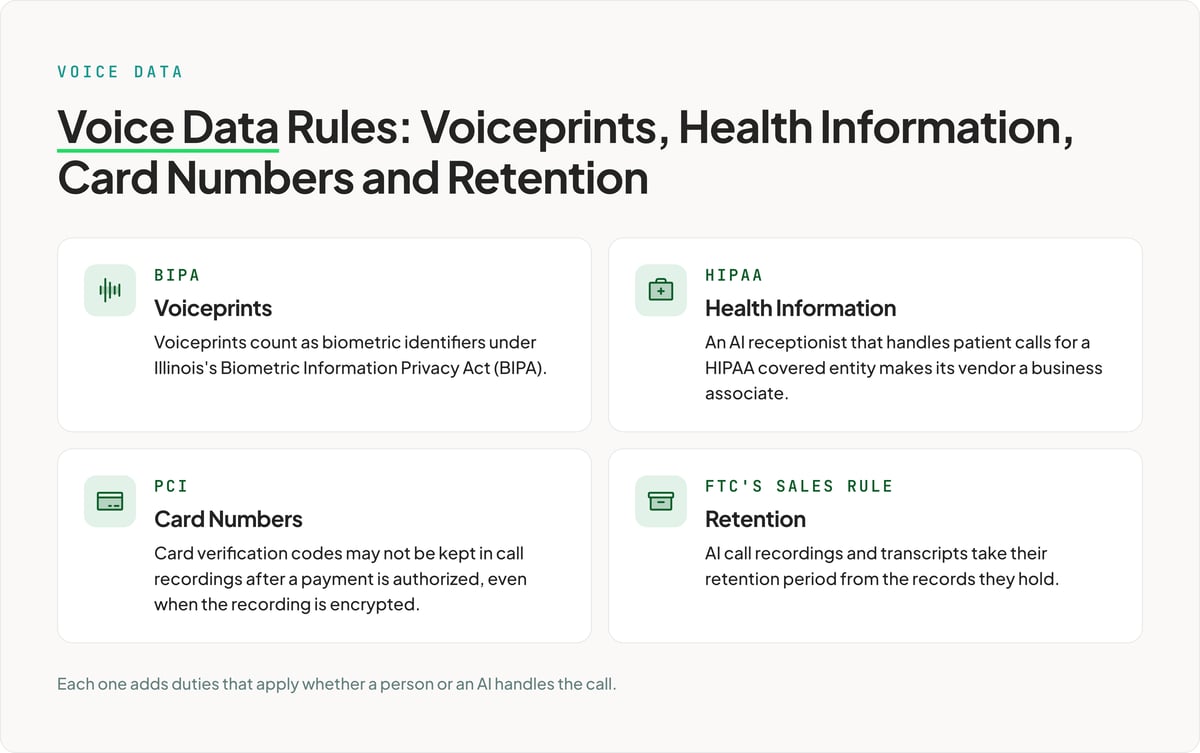
Voice data rules don't apply only to words exchanged during a call: a voiceprint is biometric data, a patient call can contain health information, and a card number read aloud falls under payment card rules. Each one adds its own set of legal complexities.
Voiceprints and biometric privacy laws
Voiceprints count as biometric identifiers under Illinois's Biometric Information Privacy Act (BIPA). A business that captures one needs a public retention schedule and a written release from the individual.
Damages are fixed by the law at $1,000 for a negligent violation and $5,000 for an intentional or reckless one. Information captured from a patient in a health care setting falls outside the scope of this law.
A voiceprint is also a biometric identifier in Texas. Capturing one there for commercial purposes requires notice and consent first. Fines can reach up to $25,000 per violation.
Voice recordings get split treatment in Washington. The state's biometric law excludes audio recordings and data generated from them. Its health-data law, the Washington MHMDA, classifies identifiers from voice recordings as biometric data.
HIPAA and AI receptionists
An AI receptionist that handles patient calls for a HIPAA-covered entity establishes its vendor as a business associate. This means it's considered a liable third-party since a business associate creates, receives, maintains or transmits protected health information. It requires an explicit business associate agreement (BAA).
For an AI receptionist, that chain of agreements can reach the speech-to-text and hosting providers behind the agent.
Card numbers on AI-recorded calls
Card verification codes may not be kept in call recordings after a payment is authorized, even when the recording is encrypted. Audio recordings fall under the ban on storing card security data, according to the PCI Security Standards Council.
An AI agent that takes payments by phone needs a way to keep card codes out of its recordings and transcripts. Where secure deletion isn't technically possible, other safeguards must be implemented.
AI call recording and transcript retention period
AI call recordings and transcripts follow the retention periods of the records they hold. A recording that carries a caller's telemarketing consent is part of the consent record, which must be kept for five years under the FTC's sales rule.
A person's do-not-call request must be honored for five years, so the record of it needs to last that long, too.
AI call rules in Canada, the EU and the UK
Canada, the EU and the UK each require prior consent for automated marketing calls. They differ on who must agree to the recording and on whether an AI must identify itself at the start of the call.
| Canada | |
|---|---|
| Recording rule | One-party consent under the Criminal Code; businesses must say they record and why |
| Automated marketing calls | Automatic dialing-announcing devices only with prior express consent |
| AI disclosure | Under review: CRTC consultation 2026-132 asks whether telemarketers must say the call isn't from a live person |
| EU | |
| Recording rule | A GDPR lawful basis and a notice for each purpose; Germany makes unauthorized recording of private speech a crime |
| Automated marketing calls | Prior consent for automated calling systems |
| AI disclosure | AI Act Article 50(1) since August 2, 2026, at the latest at the first interaction |
| UK | |
| Recording rule | Businesses may record on their own systems for listed purposes after reasonable efforts to inform users |
| Automated marketing calls | Prior consent for automated marketing calls under PECR regulation 19 |
| AI disclosure | No AI-specific rule in PECR regulation 19 or the 2018 business-monitoring regulations |
Recording and AI calls in Canada
A call in Canada may be recorded when one party consents.
A business can rely on implied consent when a caller carries on after the notice. It may need express consent for voiceprints. Callers must get a choice when recording isn't integral to the call, such as outbound appointment reminders.
Sales calls by automated dialers fall under a second regulator, the Canadian Radio-television and Telecommunications Commission (CRTC). It allows automatic dialling-announcing devices only with the consumer's prior express consent.
A business in Quebec that makes a decision about a person based only on automated processing must inform the person of these algorithmic workflows. An AI agent that only routes or books a call is not required to do so; Enzuzo's guide to PIPEDA and Quebec's Law 25 cover the wider privacy rules.
Recording and AI calls in the European Union
Each purpose of a call recording in the EU needs a lawful basis, one of the legal grounds listed in the GDPR, the EU's data protection law. It also needs a notice when the data is collected.
Recording another person's private speech without authorization is a crime in Germany, punishable by up to three years in prison or a fine. In practice, that makes all-party consent the working rule there.
Marketing calls carry a separate consent rule: automated calling systems need prior consent under the ePrivacy Directive. Whether a conversational AI agent counts as one of those systems is unsettled.
AI that analyzes calls faces its own limit in the EU. AI that infers workers' emotions has been banned under the AI Act since February 2025, except for medical or safety reasons.
Recording and AI calls in the United Kingdom
UK businesses may monitor and record calls on their own systems for listed purposes, such as establishing facts, meeting regulatory duties and checking quality standards. They must make all reasonable efforts to tell everyone who may use the system.
Marketing calls follow a separate rule in the Privacy and Electronic Communications Regulations (PECR). Regulation 19 requires the person's prior consent for calls by automated calling systems. Fines for breaking the UK marketing-call rule can reach GBP 17.5 million or 4% of worldwide annual turnover.
Proving consent for AI calls
Proving consent to an AI call means storing records at the moment the person agrees. The record shows what the person saw or heard, what they answered, and when. Sales-call consent, recording consent, AI notices and withdrawals all call for the same kind of record.
A consent record for an AI call should include details on who agreed, to which notice, for which purposes, and when, plus any later withdrawal.
| Field | Why it matters |
|---|---|
| Who agreed: name, and the phone number or participant ID | The FTC's sales rule lists the person's name and number in a complete consent record |
| The notice text and its version | The FTC's sales rule requires a copy of the consent request as it was shown; the Google ruling turned partly on what a privacy notice said |
| The purposes covered: the call, the recording, AI analysis, model training | Canada's privacy regulator expects callers to be told why a call is recorded; the FTC's sales rule records the purpose |
| The answer and how it was given: spoken yes, key press or written | The FTC's sales rule requires a copy of the consent itself; Canada's CRTC accepts written, oral or electronic consent |
| Date and time | The FTC's sales rule records the date of consent |
| Call ID | Links the consent to the recording or transcript it covers |
| AI vendors named in the notice | The Google ruling looked at whether a notice naming service providers covered the vendor |
| Any withdrawal, its date and its category (marketing or informational) | From November 25, 2026, a marketing opt-out ends all marketing calls; opt-outs must be honored within 10 business days |
Consent records for an AI call follow the same logic as consent management on a website. Each choice is stored with what the person saw and when.
Consent steps in an AI call flow
The consent step in an AI call flow comes before any recording or analysis starts. In all-party states, an AI agent that records first and asks later has already recorded without consent. Without a confirmed yes, the safe default is not to record at all.
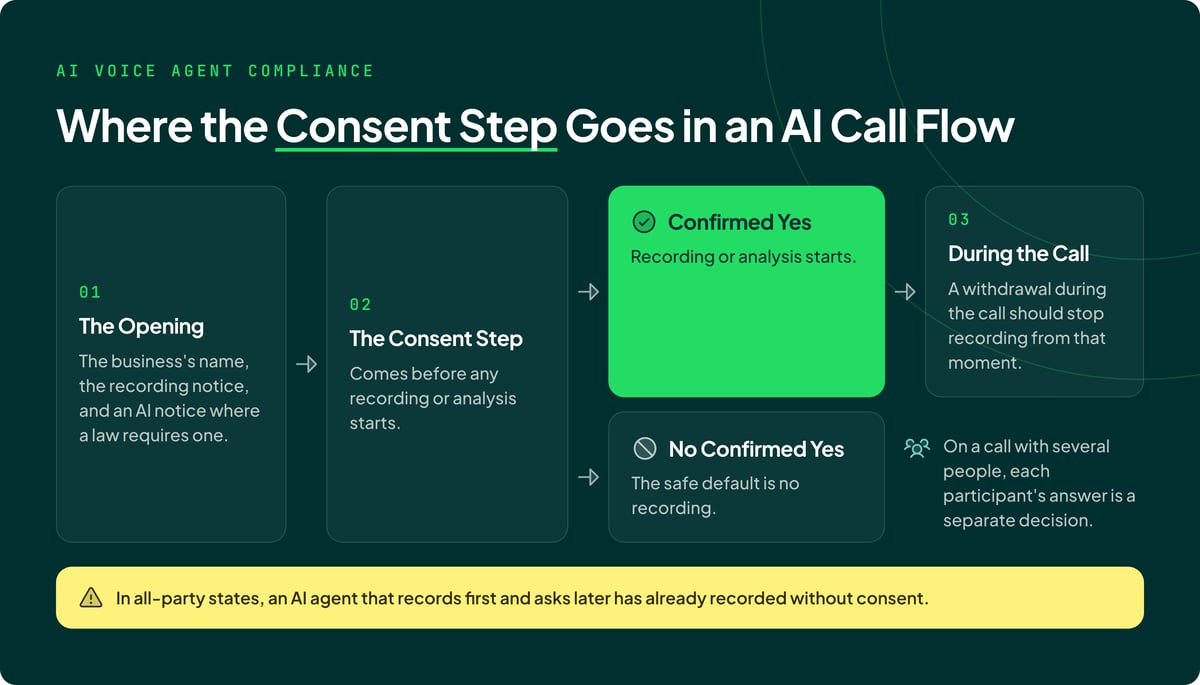
The opening of an AI call carries several duties at once: the business's name, the recording notice, and an AI notice.
A withdrawal during the call should stop recording from that moment on. On a call with several people, each participant's answer is a separate decision.
What to check in an AI voice vendor's contract
The main items to check here should be who collects consent, what the vendor may do with call data, and how the business's notice covers the vendor:
- The contract should explicitly say which party collects consent. Google's contract put that duty on Home Depot, for instance.
- It should say whether the vendor trains its AI tools on call data. Alleged training made Otter a plausible third party, dragging it into the current legal troubles.
- The business's privacy notice should name the vendor or its category, such as service providers.
- How consent is shared between partners.
- A business associate agreement is required when the vendor handles protected health information for companies liable under HIPAA.
- Retention periods should match the purposes of the data collected.
- Card codes should stay out of recordings and transcripts.
- For EU callers, the provider should confirm it built the AI notice into the agent.
AI voice agent compliance checklist
An AI voice agent compliance checklist focuses on establishing and proving consent:
- Prior express written consent on file before any AI-voice marketing call, plus the written agreement the FTC's sales rule requires for prerecorded telemarketing.
- Do Not Call Registry and internal do-not-call checks before every sales call.
- Sales calls placed only within federal and state calling hours.
- The business's name at the start of every AI-voice call, a callback number, and an in-call opt-out on sales calls.
- Opt-outs logged with their category and honored within 10 business days.
- A recording notice at the start of the call that names each purpose; AI analysis and model training included.
- All-party consent as the default when calls cross state lines.
- An AI disclosure wherever a state law or the EU AI Act requires one.
- Biometric notice and consent, a written release in Illinois, before any voiceprint or speaker recognition.
- A business associate agreement with each vendor that handles patient calls for a HIPAA-covered company.
- No card verification codes in recordings or transcripts after authorization.
- Consent records that hold the notice version, the answer, the time, the call ID and any withdrawal.
How Enzuzo handles consent for AI calls
Ledger is Enzuzo's consent API, in private alpha. An app sends each consent decision to Ledger, which stores it as an append-only record of who agreed to what and when. Each record can be read back by its ID with an API token. Records can be kept in separate, named ledgers.
Which consent a call needs still depends on the call type, the places involved and the purposes named.
Frequently asked questions
Does the TCPA apply to an AI receptionist that only answers calls?
The TCPA's consent rules generally don't apply to an AI receptionist that only answers incoming calls, because those rules govern outbound calls mostly. Any callback, reminder or follow-up call the agent places is an outbound call and needs consent for its type. Recording rules and state AI disclosure laws still apply to the inbound call itself.
Does a standard recording notice cover AI analysis of the call?
A standard recording notice may not cover AI analysis, because some privacy rules require a business to name each purpose of a recording. A business shouldn't cite quality assurance when it uses recordings in other ways, according to Canada's privacy regulator.
Can a business use call recordings to train its AI model?
A business that trains an AI model on call recordings should name that purpose in its recording notice. Each purpose of an EU recording needs its own lawful basis under the GDPR.
Is an AI voice agent a robocall?
An AI voice agent that places calls is treated as a robocall under US federal rules, because AI-generated voices count as artificial voices. That holds for a real-time agent that talks back, since the FCC allows no exception for live-agent technology.
Do AI voice agents need to be HIPAA compliant?
An AI voice agent needs to meet HIPAA's rules when it handles protected health information for a covered entity, such as a clinic's AI receptionist booking patient appointments. The vendor is then a business associate and needs a business associate agreement. Its own subcontractors need agreements too. An AI agent that never touches patient information is not liable.
Is it legal to clone a real person's voice for an AI agent?
Cloning a real person's voice for an AI agent can be illegal without that person's authorization. In Tennessee, the ELVIS Act has made a voice a protected property right since July 2024. Publishing a voice without authorization creates liability under that law. Calls that use any cloned voice also count as artificial-voice calls under the TCPA, so they need the same consent as other AI calls.
Do AI calls to businesses (B2B) need consent?
Many AI calls to businesses still need consent. The TCPA's consent rules for AI voices doesn't make a distinction, and focuses on the type of number called, such as a cell phone, and on the call's purpose. Robocalls to business lines need prior express written consent in Pennsylvania. Most B2B calls are exempt from the FTC's sales rule, though its ban on misleading statements has applied since 2024.
Mate Prgin
Mate is the CEO & Founder of Enzuzo. He has an executive MBA from Ivey Business School and is a subject matter expert in data privacy and compliance.
More related blogs
Your next read