Cookie Consent for Car Dealerships: Guide to Avoid Fines
Table of Contents
Cookie consent management for car dealerships means getting a visitor's permission before advertising and analytics tools (Meta Pixel, Google Ads, session-replay and video-tracking scripts) load on your site.
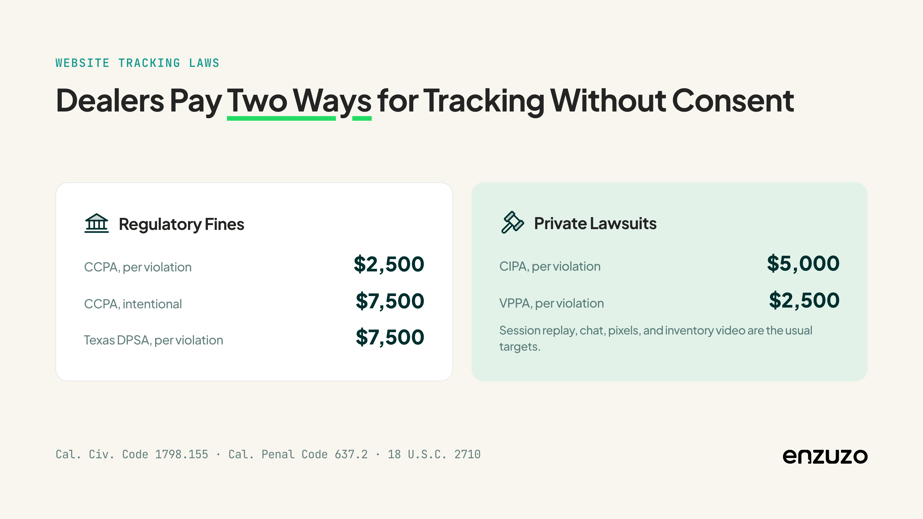
This matters because website tracking laws now cost dealers two ways: regulatory fines under state privacy laws like the CCPA (up to $7,500 per intentional violation), and private lawsuits under wiretapping and video-privacy laws like CIPA and the VPPA. A consent banner that blocks tracking until a shopper opts in, tuned by state, keeps you clear of both.
If you run a dealership website, you are collecting more visitor data than almost any other local business: Meta and Google pixels, chat widgets, session replay, inventory video, and a stack of marketing scripts, often firing at once. That data sells cars. It is also exactly what regulators and plaintiffs' firms are targeting.
Car dealerships traditionally thought of consent management as a compliance afterthought. That's a dangerous mistake now, given fines from state privacy regulators and lawsuits under website-tracking laws.
This guide walks through what those laws actually require, what compliant consent looks like on a dealer site, and how to meet the bar without throwing away the data you need.
How can a dealership get fined over website tracking?
Two different cost vectors are in play, and a dealer site can trigger both.
1. Regulatory fines under state privacy laws. Laws like California's CCPA/CPRA require you to let visitors opt out of tracking and the "sale" or sharing of their data, and to honor opt-out signals. State regulators can levy administrative fines of up to $2,500 per violation, or $7,500 per intentional violation (California Civil Code section 1798.155). The newer state laws work the same way: the Texas Data Privacy and Security Act, for example, allows penalties up to $7,500 per violation. With hundreds or thousands of visitors, "per violation" adds up fast.
2. Private lawsuits under website tracking laws. Separately, plaintiffs' firms sue dealers directly:
- CIPA (California Invasion of Privacy Act), a wiretapping law used against session-replay, chat, and pixel tracking, carries statutory damages of $5,000 per violation (California Penal Code section 637.2).
- The VPPA (Video Privacy Protection Act), a federal law, targets sites that share video-viewing data with third parties like Facebook without consent, at $2,500 per violation (18 U.S.C. section 2710). Dealer sites are full of inventory and walkaround video, which is exactly what these cases look for.
The common thread: both the fines and the lawsuits come down to tracking visitors without proper consent. Fix the consent, and you close both doors at once.
What does compliant cookie consent look like on a dealer site?
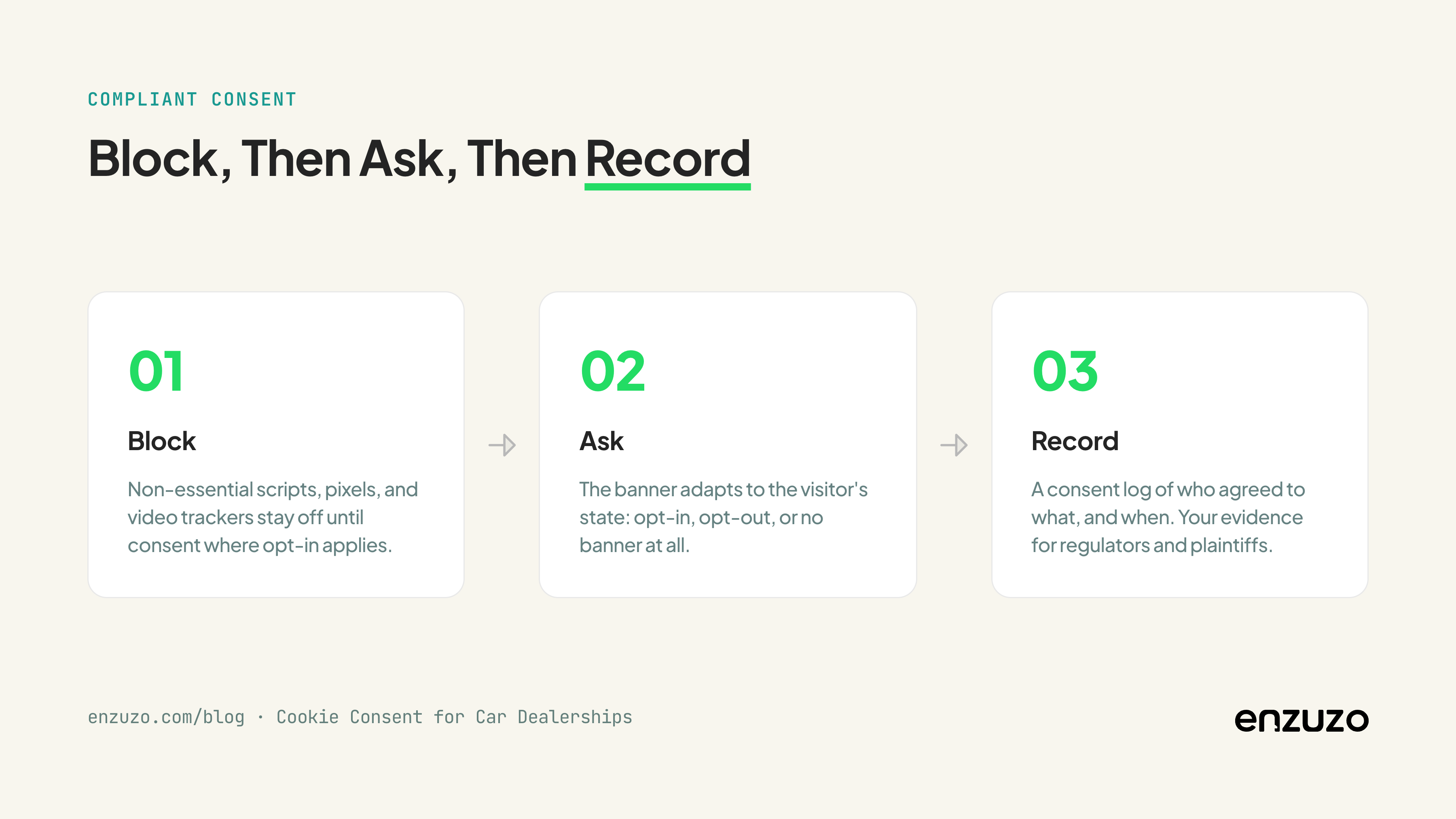
Compliant consent has three parts: block, then ask, then record.
1. Block non-essential scripts before consent. Advertising, analytics, and video-tracking pixels should not fire until the visitor opts in where opt-in is required. If your pixels load the moment the page does, a banner shown afterward does not protect you.
2. Ask in a way that fits the law where the visitor is. A shopper in California is under different rules than one in Texas or a no-law state. Your banner should adapt by location, not apply the strictest setting to everyone.
3. Record the consent. Keep a log of who agreed to what, and when. That record is your evidence for both a regulator and a plaintiff.
A real consent management platform (CMP) does all three automatically: it scans your site for cookies, pixels, and scripts, blocks the non-essential ones until consent, honors opt-out signals, and keeps the log. Enzuzo's consent management platform is built to do this across every rooftop from one dashboard.
The mistake most car dealerships make: the "block everything" banner
Many dealers inherit a cookie banner bundled inside an all-in-one dealer-compliance suite like ComplyAuto. To be safe, those banners default to the most aggressive setting possible: block every script everywhere and force every visitor through a full opt-in before anything loads.
That feels safe. It quietly costs you money.
- It wrecks the shopping experience, especially on mobile, where an oversized banner can swallow most of the screen before a shopper sees a single vehicle.
- It throws away data you are legally allowed to collect. Most U.S. states are opt-out, not opt-in, and roughly 30 have no comprehensive privacy law at all. Forcing a hard opt-in on a shopper in a state that does not require one loses you conversions and attribution for no legal benefit.
- It is overkill for your actual jurisdiction. If most of your buyers sit in opt-out states, you can meet the legal requirement and still collect the data you need. A rigid, one-size-fits-all banner cannot make that distinction.
The goal is not "block the most." It is "meet the legal bar precisely in each state, gate the tracking that creates exposure, and keep the data you are entitled to."
How cookie consent works state by state
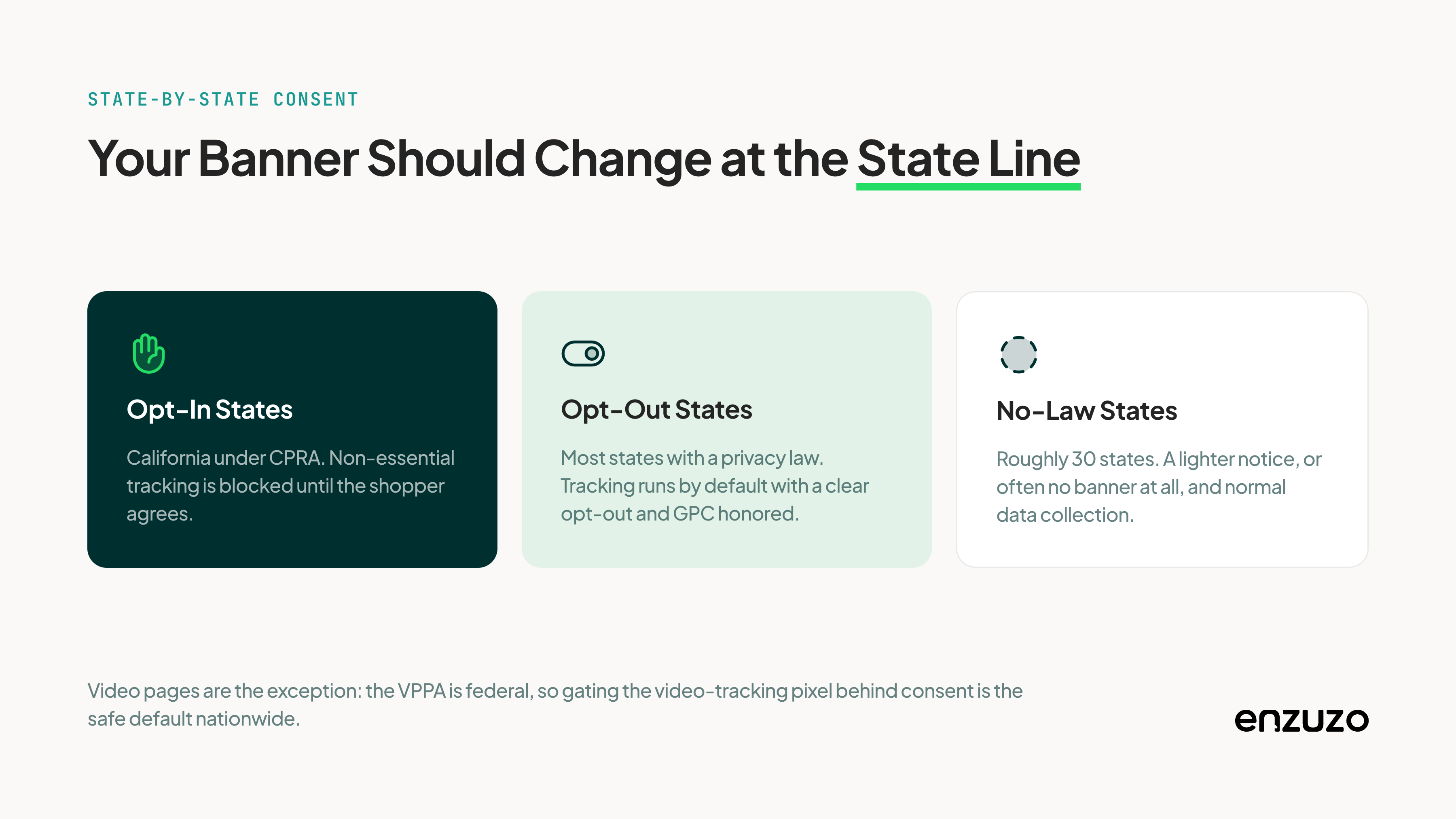
Consent obligations change at the state line, so your banner should too. A well-configured CMP uses the visitor's location to apply the right rule:
- Opt-in states (for example, California under CPRA): non-essential tracking is blocked until the shopper agrees.
- Opt-out states (most US states with a privacy law): you can run tracking by default, but you must give a clear way to opt out and honor Global Privacy Control signals.
- No-law states: a lighter notice, or in many cases no banner at all, and normal data collection.
- Video pages, everywhere: because the VPPA is federal, gating the video-tracking pixel behind consent is the safe default nationwide, not just in opt-in states.
This is the flexibility that separates a purpose-built CMP from a bundled banner. You set the legal recommendation once, and the platform applies opt-in, opt-out, or no-banner based on where each shopper is.
You meet the requirement in California without punishing a shopper in Texas.
Do not lose your ad performance: Google Consent Mode v2
If you spend money on Google Ads and rely on GA4 for tracking & conversion analytics, blocking cookies the wrong way can gut your reporting and remarketing.
Google Consent Mode v2 is the fix: it lets Google's tags adjust their behavior based on the visitor's consent choice, so you stay compliant and still recover modeled conversions instead of losing them outright.
This is a real differentiator, and a gap in most bundled suite banners that sell to the automotive industry.
Enzuzo is a Google Gold-certified CMP, so Consent Mode v2 is native. Your paid-search and analytics data keeps working while you stay on the right side of the law.
A practical cookie consent checklist for dealer groups
If you manage more than one rooftop, this is where a real CMP earns its keep:
- [ ] Scan every domain for cookies, pixels, and scripts, including the ones OEMs and agencies added without telling you.
- [ ] Auto-block non-essential scripts until consent, by state.
- [ ] Gate the Meta Pixel on vehicle and video pages behind consent.
- [ ] Deploy one configuration across all rooftops from a single dashboard, instead of hand-configuring each site.
- [ ] Tune for mobile. Most shoppers are on phones. The banner should be compact.
- [ ] Enable Global Privacy Control handling for opt-out states.
- [ ] Keep consent logs as your evidence trail for both regulators and plaintiffs.
- [ ] Turn on Google Consent Mode v2 to protect ad and analytics data.
- [ ] Re-scan on a schedule. New scripts appear constantly through Tag Manager. A one-time setup is not enough.
Meet the legal bar without losing the data that sells cars
Cookie consent for car dealerships comes down to one balance: do enough to avoid fines and lawsuits, but not so much that you sacrifice the marketing data and shopping experience that move metal.
A rigid bundled banner picks the first goal and sacrifices the second. A purpose-built CMP gives you both.
Enzuzo's consent management platform scans your sites, blocks non-essential scripts by state, gates the Meta Pixel on video pages, supports Google Consent Mode v2, keeps your consent logs, and deploys across every rooftop from one dashboard.
See it on your own dealership sites. Book a demo with Enzuzo
Frequently asked questions
Can a car dealership actually be fined for cookies?
Yes, indirectly. State privacy laws like the CCPA require you to let visitors opt out of tracking and honor opt-out signals. Regulators can impose fines up to $2,500 per violation, or $7,500 per intentional violation, under California Civil Code section 1798.155. Newer laws like the Texas Data Privacy and Security Act carry similar penalties. On top of fines, dealers face private lawsuits under tracking laws like CIPA and the VPPA.
Do I need a cookie banner if my dealership is not in California?
Often yes, but not always the same banner. Your obligations depend on where your visitors are, not just where your dealership is. If you get traffic from states with privacy laws, you need consent handling for those visitors, and the VPPA (federal) applies to video tracking nationwide. A CMP applies the right rule by state automatically.
Will a cookie banner hurt my marketing data?
A badly configured one will. A "block everything, ask everywhere" banner throws away data you are legally allowed to collect in opt-out and no-law states. A properly tuned CMP with Google Consent Mode v2 keeps you compliant while preserving the maximum data the law allows.
Isn't the cookie banner in my dealer compliance suite good enough?
It may check a box, but bundled banners are usually rigid, block-everything defaults with weak mobile UX and no Google Consent Mode v2. That protects you on paper while quietly costing you conversions and ad performance. A dedicated CMP meets the legal bar precisely and preserves your data.
How fast can I deploy consent across multiple dealership sites?
With a multi-domain CMP, in hours, not weeks. You configure once and roll the same setup across every rooftop from one dashboard, rather than setting up each site manually.

Osman Husain
Osman is the content lead at Enzuzo. He has a background in data privacy management via a two-year role at ExpressVPN and extensive freelance work with cybersecurity and blockchain companies. Osman also holds an MBA from the Toronto Metropolitan University.