Received a Florida FSCA Wiretapping Demand Letter? Read This First

Osman Husain

If you just opened a certified mail envelope from a Florida law firm accusing your website of "wiretapping," you are not the first, and you won't be the last. The same playbook that produced thousands of California CIPA lawsuits in 2023 and 2024 is now running in Florida, and the plaintiff bar has a year of tested claims behind it.
The wave has a specific trigger date. On March 6, 2025, a federal judge in the Middle District of Florida refused to dismiss the FSCA claim in W.W. v. Orlando Health, Inc., finding that pixel tracking technologies on a healthcare website intercepted "substantive messages" about patient health, not just behavioral metadata.
That ruling distinguished pixel tracking from the session replay technologies Florida courts had previously dismissed in Jacome v. Spirit Airlines and Goldstein v. Costco. Once a federal court in Florida accepted the theory, demand letters followed at volume.
This is a response playbook, not a panic post. It's written for founders, ops leaders, and in-house counsel who need to triage the letter today, not in two weeks. It is not legal advice, but a summary of best practices. By the time you finish this page, you should know what you're holding, what to do in the next 48 hours, and what to fix so this doesn't happen again.
FSCA demand letter types
FSCA demand letters come in three shapes, and the playbook depends on which one landed on your desk.
1. Pre-suit demand letter. A settlement demand from a plaintiff firm, usually on letterhead, usually citing Fla. Stat. §§ 934.03 and 934.31, and usually quoting a five- or six-figure "early resolution" number. No case has been filed yet. You have leverage here. Most of these never become lawsuits because firms are running the economics on volume, not depth.
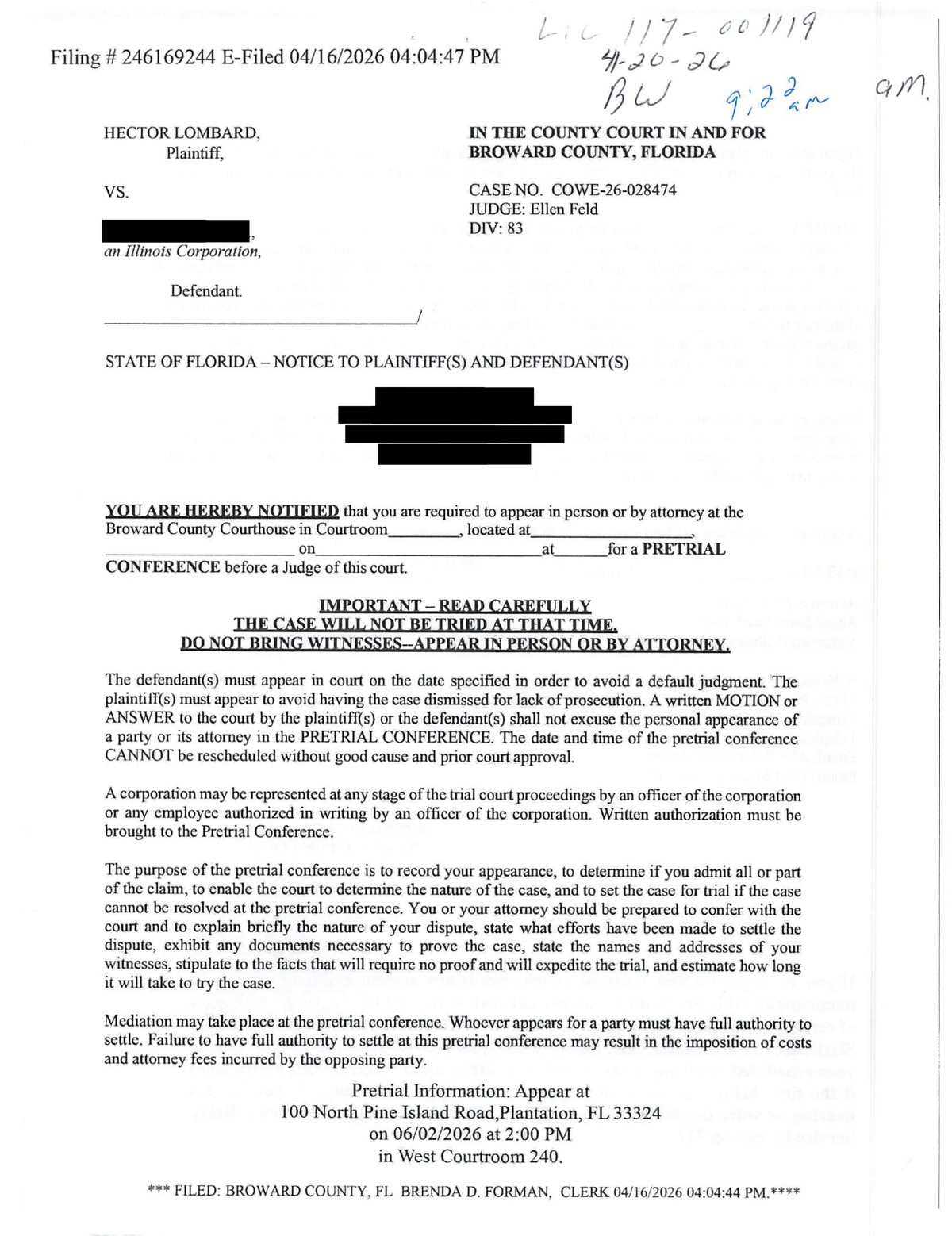
2. Small-claims summons from Broward County. Johnson Dalal in Plantation and similar firms have filed hundreds of individual small-claims actions seeking $500 to $2,500 per plaintiff. Cheap for them to file, expensive for you to defend per matter, designed to stack pressure for a quick settlement. Real cases. Real deadlines. Pretrials typically set 45 to 60 days out.
3. Federal class action. Salpeter Gitkin's filings against Nike (Magenheim v. Nike, S.D. Fla.) and The Walking Company are the template. Amount in controversy exceeds $5 million. This is the bet-the-company tier. If you got one of these, stop reading this post and call a privacy class-action defense firm today.
The theory is the same across all three. Plaintiffs claim your website deploys third-party trackers (Meta Pixel, GA4, Floodlight, session replay tools, ad retargeting) without obtaining "prior, informed consent" from every party to the communication. Florida, like California and 10 other states, is an all-party consent state for intercepted communications. The statute they're leaning on, Fla. Stat. § 934.31, treats trackers as "pen registers" or "trap and trace" devices. It's a 1969 wiretapping law being applied to 2026 ad tech.
Identify the plaintiff firm in the first hour. Salpeter Gitkin signals federal class action. Johnson Dalal signals small-claims volume play. Morgan & Morgan signals multi-jurisdictional coordination. Each has a different negotiation posture, and your counsel will know the dance.
FSCA Demand Letter Example
Responding to an FSCA complaint: the first 48 hours
Follow this step-by-step approach to minimize your liability:
1. Calendar every deadline. A demand letter usually gives 14 to 30 days to respond. A small-claims summons has a firm statutory response window (20 days for most Florida small claims). Miss the window, get a default judgment. Log every date in two places.
2. Preserve evidence. Do not edit your cookie banner, your privacy policy, your tag manager, or your website code until counsel tells you to. Take a full backup of your live site, your consent configuration, and your tag manager container today.
3. Notify your insurance carrier. Cyber liability and commercial general liability policies sometimes cover privacy claims. Most have 30-day notice requirements and will refuse coverage if you miss them. Send written notice even if you aren't sure it's covered.
4. Retain Florida counsel. You need a privacy litigator licensed in Florida. General counsel and out-of-state firms are not enough for FSCA. Good signals: prior FSCA defense filings, CIPA defense experience, familiarity with Jacome v. Spirit Airlines and Goldstein v. Costco.
5. Pull the tag audit. Have someone run a scan on your website that lists every third-party script firing, whether it fires before consent, what data it captures, and which jurisdiction it serves. Your counsel will need this for the response letter. If you don't have a consent management platform that produces this report, that's a problem we'll come back to in Part 4.
Five things not to do. Don't call the plaintiff firm. Don't pay the first demand to "make it go away." Don't post anything on social media about the letter. Don't delete your banner or change your tags before counsel says so. Don't assume this is a scam. A few early letters in 2024 were opportunistic, but the 2026 wave is structured, repeatable, and tied to real filings.
Received a demand letter? Enzuzo can audit your site today.
We identify which scripts are firing before consent and implement a compliant GTM configuration.
Book a compliance strategy call →
Should you settle or fight?
By week two, you'll face the core decision. The math is not as one-sided as the demand letter makes it look.
Settlement economics. Demand letters in the pixel-tracking wave are typically landing between $15,000 and $50,000, depending on site traffic, tracker count, and whether session replay or form-field capture is in play. Federal class action early settlements scale much higher, into the six and seven figures, depending on class size and discovery exposure. Plaintiff firms take 35 to 40 percent - they're looking for volume and speed, not trials.
Defense economics. Motions to dismiss in federal court cost $15,000 to $40,000. Before March 2025, defendants were able to dismiss Florida wiretapping claims at a healthy rate. But after W.W. v. Orlando Health, that math has shifted: pixel tracking cases that involve "substantive message" capture (health data, form inputs, sensitive category browsing) are now much harder to get dismissed early.
The two defenses worth understanding. First, the "contents" argument: FSCA targets interception of communication "contents," not mere behavioral metadata. If your trackers capture clicks, scrolls, and page views without message content, Goldstein still gives you a shot at dismissal — but Orlando Health narrowed this defense for pixel trackers that transmit form inputs, search queries, or other substantive user messages.
Second, the "movement-tracking" carveout: the 1988 amendment to § 934.03 excludes devices that track "movement of a person or object," which courts have stretched to cover pure session replay. Neither is a slam-dunk post-Orlando Health, but both have worked and both still matter for the right fact pattern.
The decision point to watch is Magenheim v. Nike, set for trial November 2, 2026 in the Southern District of Florida. It's the first major FSCA pixel case heading to a jury. A plaintiff win there accelerates the wave. A defense win, or a mid-trial settlement, dampens it. Either way, the outcome reshapes settlement math for every open demand letter.
Here's what we suggest
Fight when: you have a narrow tag stack, no session replay, no form-field capture, and a credible consent record.
Settle when: you had Meta Pixel, TikTok, or Floodlight firing pre-consent for months, your banner was decorative, and the plaintiff has good standing facts. Most defendants end up somewhere in the middle, negotiating a reduced settlement conditioned on remediation.
Prevent future FSCA lawsuits
Settling an existing lawsuit doesn't mean you're totally out of the weeds just yet. A long-term fix is important, and the steps outlined here will help.
Deploy a gatekeeper consent banner. Your banner cannot be decorative. No non-essential tag fires until the visitor clicks accept. This is the single highest-leverage change. "By using this site you agree" does not satisfy Florida's prior, informed, all-party consent standard, and it has failed repeatedly in court.
Honor Global Privacy Control signals. Florida courts have not yet ruled on GPC the way California has, but plaintiff firms include GPC-ignoring allegations in every complaint. Honoring GPC at the browser level removes an entire category of exposure.
Run a tag audit, then remove or gate what you don't need. Every tracker is a potential count in a complaint. If marketing isn't using a pixel actively, kill it. For the ones you keep, verify they fire only after consent category approval, and document it with timestamps.
Refresh your privacy policy with named tools. Generic "we use cookies for analytics" language fails. List the tools. Name Meta Pixel, GA4, Floodlight, your session replay vendor. Transparency is the opposite side of the same consent coin.
This is what Enzuzo's consent management platform is built for. It blocks non-essential scripts until the visitor consents, honors GPC at the browser level, produces timestamped audit logs that stand up in court, and generates a policy that names every tool your site runs.
The same configuration covers Florida, California, GDPR, CCPA, Colorado, and every other jurisdiction you operate in. Our customers have deployed it before the next letter arrives, and in two cases, used the resulting audit trail to get demand letters withdrawn.
Book a compliance strategy call →
FAQs
Is a Florida wiretapping demand letter a real lawsuit? Not yet. A demand letter is a pre-suit settlement claim. It becomes a real lawsuit only if the firm files in Broward County Court or the Southern District of Florida. Many demand letters never become filings, but ignoring one is still a bad idea because firms will file to pressure settlement.
How much does an FSCA violation cost? Statutory damages under Fla. Stat. § 934.10 are $1,000 per violation minimum, or $100 per day of violation, whichever is greater, plus actual damages, attorney's fees, and possible punitive damages. Class actions multiply this across every site visitor in the class period.
Can my privacy policy protect me? No. A privacy policy alone is never enough under FSCA. Florida requires all-party, prior, informed consent obtained before any interception, which means before any non-essential tracker fires. Policies support consent, but they do not replace it.
What if I'm based outside Florida? FSCA applies based on visitor location, not business location. If your website has Florida visitors and your trackers fire on them without consent, you are in scope and at risk of a lawsuit.
What to do after receiving a letter
If you got a letter this week, the order is: preserve evidence, calendar deadlines, notify insurance, retain Florida counsel, run a tag audit. Then decide settle or fight with your lawyer, not with the plaintiff firm.
If you haven't gotten a letter yet, but you read this far, you have a feeling that you're in violation. Most of the sites receiving these letters have a banner in place. It just isn't doing anything. Two hours of configuration is the difference between a dismissed letter and a five-figure settlement.
If you want to see what a real consent gate looks like, what an audit-ready log looks like, and how Enzuzo handles Florida, California, and GDPR from the same dashboard, book a demo. We'll walk your actual site and show you exactly which trackers are firing pre-consent today.
This article is for general information only and is not legal advice. FSCA cases turn on specific facts, and outcomes vary by jurisdiction, tracker configuration, and consent posture. Retain qualified Florida counsel for any actual demand letter or lawsuit.
Osman Husain
Osman is the content lead at Enzuzo. He has a background in data privacy management via a two-year role at ExpressVPN and extensive freelance work with cybersecurity and blockchain companies. Osman also holds an MBA from the Toronto Metropolitan University.
LinkedIn →More related blogs
Your next read


-M-1.jpg)